


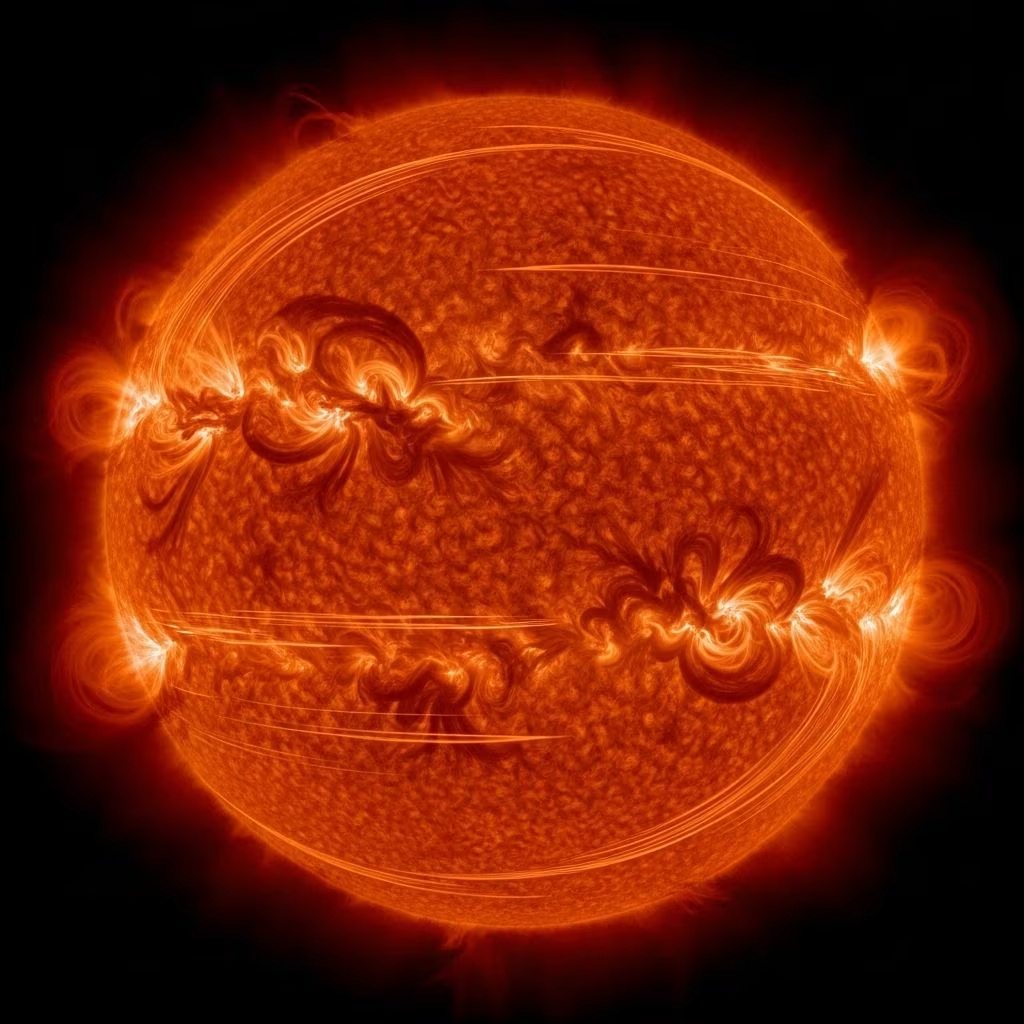
The Sun, our nearest star, has fascinated humankind for millennia. While it might appear as a constant, unchanging sphere in the sky, the Sun is in fact a dynamic, churning body of hot plasma that actively rotates on its axis. This rotation is not uniform or rigid, and it holds keys to understanding both the physics of our star and the effects it has on the solar system. In this article, we dive into the science of the Sun’s rotation, explore how astronomers study it, and examine why this motion matters.
What Is Solar Rotation?
Solar rotation refers to the Sun’s movement around its own axis. Unlike a solid planet, the Sun is a giant sphere of hot, electrically charged gas called plasma. As a result, different parts of the Sun rotate at different speeds—a phenomenon known as differential rotation.
- Equatorial regions: Complete a rotation roughly every 24–25 days.
- Mid-latitudes: Rotate in about 27–28 days.
- Polar regions: Can take more than 30 days to complete a full spin.
This variation occurs because the Sun’s plasma does not behave like a solid object. Instead, the gaseous layers are free to move at their own speeds, resulting in faster rotation at the equator and slower at the poles.
How Do We Know the Sun Rotates?
Human observers have been tracking the Sun’s activity for centuries, but it was the discovery and observation of sunspots in the 17th century that provided the first clear evidence of solar rotation. Sunspots are dark, cooler regions on the Sun’s surface, and they appear to drift across the solar disk as the Sun spins.
- Galileo Galilei and other astronomers mapped sunspots and noticed their regular movement.
- By tracking the time it took for a sunspot to travel from one limb of the Sun to the other, they inferred the Sun’s rotation period.
Today, advanced telescopes and space observatories use a variety of techniques to monitor solar features, confirming and refining our understanding of the Sun’s rotation.
Why Doesn’t the Sun Rotate Like a Solid Ball?
The Sun is composed of plasma—ionized gas—rather than solid matter. This distinction is crucial because, in a fluid or plasma state, internal layers can move independently. Each latitude on the Sun’s surface experiences different forces and flows. This gives rise to differential rotation and complex internal motions.
- The equator has the least resistance, so it rotates fastest.
- The poles see greater resistance from magnetic and internal forces, so they lag behind.
This non-uniform rotation is not unique to the Sun; other stars exhibit similar behaviors, although the exact mechanics differ based on their mass, composition, and age.
Solar Rotation: Key Numbers and Equations
It’s important to note that various values are associated with the Sun’s rotation period, depending on measurement method and reference point.
- Sidereal rotation (relative to distant stars):
- Equator: Approximately 25.6 days.
- Pole: Approximately 33.5 days.
- Synodic rotation (as seen from Earth, accounting for Earth’s orbit):
- Equator: About 27–28 days.
Mathematical Expression of Solar Rotation
The Sun’s surface (photosphere) rotation rate at a given latitude (φ) can be approximated by the equation:
\[\omega = A + B \sin^2 ( \varphi ) + C \sin^4 ( \varphi )\]Where:
- ω = angular velocity (degrees per day)
- φ = solar latitude
- A, B, C = constants
Typical accepted average values:
A = 14.713 ± 0.0491°/day
B = −2.396 ± 0.188°/day
C = −1.787 ± 0.253°/day
| Latitude | Rotation Period (days) |
|---|---|
| 0° (Equator) | 25.6 |
| 45° (Mid-latitude) | ~27-28 |
| 75° (Near Pole) | 33.4 |
What Causes Differential Rotation?
Solar physicists point to the interplay of the Sun’s internal structure and its magnetic field as the drivers of differential rotation.
- Convective Zone: The outer third of the Sun is characterized by convective currents—hot plasma rises while cooler plasma sinks. This movement, combined with the Sun’s overall rotation, leads to increased equatorial speed.
- Magnetic Fields: Magnetic forces generated by currents of charged particles interact with the differentially rotating plasma, further influencing rotation rates at various latitudes.
The process is an area of ongoing research, as understanding it helps explain other phenomena, such as the solar cycle, sunspot patterns, and the creation of the solar magnetic field.
How Does Solar Rotation Affect the Solar System?
The Sun’s dynamic motion directly impacts space weather and the broader solar environment:
- Magnetic Field Dynamics: The varying speeds at different latitudes ‘wind up’ the Sun’s magnetic field, contributing to twists, breaks, and reconnections. This process can generate solar storms.
- Solar Cycle: The differential rotation is deeply linked to the 11-year solar cycle, which governs the appearance and migration of sunspots and the periodic intensification and weakening of solar activity.
- Space Weather: Powerful bursts of solar energy, such as solar flares and coronal mass ejections (CMEs), can be traced in part to effects of solar rotation and turbulence within the Sun’s outer layers. These events can disrupt satellites, communications, and even power grids on Earth.
- Heliosphere: The Sun’s rotation sweeps its magnetic field throughout the solar system, forming a vast bubble of charged particles—the heliosphere—that protects planets from cosmic rays.
How Do Scientists Study the Sun’s Rotation?
Solar researchers use a range of techniques to measure and understand the Sun’s spin:
- Sunspots: As visual indicators, sunspots help gauge surface movement.
- Doppler Imaging: Measures the motion of gases on the Sun’s surface through shifts in observed light wavelengths.
- Spacecraft Observations: Missions like SOHO, SDO, and Parker Solar Probe continually monitor the Sun in multiple wavelengths, providing real-time data from unique perspectives.
- Helioseismology: The study of how acoustic waves travel through the Sun. These waves reveal details about internal rotation, structure, and dynamics, much like seismic studies of Earth’s interior.
Does the Sun’s Rotation Change Over Time?
Yes, but very gradually. When the Sun was young, it spun much faster—possibly up to ten times its current rate. Over billions of years, a process called magnetic braking (where the solar wind, coupled to the Sun’s magnetic field, carries angular momentum away) has slowed down the rotation.
- The early, fast-spinning Sun likely had far stronger solar activity, with more extensive sunspot coverage and dramatic space weather.
- Modern measurements suggest the Sun’s core still rotates faster than its surface layers.
The gradual slowing will continue as the Sun ages, altering its surface activity and magnetic dynamics in subtle ways.
How Do We Track Solar Rotation? Carrington Rotations Explained
Astronomers track solar rotation using a system known as Carrington Rotations—named after Richard Carrington, who first mapped sunspot motion in the 19th century.
- A Carrington rotation corresponds to about 27.3 Earth days, which is close to the synodic period as seen from Earth.
- This system allows scientists to map solar phenomena by rotation number. For example, “Carrington Rotation 2300” refers to the Sun’s 2,300th observed spin since the start of this system.
What Does Solar Rotation Mean for Life on Earth?
Without the Sun’s rotation, its magnetic field would not be wound up and reorganized, likely resulting in a much quieter star. The persistent movement is essential for:
- Generating the solar magnetic field, which shelters Earth from harmful cosmic rays.
- Driving spectacular space weather phenomena, including the auroras seen near Earth’s poles.
- Enabling the solar cycle that affects everything from climate patterns to satellite safety.
Frequently Asked Questions: The Sun’s Rotation
Q: Does the Sun rotate in the same direction as Earth?
A: Yes. Viewed from above the Sun’s north pole, both the Sun and the planets in our solar system rotate counterclockwise. This shared direction is a remnant of the primordial disk from which the solar system formed.
Q: Why do different parts of the Sun rotate at different speeds?
A: Because the Sun is a vast sphere of plasma, not a solid body. The varying resistance and internal flows at different latitudes create faster rotation at the equator and slower at the poles.
Q: How do sunspots help us track solar rotation?
A: By following the movement of sunspots across the Sun’s visible surface, astronomers can estimate the time it takes for the Sun to complete a full rotation at specific latitudes.
Q: Has the Sun always rotated at the same speed?
A: No. The young Sun spun much faster and slowed over time due to magnetic braking. This gradual decrease in rotation speed is a feature of stellar evolution.
Q: How does solar rotation impact space weather?
A: The Sun’s rotation drives solar magnetic activity, which can produce storms, flares, and ejections. These influence the heliosphere and sometimes affect Earth’s technology and atmosphere.
Key Takeaways
- The Sun rotates, but not as a solid body—its plasma causes differential rotation.
- The equator spins fastest (~25.6 days) and the poles slowest (up to ~33.5 days).
- This rotation shapes the Sun’s magnetic field and space weather throughout the solar system.
- Solar rotation is measured using sunspots, Doppler imaging, spacecraft, and helioseismology.
Further Exploration
The science of solar rotation continues to be a hot topic in astrophysics. Ongoing missions and research are yielding new insights into the Sun’s internal dynamics and their effects on the solar system. As our tools improve, so does our ability to predict space weather and understand the life cycle of stars like our Sun.
References
- https://science.nasa.gov/sun/facts/
- https://www.nasa.gov/image-article/solar-rotation-varies-by-latitude/
- https://www.space.com/does-the-sun-rotate
- https://en.wikipedia.org/wiki/Sun
- https://en.wikipedia.org/wiki/Solar_rotation
- https://science.howstuffworks.com/does-sun-rotate.htm
- https://cesar.esa.int/index.php?Section=Sun%E2%80%99s_rotation
- https://www.livescience.com/32894-does-the-sun-rotate.html
- https://www.youtube.com/watch?v=8QolrLfmfQM
- https://www.star.bris.ac.uk/bjm/solar/solarrot.html
- https://www.twigsciencereporter.com/fact-pack/5-facts-about-the-sun/
- https://kidseclipse.com/sun-earth-moon-move/
- https://www.livescience.com/space/the-sun/sun-facts
- https://www.youtube.com/watch?v=duVrrZXFFiM
- https://cesar.esa.int/index.php?Section=SSE_Sun_Rotation
- https://www.universetoday.com/articles/does-the-sun-rotate
- https://nineplanets.org/the-sun/


