Saturn’s Stunning Rings—Moments Before Vanishing
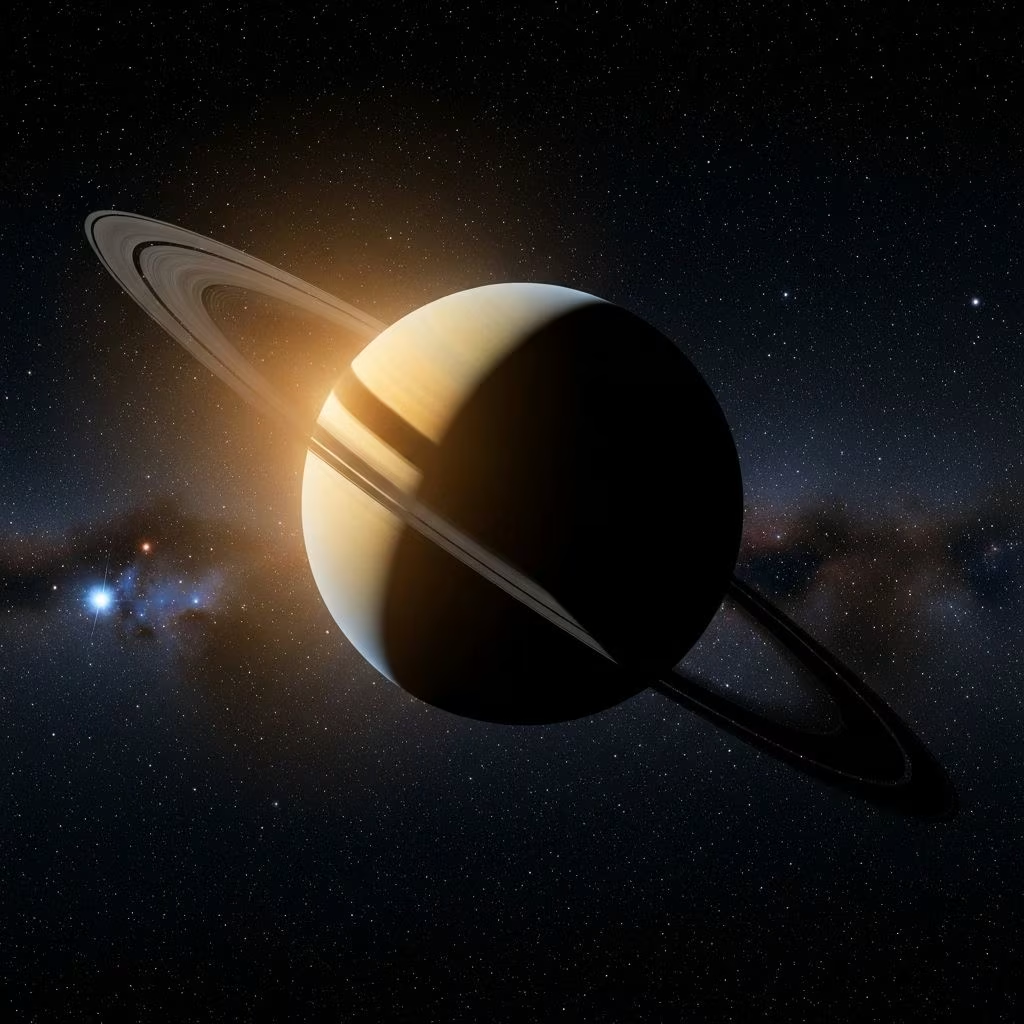
For centuries, Saturn’s iconic rings have captivated astronomers and skywatchers, standing as one of the most spectacular features in our solar system. In a rare astronomical event set for 2025, these breathtaking rings will vanish from Earth’s view, reminding us of the dynamic dance between planets, light, and perspective. But why do Saturn’s rings temporarily disappear, and what does this fleeting phenomenon reveal about the nature of celestial mechanics?
Why Are Saturn’s Rings Disappearing in 2025?
Saturn’s rings won’t actually disappear; instead, they will temporarily become invisible from Earth. This cosmic illusion is caused by the ring plane crossing, a rare event that occurs roughly every 13 to 15 years as Saturn’s orbital tilt aligns its equator—where the rings reside—edge-on with our vantage point on Earth.
Key reasons for their disappearance:
- The tilt of Saturn’s axis (27 degrees, similar to Earth’s) means we typically see the rings at an angle.
- Roughly every 13 to 15 years, both planets reach positions in their respective orbits such that the rings appear edge-on.
- The vast but extremely thin structure of the rings—often just 10 to 30 meters (about 30 feet) thick—makes them vanish from our view when seen side-on.
Because Saturn completes one orbit every 29.5 Earth-years, we get two such edge-on events each Saturnian year. In March 2025, one of these alignments will occur, causing the rings to all but disappear in ground-based telescopes. A similar effect will occur in November 2025 as Saturn’s path continues.
How Does This Phenomenon Work?
Saturn’s rings are made predominantly of ice particles, dust, and rock, forming an intricate disk structure that, despite containing billions of pieces, is razor-thin compared to its diameter. When the rings are edge-on:
- Even powerful telescopes on Earth see very little reflected sunlight, as the bright broadside surface all but vanishes.
- For days or weeks at a time, Saturn appears as a planet without its most iconic adornment; only the planet and perhaps faint shadows of the rings remain.
However, the rings themselves remain fully intact—this is a matter of human perspective, not planetary change.
When Exactly Will the Rings Disappear?
| Key Event | Date |
|---|---|
| Rings begin to thin noticeably | Late 2024 – Early 2025 |
| First Edge-on Alignment | March 2025 |
| Rings gradually reappear | Spring to Summer 2025 |
| Second Edge-on Alignment | November 2025 |
| Rings regain broader visibility | Late 2025 onwards |
During early 2025, amateur astronomers and stargazers will notice the rings narrowing until, in March, they seem to vanish completely. They will briefly reappear over the summer before a second, shorter disappearance in November.
Historical and Scientific Context
Why Do Ring Disappearances Matter?
While Saturn’s fleetingly invisible rings might disappoint some skywatchers, the event is a scientific boon. Historically, such events have enabled astronomers to:
- Study ring structure and composition in fine detail, as edge-on alignments allow for the detection of vertical features, ringlets, and gravitational warps.
- Observe Saturn’s moons without interference from the bright rings, leading to discoveries such as previously unknown moons and faint dust bands.
- Monitor seasonal and axial changes on Saturn, contributing to our understanding of planetary dynamics.
The phenomenon has been witnessed in past centuries and by modern telescopes, notably by the Hubble Space Telescope in 1995 and again in 2009.
Are the Rings Disappearing Forever?
Although Saturn’s rings will one day dissipate due to the gradual loss of material, this event is entirely temporary and cyclic. Astronomers estimate Saturn’s main rings may last another 100 to 300 million years before vanishing for good, caused by particles slowly spiraling into the planet.
The Structure and Mystery of Saturn’s Rings
Saturn’s rings constitute the broadest ring system in our solar system, extending up to 175,000 miles (282,000 kilometers) from the planet and composed primarily of water ice mixed with dust and other elements. Key structural aspects include:
- Main rings (A, B, C) are bright, divided by dark gaps including the Cassini Division.
- Fainter rings (like D, E, and G) lie both inside and outside the main rings.
- The ring plane is so thin—often just dozens of meters thick—compared to the planet’s vast diameter, leading to the dramatic ‘vanishing act’ during edge-on years.
- The rings’ particles range from tiny dust grains to boulders the size of houses.
How to Observe Saturn and Its Vanishing Rings
Stargazers hoping to witness the disappearance will need moderate to large telescopes, as the subtlety of the edge-on alignment may require advanced optics to notice. To catch the best views of Saturn in 2025:
- Track Saturn’s position with astronomy apps or online guides.
- Look in the night sky when Saturn is prominent (usually summer to fall in the Northern Hemisphere).
- Observe regularly to track the thinning ring plane week by week.
- Join local or virtual astronomy clubs for group viewing events and expert tips.
For those with only binoculars or small scopes, Saturn will appear as a golden ‘star’—without its typical flared appearance during the alignment window.
What Will Saturn Look Like Without Its Rings?
During the edge-on moments, Saturn will appear as a spherical planet seemingly stripped of its illuminated discs. The rings will be so slender that light reflected toward Earth is negligible, making them blend into the darkness of space. In professional telescopes, a faint line might be visible across Saturn’s middle if conditions are ideal.
What Makes Saturn’s Ring Plane Crossings Special?
- Rarity: These events repeat only every 13 to 15 years, providing a unique observational window for each generation of astronomers and enthusiasts.
- Scientific Opportunity: With the rings obscured, astronomers can better study faint moons, faint dust bands, and the planet’s atmosphere close to the equator.
- Historical Record: Past edge-on events revealed hidden features and allowed for precision tracking of ringlets and embedded objects.
- Astronomical Insight: The phenomenon illustrates cosmic mechanics—showcasing how planetary tilt, sunlight, and orbital cycles generate the awe-inspiring vistas observed from Earth.
Frequently Asked Questions (FAQ)
Q: Why do Saturn’s rings “disappear” at all?
A: The rings only seem to vanish because during a precise orbital alignment, we observe the ultra-thin edge of Saturn’s rings instead of their broad face. This makes them practically invisible to ground-based telescopes for a short period.
Q: Will Saturn’s rings ever disappear permanently?
A: Eventually, yes—astronomers estimate Saturn’s main rings will dissipate over the next 100 to 300 million years, but this event is simply a short-lived visual illusion, not a sign of permanent loss.
Q: How often does this disappearance happen?
A: About every 13 to 15 years, Saturn’s orbital motion brings its ring plane edge-on to Earth, resulting in temporary invisibility from our planet’s perspective.
Q: Can the rings be seen through binoculars during this period?
A: No. Even with good binoculars, Saturn will look like a small golden dot without visible rings during the disappearance. Only high-powered telescopes have a chance to spot a thin line, and even that may be difficult.
Q: When will we next see the rings at their fullest?
A: After the alignments in March and November 2025, the rings will slowly tilt back toward Earth, returning to their dazzling broadside appearance by late 2025 and beyond.
Saturn’s Vanishing Rings in Perspective: Cosmic Cycles and Awe
Saturn’s periodic “disappearance” of its rings serves as a humbling reminder of the clockwork choreography of our solar system. These fleeting moments connect generations of earthbound observers, give scientists rare research opportunities, and reveal that even the grandest celestial landmarks are subject to the inexorable rhythms of orbital mechanics. As Saturn’s rings fade from view and then re-emerge, they invite us to discover anew the hidden wonders of planetary motion and the marvels waiting in the night sky.
References
- https://www.smithsonianmag.com/smart-news/saturns-rings-will-disappear-from-view-in-2025-but-its-only-temporary-180983244/
- https://apod.nasa.gov/apod/ap250429.html
- https://science.nasa.gov/solar-system/whats-up-september-2025-skywatching-tips-from-nasa/
- https://www.space.com/stargazing/saturns-iconic-rings-will-disappear-this-weekend-heres-why
- https://www.usatoday.com/story/graphics/2025/01/02/why-saturn-rings-will-disappear-2025/77318282007/
- https://www.usatoday.com/story/news/nation/2024/11/30/saturn-rings-disappear-2025/76498718007/
- https://nasaspacenews.com/2024/09/why-saturns-rings-will-vanish-in-2025/
- https://en.wikipedia.org/wiki/Rings_of_Saturn
- https://www.livescience.com/space/saturn/saturn-will-be-at-its-biggest-and-brightest-on-sept-21-heres-how-to-see-it
- https://www.drishtiias.com/daily-updates/daily-news-analysis/saturn-s-rings-will-briefly-disappear-in-2025
- https://www.youtube.com/watch?v=2yIGAvqKo3c
- https://www.skyatnightmagazine.com/space-science/saturn-ring-plane-crossing
- https://www.youtube.com/watch?v=AB0juetv9bE
- https://www.space.com/stargazing/titan-shadow-crosses-saturn-as-planet-offers-up-best-views-of-2025-this-weekend
- https://www.earth.com/news/saturns-rings-beautiful-iconic-will-disappear-this-weekend-ring-plane-crossing/