Diamond Rain: The Glittering Phenomenon on Uranus and Neptune
Among the solar system’s many curiosities, few are as dazzling as the concept of diamond rain. On the distant ice giants Uranus and Neptune, conditions deep within their mysterious atmospheres could produce showers of glittering diamonds—an extraordinary prediction born from planetary science, laboratory experiments, and adventurous imagination. This article explores the science behind diamond rain, recent experimental breakthroughs, and why this phenomenon matters to our understanding of giant planets.
What Is Diamond Rain?
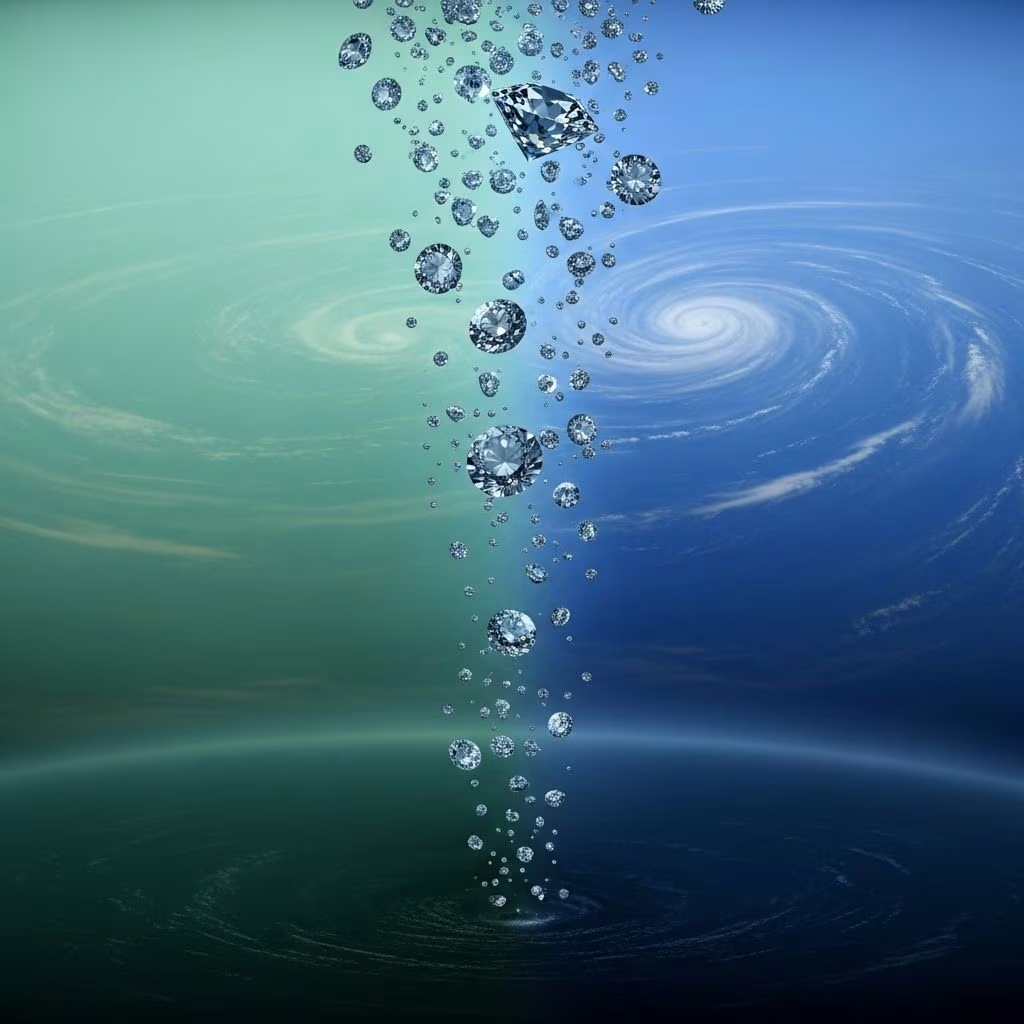
Diamond rain refers to the hypothetical and now experimentally supported process in which intense pressure and high temperatures deep inside planets, particularly Uranus and Neptune, transform common molecules into solid diamond crystals. These diamonds are believed to fall, or ‘rain,’ through the planets’ interior layers, just as water droplets fall through Earth’s atmosphere, but replaced by carbon in its most precious form.
- Occurs deep beneath the clouds of Uranus and Neptune.
- Requires extremely high pressures and temperatures, far beyond those on Earth’s surface.
- Involves simple compounds such as methane (CH4), abundant in the planets’ icy mantles.
Why Uranus and Neptune?
Uranus and Neptune are classified as ice giants, differing from the larger gas giants Jupiter and Saturn by their composition and internal structure. Their interiors are rich in elements like hydrogen, helium, carbon, oxygen, and nitrogen, along with an abundance of ‘ices’—molecules that would be frozen at surface temperatures, such as water, methane, and ammonia.
- Their distinct blue and cyan appearance is due to methane, which absorbs red light and reflects blue.
- Beneath their clouds, pressure rises to millions of atmospheres and temperatures soar to thousands of degrees Celsius.
- These conditions are theoretically suitable for the formation of diamond from carbon-based molecules.
The Structure of the Ice Giants
| Layer | Description |
|---|---|
| Atmosphere | Mainly hydrogen, helium, methane; cold, windy, and featureless compared to Jupiter or Saturn. |
| Ice Mantle | Composed of water, ammonia, and methane ices intermixed with rocks; extremely hot and high-pressure. |
| Core | Dense rocky center, possibly surrounded by a slushy shell. |
The Science Behind Diamond Formation
The transformation from simple molecules in the atmospheres of Uranus and Neptune into solid diamonds is a story of chemistry under extreme conditions. The key players are:
- Methane (CH4): A molecule made of one carbon and four hydrogen atoms, abundant in the icy mantles.
- High Pressure: Pressures exceeding 100,000 times Earth’s atmospheric pressure at sea level are required to break chemical bonds.
- High Temperature: Temperatures of thousands of degrees Celsius facilitate the rearrangement of atoms.
Under these conditions, carbon atoms are squeezed out of methane and begin to bond tightly with each other, forming the strong lattice of diamond. These diamonds, heavier than the material above, are thought to sink deeper through the planetary layers—creating a kind of diamond rain.
Experimental Evidence: Creating Diamond Rain in the Lab
While it’s impossible to directly observe diamond rain on Uranus and Neptune (no probe has ventured into their interiors), scientists have recreated the process in laboratory settings on Earth. Recent experiments use high-powered lasers and X-ray imaging to reproduce the intense pressures and temperatures found inside ice giants.
- Researchers used plastic materials rich in carbon and hydrogen to simulate planetary ices.
- Lasers compressed these materials to very high pressures—mimicking those about 5,000 miles below the planets’ cloud tops.
- Using X-rays, scientists observed tiny diamonds forming in real time.
This experimental confirmation supports earlier theoretical models and brings us closer to understanding the exotic chemistry of icy worlds.
How Lab Experiments Work
- A small sample of a plastic analog for methane, such as polystyrene (C8H8), is prepared.
- High-powered lasers compress and heat the sample to pressures over 100 gigapascals (GPa) and temperatures of several thousand kelvin.
- X-ray snapshots monitor the formation of crystalline diamond structures within microseconds.
Results indicate that diamond rain can form at lower pressures and temperatures than previously assumed, suggesting these processes could be widespread within Uranus, Neptune, and possibly other similar exoplanets.
The Life Cycle of a Diamond Deep Within a Planet
Imagine the journey of a carbon atom inside Neptune. High in the atmosphere, methane is stable. As it drifts lower into hotter, more pressurized regions:
- Methane molecules split, freeing the carbon atoms.
- These carbon atoms experience forces so great they form diamond crystals.
- Larger crystals—actual gems—form and begin to fall, sinking through denser fluid layers.
- At even greater depths, conditions become so extreme that diamonds may melt or dissolve, recycling carbon back upward.
This process is sometimes described as analogous to the Earth’s water cycle—with rain, condensation, and evaporation—only here, the cycle involves solid diamonds instead of water droplets.
The Role of Diamond Rain in Planetary Processes
Diamond rain is more than a planetary curiosity. It plays a role in:
- Energy and Heat Transport: As diamonds sink, they may help transfer heat from the interior to outer layers, influencing the planet’s thermal structure.
- Magnetic Fields: The movement of conductive materials, possibly influenced by diamond formation and sinking, could tie in to the origin of the planets’ unusual magnetic fields—an ongoing area of research.
- Carbon Distribution: By transporting carbon downward, diamond rain affects the internal chemistry and could eventually lead to diamond-rich cores or layers within the planet.
Comparing Uranus, Neptune, and Other Planets
| Planet | Diamond Rain Likelihood | Reason |
|---|---|---|
| Uranus | Highly probable | Rich in methane, adequate pressure and temperature deep in the mantle |
| Neptune | Highly probable | Similar composition and mantle profile to Uranus |
| Jupiter/Saturn | Possible (but less certain) | Conditions may exist briefly at intermediate layers, especially for Saturn |
| Earth | No natural diamond rain | Diamonds form deep in the mantle and are brought up by volcanic activity |
The parallel between Uranus and Neptune is strong, while the larger gas giants exhibit different interior dynamics due to differing compositions and the absence of thick ice-rich mantles.
Implications for Exoplanets
Diamond rain may not be unique to our solar system. Thousands of Neptune-like exoplanets have been discovered, many with likely similar bulk compositions. If the same ingredients and conditions are found there, raining diamonds could be common across the galaxy, hinting at truly alien planetary geology and chemistry beyond Earth’s.
Cutting-Edge Research and Future Questions
Recent breakthroughs (such as those at SLAC National Accelerator Laboratory) show that diamonds can form under icy giant-like conditions at even lower pressures and temperatures than thought. This may change our models of these planets’ interiors:
- Could ‘diamond oceans’ exist at transitional layers deep inside?
- Is diamond rain a key mechanism for creating complex, offset magnetic fields?
- How significant is diamond rain in maintaining internal heat flows in ice giants?
None of these questions have definitive answers yet. As of now, direct exploration is impossible—no probe has survived the crushing depths of Uranus or Neptune.
The Allure of Diamond Rain
Picturing entire worlds where diamonds fall like hail through vast blue depths captures the imagination. While we may never ‘harvest’ these diamonds, their presence is crucial to understanding the nature—and the physical laws—of distant planets.
- Reveals how materials behave under extreme conditions, far different from any on Earth.
- Sparks new laboratory methods to recreate exoplanetary chemistry and physics.
- Connects planetary formation, evolution, and magnetic properties across the universe.
Frequently Asked Questions (FAQs)
Q: What exactly is ‘diamond rain’?
A: Diamond rain is the process where, deep inside ice giant planets like Uranus and Neptune, carbon atoms form solid diamonds that fall or ‘rain’ through the interior layers due to high pressures and temperatures.
Q: Has diamond rain been directly observed on Uranus or Neptune?
A: No probe has yet directly observed diamond rain on these planets. However, laboratory experiments have successfully reproduced the process, confirming that it’s plausible under the known planetary conditions.
Q: Can diamond rain be found on Earth?
A: No, diamond rain does not occur naturally on Earth. Diamonds here are formed deep in the mantle under high pressure, but there is no analogous precipitation process.
Q: Why do Uranus and Neptune have such different weather and magnetic fields compared to other planets?
A: Their unique composition, internal layering, and processes like diamond rain could help explain their unusual magnetic fields and internal heat dynamics, though much remains under study.
Q: Could similar rain happen on exoplanets?
A: Given the number of Neptune-like exoplanets discovered, similar conditions could exist elsewhere, making diamond rain a potentially common phenomenon in the universe.
Glossary of Key Terms
- Ice Giants: Planets primarily composed of substances that would be ices at low temperatures, such as Uranus and Neptune.
- Methane: A simple hydrocarbon (CH4) abundant in the atmospheres and mantles of ice giants.
- High-pressure Synthesis: Laboratory methods used to make diamonds on Earth, similar to the purported planetary processes.
- Exoplanet: A planet orbiting a star outside our solar system.
Conclusion: Unveiling the Hidden Gems of the Cosmos
Diamond rain offers a stunning window into the exotic processes shaping the solar system’s ice giants and worlds far beyond. As laboratory science pushes boundaries, each ‘gem’ uncovered in the physics of Uranus and Neptune deepens our understanding of not only these distant neighbors, but the very possibilities that exist across the cosmos. In unraveling diamond rain, we see that even the wildest planetary phenomena may be rooted in the most fundamental chemistry—and that our universe remains as dazzling in reality as it is in imagination.
References
- https://www.americanscientist.org/article/on-neptune-its-raining-diamonds
- https://www.space.com/diamond-rain-atmosphere-uranus-neptune
- https://www.nasa.gov/podcasts/gravity-assist/gravity-assist-its-raining-diamonds-on-these-planets/
- https://www6.slac.stanford.edu/news/2024-01-08-diamond-rain-icy-planets-offers-clues-magnetic-field-mysteries
- https://www.llnl.gov/article/43621/scientists-create-diamond-rain-forms-interior-icy-giant-planets-neptune
- https://phys.org/news/2024-01-reveal-diamond-ice-planets.html
- https://www.universetoday.com/articles/its-thought-to-rain-diamonds-on-uranus-and-neptune-and-now-scientists-duplicated-it-in-the-lab
- https://www.youtube.com/watch?v=LUKqMGTRd-Q
- https://artsandculture.google.com/story/diamond-rain-on-uranus-and-neptune/jgWh_HTWXggajA?hl=en
- https://www.youtube.com/watch?v=cc1tzzIJFsc
- https://www.jagranjosh.com/general-knowledge/science-behind-it-why-does-it-rain-diamonds-on-uranus-and-neptune-1742902095-1
- https://artsandculture.google.com/story/diamond-rain-on-uranus-and-neptune/jgWh_HTWXggajA
- https://scitechdaily.com/from-diamond-rain-to-hidden-oceans-the-true-secrets-of-uranus-and-neptune/
- https://skyandtelescope.org/astronomy-news/do-diamonds-rain-on-the-ice-giants/
- https://eos.org/articles/diamonds-really-do-rain-on-neptune-experiments-conclude
- https://www.aakash.ac.in/blog/web-stories/feature-fact-or-fiction-it-rains-diamonds-on-neptune-and-uranus/
- https://www.euronews.com/next/2022/09/07/diamonds-on-uranus-how-it-may-be-raining-million-carat-jewels-on-icy-planets
- https://www.mining.com/scientists-gain-new-insights-into-diamond-rain-in-neptune-uranus/