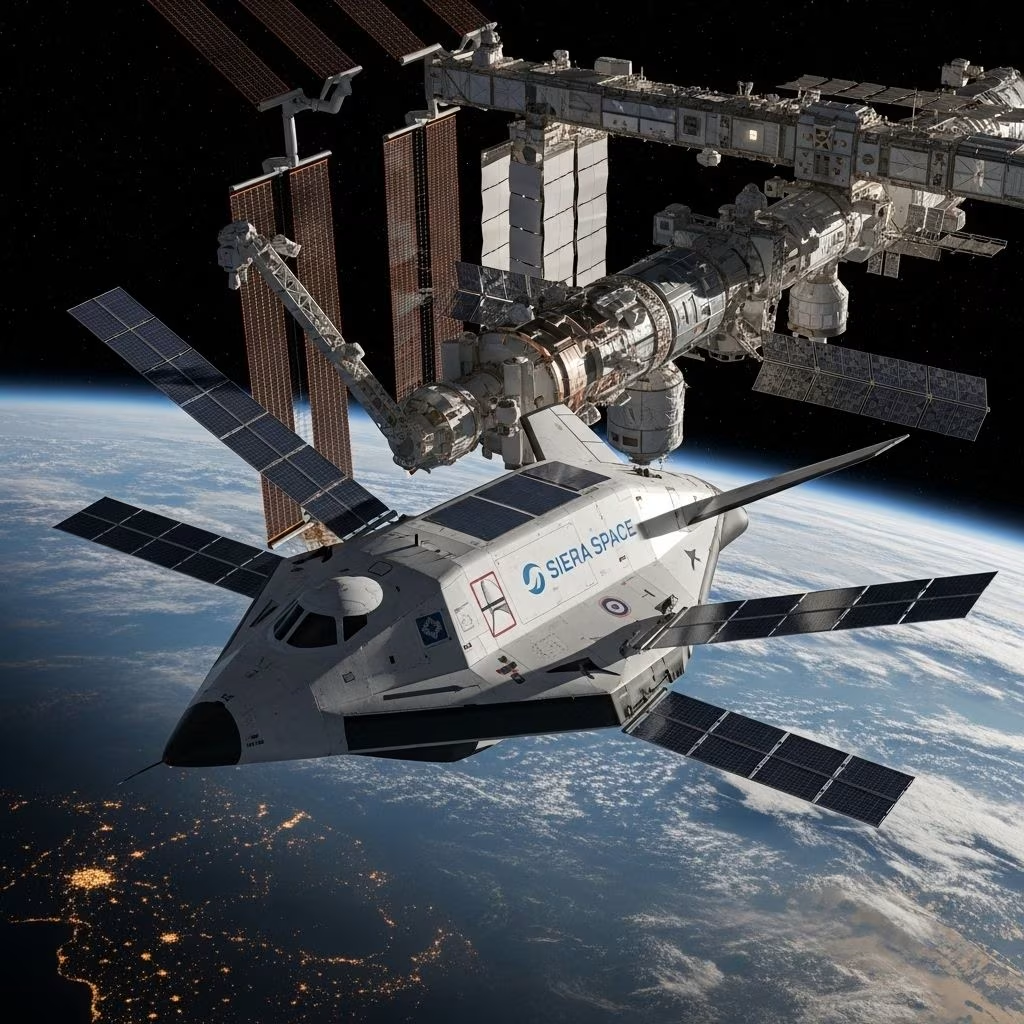
NASA and Sierra Space: Preparing for Dream Chaser’s First ISS Mission
The Dream Chaser spaceplane, developed by Sierra Space in partnership with NASA, is charting an exciting course for the future of space station resupply missions. Designed as a reusable lifting-body vehicle capable of runway landings, Dream Chaser promises to transform how we deliver critical supplies, experiments, and hardware to the International Space Station (ISS)—starting with its highly anticipated maiden flight.
Overview: A New Era in Spaceplane Logistics
With NASA and Sierra Space’s collaboration, Dream Chaser will serve as a flexible and innovative workhorse for the ISS. The spaceplane’s first operational mission is part of NASA’s Commercial Resupply Services 2 (CRS-2) contract, which expands options for safe and reliable cargo delivery and return from low Earth orbit.
- Reusable design reduces mission costs and turnaround time.
- Gentle runway landings enable rapid access to sensitive science payloads.
- Shooting Star cargo module enhances capacity for both delivery and waste disposal.
- The first Dream Chaser vehicle, Tenacity, leads this new operational chapter.
Why Dream Chaser? Sierra Space’s Vision and NASA’s Need
The ISS depends on regular cargo deliveries to maintain operations, and traditional capsule methods—while effective—have limitations. Dream Chaser’s lifting-body design combines shuttle-like versatility with modern reliability, offering both NASA and its international partners new options for:
- Rapid return of time-sensitive research
- Expanded types of cargo (pressurized, unpressurized, and trash for safe disposal)
- Flexible landing locations, thanks to its ability to touch down on conventional runways
NASA’s CRS-2 initiative actively encourages such commercial advancements, aiming to sustain the ISS and future orbital outposts via diverse U.S.-built vehicles.
Key Innovations in the Dream Chaser Program
- Reusability: Each Dream Chaser is built to fly at least 15 times, maximizing asset utilization and reducing refurbishment time and cost.
- Adaptable Cargo: Can carry up to 5,500 kg to the ISS and return 1,850 kg, including sensitive experiments and cooled samples[10].
- Wings and Lifting Body: The foldable wings allow it to fit inside the fairings of various launch vehicles, while the body generates lift for a controlled, gentle descent[10].
- Runway Landings: Allows for rapid retrieval at multiple airports near NASA and commercial research centers, a significant upgrade over ocean splashdowns[10].
Preparing for Launch: The Road to Dream Chaser’s Maiden ISS Flight
Spacecraft and Module Integration
The star of the debut mission, the Dream Chaser Tenacity vehicle, is now complete and has been undergoing extensive final preparations, including integration with its expendable Shooting Star cargo module. The Shooting Star attaches to Dream Chaser’s aft end, boosting storage, power generation, and trash disposal capabilities.
- Shooting Star module: Adds up to 10,000 pounds (4,500 kg) of additional cargo and has solar arrays supplying up to 6 kW of power[10].
- The module burns up on re-entry, safely disposing of ISS waste.
Testing and Validations
Before being cleared for flight, Dream Chaser Tenacity has undergone a rigorous series of tests:
- Thermal vacuum testing to simulate the hostile environment of space
- Acoustic and vibration testing to ensure endurance during launch on United Launch Alliance’s Vulcan Centaur rocket
- Flight software and guidance system validation, demonstrating automated approach and runway landing capability
- Simulated mated operations with the ISS docking system for safe berthing and cargo transfer
These tests are designed to reduce risk and ensure reliability for this and future missions.
Ground Operations and Launch Preparations
The Dream Chaser and Shooting Star module are prepared at NASA Kennedy Space Center (KSC) and then transferred to ULA facilities for integration with the Vulcan Centaur launch vehicle. Engineering teams from Sierra Space, NASA, and ULA closely coordinate to verify mechanical and software interfaces at every stage. Key steps include:
- Pre-launch fit checks between Dream Chaser and Vulcan Centaur
- Mission simulations for approach, docking, and re-entry
- Deployment of contingency plans for recovery and emergency landing scenarios
Technical Profile of Dream Chaser and Shooting Star
| Feature | Dream Chaser | Shooting Star Module |
|---|---|---|
| Length | ~30 feet | ~15 feet |
| Wingspan | 22 feet (extended) | N/A |
| Launch Vehicle | Vulcan Centaur (primary), Atlas V, Falcon 9 compatible | Mounted on Dream Chaser |
| Cargo to ISS | Up to 5,500 kg (with module) | Up to 4,500 kg additional |
| Cargo Return | Up to 1,850 kg (gentle runway landing) | N/A (burns up on return) |
| Solar Power | Onboard recharge system | 6 kW solar arrays |
| Pressurized/Unpressurized | Both | Both |
| Disposal | Reused up to 15 times | Single-use, burns up with trash |
The First Mission: What to Expect
The inaugural Dream Chaser cargo resupply flight aims to:
- Deliver thousands of pounds of science, food, hardware, and crew supplies to the ISS
- Demonstrate automated approach to ISS’s docking port
- Enable rapid return and offloading of experiments, especially those requiring controlled, gentle return conditions
- Burn up unneeded station waste via the Shooting Star module’s destructive re-entry
After unloading, Dream Chaser will autonomously undock, re-enter Earth’s atmosphere, and land on a runway in the U.S.—a process offering immediate ground access to returned research and equipment.
Flight Timeline and Mission Operations
- Launch: Vertical launch atop ULA Vulcan Centaur from Cape Canaveral
- Orbit operations: Autonomous rendezvous and approach to the ISS
- Station stay: Several weeks berthed at ISS for cargo transfer
- Departure: Shooting Star detaches for destructive re-entry; Dream Chaser returns to Earth
- Landing: Runway touchdown (Kennedy Space Center Shuttle Landing Facility or other approved sites)
The Road Ahead: Future Applications and Expansion
While this initial flight will focus on ISS cargo, Dream Chaser’s design supports broader ambitions:
- Crewed Version in Development: Plans exist to develop a version carrying up to 7 astronauts[10].
- Compatibility with Multiple Launch Vehicles: Flexibility reduces launch risk and increases mission cadence.
- Scientific and Commercial Use: Dream Chaser’s gentle re-entry makes it uniquely beneficial for sensitive biological samples, medical payloads, and high-value experiments.
- Lunar Gateway and Beyond: Exploring applications for cislunar transport and support of NASA’s Artemis program.
The vehicle’s lifting-body heritage can be traced to NASA’s HL-20 concepts, evolved with modern avionics, composites, and thermal protection systems. Sierra Space’s commercial aspirations include building a fleet of Dream Chaser vehicles for varied orbital and off-Earth missions[10].
Technical Innovations in Materials and Avionics
- Thermal Protection System: Made of silica-based tiles and a robust, oxidation-resistant TUFROC composite for heat shield areas[10].
- Autonomous Flight Software: Enables precise navigation, berthing, and runway landings without crew intervention.
Dream Chaser’s Impact on ISS Logistics
Dream Chaser promises to significantly expand NASA’s ISS logistics toolkit, complementing existing SpaceX Dragon and Northrop Grumman Cygnus capsules with:
- Runway landings for rapid experiment access
- Multiple cargo types (including precious, perishable, or urgent samples)
- Enhanced waste disposal capacity
- Greater mission frequency through fast turnaround and reusability
Comparison: Dream Chaser vs. Other ISS Cargo Vehicles
| Vehicle | Reusability | Landing Method | Return Payload | Primary Partner |
|---|---|---|---|---|
| Dream Chaser | Yes (15+ uses) | Runway landing | 1,850 kg (gentle return) | Sierra Space |
| SpaceX Dragon | Yes (multiple uses) | Water splashdown | ~3,000 kg | SpaceX |
| Northrop Grumman Cygnus | No | Destructive re-entry | None | Northrop Grumman |
This table illustrates how Dream Chaser’s runway landing and reusable design offer a distinct advantage, particularly for sensitive science and rapid sample recovery.
Frequently Asked Questions (FAQ)
Q: What is the Dream Chaser spaceplane designed to do?
A: Dream Chaser is designed to deliver and return cargo to the International Space Station and other orbital destinations. Its reusability, runway landing, and gentle re-entry profile make it ideal for transporting sensitive scientific and commercial payloads.
Q: How does Dream Chaser differ from traditional capsule cargo spacecraft?
A: Unlike capsules that typically land via ocean splashdown, Dream Chaser lands on selected runways, allowing immediate access to returned cargo. Its lifting-body design also enables up to 15 reuses, significantly reducing mission turnaround costs[10].
Q: What is the Shooting Star module, and what does it do?
A: The Shooting Star module attaches to Dream Chaser for cargo resupply missions, allowing extra cargo space and providing a means of safe disposal for ISS waste by burning up on re-entry. It also contributes additional electrical power and thermal regulation[10].
Q: When will Dream Chaser’s first flight to the ISS take place?
A: The launch schedule is subject to vehicle readiness and launch vehicle timelines, but the maiden flight is anticipated in the near future as the hardware and mission preparations near completion at NASA Kennedy Space Center and ULA’s launch facilities.
Q: Are there plans for a crewed version of Dream Chaser?
A: Yes. Sierra Space is developing a crewed variant that could carry up to seven astronauts to low Earth orbit destinations, with potential applications in NASA’s Artemis and lunar gateway programs[10].
Conclusion: The Dawn of Spaceplane Supply
The Dream Chaser program represents a defining shift in how cargo—and soon, crew—are ferried to and from orbit. As NASA and Sierra Space finalize preparations for its first ISS mission, the space community watches closely: Dream Chaser’s success could open new possibilities for sustainable, responsive, and cost-effective access to space for government, scientific, and commercial partners worldwide.
References
- https://en.wikipedia.org/wiki/Dream_Chaser
- https://www.sierraspace.com/dream-chaser-spaceplane/
- https://www.nasa.gov/missions/station/commercial-resupply/sierra-spaces-dream-chaser-new-station-resupply-spacecraft-for-nasa/
- https://www.sierraspace.com/dream-chaser-spaceplane/uncrewed-cargo-spacecraft/
- https://en.wikipedia.org/wiki/Dream_Chaser_Tenacity
- https://www.nasa.gov/general/sierra-spaces-dream-chaser-new-station-resupply-spacecraft-for-nasa/
- https://www.icao.int/Meetings/SPACE2015/Presentations/3%20-%20L.%20Saccani%20-%20Sierra%20Nevada%20Corp.pdf
- https://newspaceeconomy.ca/2023/11/05/the-sierra-dream-chaser-spacecraft/
- https://www.space.com/15366-dream-chaser-private-space-plane-infographic.html
- https://www.wikiwand.com/en/articles/Dream_Chaser
- https://phys.org/news/2024-05-nasa-sierra-space-chaser-spaceplane.html
- https://www.nasaspaceflight.com/2023/09/dream-chaser-tps/
- https://www.nasaspaceflight.com/2025/03/dream-chaser-pre-flight-milestones/
- https://www.youtube.com/watch?v=y-YVynulzzo
- https://spaceflightnow.com/2024/02/02/sierra-space-unveils-fully-integrated-dream-chaser-spaceplane-amid-testing-campaign/
- https://www.youtube.com/watch?v=dr8qY6VgHF8
- https://www.supercluster.com/launches/dream-chaser-demo-11/
- https://scitechdaily.com/sierra-spaces-dream-chaser-spaceplane-revolutionizing-iss-resupply-for-nasa/