


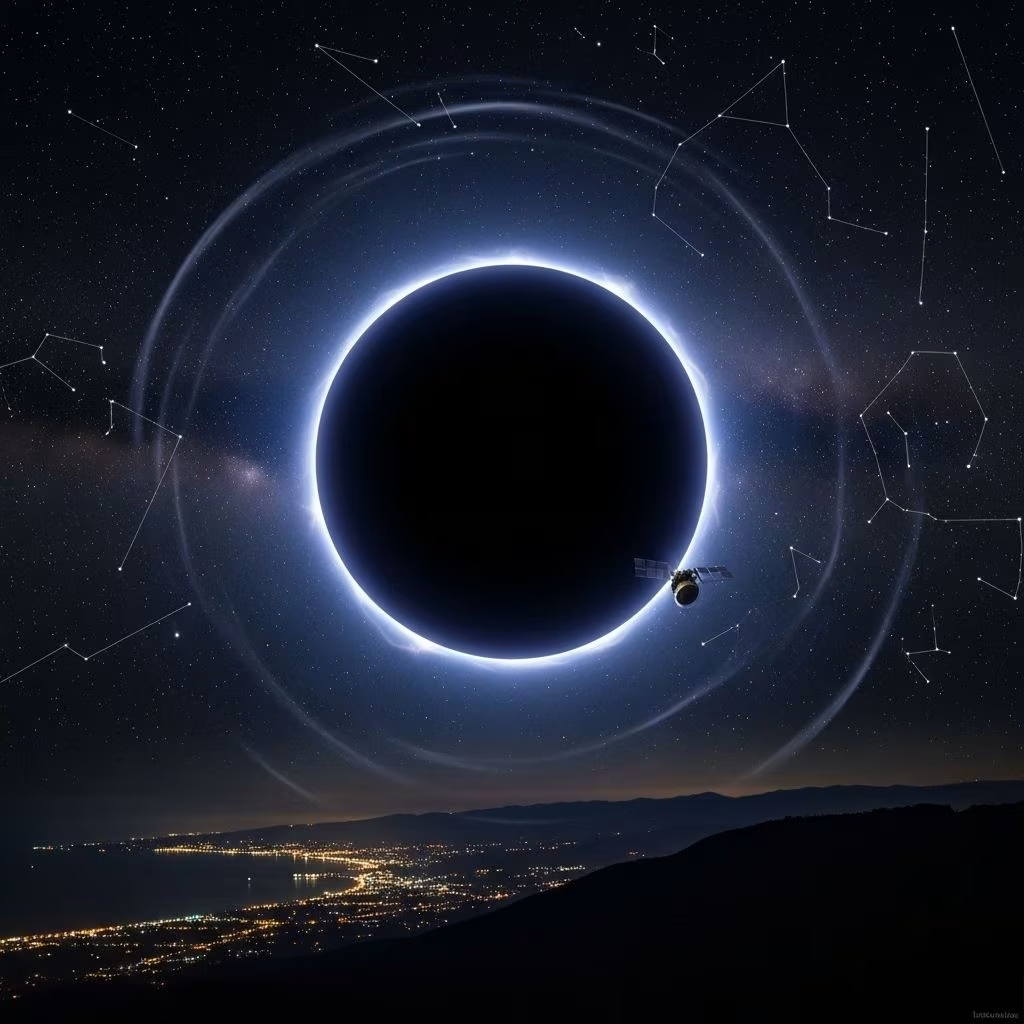
The moon has been Earth’s steadfast companion for billions of years, profoundly influencing our planet’s tides, climate, and even the evolution of life. But what would become of Earth, its inhabitants, and its cosmic destiny if the moon simply vanished? This article explores the science, effects, and existential questions surrounding a moonless world.
The Story of Earth’s Moon
The moon originated around 4.5 billion years ago, likely born from an ancient collision when a Mars-sized object—often called Theia—struck the young Earth. The resulting debris coalesced under gravity to form our only natural satellite. Since then, the moon’s presence has shaped everything from tides to timekeeping, providing a unique window into the solar system’s history.
- Serves as a gravitational stabilizer for Earth’s rotation
- Inspires calendar systems, myths, and scientific exploration
- Acts as a record of early solar system impacts and processes
Is the Moon’s Disappearance Even Possible?
According to astrophysicists, there are few plausible scenarios where the moon could disappear suddenly. Noah Petro, NASA Artemis 3 mission project scientist, notes that destroying or ejecting the moon would require an astronomical event as rare as the one that created it—a massive impact from a planet-sized interloper.
- Collision scenario: A Mars-sized body smashing into the moon could, in theory, destroy or disperse it.
- Drifting away: Over billions of years, the moon is slowly moving away (~3.8 cm/year), but it would not naturally escape Earth’s gravity anytime soon.
- Rogue bodies: Theoretical, but exceedingly unlikely—rogue planets or cosmic collisions that could remove the moon are incredibly rare.
With these scenarios unlikely, the discussion of a vanished moon is speculative but scientifically enlightening, helping us grasp how crucial it is to life and planetary stability.
Immediate Physical Effects: A Changed Earth
Should the moon disappear instantly, Earth would experience immediate and dramatic changes across a variety of domains.
The Fate of the Tides
- Tidal force loss: The moon’s gravity is the prime mover of our tides, pulling at the oceans and creating predictable, rhythmic high and low tides.
- Change upon disappearance: Tides would weaken drastically—remaining influenced only by the sun, causing less pronounced tides roughly one-third the height of today’s.
- Direct consequences:
- Coastal ecosystems would be disrupted, as many depend on the ebb and flow of strong lunar tides.
- Tidal mixing that helps distribute nutrients and oxygen in the ocean would be dramatically reduced.
- Animals like crabs, mollusks, and some fish, which synchronize reproduction with the full moon, could face extinction or severe decline.
- Human coastal living and maritime industries would face new challenges.
Impact on Earth’s Axial Tilt
The moon acts as a stabilizer for Earth’s tilt—or obliquity—which governs our planet’s climate and seasonal patterns.
- Without the moon:
- Earth’s axial tilt would become increasingly unstable over millions of years.
- Obliquity could swing chaotically between 0° (no seasons) to 85° (wild, extreme seasons).
- This would trigger unpredictable, possibly severe climate shifts, threatening the stability of ecosystems and the future of complex life.
Shorter and Unstable Days
- Moon’s role: The gravitational interaction with the moon slows Earth’s rotation, leading to our current 24-hour day.
- Loss effect: Without the moon, Earth’s rotation would gradually speed up, shortening the length of our day over millions of years—potentially down to as little as 6 to 8 hours.
- Consequence: Faster spins would mean more frequent sunrise and sunset, disrupting circadian (biological) rhythms and ecological timing for all living things.
The Moon and Life on Earth
The moon has shaped biological evolution on Earth in profound ways, from the rhythm of reproductive cycles to the evolution of sight.
- Many marine and coastal species are guided by the moon for timing of reproduction, migration, and feeding.
- Some animals have evolved the ability to see in low-light environments—adapting to moonlit nights.
- The absence of the moon would force a re-evolution or extinction of these species, especially those reliant on tidal synchronization.
Disruption of Biological Rhythms
Many forms of life, including plankton and coral, time their lives to the lunar calendar. For instance, the mass spawning of Australia’s corals is linked to the phases of the moon.
- Loss of this clock would halt or confuse essential reproductive and feeding cycles.
- Predatory-prey relationships could collapse; nocturnal animals would experience darker nights, while others might proliferate unchecked without natural controls.
Long-Term Changes: Climate and Habitability
While the most immediate changes would devastate coastlines and certain lifeforms, the long-term consequences could alter Earth’s ability to support life as we know it.
Axial Instability and Climate Chaos
- The growing instability of Earth’s axial tilt would introduce erratic seasons and unpredictable climate changes.
- Regions could oscillate between freezing and scorching temperatures from year to year or over millennia, making adaptation challenging for all but the most resilient creatures.
Planetary Science: Losing a Window Into the Past
The moon offers unique insights into planetary formation and history. Losing it would cripple scientific efforts to understand Earth’s origins.
- Much of what scientists know about the early solar system—such as impact history, planet formation, and the possibility of life elsewhere—comes from studying the moon’s surface and geology.
- Future generations would lose a critical archive of Earth’s cosmic past.
What Would Happen in the Sky?
The night sky would be forever transformed. The moon, a beacon for navigation, a calendar for ancient peoples, and a subject of poetry and science, would vanish.
- Brighter stars, darker nights: With no moon, the night sky would darken significantly, rendering stars and nebulae far more visible to the naked eye.
- Cultural loss: Stories, rituals, and traditions anchored to the lunar cycle would disappear or be radically changed.
- Navigation: Mariners and ancient cultures would lose a reference point for orientation and timekeeping.
The Moon’s Importance to Humanity
The moon provided crucial stepping stones in understanding Earth’s place in the cosmos and fuelled some of humanity’s earliest scientific inquiry.
- Scientists used lunar and solar observations to develop the calendar, track time, and predict eclipses.
- Lunar impacts preserved in craters reveal Earth’s own turbulent early years.
- The moon remains our primary testing ground for future crewed planetary missions.
Astronomical Rarity: Could It Really Happen?
While fascinating to imagine, the loss of the moon ranks among the least likely cosmic cataclysms. Most large solar system objects have already found their orbits or been absorbed. Astrophysicists agree that only a titanic, nearly unimaginable impact or a disruption by a massive interstellar object could truly unseat the moon.
Summary Table: Life With and Without the Moon
| Aspect | With the Moon | Without the Moon |
|---|---|---|
| Tides | Strong, regular, support ecosystems | Weak, less mixing, ecosystem collapse |
| Earth’s Tilt | Stable (23.5°), regular seasons | Unstable, wild and shifting seasons |
| Length of Day | ~24 hours | Decreasing over eons, <8 hours possible |
| Biological Rhythms | Synchronized with lunar cycles | Disrupted, mass extinction risk |
| Night Sky | Bright, moonlit nights | Darker nights, stargazing improved |
| Human Legacy | Science, culture, and exploration | Loss of cosmic history, calendar changes |
Frequently Asked Questions (FAQs)
Q: Could life exist on Earth without the moon?
A: Some forms of life might survive, but coastal and tidal-dependent species would face extinction, and axially-induced climate chaos could imperil complex life over millions of years.
Q: Has the moon ever disappeared before?
A: No, but rare atmospheric events and volcanic eruptions have temporarily obscured the moon from view, as recorded in historical chronicles and recently confirmed by scientific studies.
Q: Would humans be able to adapt if the moon vanished?
A: Humanity could adapt to some immediate changes, but the long-term destabilization of climate and ecological collapse could pose existential threats.
Q: What if the moon simply drifted away over time?
A: The moon is gradually receding from Earth at about 3.8 centimeters per year, but at this rate, it would take billions of years to escape entirely—well beyond the projected lifespan of Earth.
Q: Would Earth’s rotation really speed up without the moon?
A: Yes; Earth’s day was much shorter in the distant past before the moon’s gravitational drag slowed our planet’s spin. Lose the moon, and the day would get shorter again, over millions of years.
Conclusion
The moon’s silent partnership with Earth is more than a cosmic dance; it is essential to our planet’s stability, biodiversity, and understanding of cosmic history. The moon’s disappearance would trigger dramatic consequences, unraveling both environmental balances and the story of life itself.
References
- https://www.accuweather.com/en/space-news/moon-years-long-disappearance-focus-of-study/1174463
- https://www.space.com/lucy-asteroid-spacecraft-photographs-moon-eclipse
- https://www.youtube.com/watch?v=Ea-PIoiZiKo
- https://www.space.com/what-would-happen-if-the-moon-disappeared
- https://www.space.com/space-exploration/search-for-life/theres-a-weird-disappearing-dark-spot-on-saturns-moon-enceladus
- https://www.space.com/31296-venus-vanishes-behind-the-moon.html
- https://www.space.com/stargazing/solar-eclipses/rare-satellite-footage-shows-the-moon-eclipsing-the-sun-on-a-strangely-crooked-path
- https://www.space.com/41256-moon-life-not-yet.html
- https://www.space.com/mars-long-lost-moon-weird-shape-extreme-terrain
- https://www.iflscience.com/disappearance-of-yet-another-nasa-moon-rock-detailed-in-new-documents-77501


