


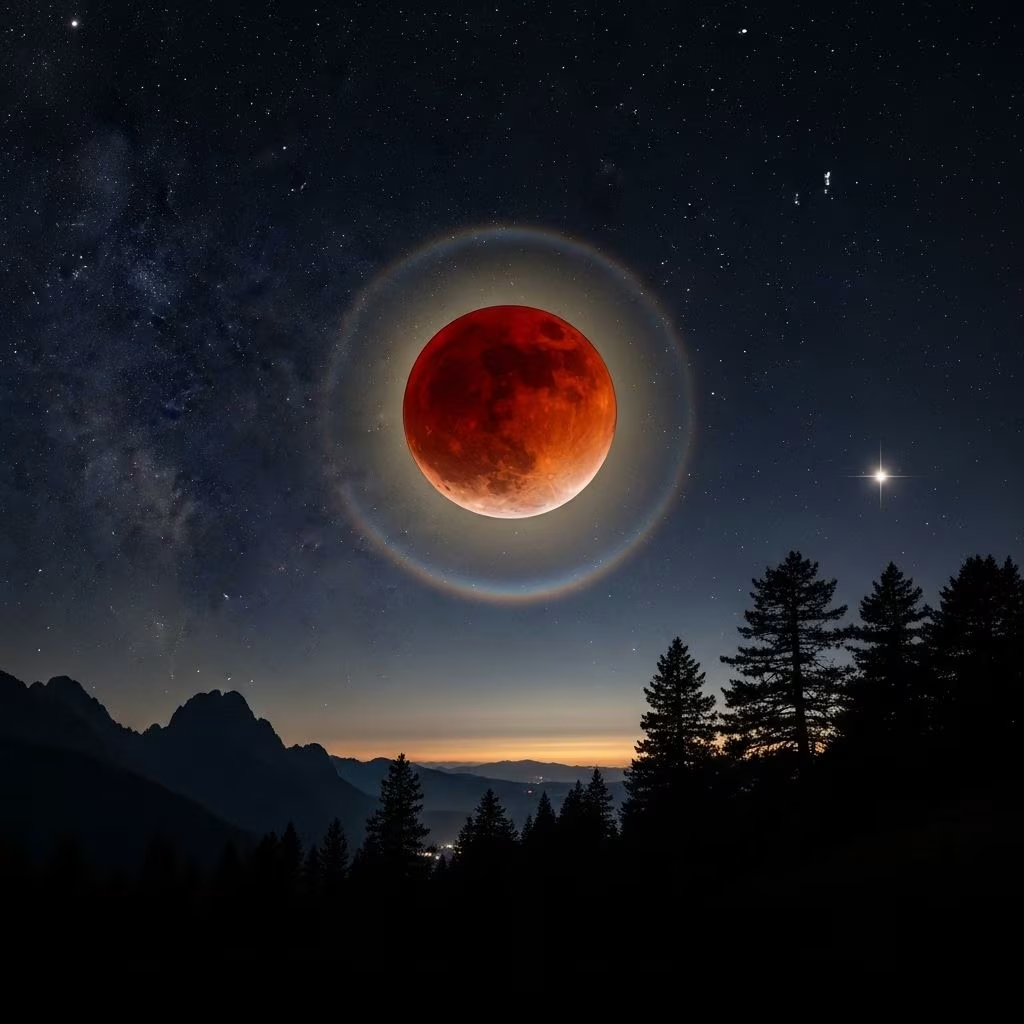
Mark your calendars for the celestial show on the night of September 7, 2025, as a total lunar eclipse—often called a ‘blood moon’—graces the skies. This rare event offers a spectacular view for billions, transforming the full moon into an eerie, coppery-red orb. In this comprehensive guide, discover the science, the schedule, and best viewing advice for the September 2025 blood moon eclipse.
What Is a ‘Blood Moon’?
A “blood moon” refers to a total lunar eclipse when Earth’s shadow completely envelops the moon, causing it to darken and acquire a reddish hue. During the eclipse, sunlight passing through Earth’s atmosphere is refracted, filtering out blue wavelengths and allowing red light to cast a ghostly glow onto the lunar surface. This creates the striking, rusty-red appearance that gives the “blood moon” its name.
Key Details: The September 7, 2025 Total Lunar Eclipse
- Date: 7–8 September 2025
- Type: Total lunar eclipse (‘blood moon’)
- Totality Duration: 82 minutes
- Maximum Eclipse: 18:11 UTC
- Lunar Saros Series: 128
- Moon closest to perigee: 2.6 days after eclipse (Moon appears slightly larger)
Eclipse Parameters Table
| Parameter | Value |
|---|---|
| Penumbral Magnitude | 2.34591 |
| Umbral Magnitude | 1.3638 |
| Gamma | –0.2752 |
| Sun Right Ascension | 11h 06m 09s |
| Sun Declination | +5° 45′ 48″ |
| Moon Right Ascension | 23h 06m 41s |
| Moon Declination | –6° 00′ 09″ |
| Moon Semi-diameter | 16′ 10″ |
| ΔT | 71.9 s |
Why Does the Moon Turn Red?
The deep red or copper shade of the eclipsed moon is caused by Earth’s atmosphere. As sunlight passes through the atmosphere, shorter blue wavelengths are scattered away, while longer red wavelengths are bent toward the moon—a process known as Rayleigh scattering. This redirected red light bathes the moon in a reddish glow during totality. The precise hue depends on Earth’s atmospheric conditions; volcanic ash or pollution can make the color deeper or even introduce hints of copper or orange.
Who Can See the Blood Moon?
The September 7–8, 2025 total lunar eclipse is visible across vast regions of the world. Whether you see the whole event or only parts of it depends on your location. Here’s a rundown of visibility:
- Best views: Most of Asia and western Australia—observers can witness the entire eclipse from start to finish .
- Good visibility: Eastern Australia, New Zealand, Africa, and parts of the Middle East—most or all of the eclipse phases are visible.
- Eclipse setting/rising: Europe and most of Africa will see the eclipse as it rises; central Pacific regions will catch the end as the moon sets.
- Misses out: Americas will not see this eclipse; however, another total lunar eclipse in March 2026 will be visible to North America.
Local Timings for the Eclipse
- Perth, Australia: 1:30–2:52 a.m. local time
- Tokyo, Japan: 2:30–3:52 a.m. local time
- Totality Everywhere: 17:30–18:52 UTC (82 minutes)
Timeline of the September 7–8, 2025 Lunar Eclipse
The eclipse unfolds in several distinct phases as the moon passes through Earth’s shadow. Times are given in UTC:
- Penumbral eclipse begins: The faint outer shadow of Earth starts to dim the moon (subtle, often not visible to the naked eye).
- Partial eclipse begins: The moon enters the central (umbral) shadow; a dark bite appears on the lunar disk.
- Total eclipse (totality) begins: The entire moon passes into the umbra, turning red.
- Maximum eclipse: The deepest, most vivid part of the eclipse.
- Totality ends: The moon begins to exit the umbra, red color gives way to brightness.
- Partial eclipse ends: Only a faint penumbral shading remains.
- Eclipse ends: The moon returns to full brightness.
Key Moments in Universal Time (UTC)
| Phase | Time (UTC) |
|---|---|
| Partial eclipse begins | 17:30 |
| Totality begins | 17:30 |
| Maximum eclipse | 18:11 |
| Totality ends | 18:52 |
Note: Viewers should check local times adjusted for their timezone to catch the eclipse’s stages.
What Makes This Eclipse Special?
- Greatest Duration: With a totality lasting 82 minutes, this is one of the longest total lunar eclipses in several years.
- Wide Visibility: Nearly half the world’s population is able to see some portion of this eclipse, with billions in Asia, Australia, Africa, and Europe perfectly positioned for dramatic skywatching.
- Larger Apparent Size: Occurring only about 2.6 days before the moon’s perigee (‘supermoon’), the eclipse features a slightly larger and brighter lunar disk.
- Part of a Tetrad: This is the second event in a series of four consecutive lunar eclipses (termed an ‘almost tetrad’).
Eclipse Season and Related Events
Lunar and solar eclipses are grouped into so-called eclipse seasons—periods when the sun, Earth, and moon align. The September 7, 2025 lunar eclipse is part of the following sequence:
- September 7, 2025: Total lunar eclipse (Lunar Saros 128)
- September 21, 2025: Partial solar eclipse (Solar Saros 154)
Such eclipse seasons repeat roughly every six months, with two to three eclipses occurring during each period. The proximity of lunar and solar eclipses is no coincidence—they’re both a result of the same orbital alignments between sun, Earth, and moon during the season.
How to Watch: Tips for Skywatchers
- Find a Dark Spot: Seek locations away from city lights for best contrast—although even urban observers can marvel at the color change.
- No Special Equipment Needed: The blood moon is easily visible with the naked eye. Binoculars or a small telescope can enhance details and color nuances.
- Arrive Early: Be in position before the partial eclipse phases begin to watch the full progression.
- Patience and Comfort: Bring a chair, snacks, and warm clothing, especially as some regions experience the event late at night or early morning.
- Photography Tips: Use a tripod for sharp images. Longer exposures show the red color. Adjust white balance to enhance the hue.
- Join the Excitement Online: Many sites will livestream the eclipse with expert commentary, making it accessible if skies are overcast or you are outside the visibility zone.
The Science Behind Lunar Eclipses
Lunar eclipses occur when the Earth moves directly between the sun and moon, casting its shadow across the lunar surface. Eclipses only happen during a full moon when the orbital planes line up. The changing shades—gray, copper, deep red—offer a visible demonstration of Earth’s atmospheric effects in action. Unlike solar eclipses, lunar eclipses are safe to view with the naked eye, providing a unique opportunity for everyone to experience a dramatic astronomical event firsthand.
Different Types of Lunar Eclipses
| Type | Description |
|---|---|
| Penumbral | Moon passes through Earth’s faint outer shadow (subtle darkening, sometimes unnoticeable). |
| Partial | Portion of the Moon enters Earth’s darkest shadow (umbral shadow); visible as a dark bite. |
| Total | Entire visible Moon passes into the umbra—producing a striking red ‘blood moon.’ |
Frequently Asked Questions (FAQs)
Q: Why do lunar eclipses last so much longer than solar eclipses?
A: A total lunar eclipse can last up to two hours because the Earth’s shadow is much larger than the Moon’s shadow cast during a solar eclipse. As a result, the Moon spends a long time in Earth’s shadow, while during solar eclipses, the sun’s disk is only briefly covered by the Moon at any given place on Earth.
Q: Do I need special glasses to view a lunar eclipse?
A: No. Lunar eclipses are completely safe to view with the naked eye; the moon’s brightness dims dramatically, making it one of the most accessible celestial events for all ages.
Q: What determines the exact color of a blood moon?
A: Atmospheric conditions on Earth—including dust, clouds, and pollution—can intensify or mute the moon’s color, varying from coppery orange to deep red or brown.
Q: When is the next total lunar eclipse?
A: After September 2025, the next chance for North Americans comes with the total lunar eclipse of March 2–3, 2026. There are also other partial and penumbral lunar eclipses in between for other parts of the world.
Q: Can I photograph a blood moon with a smartphone?
A: Yes. Modern phone cameras, especially with the use of a tripod and night mode features, can capture the event. For best results, adjust focus and exposure manually.
Key Takeaways: Don’t Miss the Blood Moon!
- Mark your calendar: September 7–8, 2025.
- Best visibility: Asia, Australia, Africa, parts of Europe and Pacific.
- Unique sight: Look for a vivid red full moon lasting over 80 minutes—no telescope required.
- Next up: If you miss this eclipse, watch for the next total lunar eclipse on March 2–3, 2026.
Wherever you are in the world, don’t miss this chance to experience one of nature’s most breathtaking—and accessible—celestial events. For those outside the main visibility zones or clouded out, follow along with global live streams, expert commentary, and stunning photography online for a front-row seat to the blood moon spectacle.
References
- https://www.timeanddate.com/eclipse/lunar/2025-september-7
- https://en.wikipedia.org/wiki/September_2025_lunar_eclipse
- https://www.space.com/stargazing/lunar-eclipses/where-to-see-the-blood-moon-lunar-eclipse-sept-7-8
- https://www.space.com/stargazing/lunar-eclipses/what-to-expect-blood-moon-total-lunar-eclipse-sept-7-2025
- https://www.youtube.com/watch?v=l1Sx0FG8EYE
- https://theskylive.com/lunar-eclipses/2025-09-07
- https://www.usatoday.com/story/news/nation/2025/09/02/total-lunar-eclipse-september-2025-path/85935798007/
- https://www.timeanddate.com/eclipse/map/2025-september-7
- https://www.accuweather.com/en/space-news/85-of-world-population-may-see-total-lunar-eclipse-sunday/1811587
- https://www.youtube.com/watch?v=BEWFpe9A1dw
- https://earthobservatory.nasa.gov/images/154814/by-the-warm-light-of-the-moon
- https://www.livescience.com/space/the-moon/where-can-you-see-the-sept-7-blood-moon-total-lunar-eclipse
- https://in-the-sky.org/news.php?id=20250907_09_100
- https://www.farmersalmanac.com/lunar-and-solar-eclipses
- https://www.skyatnightmagazine.com/news/lunar-eclipse-september-7-2025
- https://www.syfy.com/syfy-wire/how-to-see-september-blood-moon-total-lunar-eclipse


