


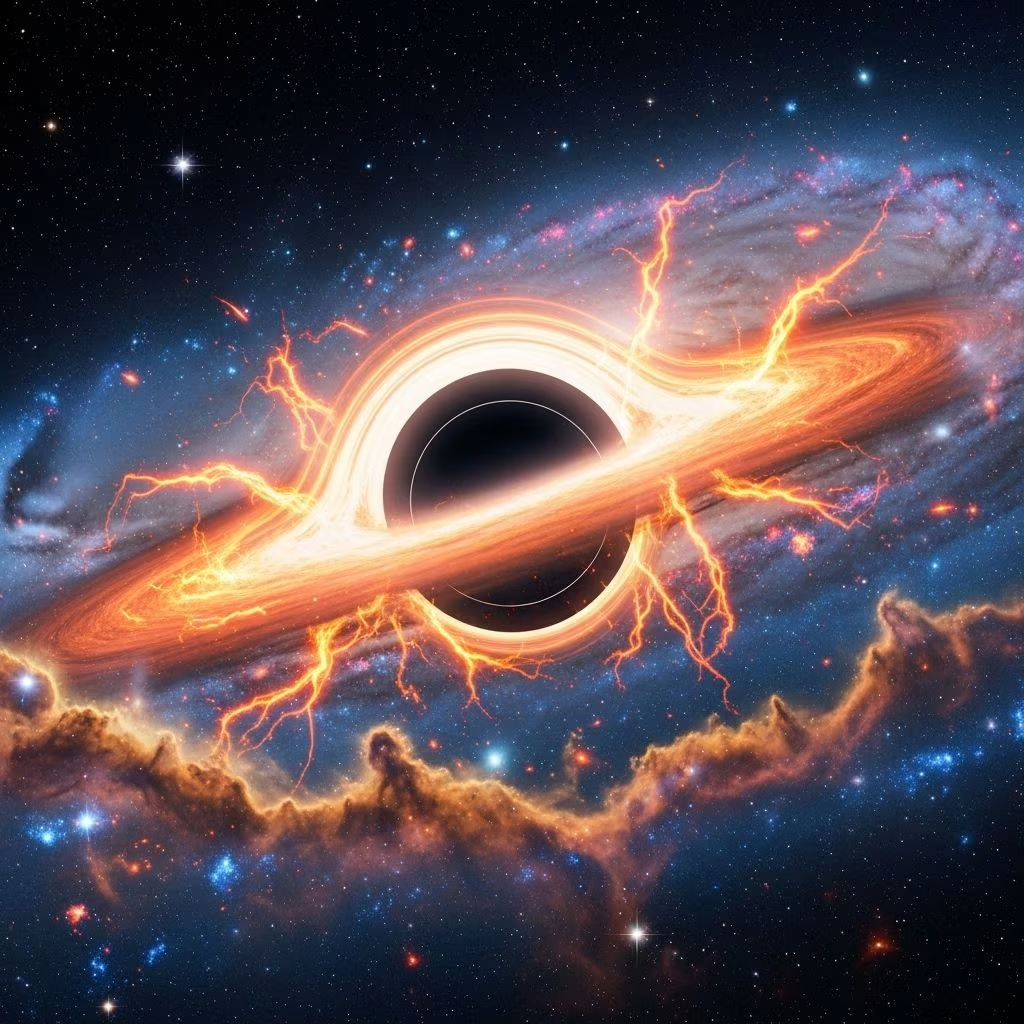
Revealing Sagittarius A*: A Hidden Heart at the Center of the Milky Way
The history of astronomy is defined by moments where the invisible is made visible. In a striking demonstration of scientific ingenuity, astronomers have unveiled the first direct image of Sagittarius A* (Sgr A*), the supermassive black hole anchoring the core of our own Milky Way galaxy. This achievement marks not only a technological milestone but also offers profound insights into the nature and dynamics of black holes lurking at the hearts of galaxies.
- Sagittarius A* lies at the very center of the Milky Way, cloaked in darkness and shrouded by clouds of dust and gas.
- The new image confirms Sgr A*’s identity as a black hole by displaying its signature shadow and glowing ring.
- Scientists used the Event Horizon Telescope (EHT), a network of radio observatories spanning the planet, to achieve this feat.
The Long-Awaited Breakthrough: How Was the Image Captured?
For decades, astronomers suspected that the mysterious, compact, massive object at the galactic center was a black hole. Its presence was inferred by tracking the high-speed orbits of stars circling an unseen, extremely dense core. However, this circumstantial evidence, while compelling, lacked direct visual proof.
The EHT changed everything:
- By combining eight radio observatories worldwide, the EHT formed a virtual Earth-sized telescope.
- This technique, called very long baseline interferometry (VLBI), allowed astronomers to resolve features as small as the event horizon — the ultimate one-way boundary of a black hole.
- The data, gathered in 2017, required years of intricate analysis, producing an image that averaged thousands of reconstructions to overcome atmospheric turbulence, interference, and intrinsic variability.
What the Image Reveals: Shadow and Light in the Void
The resulting image is both haunting and mesmerizing. Because black holes themselves emit no light, the EHT captured the glowing gas swirling at relativistic speeds around Sgr A*. The intense gravitational field bends and traps light, forging two essential features:
- A dark central shadow: the black hole’s silhouette, cast by its event horizon.
- A luminous ring: light emitted by superheated gas as it orbits the black hole at nearly the speed of light.
Sagittarius A* is estimated to be about four million times more massive than our Sun. Despite this immense mass, the black hole’s event horizon is so compact that its scale appears minute even when viewed across 26,000 light-years of space.
Unlocking Hidden Features: What Lies within the Image?
While EHT’s historic image primarily confirms Sgr A*’s existence, further analysis has begun to reveal hidden, dynamic features in unprecedented detail.
- Variability of the Ring: The ring’s brightness and orientation subtly vary, reflecting the turbulent motion of matter infalling toward the black hole. These subtle changes offer clues about the magnetic fields and the chaotic nature of accreting material.
- Differences from Other Black Holes: Compared to the first black hole image (M87*) captured by the EHT in 2019, Sgr A*’s surroundings are more rapidly variable and less structured, indicating different feeding mechanisms and environmental conditions.
- Orientation and Spin: The ring’s appearance suggests that the black hole’s spin axis is tilted, impacting how material spirals inward and how jets might be launched from the core.
The Technology and Science Driving the Discovery
The achievement behind the Sgr A* image is a testament to decades of scientific cooperation, technological innovation, and patient data analysis. Key elements include:
- Global collaboration: The EHT initiative united hundreds of scientists from over 80 institutions worldwide.
- Advanced computing: Vast quantities of data from each observatory were collected on high-performance hard drives, physically shipped, and then correlated with custom-built supercomputers.
- Dealing with black hole variability: Unlike stationary images, Sgr A*’s appearance changes quickly, requiring novel algorithms to average images and capture reliable structure.
Physical Properties of Sagittarius A*
| Property | Value |
|---|---|
| Location | Core of Milky Way (26,000 light-years from Earth) |
| Type | Supermassive black hole |
| Mass | Approximately 4 million solar masses |
| Diameter of Event Horizon | ~24 million kilometers (about 17 solar diameters) |
| Image captured by | Event Horizon Telescope (EHT) |
| Date of Image Acquisition | 2017 (announced publicly after years of analysis) |
Why This Matters: The Importance of Imaging Sgr A*
The direct imaging of Sgr A* has profound implications for astrophysics and our understanding of the universe:
- Einstein’s General Relativity: The shadow and light-bending effects precisely match predictions from Einstein’s theory, confirming gravity’s behavior in extreme conditions.
- Galaxy Evolution: Supermassive black holes sculpt the evolution of galaxies. Sgr A*’s behavior informs theories about star formation, galactic dynamics, and the exchange of matter and energy between black holes and their environments.
- Testing the Laws of Physics: With detailed data, astronomers can probe for deviations from established physics and search for new fundamental phenomena.
- Public Inspiration: Stunning images make complex science accessible and ignite public interest in the cosmos.
What’s Next? Future Observations and Cosmic Challenges
Though the first image is definitive, it is only the beginning. Scientists are already planning new campaigns and technical upgrades to achieve even greater resolutions and unveil finer details.
- Higher-frequency observations: New telescopes and higher radio frequencies promise to sharpen images and capture rapid activity closer to the event horizon.
- Polarization and magnetic fields: Studies of the light’s polarization help map the black hole’s magnetic field, which shapes the behaviors of accreting matter and potential jets.
- Time-lapse and motion studies: By monitoring Sgr A* over time, astronomers aim to create movies showing real-time changes in the accretion disk, revealing how material falls into the black hole.
- Space-based interferometry: Future missions may extend VLBI into space, providing ultra-high-resolution images beyond Earth’s atmospheric limitations.
A Black Hole in the Context of the Milky Way’s History
Sagittarius A* is more than an astronomical curiosity; it is a cosmic anchor around which our entire stellar neighborhood revolves. Its gravitational influence:
- Shapes the orbits of nearby stars, confining them to tight, high-speed orbits in the galactic center.
- Acts as a possible regulator of star formation by affecting the movement and collapse of molecular clouds.
- May have played a role in the dramatic events (such as starbursts and ejections) that shaped the heart of the Milky Way.
Broader Implications: The Role of Supermassive Black Holes in the Universe
The observation of Sgr A* is only part of a larger quest. Supermassive black holes, once considered theoretical oddities, are now known as common cosmic features, residing at the centers of most massive galaxies. Images like these:
- Allow comparisons across different environments (quiescent vs. active black holes; Sgr A* vs. M87*).
- Inform models of how black holes grow and interact with their host galaxies.
- Help astronomers decipher mechanisms behind powerful astronomical phenomena like relativistic jets, gravitational waves, and galaxy-wide feedback loops.
Frequently Asked Questions (FAQs)
Q: Can we actually *see* a black hole in these images?
A: We cannot see the black hole directly; instead, we see the glowing ring of hot gas trapped by its immense gravity. The black hole itself is the dark ‘shadow’ in the center, caused by the event horizon absorbing all light.
Q: How does Sagittarius A* compare to the black hole in galaxy M87?
A: Sgr A* is about 4 million solar masses, while M87* weighs in at an estimated 6.5 billion solar masses. The ring around Sgr A* fluctuates more rapidly because of its smaller size and dynamic environment.
Q: What did astronomers use to create the image?
A: The Event Horizon Telescope combined radio signals from observatories across the globe, collecting petabytes of data and using powerful computational methods to reconstruct the image.
Q: Does Sgr A* pose a threat to Earth or the solar system?
A: No. Although Sagittarius A* is incredibly powerful, it is located about 26,000 light-years away, and its distance ensures that it poses no danger to Earth or our solar system.
Q: Why is this discovery significant to everyday people?
A: Revealing an image of something so fundamentally extreme and invisible expands our perspective on the universe, fuels inspiration, and validates technologies with wide-ranging applications, from medical imaging to global communications.
Further Reading & Resources
- Learn more about the Event Horizon Telescope’s global collaboration and technical achievements.
- Explore the differences between Sgr A* and other galactic black holes through public databases and astronomy news platforms.
- Follow ongoing updates from space agencies, including NASA and major observatories, for the latest discoveries at the galactic core.
The Ongoing Journey to Illuminate Cosmic Shadows
Capturing the first image of Sagittarius A* is a landmark in the journey to understand our galaxy and the hidden engines that shape the cosmos. As observational techniques evolve and humanity’s virtual eyes sharpen, astronomers stand on the edge of unveiling even more secrets from the ultimate cosmic shadows.
References
- https://www.space.com/black-hole-milky-way-new-image-hidden-feature
- https://www.bu.edu/articles/2024/stunning-new-image-shows-black-hole/
- https://science.nasa.gov/blogs/webb/2025/07/15/nasas-webb-finds-possible-direct-collapse-black-hole/
- https://eventhorizontelescope.org/blog/astronomers-reveal-first-image-black-hole-heart-our-galaxy
- https://www.nasa.gov/image-article/telescopes-show-the-milky-ways-black-hole-is-ready-for-a-kick/
- https://www.youtube.com/watch?v=kxjLn6Cc4v0
- https://www.skyatnightmagazine.com/space-science/sagittarius-a-black-hole-images
- https://www.youtube.com/watch?v=XseCFOWZfpI
- https://www.space.com/milky-way-center-black-hole-deepest-sharpest-images
- https://www.smithsonianmag.com/smart-news/astronomers-capture-dazzling-new-image-of-the-black-hole-at-the-milky-ways-center-180984039/
- https://en.wikipedia.org/wiki/Sagittarius_A*
- https://www.snexplores.org/article/black-hole-milky-way-first-image-event-horizon-telescope
- https://www.almaobservatory.org/en/press-releases/astronomers-unveil-strong-magnetic-fields-spiraling-at-the-edge-of-milky-ways-central-black-hole/
- https://www.sciencedaily.com/releases/2025/06/250614121952.htm
- https://chandra.harvard.edu/photo/2025/j1610/
- https://eventhorizontelescope.org


