Cosmology: The Quest to Understand the Universe
Cosmology is the branch of science dedicated to the study of the universe as a whole—its origin, development, structure, and ultimate fate. It tackles questions both ancient and cutting-edge: How did time and space begin? What forces and matter shaped the cosmos? Where is the universe headed?
Fields such as astrophysics, philosophy, and mathematics intersect in cosmology, but its modern scientific approach centers on physical models tested by observation and data from telescopes, satellites, and particle experiments.
Key Questions in Cosmology
- How old and how large is the universe?
- What were the conditions at the beginning of time?
- How did galaxies, stars, and planets form?
- What is the universe made of—both seen and unseen?
- What will happen to the universe in the distant future?
Cosmology Through History
The urge to understand the universe stretches back to ancient civilizations. Early cosmologies were based on religious, mythological, and philosophical interpretations. Over centuries, rational investigation and observation replaced speculation with evidence-based theories.
- Ancient Period: Many early cultures, from Babylon and Egypt to Greece and China, devised creation myths and models placing Earth or gods at the center of the cosmos.
- Classical & Medieval Thought: Philosophers such as Aristotle supposed a geocentric universe—a finite Earth at the center enveloped by perfect, unchanging heavens.
- The Copernican Revolution: In the 16th century, Copernicus proposed a heliocentric model, placing the Sun at the center. Galileo’s telescope soon revealed that heavenly bodies were dynamic, not perfect.
- Newton & Gravity: In the 17th century, Sir Isaac Newton’s laws of motion and gravity explained both earthly and celestial movements, laying scientific foundations for studying the cosmos.
- Modern Era: The 20th century brought Einstein’s relativity, the discovery of expanding space, and finally the Big Bang theory, dramatically revising our view of the universe.
The Expanding Universe
One of the most extraordinary discoveries of the 20th century was that the universe is expanding. Astronomer Edwin Hubble in 1929 observed that distant galaxies were moving away from us—and the farther the galaxy, the faster it receded. This relationship is encapsulated in the Hubble Law:
- Galaxies are not moving through space away from a fixed point; rather, space itself is stretching between them.
- This expansion provides compelling evidence that the universe had a beginning—a hot, dense state from which everything expanded, known as the Big Bang.
A key consequence: when astronomers view galaxies billions of light-years away, they are actually looking deep into the past, seeing these galaxies as they existed when the universe was far younger.
The Big Bang Theory
The prevailing model for the origin and evolution of the cosmos is the Big Bang Theory. According to this theory, the universe began approximately 13.8 billion years ago from a state of extreme density and temperature.
Features of the Big Bang model include:
- A hot, dense state expanding and cooling over time.
- Formation of light atomic nuclei in the first three minutes (nucleosynthesis).
- Emergence of neutral atoms as the universe cooled, allowing light to travel freely and form the cosmic microwave background.
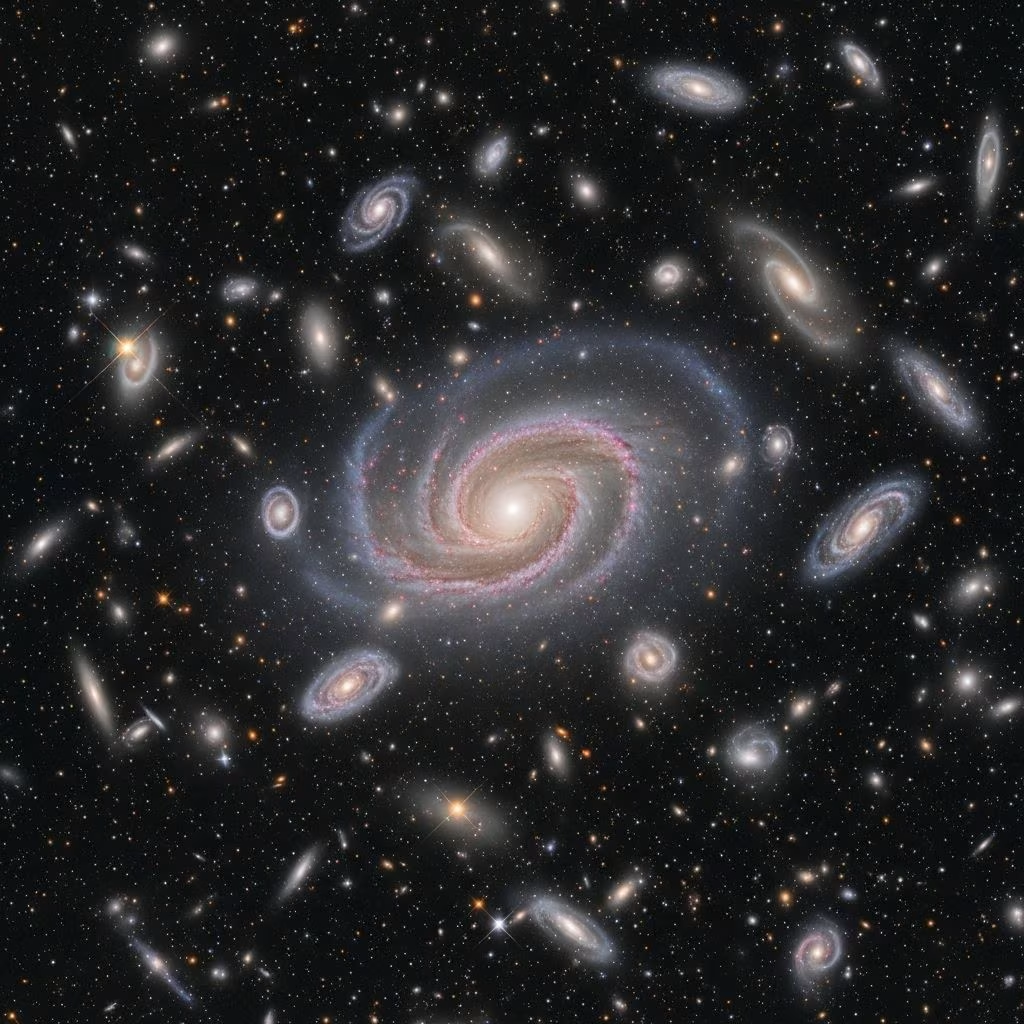
- Gradual clumping of matter to form galaxies and later, stars and planets.
The Big Bang is supported by robust observational evidence, most notably the cosmic microwave background radiation—a faint afterglow filling all space, detected by radio telescopes and satellites.
Evidence for the Big Bang: The Cosmic Microwave Background
In 1965, Arno Penzias and Robert Wilson discovered mysterious microwave radiation coming from all directions. This cosmic microwave background (CMB) is a faint signal from the universe’s infancy, now cooled to just 2.7 Kelvin above absolute zero.
- The CMB confirms that the early universe was indeed hot and dense, matching Big Bang predictions.
- Subtle temperature variations in the CMB reveal the seeds of cosmic structure, mapping initial density fluctuations that evolved into galaxies.
- Further measurements by COBE, WMAP, and Planck satellites have transformed cosmology into a precision science.
The Nature of Space and Time
Cosmology deals with the largest scales of existence: space, time, and the fabric connecting them. This investigation raises deep questions:
- Is the universe finite or infinite?
- What is the geometry and topology of space?
- How do gravity and energy shape the universe’s structure and evolution?
Einstein’s General Theory of Relativity describes gravity not as a force, but as the curvature of spacetime by matter and energy. The theory’s equations underpin all modern models of the universe’s dynamics.
Relativistic Cosmological Models
- Einstein’s Static Model: Attempted to picture an unchanging universe; proved unstable.
- de Sitter’s Model: Showed an empty, expanding universe was possible.
- Friedmann-Lemaître Models: Presented solutions that allowed for expansion—predicting later discoveries.
- Models differ on whether the universe is open, closed, or flat—depending on its total density and geometry.
Composition of the Universe: Ordinary and Mysterious Matter
The universe as we know it is remarkably diverse, but most of its mass-energy is invisible and poorly understood. Observations indicate the following proportions:
| Component | Approximate Percentage |
|---|---|
| Ordinary Matter (Atoms) | ~5% |
| Dark Matter | ~27% |
| Dark Energy | ~68% |
- Ordinary Matter: The familiar atoms making up stars, planets, and life.
- Dark Matter: An unknown form of matter, invisible but detected by its gravitational effects on galaxies and clusters.
- Dark Energy: A mysterious force driving the accelerated expansion of space.
Major Eras in Cosmic Evolution
- Primordial Nucleosynthesis: In the universe’s first minutes, light atomic nuclei (hydrogen, helium, lithium) formed from protons and neutrons.
- Recombination and CMB: About 380,000 years after the Big Bang, electrons combined with nuclei to create neutral atoms, unveiling the cosmic microwave background.
- Structure Formation: Over hundreds of millions of years, gravity pulled matter together, forming clouds, then galaxies, then stars and planets.
- Stellar and Galactic Evolution: Galaxies and stars continue to evolve, recycle matter, and shape cosmic history.
Unsolved Mysteries and Research Frontiers
- What is Dark Matter? All known matter (stars, gas, dust, planets) sums to a small fraction of the universe’s total mass. Dark matter is invisible to telescopes but needed to explain galactic motion and structure formation.
- What is Dark Energy? The universe’s expansion is accelerating, implying a repulsive force or energy inherent in space itself, unlike anything in standard physics.
- Inflation: A rapid, early expansion hypothesized to explain uniformity and structure in the cosmos. What caused it, and what physics prevailed in the first tiny fraction of a second?
- Fate of the Universe: Will the cosmos expand forever, slow down, or rip apart? The answer depends on the properties of dark energy and the universe’s total density.
Observational and Theoretical Tools
- Telescopes and Satellites: Space missions such as Hubble, Planck, and the James Webb Space Telescope peer billions of years back in time to capture early galaxies and cosmic phenomena.
- Particle Physics Experiments: Colliders and underground detectors search for dark matter, study neutrinos, and recreate conditions close to those of the Big Bang.
- Supercomputers: Simulate cosmic structure formation and test competing theoretical models against observational data.
Alternative Theories to the Big Bang
While the Big Bang framework fits most observations, alternative models have been proposed:
- Steady State Theory: Suggested the universe had no beginning or end, with continuous creation of new matter; abandoned after discovery of the CMB.
- Oscillating Universe: Universe cycles through endless expansions and contractions.
- Other speculative models include quantum universes and multiverse theories.
Cosmology and Philosophy
Cosmology isn’t just about numbers and observations—it touches on profound philosophical and even spiritual questions:
- Why does the universe exist at all?
- What is the ultimate nature of time and causality?
- Do the laws of physics hold everywhere and everywhen?
The borderlands between science and metaphysics remain active areas of inquiry.
Frequently Asked Questions (FAQs)
Q: How do we know the universe is expanding?
A: The redshift of light from galaxies indicates that they are moving away from us, and the more distant the galaxy, the greater this effect. This observation matches the predictions of an expanding universe.
Q: What is the Big Bang?
A: The Big Bang is the leading scientific theory for the origin of the universe. It describes an initial hot, dense state from which space and time expanded, forming matter and energy as we know them.
Q: What is dark matter?
A: Dark matter is a hypothetical form of matter that doesn’t emit, absorb, or reflect light. Its existence is inferred from its gravitational effects on galaxies and cosmic structure.
Q: What is dark energy?
A: Dark energy is a mysterious form of energy thought to drive the accelerating expansion of the universe. Its fundamental nature remains unknown.
Q: Are there alternative theories to the Big Bang?
A: Yes, alternatives like the steady state model and oscillating universe have been proposed, but most lack the observational support of the Big Bang model, particularly the evidence furnished by the cosmic microwave background and expanding space.
Q: Will the universe end?
A: The ultimate fate of the universe depends on the properties of dark energy and the total mass-energy content. Current evidence suggests the universe will keep expanding indefinitely, but new discoveries could alter our expectations.
Conclusion: Expanding Our View of the Cosmos
Modern cosmology has transformed our picture of reality, revealing a universe that is ancient, evolving, and often stranger than anything imagined in myth. By blending observation, theory, and philosophy, cosmology invites us to ponder both the origins and destiny of all existence.
References
- https://www.space.com/cosmology-crisis-age-of-the-universe
- https://www.space.com/universe-standard-model-hubble-constant-new-measurements.html
- https://www.spaceandmotion.com/cosmology-history-astronomy-universe-space.htm
- https://www.spacedaily.com/cosmology.html
- https://en.wikipedia.org/wiki/Cosmology
- https://cosmologyscience.com/cosblog/key-cosmology-papers-original-text-2/
- http://fermancebo.com/Current_state_Cosmology.html
- https://www.britannica.com/science/cosmology-astronomy
- https://science.nasa.gov/universe/overview/
- https://en.wikipedia.org/wiki/Outer_space
- https://www.tsijournals.com/articles/space-time-and-matter-in-cosmology-16274.html
- https://www.sciencedaily.com/news/space_time/
- https://www.energy.gov/science/doe-explainscosmology
- https://discoveringcosmos.com/cosmology-vs-astronomy-the-difference-defined/
- https://science.nasa.gov/exoplanets/what-is-the-universe/
- https://www.universetoday.com/articles/cosmology-101-the-beginning
- https://www.sciencedaily.com/news/space_time/cosmology/