


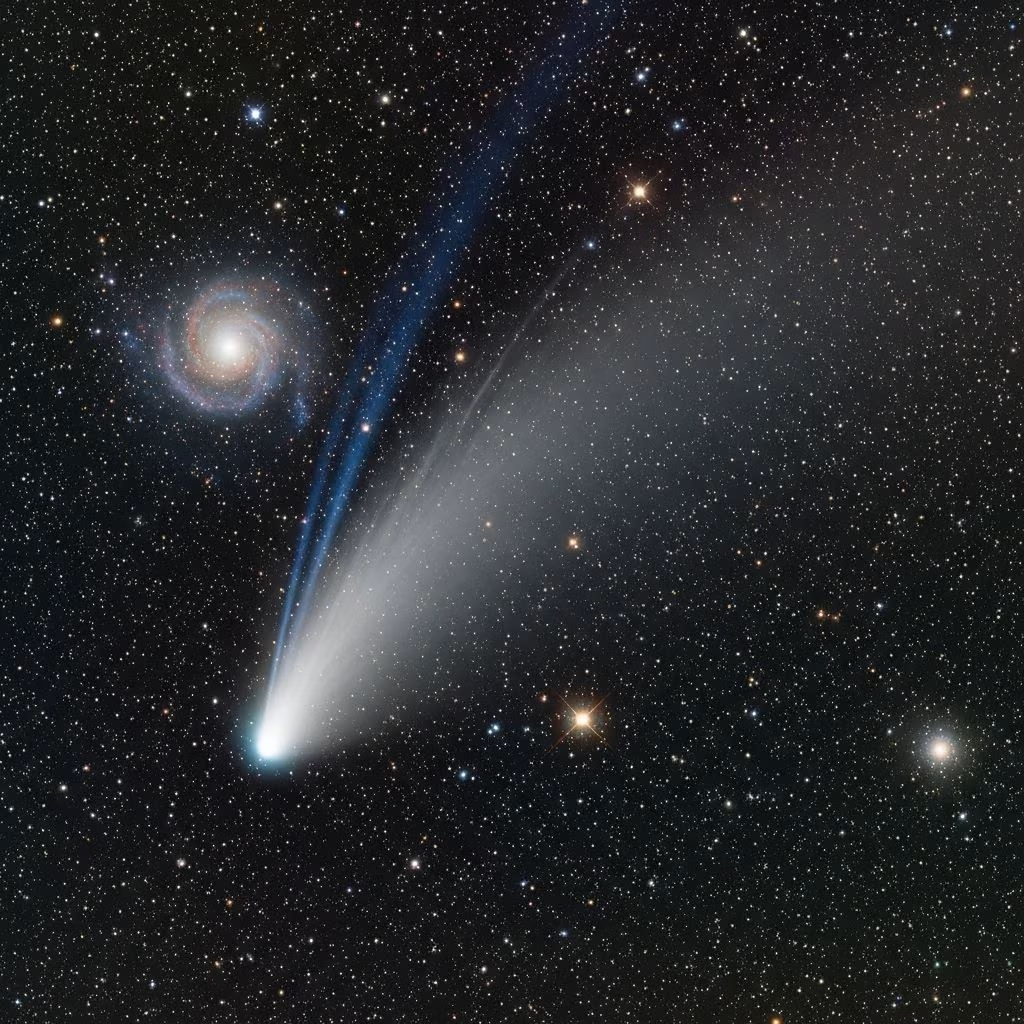
Halley’s Comet: An Enduring Icon in Astronomy
Halley’s Comet, also designated as 1P/Halley, has captivated skywatchers, scientists, and historians for centuries. Famous for being the first comet identified as a periodic visitor to Earth’s night sky, its appearance roughly every 76 years has linked generations in observation and awe. From ancient chronicles to modern space missions, Halley’s Comet’s legacy provides a remarkable window into the evolution of astronomical discovery, scientific theory, and human imagination.
About Halley’s Comet
Halley’s Comet is a short-period comet whose orbital period is approximately 76 years. It is the only known short-period comet regularly visible to the naked eye, making it uniquely memorable across generations.
- Designation: 1P/Halley
- Type: Short-period (periodic) comet
- First predicted return: 1758/1759
The comet’s nucleus is estimated to be about 15 km long, 8 km wide, and 8 km thick, with a surface composed of a mix of dust, ice, and volatile gases.[10]
Historical Appearances and Cultural Impact
Halley’s Comet’s brilliance has marked it as an object of legend, woven into chronicles and art for over 2,000 years. The earliest reliable observation dates back to 240 BCE in Chinese records; subsequent appearances are documented in Babylonian and European medieval sources.
- 240 BCE: First recorded appearance in Chinese chronicles
- 1066: Depicted in the Bayeux Tapestry, coinciding with the Battle of Hastings, and interpreted as an omen
- 1301: Believed to have inspired Giotto’s portrayal of the Star of Bethlehem
- 1910: Passed close to Earth, causing widespread excitement and scientific interest
- 1986: Observed by millions and studied up-close by spacecraft fleet
Throughout history, Halley’s Comet has been seen as both a harbinger of doom and a celestial marvel, referenced in literature, art, and folklore around the world.
The Scientific Discovery and Edmond Halley’s Legacy
Until the early eighteenth century, comets were believed to make only one pass through the Solar System, sometimes regarded as atmospheric phenomena. A revolution in scientific thinking was sparked by the theories of Isaac Newton and the work of Edmond Halley, who connected multiple historic comet sightings as being of the same recurring object.
- 1577: Tycho Brahe proved comets traveled beyond the Moon using parallax measurements
- 1687: Isaac Newton theorized cometary orbits in “Principia Mathematica”
- 1705: Edmond Halley utilized Newton’s physics and historical records to calculate the comet’s periodicity, correctly predicting its return in 1758
- 1759: Named Halley’s Comet posthumously in his honor
Halley’s insights established the foundation for modern cometary science and proved Newtonian physics could extend beyond planetary motion to smaller bodies in the Solar System.
Orbital Characteristics and Structure
As one of the brightest short-period comets, Halley’s orbit is well-studied and predictable. Its highly elliptical path carries it from the vicinity of the sun (perihelion, around 0.6 astronomical units) to the far reaches of the Solar System (aphelion, about 35 AU, past Neptune).
- Period: ~76 years
- Perihelion (closest to Sun): 0.6 AU
- Aphelion (farthest from Sun): 35 AU
- Orbital path: Retrograde, inclined about 18 degrees to the ecliptic
When close to the Sun, Halley’s Comet displays a spectacular tail as volatile compounds sublime from its nucleus, forming bright dust and gas tails visible from Earth.[10]
Comparative Table: Halley’s Comet vs Typical Comet
| Feature | Halley’s Comet | Typical Short-Period Comet |
|---|---|---|
| Orbital Period | ~76 years | Less than 200 years |
| Visibility to Naked Eye | Yes (regularly) | Rarely |
| Orbit | Retrograde; highly elliptical | Prograde or retrograde; varied eccentricity |
Spacecraft Encounters and Modern Science
Halley’s Comet’s last close approach in 1986 spurred an international fleet of spacecraft to study its nucleus, tail, and gas emissions. The unique, coordinated observations provided an unprecedented look at the structure and composition of a comet.
- European Space Agency’s Giotto: Provided the first close-up images of a comet nucleus
- Soviet Vega 1 and Vega 2: Dual mission from Venus flyby turned to Halley, launching probes into the comet’s coma
- Japan’s Suisei & Sakigake: Examined gas and plasma environment
- ISEE-3 (ICE): Investigated interactions with solar wind
- NASA’s Pioneer 7 & 12: Contributed long-distance and precursor data
Findings from these missions included the discovery of Halley’s dark, potato-shaped nucleus, jets of streaming gas and dust, and details of the comet’s chemical composition.
When Will Halley’s Comet Return?
Halley’s Comet last appeared in Earth’s skies in 1986. Its next predicted return is in 2061, offering a new generation a chance to watch its famous blaze across night skies.
- Last perihelion: 1986
- Next perihelion: Expected mid-2061
Advancements in technology and organized global observation may reveal even more about Halley’s evolving structure and behavior upon its next visit.
Frequently Asked Questions
Q: Why is Halley’s Comet so famous?
A: Halley’s Comet is the first comet recognized as periodic, reappearing in Earth’s skies every ~76 years, and has been linked to historic events and global folklore for over two millennia.
Q: Who discovered Halley’s Comet?
A: While observed since antiquity, Edmond Halley demonstrated its periodicity in 1705. He utilized Newton’s laws to calculate its future appearances, and the comet was later named in his honor.
Q: What causes a comet’s tail?
A: When a comet nears the Sun, heat causes its icy components to sublimate, releasing dust and gas that form a glowing coma and tail pointing away from the Sun due to solar wind.[10]
Q: How large is Halley’s Comet?
A: The nucleus is about 15 km long, 8 km wide, and 8 km thick, composed of volatile ices and dust.[10]
Q: Has Halley’s Comet affected history?
A: Yes. Its 1066 appearance was interpreted as an omen before the Battle of Hastings and depicted in the Bayeux Tapestry. It is commonly referenced in art, literature, and popular culture.
Q: What did spacecraft reveal about Halley’s Comet?
A: They revealed a dark, irregular nucleus with active jets and complex dust and plasma structures, transforming our understanding of comets.
Key Facts Snapshot
- First recorded: 240 BCE
- Named for: Edmond Halley
- Periodic orbit: ~76 years
- Next visible: 2061
- Significant spacecraft missions: Giotto, Vega 1 & 2, Suisei, Sakigake, ISEE-3 (ICE), Pioneer 7 & 12
The Lasting Legacy of Halley’s Comet
Every return of Halley’s Comet marks a shared global event, connecting generations in science and wonder. As astronomy has evolved, Halley’s Comet remains a powerful symbol of humanity’s quest for knowledge—from ancient skies to space-age exploration. Historians, scientists, and stargazers alike await its next appearance, promising new revelations and another chapter in its storied journey.
References
- https://science.nasa.gov/solar-system/comets/1p-halley/
- https://www.britannica.com/topic/Halleys-Comet
- https://en.wikipedia.org/wiki/Halley’s_Comet
- https://www.sciencemuseum.org.uk/objects-and-stories/halleys-comet-collisions-history
- https://www.nasa.gov/history/955-years-ago-halleys-comet-and-the-battle-of-hastings/
- https://byjus.com/physics/halleys-comet/
- https://phys.org/news/2015-06-halley-comet.html
- https://en.wikipedia.org/wiki/Halley’s_comet
- https://study.com/learn/lesson/halleys-comet-discovery-facts-orbit-return.html
- https://theplanets.org/halleys-comet-facts/
- https://www.sciencehistory.org/stories/magazine/the-comet-panic-of-1910-revisited/
- https://www.ebsco.com/research-starters/history/halleys-comet-makes-its-closest-recorded-passage-earth
- http://www.ianridpath.com/halley/halley6.html
- https://www.universalcompendium.com/tables/science/ast/hc.htm
- https://www.britannica.com/summary/Halleys-Comet
- https://softschools.com/facts/space/halleys_comet_facts/511/
- https://universemagazine.com/en/the-most-famous-in-history-where-halleys-comet-came-from-and-when-it-will-return/
- https://www.astronomytrek.com/10-interesting-facts-about-halleys-comet/


