Brilliant Fireball Turns Night to Day Over Japan
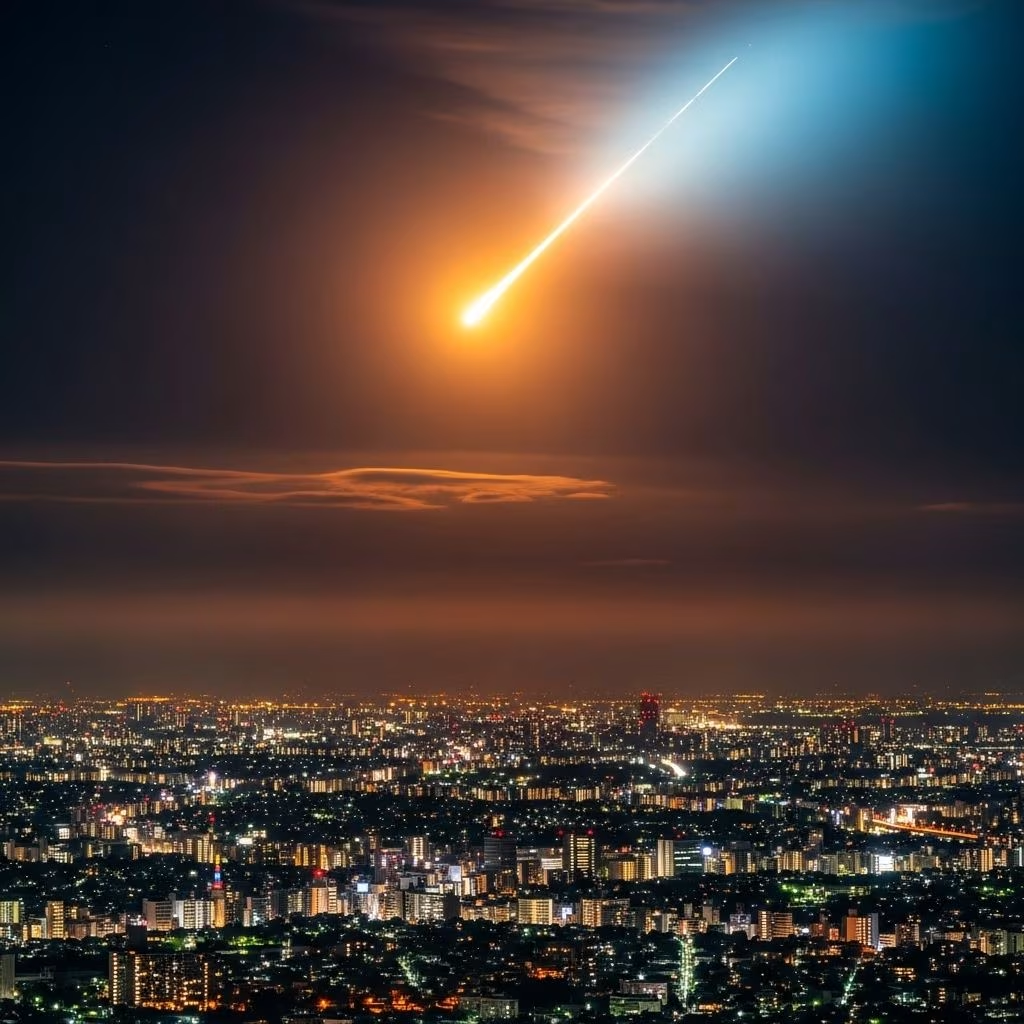
On the night of August 19, 2025, residents across southern Japan were treated to a cosmic spectacle as a brilliant fireball streaked through the night sky, turning darkness into daylight for a brief, awe-inspiring moment. The phenomenon began at 11:08 p.m. local time and was captured by numerous surveillance and dashcam systems throughout cities such as Kagoshima, Kumamoto, and even as far away as Osaka’s bustling Kansai Airport. This event quickly became a viral sensation, with videos and eyewitness accounts proliferating across social media and news outlets.
Event Overview: Night Sky Transformed
The fireball’s trajectory saw it shooting southwest above southern Japan, beginning its dazzling descent near the Sakurajima volcano and Kagoshima City. Observers described the moment as breathtaking, with many noting that the unfamiliar intensity of the light made it almost “as bright as the moon,” and temporarily obscured familiar landmarks. Surveillance cameras recorded the spectacle, making it possible for the event to be replayed and analyzed in detail by both scientists and the public.
Visual Impact and Witness Accounts
- The fireball emitted a series of green-blue flashes, some so bright they overwhelmed camera sensors, illuminating entire neighborhoods.
- It delivered a remarkable final burst of orange-red light before fragmenting over the Pacific Ocean, seen by observers hundreds of kilometers away.
- “A white light I had never seen before came down from above, and it became so bright that I could barely see the shapes of the houses around us,” reported local witness Yoshihiko Hamahata.
- Videos captured by residents and travelers rapidly accumulated thousands of views online, as the stunning visual feast captivated audiences far beyond Japan.
Scientific Explanation: What Are Fireballs?
Fireballs, in astronomical terms, are exceptionally bright meteors. They occur when a meteoroid—a fragment of space rock—enters Earth’s atmosphere at high speed, compressing and heating as it collides with air molecules. The friction causes these rocks to incandesce, often with vivid coloration resulting from the rock’s composition and atmospheric chemistry.
| Meteor Type | Typical Characteristics | Visibility |
|---|---|---|
| Shooting Star | Small, brief streaks of light | Momentary, visible to naked eye |
| Fireball | Extremely bright, often visible over large distances, lasting seconds | Can outshine planets and even the Moon, visible over hundreds of miles |
According to NASA, a fireball is defined as a meteor that exceeds a visual magnitude of -3 when seen at the observer’s zenith. Fireballs are often a result of larger objects (one meter or more in diameter) compared to the smaller particles that produce typical meteors.
Colorful Phenomena: Why Do Fireballs Glow?
This particular event in Japan was notable for the green-blue flashes it emitted, followed by a dramatic orange-red burst. The coloration can be attributed to:
- Different minerals in the meteoroid burning at high temperatures (e.g., magnesium for green, sodium for yellow, iron for orange).
- The presence of atmospheric oxygen and nitrogen, which can further tint the resulting flashes.
- Camera sensors amplifying specific wavelengths under intense brightness—often saturating colors as the light flares.
Skywatching Season: Meteor Showers of August
The event occurred during a highly active period for meteor watchers. The Perseid meteor shower, renowned for its frequent fireballs, was underway at the time, raising speculation about whether the Japanese fireball was related. The weaker Kappa Cygnids were also present. However, determining the origin of individual meteors is complex, and scientists could not definitively link the Aug. 19 fireball with any ongoing shower, suggesting it may have been a sporadic meteor—a random piece of space debris striking Earth’s atmosphere.
How Fireballs Differ From Other Meteors
- Duration: Fireballs last longer in the sky, with brighter and more dramatic flares than standard meteors.
- Brightness: They can be brighter than all planets and even rival the full moon’s luminosity.
- Frequency: Fireballs occur less frequently than regular meteors but are most common during major showers such as the Perseids.
Technology and Observation: How the Event Was Recorded
This Japanese fireball was a triumph of modern observational technology. Dashcams, surveillance cameras, and even airport live feeds created a rich portfolio of data, allowing scientists and the public to view the phenomenon from various angles. Social media played an indispensable role in spreading footage and information rapidly, attracting the attention of international news outlets, experts, and amateur astronomers alike.
Public and Expert Reactions
- Luke Daly, planetary geoscience professor, described the event as “a beautiful live show in the sky,” emphasizing that fireballs are a unique class of meteor that often draw widespread attention.
- News outlets from around the world commented on the “stunning blue fireball,” underscoring its visual brilliance and the excitement it provoked among witnesses.
- The event reignited public interest in meteor observation and planetary science.
Fireball Safety and Rarity
While fireballs themselves rarely pose a danger, the event’s vividness can incite concern. Most meteoroids burn up entirely before reaching the ground; any fragments that survive are called meteorites. Such large and bright events as this Japanese fireball are infrequent, making them scientifically valuable as well as visually arresting.
How To Capture and Share Fireball Events
The editors of Space.com invite skywatchers to become part of the global astronomical community by sharing images, videos, and personal accounts of fireballs. Submissions of photographs, comments, and viewing locations enrich the collective record and advance the study of meteor phenomena.
- Use reliable cameras or dashcams aimed at the sky during peak meteor shower periods.
- Note the exact time, location, and description of observed phenomena.
- Share content and observations with dedicated platforms and scientific communities.
Frequently Asked Questions (FAQs)
Q: What causes a fireball?
A: A fireball is caused when a relatively large meteoroid enters Earth’s atmosphere at high speed, compresses and heats up, producing exceptionally bright light as it burns up and occasionally fragments. The colors seen depend on both the object’s composition and atmospheric gases.
Q: Was the August 19, 2025 fireball over Japan related to a meteor shower?
A: The Perseids and Kappa Cygnids were both active; however, there was no definitive link established between the observed fireball and these showers. It may have been a sporadic meteor—a random piece of space debris.
Q: Are fireballs dangerous?
A: Fireballs are rarely dangerous because most space rocks burn up before reaching the ground. Only exceptionally large objects may pose any risk, and such events are extremely rare.
Q: Can fireballs be predicted?
A: While major meteor showers provide general guidance for potential sightings, individual fireballs cannot be predicted due to their random occurrence.
Q: How can I contribute my observation?
A: Space.com encourages submissions of fireball photos, videos, and observations. Send details including date, time, location, and any commentary to their specified address to help build the public record of such events.
Further Resources and Tips for Skywatchers
- Monitor meteor shower calendars for peak viewing times.
- Use wide-angle lenses for better sky coverage.
- Join online communities and forums dedicated to astronomy for real-time notifications and discussion.
- Respect regional weather conditions and find locations with minimal light pollution for best results.
Recap: Fireball’s Lasting Impact on Public Astronomy
The August 19, 2025 fireball over Japan will remain a memorable milestone in skywatching history. The vivid green-blue flashes, the fact that night was transformed briefly into day, and the collaborative spirit among the public all contributed to a remarkable event that brought planetary science closer to everyday people. The widespread sharing of footage and scientific analysis underscores the importance of observational technology and digital media in enhancing our understanding of cosmic phenomena.
References
- https://www.space.com/stargazing/meteor-showers/bright-fireball-japan-video-aug-19
- https://www.youtube.com/watch?v=olIawbmJNeQ
- https://www.youtube.com/watch?v=WbGYN4S8MNI
- https://www.hindustantimes.com/world-news/fireball-meteor-lights-japans-sky-up-in-blue-caught-on-camera-fukuoka-airport-watch-101755628334559.html
- https://petapixel.com/2025/08/20/watch-an-extremely-bright-fireball-light-up-the-night-sky-above-japan/
- https://thedailyguardian.com/world/japan/stunning-blue-fireball-meteor-illuminates-japans-sky-video-goes-viral-watch-645169/
- https://www.boston25news.com/news/trending/fireball-bright-moon-lights-up-sky-over-japan/OAW57ZYUENGGFEOKTCQMZLVFSQ/
- https://nasaspacenews.com/2025/08/when-night-turned-to-day-japan-fireball-2025-of-august-19-2025/
- https://www.moneycontrol.com/science/fireball-meteor-lights-up-japan-s-night-sky-in-brilliant-blue-watch-video-here-article-13470450.html
- https://www.nzherald.co.nz/world/spectacular-fireball-streaks-across-western-japan-lighting-up-night-sky/VZNNWPBKPZB7ZGTFARTIBXIQBE/
- https://timesofindia.indiatimes.com/etimes/trending/huge-and-bright-fireball-burns-over-japan-turns-the-night-sky-into-daylight-watch/articleshow/123428348.cms
- https://spaceweekly.com/?p=797852
- https://ground.news/article/we-felt-the-air-vibrating-as-bright-as-the-moon-the-fireball-in-the-japanese-sky-was-a-meteor
- https://www.channelnewsasia.com/east-asia/japan-fireball-meteor-shooting-star-lights-up-sky-kyushu-shikoku-5303901
- https://englishnewsinlevels.com/news/level-2/bright-fireball-lights-up-japans-sky
- https://englishnewsinlevels.com/news/level-3/bright-fireball-lights-up-japans-sky
- https://evrimagaci.org/gpt/fireball-meteor-lights-up-night-sky-over-japan-492311
- https://thepeninsulaqatar.com/article/20/08/2025/fireball-lights-up-japanese-skies