NASA Satellites Show Antarctica Gaining Ice—But What Does It Mean?
For decades, climate scientists have warned that rising global temperatures are melting the Antarctic ice sheet—a vast reservoir holding 90% of the world’s fresh water. However, recent findings from NASA satellites suggest that, despite global warming, Antarctica saw an increase in ice mass between 2021 and 2023. This surprising signal, while eye-catching, doesn’t tell the whole story about the continent’s response to climate change or its role in global sea level rise.
Understanding the Antarctic Ice Sheet
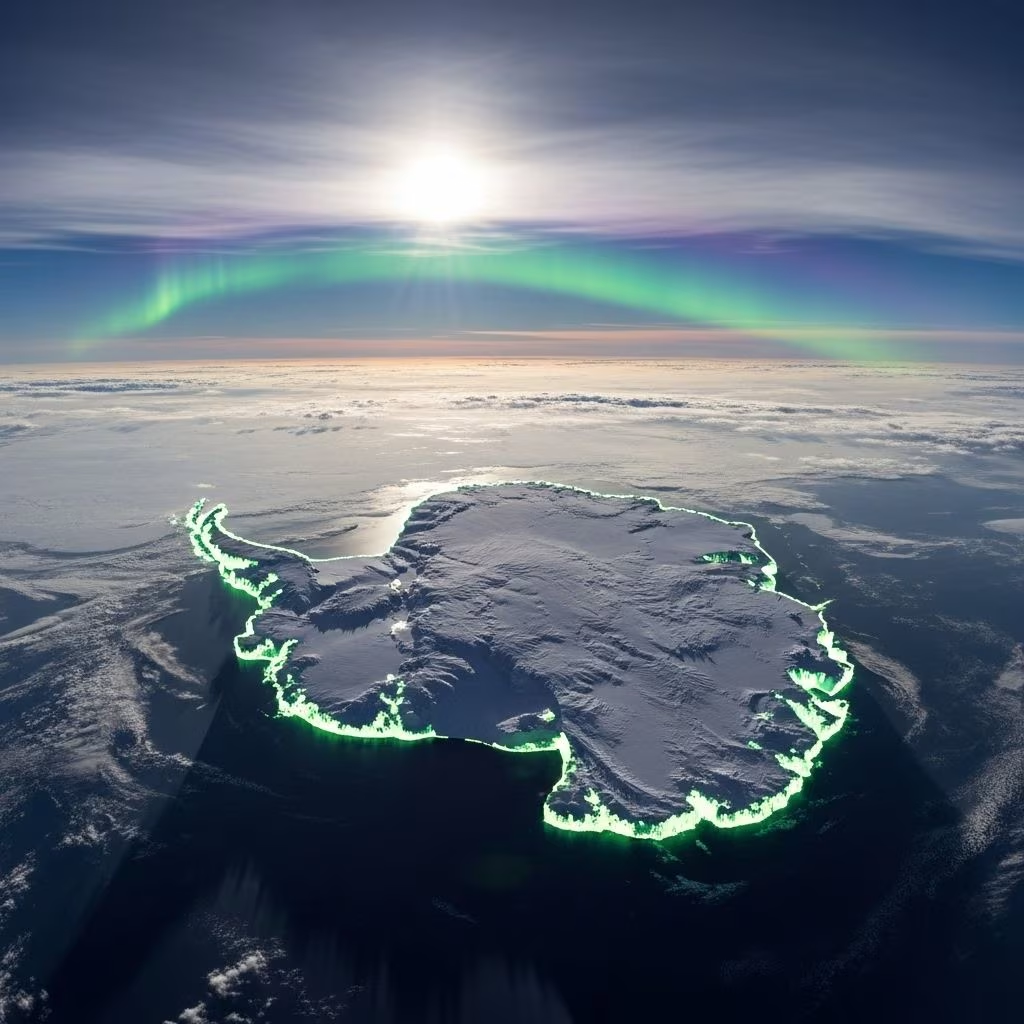
The Antarctic ice sheet is the single largest body of ice on Earth, covering an area larger than the entire United States. It contains approximately 90% of the world’s fresh water. This ice sheet is accompanied by sea ice formations, which grow and retreat with the seasons.
- Ice Sheet: Frozen land ice, mainly covering East and West Antarctica.
- Sea Ice: Frozen seawater that expands in winter and contracts during summer.
- The dynamics of these ice masses influence not only local ecosystems but also global sea levels and climate systems.
What Did NASA Satellites Observe?
A research team from Tongji University in Shanghai, using NASA’s Gravity Recovery And Climate Experiment (GRACE) and GRACE Follow-On satellites, tracked changes in the Antarctic ice sheet from 2002 forward. Their data, published in Science China Earth Sciences, showed two decades dominated by ice loss, punctuated by an abrupt period of ice gain from 2021 to 2023.
Key Satellite Findings
- 2002–2020: Steady, accelerating ice loss — average loss of 81 billion tons/year in the 2000s, ramping up to 157 billion tons/year by the 2010s.
- 2021–2023: Unexpected ice gains, temporarily reversing two decades of losses.
- 2024–2025: Ice levels appear to have returned to amounts observed around 2020, halting the gain trend.
These measurements are crucial because any change in the Antarctic ice sheet impacts global sea level rise, with direct consequences for coastal communities worldwide.
The Long-Term Trend: Loss Not Gain
While the recent upturn in Antarctic ice mass seems like good news, it’s best seen as a temporary bump rather than a sign of recovery. Scientists liken the pattern to “a long ski slope with a small jump at the end”—where years of losses far outweigh the brief gains.
- Net Ice Loss: Over the last two decades, Antarctica has lost far more ice than it has regained.
- Recent Gain: Does not offset the prior 20 years of melting; overall trend remains downward.
- Fluctuations: These are common as Antarctic climate varies year by year, driven by natural and human-influenced factors.
| Period | Average Annual Ice Change |
|---|---|
| 2002–2010 | -81 billion tons (loss) |
| 2011–2020 | -157 billion tons (loss) |
| 2021–2023 | Gain (exact total varies, but does not fully offset past losses) |
What Caused Antarctica’s Recent Ice Gain?
The brief reversal in the ice loss trend is mainly attributed to anomalously high precipitation—essentially more snowfall and even some rainfall falling across key regions of the continent.
- Increased precipitation leads to more snow accumulation, which eventually compresses into new ice mass.
- This weather anomaly was likely driven by shifts in atmospheric circulation patterns, possibly linked to natural variability or temporary climate phenomena like the Southern Annular Mode.
- No evidence suggests the underlying drivers of climate change have been reversed; the overall warming of the Antarctic system continues.
Antarctic Sea Ice: Separate from the Ice Sheet
When discussing Antarctica’s ice, it is important to distinguish between the continental ice sheet and sea ice that surrounds it.
- Sea Ice forms from frozen ocean water, expanding during the southern winter and retreating drastically with summer warmth.
- 2025 marked the second-lowest Antarctic sea ice extent on record (tied with 2022 and 2024), according to the National Snow and Ice Data Center.
- Sea ice extent is crucial for regulating ocean temperatures, ecosystems, and global climate feedback loops.
Impacts of Sea Ice Change
- Loss of sea ice disrupts polar ecosystems, affecting species dependent on stable ice cover.
- Alters heat exchange between ocean and atmosphere, with repercussions for global climate.
Scientific Importance of Antarctic Ice Monitoring
Antarctica’s massive ice sheet is a key regulator of global sea level. Every ton of ice that melts from the continent can raise sea levels and threaten coastal infrastructure and habitats.
- Between 2002 and 2020, accelerating Antarctic melt was a major driver of global sea level rise.
- Even with occasional short-term gains, rising temperatures are expected to push the ice sheet toward further losses in coming decades.
- Continuous satellite monitoring allows scientists to detect both long-term trends and brief anomalies, deepening our understanding of polar climate systems.
Antarctica’s Role in the Global Climate System
Antarctica is not only a cold, remote landscape but serves as a powerful climate stabilizer. The interactions between the ice sheet, sea ice, ocean currents, and atmospheric systems can:
- Modulate global weather through alteration of jet streams and oceanic circulation.
- Act as a buffer against warming by reflecting sunlight (high albedo).
- Store massive amounts of water, affecting the pace of sea level rise worldwide.
Addressing Common Questions and Misceptions
Does Recent Ice Gain Mean Climate Change Is Reversing?
No. The scientific consensus is that climate change is ongoing, and the brief Antarctic ice gain is an anomaly rather than a fundamental change in trend. Researchers compare the overall ice loss trend to a ski slope with a small upward bump—the underlying trajectory is downward.
How Reliable Are NASA’s Satellite Measurements?
NASA’s GRACE and GRACE-FO satellites use precise gravity measurements to calculate changes in the mass of the Antarctic ice sheet. These data are among the most accurate available for tracking ice loss (or gain) over broad regions, complementing other remote sensing and ground observation techniques.
Is Sea Ice the Same as Land Ice?
No. Sea ice forms from frozen seawater and is highly seasonal, while land ice makes up the permanent Antarctic ice sheet. Loss of land ice is much more damaging for sea level, whereas sea ice primarily affects local temperature regulation and ecosystems.
Will New Snowfall Continue to Grow Antarctic Ice?
It’s unlikely. Scientists expect snowfall to vary year by year, but steady warming driven by climate change increases the likelihood that melting will outweigh any new accumulation over the coming decades.
Visualizing Antarctic Ice Change
Animations from NASA show Antarctic sea ice fluctuating dramatically with the seasons. Still, the annual minimum—the lowest point reached by sea ice at the end of summer—continues to shrink, demonstrating a persistent downward trend despite short-term variability.
These visual tools help scientists—and the public—understand the patterns and implications of ice change in one of Earth’s most remote environments.
The Bottom Line: Antarctic Ice in a Warming World
- Recent ice gains in Antarctica do not mean climate change is reversing, nor do they compensate for decades of mass loss.
- The dominant trend remains long-term ice melt, with profound implications for global sea levels.
- Ongoing satellite monitoring is essential to track changes and improve climate predictions for Antarctica and beyond.
Frequently Asked Questions (FAQs)
Q: Why did Antarctica gain ice recently despite global warming?
A: Antarctica’s recent ice gain was primarily due to an increase in precipitation (mainly snowfall), which temporarily outweighed ice losses from melting. However, this is an anomaly and not evidence of a reversal in the long-term ice loss trend.
Q: Will the temporary ice gain affect global sea levels?
A: The recent increase helps delay sea level rise slightly, but does not offset the long-term melting trend, which continues to push global sea levels higher.
Q: What are the main causes of Antarctic ice loss?
A: Warming ocean waters erode ice shelves from below, while increasing air temperatures promote surface melt. Both processes are driven largely by climate change.
Q: How are Antarctic sea ice and land ice different?
A: Sea ice forms from frozen seawater and is highly seasonal, while land ice is the permanent ice sheet. Only loss of land ice adds water to the ocean, increasing sea level.
Q: What tools do scientists use to monitor Antarctic ice?
A: NASA deploys satellites—like GRACE and GRACE-FO—to measure changes in ice mass by tracking gravity field variations, providing accurate long-term data.
References
- https://www.space.com/astronomy/earth/nasa-satellites-show-antarctica-has-gained-ice-despite-rising-global-temperatures-how-is-that-possible
- https://www.ndtv.com/world-news/nasa-satellites-reveal-antarctica-gained-ice-despite-global-warming-here-039-s-why-8527727
- https://earthobservatory.nasa.gov/world-of-change/sea-ice-antarctic
- https://www.livescience.com/planet-earth/antarctica/nasa-satellites-show-antarctica-has-gained-ice-despite-rising-global-temperatures-how-is-that-possible
- https://svs.gsfc.nasa.gov/5517/
- https://nsidc.org/sea-ice-today
- https://scitechdaily.com/antarctica-on-thin-ice-satellite-data-reveals-2025s-stunning-sea-ice-collapse/
- https://en.as.com/latest_news/nasa-satellites-reveal-more-ice-in-antarctica-whats-behind-this-phenomenon-that-seems-to-defy-climate-change-n/
- https://www.space.com/astronomy/earth/nasa-satellites-show-antarctica-has-gained-ice-despite-rising-global-temperatures-how-is-that-possible&rut=b4b7fbaab03f46bbf8e70de7917f1b78d4c5ffeac90fb8acbcac2b8448255dcc
- https://nsidc.org/ice-sheets-today/analyses/antarctic-ice-sheet-2024-2025-melt-season-fast-start-early-end
- https://www.youtube.com/watch?v=ghkXguNIzx8
- https://www.youtube.com/watch?v=IGAlJjCOcyc
- https://www.livenowfox.com/news/antarctica-ice-sheet-growth
- https://www.climate.gov/news-features/event-tracker/2025-summer-minimum-sea-ice-extent-antarctic-tied-second-lowest-record
- https://opentools.ai/news/nasa-satellites-reveal-antarctic-ice-gain-amid-rising-global-temperatures
- https://www.asoc.org/ice-archive/ice-gain-in-antarctica-cool-story-still-a-hot-planet/
- https://theoptimistmagazine.co.uk/2025/05/27/antarctica-ice-sheet-grows-for-the-first-time-in-decades/
- https://www.climate.gov/news-features/event-tracker/2024-antarctic-sea-ice-winter-maximum-second-lowest-record