


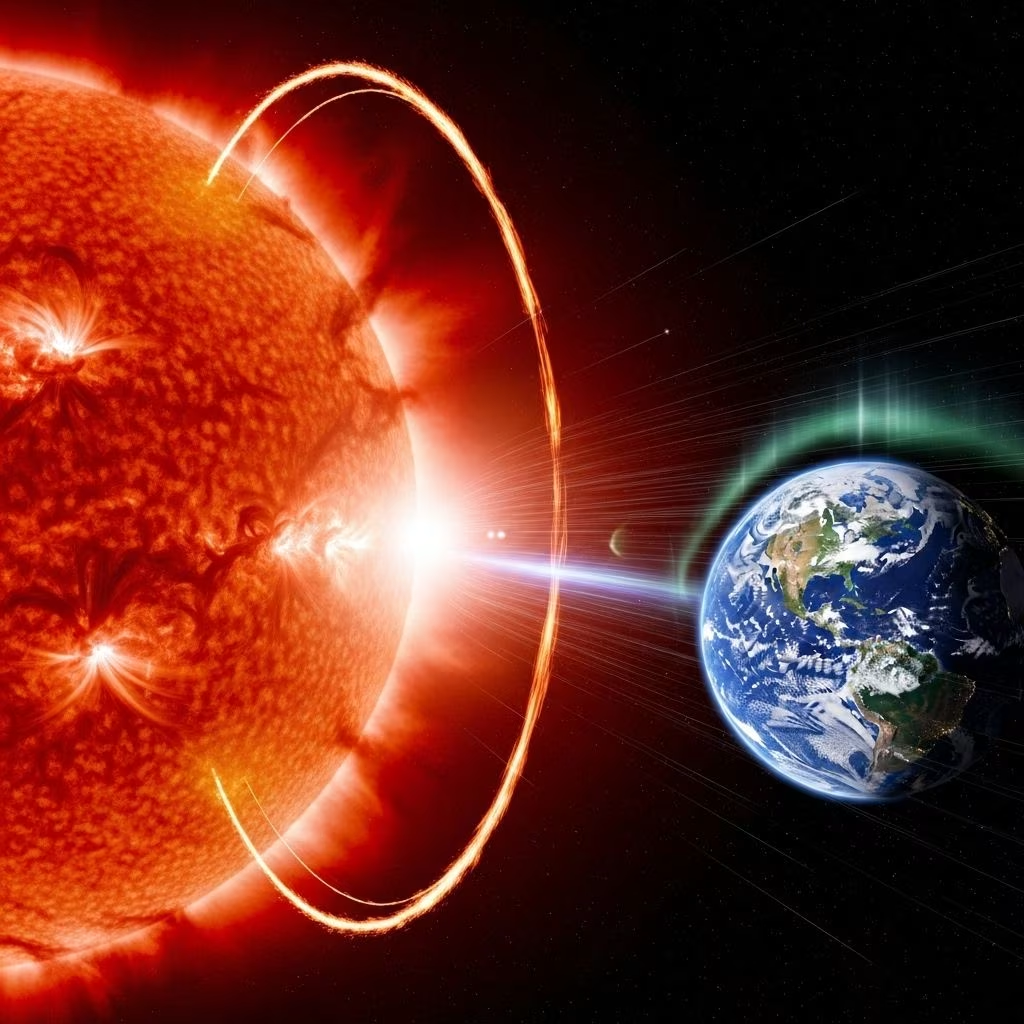
Solar Flares: Origins, Classifications, and Impacts on Earth
Solar flares are some of the most spectacular and powerful phenomena originating from the Sun, releasing immense bursts of energy and radiation into space. These events play a pivotal role in the dynamics of our solar system and can have deep-reaching effects on Earth’s environment and technological infrastructure.
What Are Solar Flares?
Solar flares are sudden, intense eruptive events on the Sun, resulting in the explosive release of electromagnetic energy — spanning wavelengths from X-rays to radio waves. Typically originating near sunspots or active regions, they are considered to be among the most energetic events in our solar system and are closely tied to the Sun’s magnetic activity[10].
- Magnitude: Solar flares can release energy equivalent to billions of hydrogen bombs within minutes.
- Nature of Emission: Their emissions include intense X-ray and ultraviolet radiation, streams of energetic particles, and blasts of magnetic energy.
- Frequency: The Sun regularly emits small flares, with the most powerful ones occurring less frequently, often during periods of high solar activity (the solar maximum)[10].
How Are Solar Flares Formed?
The formation of solar flares is deeply intertwined with the Sun’s complex magnetic field dynamics. They most commonly arise in regions where magnetic fields are strongest and most tangled, often above sunspots and active solar regions[10].
Process of Formation
- Magnetic Field Buildup: The Sun’s surface is threaded with magnetic field lines produced by the motion of electrically charged plasma. These lines can become twisted and sheared by differential rotation and convective movements.
- Magnetic Reconnection: When magnetic field lines of opposite direction come into close contact, they can reconfigure suddenly through a process known as magnetic reconnection. This abrupt realignment releases massive amounts of stored magnetic energy.
- Release of Energy: The released energy rapidly accelerates solar plasma and charged particles, heating local regions to tens of millions of degrees Celsius and generating a pulse of electromagnetic radiation across the spectrum[10].
Solar flares are often associated with coronal mass ejections (CMEs), which are giant eruptions that hurl huge amounts of solar plasma and magnetic fields into space. While CMEs and flares often occur together, they are distinct phenomena.
Classification of Solar Flares
The classification of solar flares is crucial for understanding their intensity and for forecasting space weather and its impacts on Earth. Solar flares are categorized based on the peak X-ray flux measured in the 1 to 8 angstrom band by satellites such as the Geostationary Operational Environmental Satellites (GOES)[10].
Solar Flare Classification Table
| Class | X-ray Peak Flux (W/m2) | Description | Impact on Earth |
|---|---|---|---|
| A | < 10-7 | Weakest flares, most common | Negligible |
| B | 10-7 – 10-6 | Very small flares | Negligible |
| C | 10-6 – 10-5 | Moderate flares | Minor impact — possible small radio blackouts at polar regions |
| M | 10-5 – 10-4 | Medium/Large flares | Short-term radio blackouts, minor radiation storms (polar) |
| X | > 10-4 | Major, most powerful flares | Planet-wide radio blackouts, long-lasting radiation storms, technological disruptions |
Naming Conventions
Each class is further subdivided using a linear scale from 1 to 9 (e.g., C1 to C9, M1 to M9). For X-class flares, there is no upper bound; e.g., X28 is exceptionally massive. Each increment within a class represents a linear increase, but each class itself represents a tenfold increase in energy output from the one below it[10].
Summary of Classification
- A and B-class: Weakest, frequent, negligible impact.
- C-class: Moderate strength, minimal terrestrial effects, occasionally minor radio interference.
- M-class: Medium/large, capable of causing short radio blackouts, minor radiation storms in polar regions.
- X-class: Largest, rarest, can trigger global blackouts, strong geomagnetic storms, and significant satellite/radio disruptions.
Effects of Solar Flares on Earth
Solar flares can have pronounced effects on Earth’s environment, atmosphere, and technological systems. The severity of the impact is directly related to the classification and intensity of the flare.
Key Effects
- Radio Blackouts: The influx of X-ray and ultraviolet radiation rapidly ionizes the upper layers of Earth’s atmosphere (the ionosphere), causing sudden disruptions and blackouts in high-frequency (HF) radio communication—especially over the sunlit side of the planet[10].
- GPS and Navigation System Errors: Changes in the ionosphere caused by solar flare energy can lead to brief but significant errors in GPS and other satellite navigation signals.
- Geomagnetic Storms: Powerful solar flares, often in combination with coronal mass ejections, disturb Earth’s magnetic field, producing geomagnetic storms. These can induce electrical currents in power lines, pipelines, and long cable networks, potentially damaging infrastructure and leading to power outages[10][13].
- Radiation Hazards: Astronauts aboard the International Space Station and satellites are at risk from intensified solar particle radiation, particularly from X-class flares. High-altitude flights in polar regions may also be exposed to increased radiation levels[10].
- Aurora Enhancement: Increased solar activity enhances the auroras (Northern and Southern Lights), sometimes making them visible at lower latitudes than usual.
- Satellite Performance Issues: Solar flare radiation can disrupt or even damage sensitive satellite electronics and solar panels, shortening their operational lifespans[10][13].
Historical Examples
- 2003 ‘Halloween Storms’: Multiple X-class flares, including the record X28 event, led to radio blackouts, GPS disruptions, and power grid stress in parts of Europe and North America.
- January 2005: A major flare caused one of the strongest radiation storms of the solar cycle, impacting spacecraft operations and high-frequency communication.
- March 1989: An intense geomagnetic storm, largely driven by solar flare activity, caused a nine-hour blackout in Quebec, Canada.
Solar Flare Hazards and Preparedness
Given the significant potential for major solar flares to disrupt modern technology and pose risks to crewed space missions, international agencies continually monitor solar activity for early signs of dangerous events. The National Oceanic and Atmospheric Administration (NOAA) and space agencies such as NASA play central roles in this monitoring and early warning effort[13].
Monitoring and Forecasting
- Spacecraft & Sensors: Satellites equipped with X-ray and ultraviolet sensors (e.g., GOES, Solar Dynamics Observatory) provide real-time monitoring of solar activity 24/7.
- Sudden Ionospheric Disturbance (SID) Alerts: Networks of ground-based sensors detect changes in Earth’s ionosphere due to strong X-ray emissions, helping provide quick alerts for communication operators.
- Space Weather Forecasts: NOAA and other agencies issue forecasts and warnings to aviation, power grid operators, and satellite industries to prepare for or mitigate potential disruptions.
Technological Countermeasures
- Power Grid Protection: Systems are being designed to shed load or temporarily disconnect vulnerable infrastructure in the event of strong geomagnetic storms.
- Satellite Safeguards: Operators can place satellites into safe mode, delay sensitive operations, or re-orient spacecraft to minimize exposure during extreme solar events.
- Flight Path Adjustments: High-altitude polar route flights may be rerouted to avoid excessive radiation exposure to crew and passengers during major solar storms.
Frequently Asked Questions (FAQs)
Q: What causes solar flares?
A: Solar flares are primarily caused by the sudden release of magnetic energy in the Sun’s atmosphere, most often during magnetic reconnection events in active regions near sunspots.
Q: What is the difference between a solar flare and a coronal mass ejection (CME)?
A: A solar flare is a burst of electromagnetic radiation, while a CME is a massive ejection of solar plasma and magnetic field into space. They often occur together but are distinct phenomena.
Q: Can solar flares harm humans on Earth?
A: Earth’s atmosphere blocks most harmful solar radiation from reaching the surface, but intense flares can disrupt technology and pose a risk to astronauts and high-altitude flights, particularly over polar regions.
Q: Which class of solar flares is the strongest?
A: X-class solar flares are the strongest, capable of causing global radio blackouts and severe radiation storms that can damage satellites and power grids.
Q: How often do X-class solar flares occur?
A: X-class events are rare and tend to occur more during the active phase of the solar cycle, approximately every 11 years, but even at solar maximum, they remain infrequent compared to smaller flares.
Conclusion
Solar flares are awe-inspiring reminders of our Sun’s dynamic and sometimes volatile nature. By classifying these eruptions and monitoring their effects, scientists can better understand the impacts of space weather on our technological society and devise strategies to mitigate those risks for humanity’s ongoing presence both on—and above—Earth.
References
- https://svs.gsfc.nasa.gov/10109
- https://svs.gsfc.nasa.gov/10109/
- https://en.wikipedia.org/wiki/Solar_flare
- https://www.swpc.noaa.gov/phenomena/solar-flares-radio-blackouts
- https://www.space.com/14343-astronomers-classify-solar-flares.html
- https://www.youtube.com/watch?v=56w_moy6klE
- https://newspaceeconomy.ca/2023/03/28/space-weather-how-are-solar-flares-classified/
- https://solar-center.stanford.edu/sid/activities/flare.html
- https://www.vedantu.com/geography/solar-flare
- https://newspaceeconomy.ca/2024/05/11/the-explosive-power-of-solar-flares-a-guide-to-their-classes-and-impacts/
- https://www.youtube.com/watch?v=oOXVZo7KikE
- https://arxiv.org/html/2505.03385v1
- https://www.skyatnightmagazine.com/space-science/solar-flares
- https://apps.dtic.mil/sti/tr/pdf/ADA203138.pdf
- https://apps.dtic.mil/sti/trecms/pdf/AD1145701.pdf
- https://www.spaceweather.com/glossary/flareclasses.html
- https://www.britannica.com/science/solar-flare
- https://study.com/learn/lesson/what-is-a-solar-flare.html


