Taurus Constellation: The Ancient Bull in the Night Sky
The Taurus constellation is among the brightest and most easily recognized patterns in the night sky. With its distinctive V-shaped cluster of stars symbolizing the head and horns of a bull, Taurus has captivated observers for thousands of years. This ancient zodiac sign bridges the worlds of mythology, astronomy, and even modern science, making it a window to our cosmic past and present.
Overview and Key Facts
- Latin Name: Taurus (“the Bull”)
- Zodiac: Yes – one of the 12 traditional zodiac constellations
- Symbol: ♉ (bull’s head and horns)
- Area: 797 square degrees (17th largest constellation)
- Main Stars: 19, with additional notable stars
- Brightest Star: Aldebaran (Alpha Tauri)
- Messier Objects: 2 (Crab Nebula (M1) and Pleiades (M45))
- Prominent Star Clusters: Pleiades and Hyades
- Meteor Showers: Taurids (Nov), Beta Taurids (June-July)
- Neighboring Constellations: Orion, Gemini, Aries, Perseus, Auriga, Cetus, Eridanus
- Visibility: Best seen in the northern hemisphere from November to March
History and Cultural Significance
Taurus is widely considered one of the oldest constellations recognized by human civilization. Its first recordings date back to at least the Early Bronze Age, where it functioned as a celestial marker for the spring equinox – a crucial turning point in prehistoric agrarian calendars. Ancient Sumer, Babylon, Egypt, Greece, Rome, and other cultures all associated the bull with leadership, fertility, and celestial power.
The constellation’s prominence in the night sky and recurring place in the agricultural year cemented its importance. Its inclusion as a zodiac sign (traced by the Sun’s apparent path – the ecliptic) has ensured that Taurus remains a familiar symbol in astrology and art to this day.
Taurus in Mythology
Across multiple cultures, the Bull represents strength, virility, and cosmic significance. Some of the major mythological associations include:
- Greek Mythology: Taurus is often identified with the bull-form of Zeus. According to myth, Zeus transformed himself into a magnificent white bull to abduct the beautiful princess Europa, carrying her across the sea.
- Ancient Egypt: The Bull was sacred to the god Osiris and symbolized the rising fertility of the Nile.
- Babylonian Astronomers: The constellation marked the vernal equinox, defining the start of the agricultural year.
- Other Cultures: Taurus or similar bull constellations appear in the mythologies of Akkad, Assyria, Persia, and even farther east, all highlighting the bull’s significance as a bringer of prosperity and power.
How to Find Taurus in the Sky
Taurus is a prominent winter constellation in the northern hemisphere. It is located between Aries (to the west) and Gemini (to the east), with Perseus and Auriga to the north, Orion rising dramatically to the southeast, Eridanus to the south, and Cetus to the southwest.
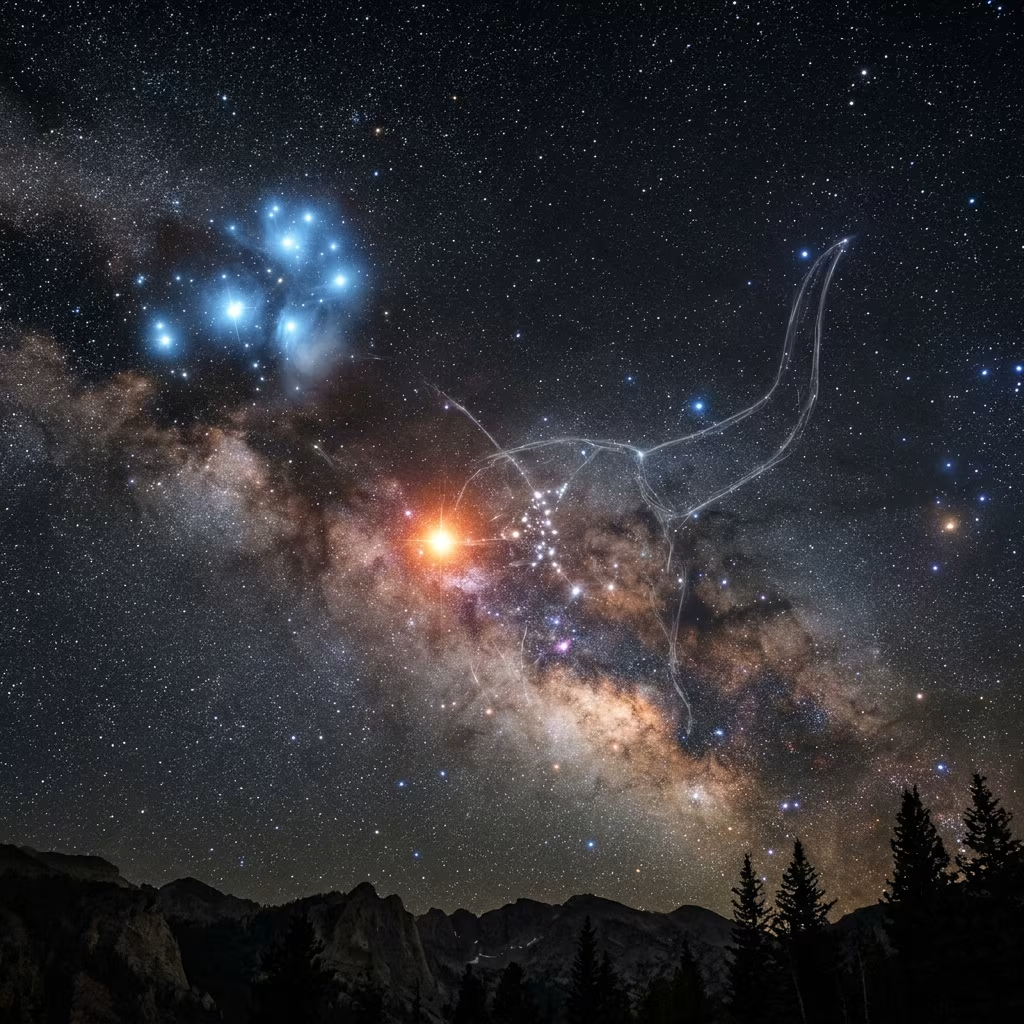
Look for Taurus in the evening sky from late autumn through early spring — it reaches its highest point in the sky around midnight in December and January. The easiest way to spot it is to look for the bright V-shape made by the Hyades cluster, with the fiery orange star Aldebaran marking the Bull’s “eye”.
The famous Pleiades star cluster (the “Seven Sisters”) lies in Taurus’s shoulder.
| Feature | Coordinates | Detail |
|---|---|---|
| Right Ascension | 04h 00m | Central position in the constellation |
| Declination | +15° 00′ | Celestial latitude |
| Visible | +90° to -65° latitudes | All inhabited regions north of the far-southern hemisphere |
Bordering Constellations
- Aries
- Auriga
- Cetus
- Eridanus
- Gemini
- Orion
- Perseus
Main Stars and Deep Sky Objects in Taurus
Taurus boasts a number of remarkable astronomical features visible even to the naked eye:
Aldebaran: The Fiery Eye of the Bull
Aldebaran (Alpha Tauri) is the brightest star in Taurus, shining with an orange-red hue. It represents the “eye” of the bull and is one of the brightest stars in the entire night sky (13th overall). It is a giant star, located about 65 light-years from Earth, with a magnitude of about 0.85.
The Hyades: The V-Shape Head
The Hyades is the closest open star cluster to Earth and forms the Bull’s characteristic “V”-shaped face. Aldebaran itself is not a member of this cluster but lies in the same line of sight. The Hyades are approximately 153 light-years away and contain several moderately bright stars, making them easy to spot with the naked eye.
The Pleiades: The Seven Sisters
The Pleiades (Messier 45) sits on the shoulder of Taurus and is perhaps the most famous open star cluster in the sky. With sharp eyes, viewers can spot six or seven blue-white stars, but binoculars or small telescopes reveal dozens more. From antiquity, the Pleiades have been a focal point of mythology, navigation, and artistic inspiration.
- Distance from Earth: Approximately 440 light-years
- Main stars: Alcyone, Maia, Electra, Merope, Taygeta, Celaeno, Sterope (Asterope)
Elnath: The Bull’s Horn
Elnath (Beta Tauri) marks the tip of one horn and is the second-brightest star in Taurus. It serves as a guidepost between Taurus and the neighboring constellation Auriga.
T Tauri: A Star in Formation
T Tauri is a variable, young star and the prototype of T Tauri-type stars. These are pre-main-sequence stars that offer astronomers valuable data on stellar formation and evolution.
Deep Sky Objects
- Messier 1 (Crab Nebula): A famous supernova remnant and pulsar located in northeastern Taurus. The explosion was observed on Earth in 1054 CE and is now one of the most studied objects in the sky.
- Simeis 147 (Spaghetti Nebula): A faint supernova remnant stretching across both Taurus and Auriga.
- NGC 1514 (Crystal Ball Nebula): A planetary nebula notable for its ghostly blue-green glow.
- Hind’s Variable Nebula (NGC 1555): Reflects variable starlight from T Tauri and fluctuates over time.
- NGC 1410 and NGC 1409: Two interacting galaxies visible with large amateur telescopes.
- Merope Nebula (NGC 1435): A faint nebulosity in the Pleiades, easily visible by astrophotographers.
Other Notable Named Stars
- Ain
- Alcyone
- Asterope
- Atlas
- Electra
- Hoggar
- Maia
- Merope
- Pleione
- Prima Hyadum
- Secunda Hyadum
- Taygeta
- Tianguan
Astronomical Significance and Science
Taurus is a key region for modern astronomers for several reasons:
- It hosts two of the closest and most studied open clusters, offering insights into stellar evolution and the motion of stars within the Milky Way.
- The Taurus-Auriga complex is a stellar nursery packed with dark molecular clouds, new stars in formation, and protostellar objects.
- Messier 1 (the Crab Nebula) is a laboratory for the study of neutron stars and supernova remnant expansion.
- The constellation is crossed by the ecliptic, the celestial equator, and the galactic equator, making it astronomically unique.
Taurus is also one of the few constellations intersected by all three critical cosmic reference surfaces: the ecliptic (Sun’s path), celestial equator (Earth’s equator in the sky), and the plane of the Milky Way galaxy.
Taurus in Astrology
In astrology, Taurus is the second sign of the zodiac, spanning April 20 to May 20. It is traditionally ruled by the planet Venus and represents qualities of steadiness, practicality, and sensual appreciation. The bull’s symbolism of power and endurance is reflected in the attributes often ascribed to people born under this sign.
Viewing Tips and Meteor Showers
Meteor Showers
- Taurids: Occur every November, producing slow yet striking fireballs.
- Beta Taurids: Peak in late June and early July, though largely best for observers in the southern hemisphere.
For best viewing of the constellation, find a dark location away from bright city lights between November and March and look up after sunset. Binoculars reveal the full splendor of the Hyades and Pleiades, while a modest telescope will reveal the Crab Nebula’s wisps and other faint nebulae.
Names, Pronunciations, and Designations
- Genitive form: Tauri (used for naming stars, e.g., Alpha Tauri)
- Pronunciation: ‘TAWR-us’
- IAU Abbreviation: Tau
- Constellation Family: Zodiac
- Official Boundaries: Defined in 1930 by astronomer Eugène Delporte
Fascinating Facts About Taurus
- Taurus’s V-shaped Hyades cluster marks the face of the bull, making it one of the easiest shapes to spot in the sky.
- The Crab Nebula is the visible remnant of a supernova explosion recorded by Chinese and Arab astronomers in 1054 CE.
- Aldebaran is visually aligned with, but not physically part of, the Hyades star cluster.
- The Pleiades star cluster has been known since prehistoric times, referenced in many ancient texts and mythologies worldwide.
- Taurus is crossed by the ecliptic, galactic plane, and celestial equator—a rare distinction among constellations.
Frequently Asked Questions (FAQs)
Q: When is the best time of year to see Taurus?
A: Taurus is best observed during the late fall and winter months in the Northern Hemisphere, especially from November through March, with peak visibility in December and January.
Q: What are the brightest stars in Taurus?
A: The brightest star in Taurus is Aldebaran, while Elnath and members of the Hyades and Pleiades clusters are also prominent features of the constellation.
Q: Can you see Taurus from the Southern Hemisphere?
A: Taurus is visible from most of the Southern Hemisphere, though it appears lower in the northern sky compared to its position in the north.
Q: Why is Taurus important in mythology?
A: Taurus’s association with the bull links it to themes of power, abundance, and leadership in multiple ancient cultures. In Greek myth, Zeus assumed the shape of a bull to abduct Europa – a legend that inspired many works of art and literature.
Q: What deep sky objects should I look for in Taurus?
A: Notable deep sky targets include the Pleiades cluster (M45), the Hyades, and the Crab Nebula (M1).
References & Further Exploration
- Explore star atlases or online sky maps to locate Taurus on various nights throughout the year.
- Visit planetariums or astronomy clubs, which often host winter night sky viewing sessions focusing on Taurus and its bright features.
- Astro-imaging enthusiasts can try to photograph the Hyades, Pleiades, or the faint wisps of the Crab Nebula using long-exposure techniques.
References
- https://en.wikipedia.org/wiki/Taurus_(constellation)
- https://www.constellation-guide.com/constellation-list/taurus-constellation/
- https://starregister.org/taurus.php
- https://astrobackyard.com/constellation-taurus/
- https://theskylive.com/sky/constellations/taurus-constellation
- https://www.britannica.com/place/Taurus
- https://www.go-astronomy.com/constellations.php?Name=Taurus
- https://theplanets.org/constellations/taurus-constellation/
- https://www.astronomytrek.com/constellations/taurus/
- https://nineplanets.org/kids/taurus-constellation/
- https://www.scifacts.net/space/constellations-taurus/
- https://starwalk.space/en/news/taurus-constellation-guide
- https://www.ebsco.com/research-starters/astronomy-and-astrophysics/taurus-space-science
- https://www.solarsystemquick.com/universe/taurus-constellation
- https://skyandtelescope.org/observing/celestial-objects-to-watch/meet-constellations/meet-the-taurus-constellation-the-ancient-bull/
- https://www.space.com/39378-taurus-constellation-skywatching-guide.html
- http://www.astronomical.org/constellations/tau.html
- https://www.centreofexcellence.com/taurus-constellation/