


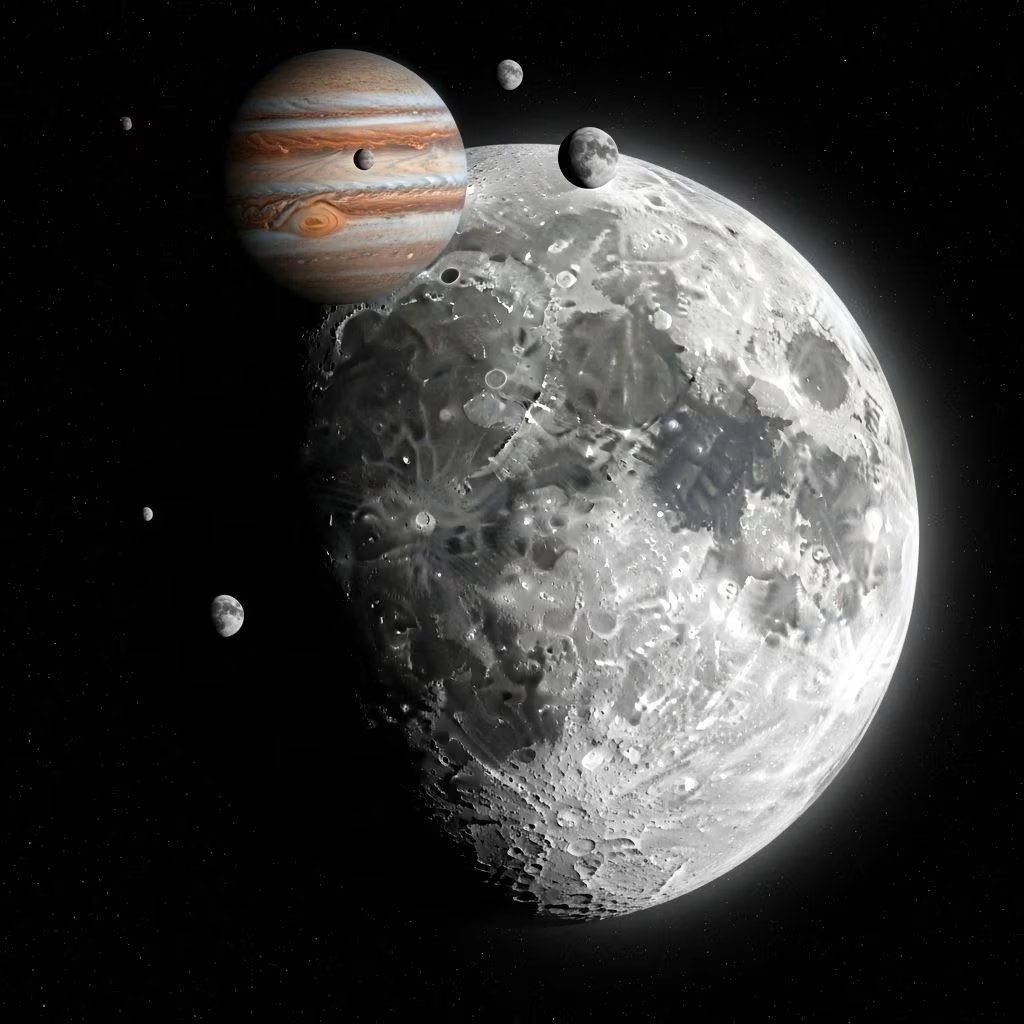
Fascinating Facts About Ganymede: Jupiter’s Largest Moon
Ganymede, the largest satellite of Jupiter and the largest moon in the entire solar system, is a world of astonishing characteristics. Bigger than the planet Mercury and featuring a unique set of properties—including its own magnetic field and possibly a hidden ocean—Ganymede offers researchers invaluable clues to the formation and evolution of not just Jupiter’s system, but the entire solar system. This article explores Ganymede’s physical characteristics, discovery, structure, magnetic field, surface features, and the story of its exploration.
Ganymede at a Glance: Quick Facts and Dimensions
- Size: Ganymede measures about 5,262 kilometers (3,273 miles) in diameter, making it the largest moon in the solar system—even surpassing Mercury in size, though it is less massive due to its lower density.
- Mass: Approximately 1.48 × 10²³ kilograms; its mass is about 2.02 times Earth’s moon.
- Distance from Jupiter: Orbits at around 1,070,400 kilometers (665,000 miles) from Jupiter’s center.
- Orbital Period: Completes one orbit of Jupiter every 7.15 Earth days, locked in synchronous rotation—meaning the same side always faces Jupiter.
- Comparison: Ganymede is not only bigger than Mercury, but if it orbited the sun directly, it would be considered a planet in its own right.
The Discovery of Ganymede
Ganymede was discovered by Italian astronomer Galileo Galilei on January 7, 1610. This momentous observation marked the first time a moon was discovered orbiting a planet other than Earth. Galileo’s discovery of Ganymede and the three other large Jovian moons, now called the Galilean satellites (Io, Europa, Ganymede, and Callisto), played a pivotal role in challenging the geocentric model of the universe by demonstrating that not everything orbits Earth.
The name Ganymede comes from Greek mythology, referencing a young man of great beauty who was carried to Olympus by Zeus to serve as cupbearer to the gods—a fitting tribute, since Jupiter is the Roman version of Zeus.
Name and Mythology
- Origin of the Name: Named after the mythological Ganymede.
- Mythological Connection: Ganymede was a handsome Trojan prince in Greek mythology, who was abducted by Zeus (in the guise of an eagle) and became the cupbearer of the gods.
Physical Composition and Internal Structure
Ganymede is a differentiated moon, which means it has a layered internal structure rather like Earth’s:
- A metallic core—primarily iron, possibly containing some nickel. This core may be partially liquid, playing a critical role in generating Ganymede’s unique magnetic field.
- Overlying the core is a silicate mantle (rocky layer).
- Above the mantle is a thick layer of water ice and possibly subsurface liquid water ocean. Estimates suggest that Ganymede’s internal ocean could be more voluminous than all the water found in Earth’s oceans combined.
Surface Composition: About half of Ganymede’s volume is water ice, mixed with silicate rock. The surface consists of two major terrain types:
- Bright, grooved regions—These lighter terrains are younger and thought to be shaped by tectonic processes, possibly driven by tidal heating.
- Darker, older areas—Heavily cratered and filled with organic-rich material and clays.
Surface Features and Geological Activity
Ganymede’s surface is a tapestry of icy features, impact scars, and signs of internal forces at play:
- Grooved Terrain: Lighter regions are crisscrossed by large grooves and ridges, indicating powerful tectonic forces. These features date back about 2 billion years and cover over two-thirds of the surface.
- Darker Terrain: Heavily cratered and at least 4 billion years old, reminiscent of the ancient surfaces of Mercury or Earth’s Moon. Clays and possibly organic material darken these regions.
- Cratering: Despite Ganymede’s size, impact features dot the landscape. Continuous geological resurfacing in some areas has helped erase older craters in the grooved terrain.
- Possible Cryovolcanism: Some scientists hypothesize that parts of Ganymede’s surface were shaped by icy volcanism, releasing water or other volatiles instead of molten rock.
Atmosphere and Magnetosphere
- Atmosphere: Ganymede has an extremely thin atmosphere made up mainly of oxygen (O2), with faint traces of atomic oxygen, hydrogen, and possibly ozone. The pressure is far too low to support life as we know it. This oxygen likely originated from water ice as it’s broken apart by radiation from the Sun.
- Unique Magnetosphere: Ganymede is the only known moon in the solar system with its own substantial magnetic field. The Galileo spacecraft confirmed in 1996 that the moon’s intrinsic field is generated by convection within its liquid iron core. Ganymede’s field interacts with Jupiter’s larger, powerful magnetic field, creating unique auroras around its polar regions.
Atmospheric and Magnetic Field Highlights
| Feature | Details |
|---|---|
| Atmosphere Composition | Oxygen (including O, O2, possible O3), atomic hydrogen; extremely thin |
| Pressure | ~0.2 micro-Pascals (virtually no pressure) |
| Magnetic Field Presence | Yes (unique among moons) |
| Source of Magnetic Field | Convecting, partially liquid iron core |
| Interaction with Jupiter’s Magnetosphere | Creates polar auroras and offsets internal field |
Subsurface Ocean: Evidence and Implications
Evidence from radio observations and from the Galileo spacecraft suggests Ganymede possesses a vast, salty subsurface ocean of liquid water. This ocean may be sandwiched between layers of ice hundreds of kilometers deep, possibly lying atop rocky mantle material.
- Depth of Ocean: Estimated to be 100–150 kilometers (62–93 miles) below the ice, with a comparable depth to Earth’s own oceans—but with much greater total volume.
- Astrobiological Potential: While the ocean lies below a thick icy crust, possibilities for niches where life may exist cannot be ruled out entirely, making Ganymede an intriguing target for future missions.
Formation and Evolution
Ganymede is thought to have formed in place from the primordial disk of gas and dust orbiting the infant Jupiter. Accretion of smaller icy and rocky objects ultimately built the moon. Radioactive decay within its interior may have helped heat the core, allowing differentiation into core, mantle, and crust.
Its geologic evolution is shaped by tidal forces from Jupiter and orbital resonances with fellow Galilean satellites Io and Europa, a relationship that can induce heating and internal movement, potentially sustaining its magnetic dynamo and active interior.
Exploration of Ganymede
Ganymede has been visited (either remotely or via flybys) by several major spacecraft, each providing new insights:
- Pioneer 10 and 11: First flybys in the early 1970s provided distant images and basic size/mass measurements.
- Voyager 1 and 2: Flew past Ganymede in 1979, capturing more detailed images and surface features.
- Galileo: Entered Jupiter’s orbit in 1995 and observed Ganymede closely from 1996 to 2000, confirming its magnetic field and ocean evidence.
- New Horizons: On its way to Pluto, New Horizons passed through the Jupiter system in 2007, collecting additional data on Ganymede’s surface and atmosphere.
The next chapter in Ganymede’s exploration involves sophisticated missions:
- ESA’s JUICE Mission: The Jupiter Icy Moons Explorer (JUICE), launched by the European Space Agency in 2023, plans multiple flybys and an eventual extended orbital tour of Ganymede in the 2030s, aiming to probe its ocean, crust, atmosphere, and magnetic field in unprecedented detail.
- NASA’s Europa Clipper: Primarily focused on Europa, the mission may gather additional Jupiter system context relevant to Ganymede.
Ganymede Compared: The Galilean Satellites
| Moon | Diameter (km) | Surface Gravity (m/s2) | Key Features |
|---|---|---|---|
| Ganymede | 5,262 | 1.428 | Largest, magnetic field, subsurface ocean |
| Callisto | 4,821 | 1.236 | Heavily cratered, ancient surface |
| Io | 3,643 | 1.796 | Active volcanoes, no ice, mostly rock |
| Europa | 3,121 | 1.314 | Possible ocean, ice crust, smoothest surface |
Frequently Asked Questions (FAQs)
What makes Ganymede unique?
Ganymede is the largest moon in the solar system and uniquely possesses its own internally generated magnetic field, a characteristic not found in any other moon.
Could Ganymede support life?
While Ganymede’s icy surface and thin atmosphere make it inhospitable, its subsurface ocean potentially provides the necessary environment for life. However, no direct evidence of life has been found.
What is Ganymede’s surface like?
Ganymede’s surface is a mosaic of bright, grooved terrains and darker, older cratered regions. The bright areas are relatively younger and shaped by tectonic forces, while the darker regions are shaped by impacts and possibly contain clays and organics.
How did Ganymede get its name?
Ganymede is named for a beautiful youth from Greek mythology who was abducted by Zeus and made cupbearer to the gods, linking it closely to Jupiter, the Roman form of Zeus.
What missions have visited Ganymede?
Major missions include Pioneer 10/11, Voyager 1/2, Galileo, and New Horizons. ESA’s JUICE mission will provide the most detailed study in the 2030s.
Conclusion
Standing as a world of its own—richer, larger, and more mysterious than most of the planets—Ganymede continues to fascinate astronomers and planetary scientists. Its multitude of unique features make it a captivating subject for future discovery as we continue to explore the wonders of the Jupiter system and the greater reaches of our solar neighborhood.
References
- https://en.wikipedia.org/wiki/Ganymede_(moon)
- https://science.nasa.gov/jupiter/jupiter-moons/ganymede/
- https://space-facts.com/moons/ganymede/
- https://solarsystem.nasa.gov/moons/jupiter-moons/ganymede/in-depth.amp
- https://sos.noaa.gov/catalog/datasets/ganymede-jupiters-moon/
- https://www.britannica.com/place/Ganymede-satellite-of-Jupiter
- https://www.ebsco.com/research-starters/history/ganymede-moon
- https://theplanets.org/ganymede/
- https://en.wikipedia.org/wiki/Galilean_moons
- https://www.funkidslive.com/learn/top-10-facts/top-10-facts-about-ganymede/
- https://phys.org/news/2015-10-jupiter-moon-ganymede.html
- https://study.com/academy/lesson/jupiters-moon-ganymede-facts-diameter-quiz.html
- http://www.spaceopedia.com/solar-system/moons/jupiter-moons/ganymede/
- https://www.youtube.com/watch?v=4LVdNXU7KHc
- https://myspacemuseum.com/facts-about-ganymede
- https://cosmosmagazine.com/space/astrophysics/moon-larger-asteroid-axis/
- https://esahubble.org/images/opo0842a/


