10 Fascinating Facts About the Moon
The Moon has held humanity’s fascination for millennia, serving as a symbol in myth and a target for science. As Earth’s closest celestial neighbor and only natural satellite, the Moon is the stage for some of the most dramatic events in our planet’s history and remains a focus for ongoing exploration. Here are ten remarkable and surprising facts about the Moon—unveiling the science, mystery, and human adventure encoded in its silvery glow.
1. The Moon Was Born of a ‘Giant Impact’
Our Moon did not always accompany Earth. According to the ‘giant impact hypothesis,’ the Moon was formed approximately 4.5 billion years ago when a Mars-sized object, often called Theia, collided with the young Earth. The immense explosion ejected material into orbit, which eventually coalesced to form the Moon. This theory is supported by similarities in isotopic composition between rocks from Earth and the Moon, as well as the relatively small iron core of the Moon compared to terrestrial planets.
- Age: The Moon is roughly 4.5 billion years old, only a shade younger than Earth itself.
- Chemical Composition: Lunar samples share near-identical oxygen isotopes with Earth’s crust.
2. The Moon Is Earth’s Only Natural Satellite
The Moon is classified as a natural satellite, distinct from artificial satellites like those built by humans. It is the fifth-largest moon in the solar system, measuring about 3,475 kilometers (2,159 miles) in diameter—roughly 27% the diameter of Earth but only about 1/80 of its mass.
- Distance from Earth: The average distance between Earth and the Moon is about 384,400 kilometers (238,855 miles).
- Orbit: The Moon orbits Earth every 27.3 days (its sidereal period), but due to Earth’s own movement, one lunar phase cycle (synodic month) is about 29.5 days.
3. The Moon is Covered in Craters and ‘Seas’
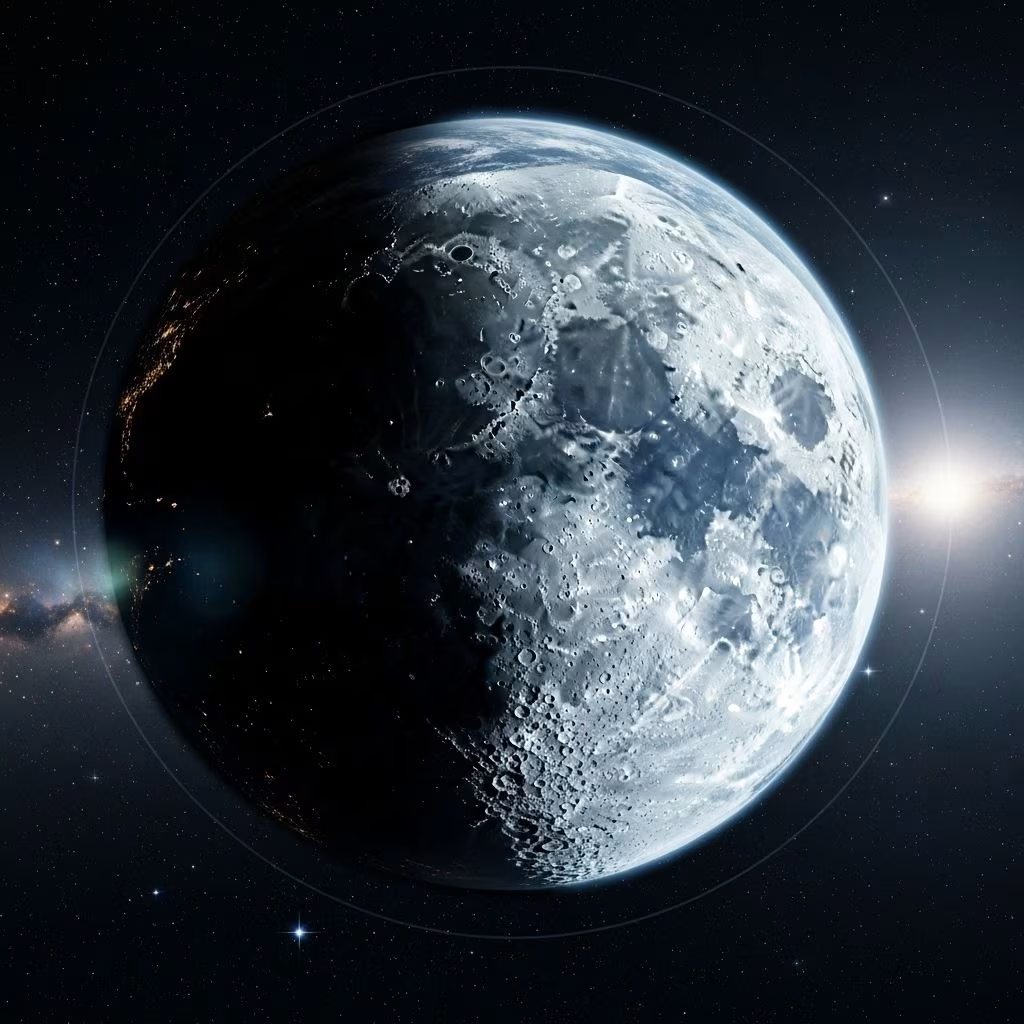
The Moon’s iconic ‘face’ is marked by thousands of impact craters, caused by billions of years of collisions with asteroids and comets. It also houses large, dark plains known as maria (Latin for ‘seas’), which are basaltic lava flows from ancient volcanic activity.
- Largest Crater: The South Pole–Aitken basin is the largest and deepest recognized impact basin on the Moon.
- Mare Imbrium: One of the largest maria, Mare Imbrium is over 1,100 km across.
- Moon Mountains: Mons Huygens is the tallest lunar mountain, standing about 5.5 kilometers (3.4 miles) high.
4. The Moon Shows Only One Face to Earth (Synchronous Rotation)
Because the Moon is tidally locked to Earth, one hemisphere—known as the near side—always faces us, while the far side (sometimes—erroneously—called the ‘dark side’) remains out of sight. This synchronous rotation results from millions of years of gravitational interaction with our planet.
- Near Side vs. Far Side: The near side is dominated by dark maria and bright highlands; the far side has fewer maria but more craters and mountains.
- No True ‘Dark Side’: Both hemispheres experience day and night as the Moon orbits Earth.
5. The Moon’s Gravity Shapes Life on Earth
The Moon’s gravity exerts a powerful pull on Earth’s oceans, causing the regular rise and fall of tides. These tidal forces are essential for many oceanic processes and may have helped foster conditions for early life on our planet.
- Tidal Lock: Just as the Moon is locked facing Earth, our planet’s rotation is gradually slowing due to the Moon’s effect, causing the day to lengthen over millions of years.
- Stabilizing Effect: The Moon’s presence stabilizes Earth’s axial tilt, leading to a more stable climate over geological timescales.
6. The Moon Has Extreme Temperatures
With no substantial atmosphere to retain heat or insulate against cold, the lunar surface experiences drastic temperature swings. Sunlit regions can soar to about 127°C (260°F), while nighttime or shadowed areas can plummet to near –173°C (–280°F).
- No Weather: The Moon lacks wind, rain, or liquid water, allowing footprints and lander impressions to persist for millions of years.
- Twilight Zone: At the boundary between sunlight and shadow, temperatures can change precipitously within just a few steps.
7. The Moon is Slowly Drifting Away
Each year, the Moon moves about 3.8 centimeters (1.5 inches) farther from Earth. This recession is caused by tidal interactions: Earth’s rotation transfers energy to the Moon, pushing it into a higher orbit. Over billions of years, this process will continue to slow Earth’s rotation and lengthen our days even further.
- Long-Term Impact: In the distant future, the Moon will eventually take more than 47 days to orbit Earth.
- Paleontological Record: Ancient tidal deposits record shorter days and closer lunar orbits in Earth’s deep past.
8. Humans Have Explored—and Left Their Mark on—the Moon
Humankind first set foot on the Moon in July 1969 during NASA’s Apollo 11 mission. Twelve astronauts from six Apollo missions ultimately walked its surface, conducting experiments, gathering samples, and leaving behind equipment—and a few surprises.
- Last Mission: Apollo 17 in December 1972 was the final crewed lunar landing, and no human has visited since.
- Lunar Legacy: Items left on the surface include scientific instruments, American flags, commemorative plaques, and dozens of bags of human waste.
- Unforgettable Words: Neil Armstrong’s famous declaration: “That’s one small step for [a] man, one giant leap for mankind.”
9. The Moon’s Surface Holds Ancient Clues
The Moon preserves a time capsule of solar system history. Its surface, pockmarked with craters and scattered with rocks, has changed little in billions of years due to the lack of wind or rain. Samples returned by astronauts have been dated to more than 4 billion years old, helping scientists unravel not only the Moon’s past but also that of the early Earth and neighboring planets.
- Pristine Record: Crater counts reveal epochs of heavy bombardment in our solar system’s history.
- Oldest Lunar Rock: Some samples are estimated to be over 4.4 billion years old.
10. The Moon Still Holds Mysteries
Despite centuries of observation and decades of exploration, the Moon continues to puzzle scientists. Ongoing investigations are examining everything from lunar water in permanently shadowed craters to the possibility of valuable resources or even future human habitats.
- Lunar Water: Water ice has been detected at the poles, raising hopes for future sustained missions.
- Moonquakes: Seismic detectors left by Apollo missions have recorded shallow and deep moonquakes, hinting at continuing geologic activity.
- Lunar Dust: The electrostatic “levitation” of dust above the lunar surface remains a curious phenomenon.
Frequently Asked Questions (FAQs)
Q: Why do we always see the same side of the Moon?
A: The Moon is tidally locked, meaning its rotation period matches its orbital period around Earth. As a result, only one hemisphere—the ‘near side’—ever faces our planet.
Q: How old is the Moon?
A: Scientific evidence indicates the Moon is about 4.5 billion years old, formed shortly after the solar system, making it nearly as ancient as Earth itself.
Q: Has anyone ever visited the far side of the Moon?
A: No human missions have landed on the far side, but robotic missions—most notably China’s Chang’e 4 in 2019—have explored and landed on the lunar far side.
Q: What causes the Moon’s phases?
A: Lunar phases arise from the changing angles between the Sun, Earth, and Moon. As the Moon orbits, varying portions of its sunlit half become visible from Earth, creating the cycle from new moon to full moon and back.
Q: Is there really water on the Moon?
A: Yes, water ice exists at the lunar poles in permanently shadowed craters. This discovery has important implications for future lunar exploration and even the possibility of establishing human habitats.
Lunar Data Table
| Feature | Value |
|---|---|
| Mean Diameter | 3,475 km (2,159 mi) |
| Distance from Earth (avg.) | 384,400 km (238,855 mi) |
| Orbital Period (Sidereal) | 27.3 days |
| Surface Gravity | 1.62 m/s² (about 1/6 of Earth’s gravity) |
| Surface Temperature Range | –173°C to 127°C (–280°F to 260°F) |
| Atmosphere | Exosphere (trace gases only) |
| First Human Landing | July 20, 1969 (Apollo 11) |
Interesting Moon Facts Quick List
- The Moon appears to change shape nightly, but actually only its illuminated portion is visible as it orbits Earth.
- The Moon’s surface is about as dark as worn asphalt, despite its bright appearance in the night sky.
- Blue moons—the second full moon in a calendar month—occur approximately every two to three years.
- Astronauts’ footprints, rover tracks, and other artifacts remain undisturbed due to the Moon’s lack of wind and water.
- The Moon’s gravitational pull was once much stronger, meaning tides were higher in Earth’s ancient oceans.
- About 60% of the Moon’s surface is visible from Earth over time, thanks to a wobble called libration.
References
- NASA: Moon Facts
- Space.com: 10 Fascinating Facts About the Moon
- Royal Museums Greenwich: Interesting facts about the Moon
- National Geographic Kids: Facts about the Moon
References
- https://www.space.com/19619-top-10-moon-facts.html
- https://www.space.com/11162-10-surprising-moon-facts-full-moons.html
- https://science.nasa.gov/moon/facts/
- https://space-facts.com/the-moon/
- https://www.rmg.co.uk/stories/space-astronomy/interesting-facts-about-moon
- https://www.natgeokids.com/au/discover/science/space/facts-about-the-moon/
- https://www.natgeokids.com/uk/discover/science/space/facts-about-the-moon/
- https://www.funkidslive.com/learn/top-10-facts/top-10-facts-about-the-moon/
- https://en.wikipedia.org/wiki/Moon
- https://www.jameswebbdiscovery.com/universe/100-facts-about-the-moon
- https://www.youtube.com/watch?v=kM-kAOaGQcM
- https://www.astronomy.com/astronomy-for-beginners/michaels-miscellany-10-cool-things-about-the-moon/
- https://spaceunited.com/blog/top-10-interesting-space-facts-you-didnt-know
- https://frostingandglue.com/facts-about-the-moon/
- https://www.factretriever.com/moon-facts
- https://science.nasa.gov/moon/
- https://www.skyatnightmagazine.com/apple-news/moon-facts-things-should-know
- https://www.youtube.com/watch?v=JeVxMZjigpc