Large Magellanic Cloud: The Milky Way’s Fascinating Satellite Galaxy
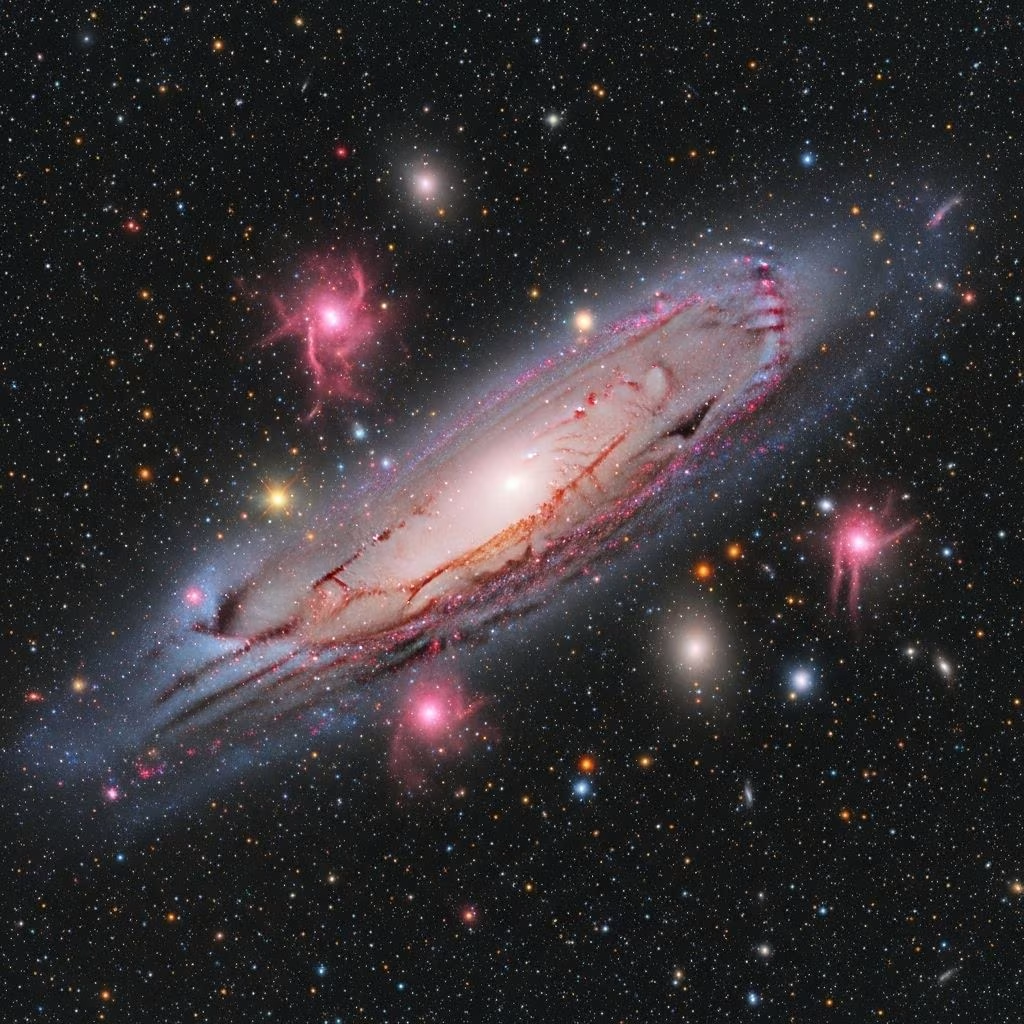
The Large Magellanic Cloud (LMC) is the brightest and one of the closest satellite galaxies to our own Milky Way. Standing out as an astronomical marvel, the LMC’s cosmic brilliance, intricate structure, and rich history have long captured the curiosity of professional astronomers and skywatchers alike. This comprehensive guide explores the galaxy’s features, significance, and the spectacular celestial attractions it holds.
Discovery and Historical Context
The Large Magellanic Cloud has been observed by southern hemisphere civilizations for thousands of years. However, it was the Portuguese explorer Ferdinand Magellan’s expedition in the early 16th century that drew European attention to the galaxy. The name ‘Magellanic Cloud’ honors this historic journey, though indigenous peoples like the Khoikhoi of southern Africa and early astronomers of the southern hemisphere were long familiar with its glowing presence in the night sky.
First described in Western literature during Magellan’s circumnavigation (1519-1522), the LMC was subsequently cataloged by astronomers and became a staple object for celestial cartographers and explorers of the southern skies. Its visibility to the naked eye has inspired countless studies since the dawn of modern astronomy.
Location, Distance, and Visibility
The Large Magellanic Cloud can be seen in the southern sky, most prominently in the constellations Dorado and Mensa. With an apparent magnitude of 0.13, it is observable without optical aid as a hazy, cloudlike patch against the Milky Way’s backdrop.
- Distance from Earth: Approximately 163,000 light-years.
- Angular Size: Spans about 10 degrees of the sky — twenty times the apparent width of the full moon.
- Visibility: Best seen during southern hemisphere summers, particularly in dark, rural skies away from city light pollution.
The chart below summarizes key characteristics:
| Property | Value/Description |
|---|---|
| Type | Barred Magellanic Spiral Galaxy (SB(s)m) |
| Diameter | Approx. 32,200 light-years |
| Mass | ~138 billion solar masses (with dark matter) |
| Number of Stars | ~20 billion |
| Neighbouring Galaxies | Small Magellanic Cloud, Milky Way |
Structure and Classification
The LMC is classified as a Magellanic spiral galaxy, specifically as a barred spiral. It is characterized by an off-centre bar and a disrupted spiral arm — features that distinguish it from typical spiral or elliptical galaxies. Here are key aspects of its structure:
- Galactic Bar: The LMC has a distinctive central bar that is warped and off-centre, likely due to gravitational interactions with the Milky Way and the Small Magellanic Cloud (SMC).
- Magellanic Spiral Features: Intermediate between dwarf spirals and irregular galaxies. The LMC shows both a central bar and patchy spiral structure.
- Tidal Interaction: The galaxy exhibits signs of tidal disruption and star formation bursts, attributed to its dynamic relationship with the Milky Way and the SMC.

Notable Features and Objects within the LMC
The Large Magellanic Cloud is a rich cosmic tapestry, containing numerous astronomical treasures:
- The Tarantula Nebula (30 Doradus): The largest and most active star-forming region known in the Local Group of galaxies. Home to some of the hottest and most massive stars observed.
- Supergiant Shells: The LMC contains at least nine enormous supergiant shells — scaffoldings of gas formed by multiple supernovae and stellar winds.
- Superbubbles: About sixteen superbubbles, or vast cavities carved by star clusters, are observed bursting with energetic young stars and glowing gas.
- Planetary Nebulae, Star Clusters, and Star Clouds: Hundreds of nebulae, stellar clusters, and intricate star-forming regions are scattered throughout the LMC.
- Globular Clusters: Includes around fifteen ancient globular clusters, as well as the only confirmed example of a binary globular cluster system.
- Other Features: Compact clusters, supernova remnants (SNRs), planetary nebulae, and unique arcs of stars, with several distant galaxies visible through its faint background.
Highlight: The Tarantula Nebula
Spanning nearly 1,000 light-years across, the Tarantula Nebula (NGC 2070) is the most visually striking nebula in the LMC. It is an absolute stellar nursery, housing young, massive stars that illuminate surrounding gas and dust, creating a stellar laboratory for astronomers to study star birth, supernovae, and the evolution of massive stars.
Star Clusters and Stellar Populations
The Large Magellanic Cloud hosts an impressive variety of stellar clusters and populations, providing invaluable data on stellar evolution:
- Open Clusters: Young, loosely bound collections of newly formed stars scattered throughout the LMC.
- Ancient Globular Clusters: Some are estimated to be more than ten billion years old, offering insights into early galactic formation processes.
- Unique Double Cluster: It is the only galaxy known to host a bona fide binary (double) globular cluster.
- Blue Star Clusters: The LMC teems with young blue globular clusters, testifying to recent star formation activity.
Role in Astronomy and Research Importance
The Large Magellanic Cloud’s proximity and distinct characteristics have made it a cornerstone for advancing our understanding of the cosmos:
- Measuring Cosmic Distances: Key observations of Cepheid variables within the LMC helped calibrate the cosmic distance ladder, enabling accurate measurements to farther galaxies.
- Supernova 1987A: The closest observed supernova in modern times happened in the LMC, revolutionizing our understanding of stellar death, supernova remnants, and neutrino physics.
- Galactic Interactions: The galaxy’s dynamic relationship with the Milky Way and the SMC provides a laboratory for studying tidal interactions, galactic evolution, and the role of dark matter.
- Star Formation Studies: As a region of prolific star birth and supernova activity, the LMC is essential for examining how massive stars form, evolve, and explode.
Observation Guide: Viewing the Large Magellanic Cloud
For skywatchers in the southern hemisphere, the Large Magellanic Cloud is an awe-inspiring target, even for beginners. Here is how you can observe it:
- Naked Eye: Seen as a faint, diffuse patch, the LMC appears as a glowing smudge against the starry sky under dark conditions.
- Binoculars: Reveal more structure — the shimmering bar and brighter knots of light representing star clusters and nebulae.
- Telescope: Even small amateur telescopes can resolve the Tarantula Nebula, supergiant shells, and numerous star clusters in intricate detail.
Best Viewing Conditions:
- Clear, dark skies far from light pollution
- Southern latitudes, ideally between October and March
- Look to the constellations Dorado and Mensa
For those with advanced equipment and long-exposure astrophotography, the LMC becomes a treasure trove, revealing filaments of gas, shock waves, and the subtle interplay of gravity and light.
Frequently Asked Questions (FAQs)
Q: What makes the Large Magellanic Cloud special among satellite galaxies?
A: The LMC stands out for its brightness, rich variety of nebulae and clusters, and its role in cosmic distance measurements and studies of galactic interactions.
Q: Can the Large Magellanic Cloud be seen from the northern hemisphere?
A: The LMC is mainly visible from southern latitudes. It is generally not observable from most of the northern hemisphere due to its declination.
Q: What is the relationship between the Large and Small Magellanic Clouds?
A: The LMC and SMC are both satellite galaxies of the Milky Way and are gravitationally bound, interacting with each other and the Milky Way, leading to tidal distortions and shared star formation history.
Q: Why is the Tarantula Nebula noteworthy?
A: It is the most active star-forming region in the entire Local Group of galaxies and contains some of the universe’s most massive and luminous stars.
Q: How did the Large Magellanic Cloud help astronomers measure cosmic distances?
A: Observations of variable stars (Cepheids) in the LMC established a key rung on the cosmic distance ladder, allowing astronomers to determine distances to remote galaxies with much greater precision.
Key Facts and Figures Recap
- Galaxy Type: Magellanic barred spiral
- Diameter: 32,200 light-years
- Known Stars: 20 billion+
- Dominant Feature: Tarantula Nebula
- Rich in: Star clusters, nebulae, supernova remnants
- Significance: Key object for galactic evolution, supernova studies, and distance calibration
From naked-eye wonder to a crucial benchmark in cutting-edge research, the Large Magellanic Cloud remains a stellar showcase—an integral neighbor forever woven into humanity’s understanding of the wider universe.
References
- https://www.space.com/25450-large-magellanic-cloud.html
- https://en.wikipedia.org/wiki/Large_Magellanic_Cloud
- https://www.nasa.gov/image-article/large-magellanic-cloud/
- https://www.space.com/large-magellanic-cloud-vista-telescope-images.html
- https://largemagellaniccloud.com
- https://www.constellation-guide.com/large-magellanic-cloud/
- https://space-facts.com/galaxies/magellanic-clouds/
- https://theskylive.com/sky/deepsky/eso056-115-large-magellanic-cloud-object
- https://phys.org/news/2025-05-hubble-captures-large-magellanic-cloud.html
- https://www.astronomy.com/observing/take-a-closer-look-at-the-large-magellanic-cloud/
- https://en.wikipedia.org/wiki/Magellanic_Clouds
- https://telescope.live/gallery/large-magellanic-cloud-47
- https://www.universetoday.com/articles/large-magellanic-cloud
- https://spaceaustralia.com/news/askap-takes-deep-look-large-magellanic-cloud
- http://www.messier.seds.org/xtra/ngc/lmc.html
- https://astrodrudis.com/large-magellanic-cloud-nebulous-systems/
- https://science.nasa.gov/missions/hubble/hubble-sees-hidden-treasure-in-large-magellanic-cloud/
- https://www.britannica.com/topic/Large-Magellanic-Cloud