How Rockets Work: The Science Behind Spaceflight
Rockets are the engines of space exploration, enabling humanity to reach beyond Earth and explore the cosmos. While the image of a rocket launch often evokes thoughts of blazing fire and thunderous noise, the true story of how rockets work is rooted in physics, chemistry, and sophisticated engineering. This article breaks down the core principles, components, types, and historic advances that define modern rocketry, from liftoff to orbit and beyond.
Contents
- How Rockets Work: Fundamental Principles
- Rocket Propulsion and Newton’s Third Law
- Types of Rockets
- Main Components of a Rocket
- Launching Rockets: Overcoming Gravity
- Challenges in Rocketry
- A Brief History of Rocket Development
- Modern Innovation and Reusability
- Frequently Asked Questions (FAQs)
How Rockets Work: Fundamental Principles
At their core, rockets operate by expelling mass in one direction to propel themselves in the opposite direction, in accordance with Newton’s third law of motion: For every action, there is an equal and opposite reaction. Unlike airplanes, rockets do not rely on air intake; they carry both fuel and oxidizer, allowing them to function in the vacuum of space.
- Thrust Generation: Hot gases produced by burning fuel and oxidizer escape at high speed from the rocket’s nozzle, pushing the rocket forward.
- Self-Contained Propulsion: Rockets carry their own oxidizer, so combustion occurs even where there is no atmosphere.
- Specific Impulse: The efficiency of a rocket is measured by the speed at which exhaust leaves the nozzle, termed specific impulse.
Rocket Propulsion and Newton’s Third Law
Every rocket is powered by a rocket engine that produces thrust by burning propellant and expelling exhaust gases. This process is a direct application of Newton’s third law, where the rocket is pushed in the opposite direction of the expelled gases.
- Action: Burning fuel and oxidizer creates expanding gases.
- Reaction: Expanding gases shoot out the nozzle, propelling the rocket forward.
- Vacuum Operation: Because the system is closed (fuel and oxidizer are both carried), rockets can function outside Earth’s atmosphere.
Types of Rockets
Rockets are broadly classified based on their propellant and construction:
- Solid-fueled Rockets: Propellant is a chemical mixture that is solid at room temperature. Commonly used in booster stages and for reliability.
- Liquid-fueled Rockets: Propellant is stored separately as liquid fuel and liquid oxidizer, allowing for precise control and higher efficiency.
- Hybrid Rockets: Combine aspects of both solid and liquid systems for flexibility.
- Ion and Electric Rockets: Propel charged particles using electricity for deep space missions.
| Feature | Solid-Fueled | Liquid-Fueled |
|---|---|---|
| Ignition | One-time, hard to stop | Start/stop possible |
| Control | Limited | Precise throttling |
| Complexity | Simple construction | Complex plumbing |
| Applications | Boosters, military | Main engines, payload delivery |
Main Components of a Rocket
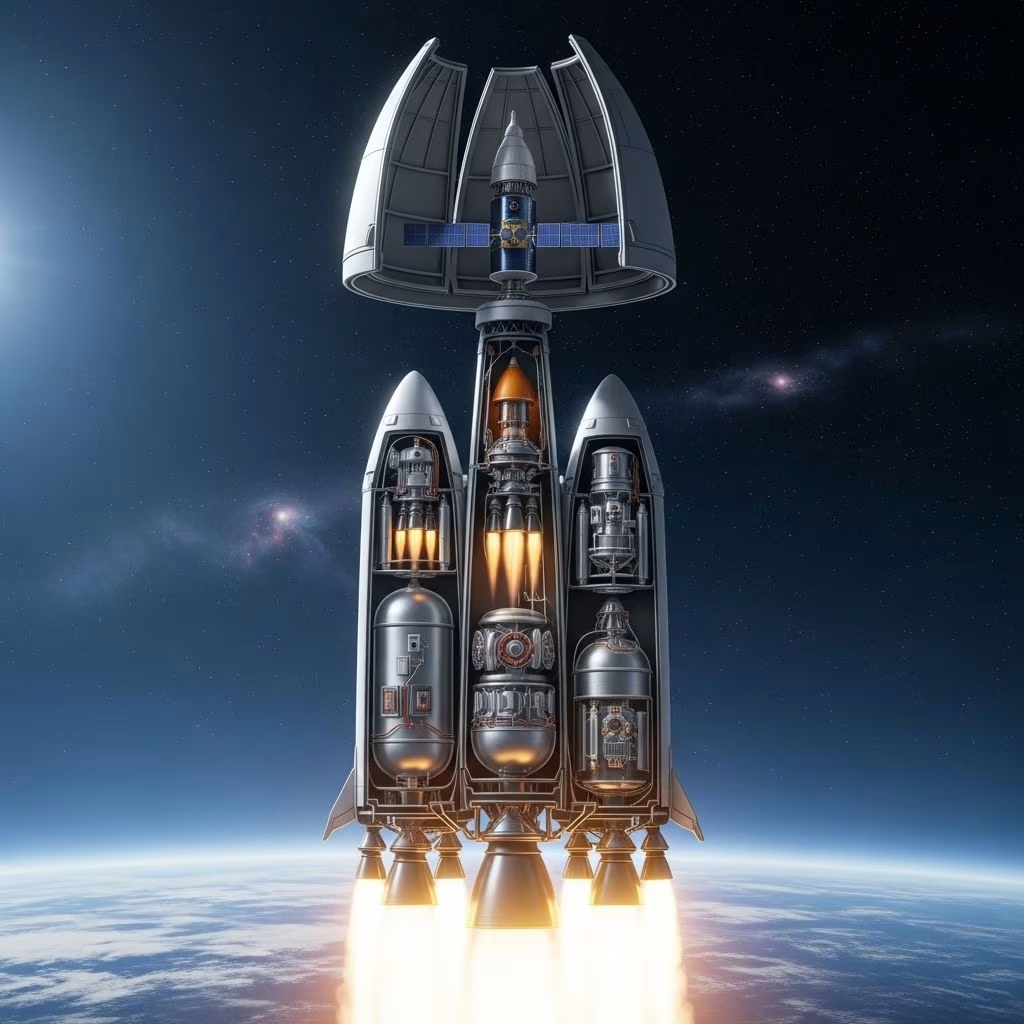
Although rocket designs vary, most orbital launch vehicles share four major parts:
- Propellant Tanks: Store the fuel and oxidizer needed for combustion.
- Engines: Burn propellants, creating fast-moving exhaust for thrust.
- Payload: The cargo carried, such as satellites, scientific instruments, or astronauts.
- Structural Frame: Provides rigidity and shape, enduring extreme forces during launch.
Additional features include control surfaces (fins or gimbaled engines) for steering and stability, and fairings to shield payloads during flight.
Launching Rockets: Overcoming Gravity
Rocket launches are a dramatic demonstration of human ingenuity. To reach space, rockets must overcome Earth’s gravitational pull by producing exceptional thrust and managing speed and trajectory:
- Lift-off: Engines ignite and expel exhaust, pushing the rocket upward. Initial acceleration is slow but increases as fuel is burned and mass decreases.
- Staging: Most rockets have multiple stages. Once a stage’s fuel is spent, it is jettisoned, lightening the vehicle and increasing efficiency.
- Reaching Orbit: The rocket reaches horizontal velocity fast enough to maintain orbit around Earth, known as orbital velocity (approximately 28,000 km/h or 17,500 mph for low Earth orbit).
The delicate balance of thrust, mass, and trajectory governs whether the rocket will reach its target altitude and speed.
Challenges in Rocketry
Launching into space is fraught with technical and physical challenges:
- Gravity: The rocket must overcome the force pulling it downward.
- Atmospheric Drag: Air resistance slows rockets, especially at lower altitudes.
- Structural Integrity: Rockets endure vibrating, twisting, and heating; strong materials are essential.
- Fuel Efficiency: Propellant takes up most of a rocket’s mass at launch; optimizing usage is key.
- Guidance and Stability: Maintaining precise control of direction and speed through computing and engine gimbaling.
A Brief History of Rocket Development
The story of rockets is one of incremental advances and historic leaps:
- Early Rockets: Gunpowder rockets traced back to China in the 13th century.
- Modern Rocketry: In 1903, Konstantin Tsiolkovsky laid out basic rocket equations. Robert Goddard launched the first liquid-fueled rocket in 1926.
- World War II: V-2 rocket became first object to reach space in 1944.
- Space Age: The Soviet Union launched Sputnik in 1957, followed by human flights and Moon landings.
- Recent Developments: NASA’s Space Shuttle and private company rockets like SpaceX’s Falcon 9 have made reuse a possibility, drastically reducing costs.
Modern Innovation and Reusability
Recent years have seen significant progress in rocket design and sustainability:
- Reusability: Companies like SpaceX and Blue Origin have successfully landed and reused rocket stages, marking a breakthrough in reducing the cost of access to space.
- Advanced Propulsion: Electric and ion thrusters now support long duration deep space missions.
- Eco-Friendly Fuels: Efforts are ongoing to reduce rocket’s environmental footprint with new propellant research.
- Autonomous Control: Onboard computers and AI now allow for more precise flight control and safety measures.
Frequently Asked Questions (FAQs)
Q: How do rockets work in space without air?
A: Rockets carry both fuel and their own oxidizer, allowing combustion and thrust without needing atmospheric air.
Q: What is the difference between a rocket and a jet engine?
A: Jet engines need atmospheric oxygen to burn fuel and generate thrust, functioning only within the atmosphere. Rockets carry their own oxygen and can operate both in the atmosphere and space.
Q: Why do rockets have stages?
A: Stages are used to shed weight during ascent, enabling rockets to reach higher speeds and carry heavier payloads into orbit.
Q: Who invented the first modern rocket?
A: Robert Goddard launched the first liquid-fueled rocket in 1926, marking the beginning of modern rocketry.
Q: Are modern rockets reusable?
A: Yes, many modern rockets—such as SpaceX’s Falcon 9 and Blue Origin’s New Shepard— are designed for reusability to save costs and support sustainable spaceflight.
Q: How fast do rockets need to go to enter orbit?
A: To achieve low Earth orbit, rockets must reach speeds of about 28,000 km/h (17,500 mph).
In Summary
From the earliest gunpowder rockets to today’s reusable launch systems, rocketry embodies the human drive to explore and innovate. Harnessing the laws of physics and the power of chemistry, rockets carry their own supplies to overcome gravity, drive themselves through the vacuum of space, and enable scientific and commercial breakthroughs that shape our future.
References
- https://spaceplace.nasa.gov/launching-into-space/en/
- https://www.livescience.com/34475-how-do-space-rockets-work-without-air.html
- https://www.space.com/curious-kids-how-does-a-spaceship-get-into-space
- https://headedforspace.com/the-main-parts-of-a-rocket-what-they-are-how-they-work/
- https://en.wikipedia.org/wiki/Rocket
- https://www.explainthatstuff.com/spacerockets.html
- https://spaceunited.com/blog/how-do-rockets-work
- https://www.masterclass.com/articles/how-rockets-work-with-chris-hadfield
- https://rocketblueprintposters.com/blogs/behind-the-blueprints/how-rockets-work-a-guide-to-space-exploration
- https://science.howstuffworks.com/rocket.htm
- https://spacemesmerise.com/en-ca/blogs/space-technology/rocket-science-understanding-how-rockets-work-in-space
- https://headedforspace.com/what-is-a-rocket/
- https://spaceyv.com/how-do-rockets-work/
- https://www.uu.edu/dept/physics/scienceguys/2002Sept.cfm
- https://www.universetoday.com/115932/how-does-a-rocket-work/
- https://starsandseas.com/how-rockets-work-a-complete-guide/
- https://www.q-files.com/technology/lets-explore-how-things-work/how-does-a-space-rocket-work
- https://www.iflscience.com/how-do-rockets-work-all-you-need-to-know-74800