Sagittarius A*: The Supermassive Black Hole at the Milky Way’s Center
Sagittarius A* (Sgr A*) is the supermassive black hole that lies at the very heart of our galaxy, the Milky Way. Long hidden behind clouds of cosmic dust, this extraordinary object has captured the curiosity of astronomers for decades, recently soaring to fame with the release of its historic first image in 2022. This article explores its discovery, structure, scientific significance, and how astronomers revealed its shadow for the first time.
Contents
- The Galactic Center and the Location of Sagittarius A*
- The Discovery of Sagittarius A*
- Anatomy of Sagittarius A: Components and Structure
- What is Sagittarius A*?
- The Event Horizon Telescope and the First Image
- The Science: Why Sagittarius A* Matters
- Frequently Asked Questions
The Galactic Center and the Location of Sagittarius A*
The Galactic Center marks the gravitational heart of the Milky Way, a dense and energetic region located approximately 27,000 light-years away from Earth in the direction of the Sagittarius constellation, close to the borders of Scorpius and visually near the Butterfly Cluster and Lambda Scorpii.
- Coordinates: Right ascension 17h 45m 40.0409s, declination −29° 0′ 28.118″
- Concealed from optical telescopes by thick clouds of cosmic dust, the region is observable primarily in radio, infrared, and X-ray wavelengths.
This central region is dynamic, teeming with massive stars and enveloped by swirling clouds of gas and dust, all dominated by the invisible influence of Sgr A*.
The Discovery of Sagittarius A*
The story of Sagittarius A*’s discovery is a testament to the dawn of radio astronomy and international scientific collaboration.
- In April 1933, Karl Jansky detected strong radio waves originating near the constellation Sagittarius—one of the first detections of radio emission from beyond Earth.
- Australian astronomers Jack Piddington and Harry Minnett later pinpointed a bright, compact radio source in this region, affirming its location at the galaxy’s center.
- The term Sagittarius A was introduced in 1954 by John Kraus and colleagues, following the convention of naming radio sources by constellation and brightness.
- In 1974, Bruce Balick and Robert Brown identified an exceptionally luminous and compact radio source within Sagittarius A, which was dubbed Sagittarius A* (A-star).
It would take decades—and technological leaps—to confirm Sgr A* as a supermassive black hole and to begin probing its mysteries.
Anatomy of Sagittarius A: Components and Structure
The region known as Sagittarius A is not just a single object but a complex interplay of several energetic astronomical features:
- Sagittarius A East: A vast supernova remnant, the largest radio source in the region.
- Sagittarius A West: Also called the “Minispiral,” this is a swirling, three-arm structure made of hot, ionized gas and dust clouds.
- Sagittarius A*: The extremely bright, compact radio source at the very center, later confirmed as a supermassive black hole.
| Component | Description | Distinguishing Feature |
|---|---|---|
| Sagittarius A East | Supernova remnant, large and diffuse. | Largest structure in Sagittarius A region. |
| Sagittarius A West (Minispiral) | Ionized gas & dust clouds in spiral-like arms. | Appears as three-arm spiral; not a true spiral. |
| Sagittarius A* | Supermassive black hole at the pattern’s core. | Bright, highly compact radio source. |
Sagittarius A West (Minispiral) is especially interesting—though spiral-looking, it is actually a 3D structure of gas and dust clouds orbiting Sgr A* at speeds up to 1,000 km/s, influenced by its immense gravity.
What is Sagittarius A*?
Sagittarius A* is a supermassive black hole, an object with mass millions of times that of the Sun packed into an area smaller than our solar system. Here are its crucial details:
- Mass: About 4 million solar masses.
- Size: Its event horizon is roughly 44 million km across—less than the orbit of Mercury.
- Type: Non-rotating (Schwarzschild) black hole, although some studies suggest it may be slowly spinning.
- Location: Geometrically at the dynamical center of the Milky Way.
- Influence: Its gravity governs the orbit of stars, dust, and gas in the surrounding few light-years.
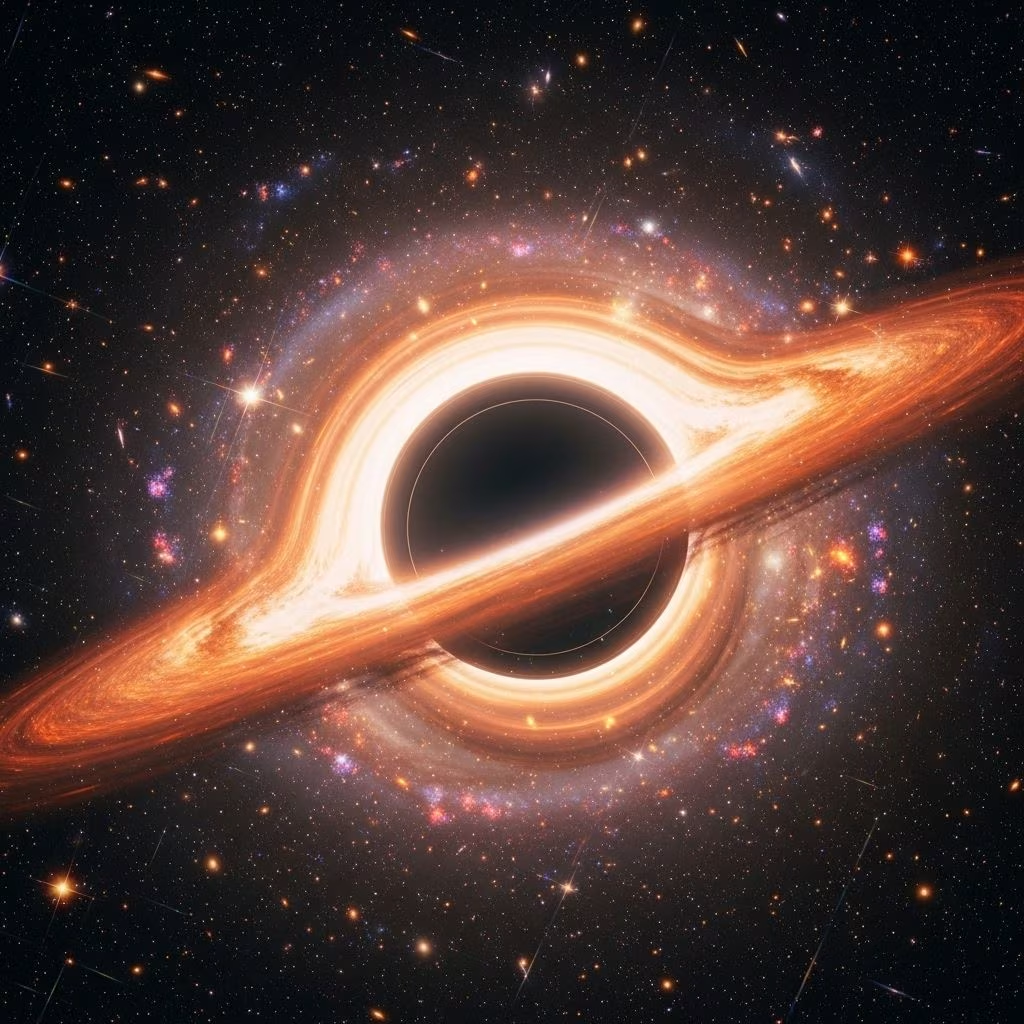
Because no light escapes a black hole, Sgr A* cannot be seen directly. Instead, it is detected through the radiation emitted by matter heated to extreme temperatures as it orbits and falls into the black hole.
The First Image of Sagittarius A*: Enter the Event Horizon Telescope
For decades, the existence of Sagittarius A* was inferred from the orbital motion of stars and the behavior of gas and dust near the galactic center. In 2022, a scientific milestone was achieved:
- May 2022: The Event Horizon Telescope (EHT) released the first-ever image of the glowing accretion disk surrounding Sgr A*’s event horizon.
- The image revealed a bright ring of radiation encircling a dark shadow—the latter corresponding to the event horizon where light cannot escape.
- This was the second image of a black hole ever produced, following the famous M87* image in 2019.
- The EHT’s global array of radio dishes synchronized their observations to achieve an effective telescope the size of Earth, capable of resolving Sgr A* despite its distant and small apparent size.
The observed radiation comes from superheated gas and dust orbiting at relativistic speeds as they spiral inward—providing a way to “see” the unseeable.
The Science: Why Sagittarius A* Matters
The study of Sagittarius A* has transformed our understanding of black holes, galaxy evolution, and the laws of physics. Here’s why it remains a cosmic touchstone:
- Confirmation of Black Holes: Precise tracking of star orbits, like the famous “S stars,” proved that an invisible object weighing millions of solar masses occupies a region far smaller than any group of stars—leaving only a black hole as the plausible explanation.
- Testing Einstein’s Theories: Observations around Sgr A* probe the limits of General Relativity’s predictions for gravitational physics under extreme conditions.
- Galactic Evolution: Supermassive black holes are now believed to reside at the centers of most galaxies, playing a role in star formation, galactic dynamics, and the growth of structure in the universe.
- Astrophysical Laboratories: Sgr A* is the closest supermassive black hole—an accessible laboratory for studying relativistic jets, accretion disks, and gravitational waves.
The techniques developed to image Sgr A* have also paved the way for observing black holes in distant galaxies, helping illuminate the interconnected history of cosmic evolution.
Fun Facts about Sagittarius A*
- The asterisk in Sgr A* is pronounced “A-star,” and is used by astronomers to highlight it as a unique, astronomical object—not a typo or footnote!
- Though it weighs four million suns, its actual event horizon is smaller than Mercury’s orbit around the Sun.
- Sgr A* is currently “quiet” compared to other galactic nuclei—it is not a strong source of high-energy jets or active emission, likely because it is starved of large meals of infalling matter at present.
- The stars zip around Sgr A* at astonishing speeds—some travel at over 10,000 km/s.
Timeline of Key Discoveries
| Year | Event | Details |
|---|---|---|
| 1933 | First radio detection | Karl Jansky detects radio emissions from Sagittarius. |
| 1950s | Name “Sagittarius A” coined | John Kraus et al. use the name for the central radio source. |
| 1974 | Sgr A* identified | Balick & Brown discover the compact, bright radio source. |
| 1990s–2000s | Stellar orbits mapped | Orbits of “S stars” confirm a supermassive black hole. |
| 2017 | EHT observes Sgr A* | Global radio array collects data over several days. |
| 2022 | First image released | The shadow of the Sgr A* black hole is revealed. |
Frequently Asked Questions (FAQs)
Q: Why can’t we see Sagittarius A* with regular telescopes?
A: Sagittarius A* is obscured by thick clouds of gas and dust in the galaxy’s disk, making it invisible at optical wavelengths. Radio, infrared, and X-ray telescopes can penetrate these clouds to detect its presence.
Q: How do we know Sagittarius A* is a black hole?
A: By tracking the orbits of stars and gas so close to Sgr A* that only an object with immense gravity—and no visible surface—could explain their speed and trajectories, astronomers have ruled out all other explanations except a supermassive black hole.
Q: Is Sagittarius A* active or dormant?
A: Compared to active galactic nuclei in other galaxies, Sgr A* is relatively quiet, showing flares and flickers but currently accreting very little matter.
Q: Are we in danger from Sagittarius A*?
A: No. At about 27,000 light-years away, Sgr A* poses no threat to Earth or our solar system.
Q: Can black holes like Sagittarius A* grow larger?
A: Yes. As gas, dust, and even stars spiral inward (known as accretion), the black hole’s mass can increase over millions of years.
See Also
- Black hole astrophysics
- Event Horizon Telescope discoveries
- Milky Way structure and evolution
- Gravitational wave astronomy
References
Some information in this article was synthesized from key sources in astronomical literature, public domain materials, NASA and EHT press releases, and Wikipedia pages on Sagittarius A* and supermassive black holes.
References
- https://en.wikipedia.org/wiki/Sagittarius_A*
- https://www.space.com/meet-milky-way-black-hole-sagittarius-a
- https://www.space.com/milky-way-black-hole-sagittarius-a-pictures
- https://www.jpl.nasa.gov/edu/resources/teachable-moment/telescopes-get-extraordinary-view-of-milky-ways-black-hole/
- https://eventhorizontelescope.org/blog/astronomers-reveal-first-image-black-hole-heart-our-galaxy
- https://www.skyatnightmagazine.com/space-science/sagittarius-a-black-hole-images
- https://www.nasa.gov/image-article/supermassive-black-hole-sagittarius/
- https://news.mit.edu/2022/first-supermassive-black-hole-sagitarrius-0512
- https://en.wikipedia.org/wiki/Sagittarius_A
- https://www.astronomy.com/science/the-history-of-sagittarius-a-the-milky-ways-supermassive-black-hole/
- https://www.astronomy.com/science/50-years-ago-a-first-hint-of-the-beast-lurking-in-the-heart-of-the-milky-way/
- https://eventhorizontelescope.org/publications/first-sagittarius-event-horizon-telescope-results-i-shadow-supermassive-black-hole
- https://viewspace.org/interactives/unveiling_invisible_universe/black_holes/sagittarius_a
- https://www.constellation-guide.com/sagittarius-a/
- https://www.universetoday.com/articles/sagittarius-a
- https://phys.org/news/2025-01-mid-infrared-flare-sagittarius-milky.html
- https://space.fandom.com/wiki/Sagittarius_A*
- https://www.sci.news/astronomy/sagittarius-a-flares-13682.html