


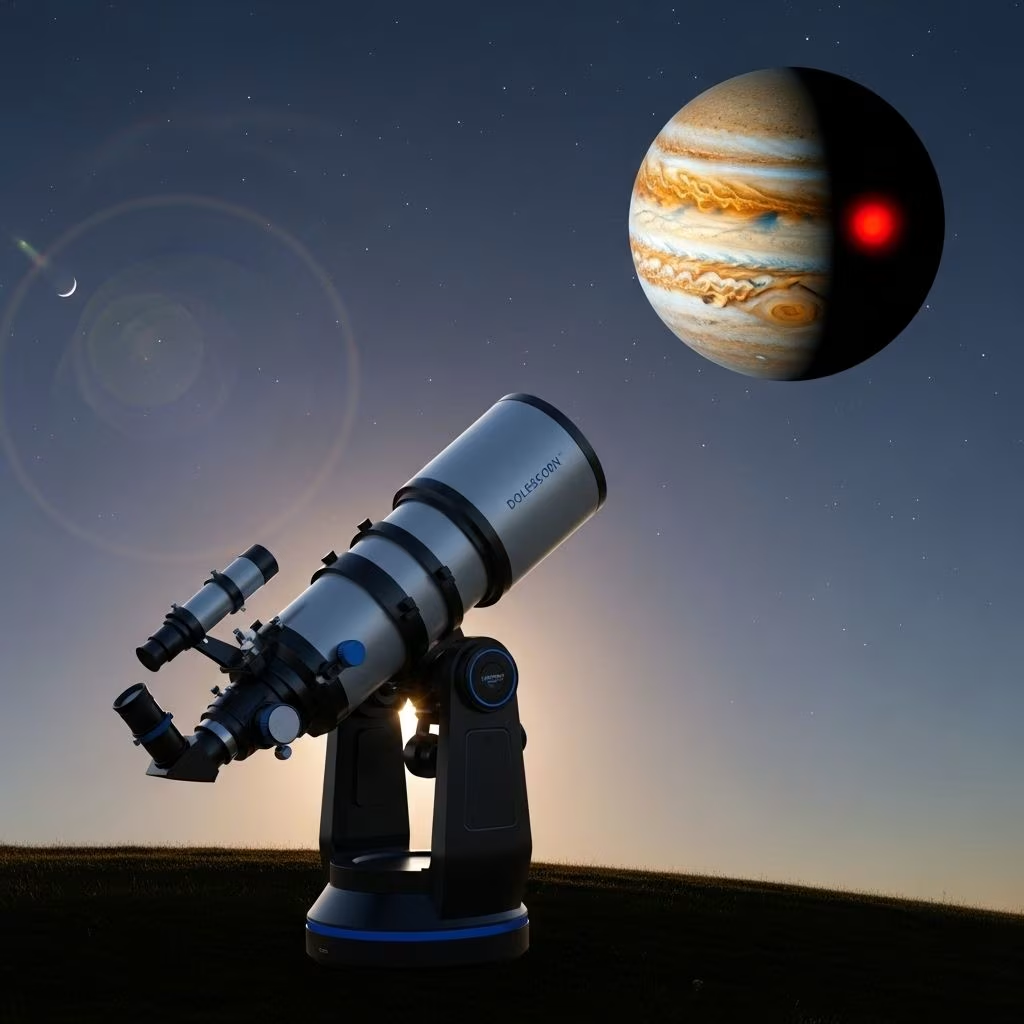
Best Telescopes for Seeing Planets in 2024: Expert Reviews and Buying Guide
Observing the planets through a telescope is one of the most rewarding experiences in amateur astronomy. With the right equipment, you can witness Saturn’s intricately ringed splendor, the cloud bands of Jupiter, Mars’s rusty surface, and even the crescent phases of Venus. In this 2024 guide, we detail the best telescopes for planetary viewing, highlight their features, compare models, and offer buying tips for enthusiasts at any experience level.
How to Choose a Telescope for Planetary Observation
Not all telescopes are created equal for viewing planets. Key factors to consider include:
- Aperture Size: Larger apertures gather more light, improving resolution and permitting finer planetary detail—especially useful for viewing subtle features like Jupiter’s Great Red Spot or Saturn’s Cassini Division.
- Focal Length: Longer focal lengths enable higher practical magnification, which is essential for examining small planetary disks and their features.
- Optical Design: Cassegrain (Schmidt-Cassegrain or Maksutov-Cassegrain) telescopes offer compact, powerful optics ideal for planets, while refractors are known for crisp views and minimal maintenance.
- Mount Stability: Equatorial or computerized GoTo mounts help you track planets smoothly as they move through the night sky.
- Accessory Support: Quality eyepieces, finderscopes, and star diagonals enhance planetary viewing and comfort.
| Feature | Importance for Planetary Views |
|---|---|
| Aperture (Diameter) | Higher detail, brighter images, ability to resolve smaller features. |
| Focal Length | Better magnification; sharper, enlarged planetary disks. |
| Optical Design | Choose Cassegrain or Refractor for clarity and low maintenance. |
| Mount Type | Ensures smooth tracking and minimizes vibrations. |
| Portability | Important for travel, field use, and setup convenience. |
Top Telescopes for Seeing Planets in 2024
Below, we compare the best telescopes for planetary viewing in 2024, selected for their performance, user-friendliness, and feature set.
Celestron NexStar 8SE
- Aperture: 8 inches (203 mm)
- Focal Length: 2,032 mm
- Optical Design: Schmidt-Cassegrain
- Mount: Computerized Alt-Azimuth
- Key Features:
- Large aperture and long focal length for max planetary detail.
- Starbright XLT coatings for high-contrast, sharp images.
- Minimal secondary obstruction for enhanced clarity.
- Stable collimation, less frequent adjustments required.
- User-friendly GoTo mount for swift planet location.
- Excellent for both advanced observers and motivated beginners.
The NexStar 8SE is one of the most celebrated planetary telescopes, providing crisp views of Jupiter’s Great Red Spot and Saturn’s Cassini Division with ease. Its computerized system makes slewing to planets straightforward, even for newcomers.
Sky-Watcher SkyMax 180 Pro Maksutov
- Aperture: 180 mm (7.1 inches)
- Focal Length: 2,700 mm (f/15)
- Optical Design: Maksutov-Cassegrain
- Weight: 7.8 kg
- Accessories: 28mm eyepiece, star diagonal, Vixen-style mounting bar
- Pros:
- Long focal length perfect for planets and lunar landscapes.
- Portable for its size, suitable for field use.
- Detailed views of Saturn, Jupiter, and deep-sky objects.
- Cons:
- More expensive than some alternatives.
- Comes with only one eyepiece—extra accessories may be needed.
Explore Scientific 127mm Maksutov-Cassegrain
- Aperture: 127 mm (5 inches)
- Focal Length: 952 mm (f/7.5)
- Eyepieces: 25mm (2-inch)
- Finderscope: 8×50 right-angled illuminated
- Weight: 8.1 kg (excluding diagonal/eyepiece)
- Pros: Medium-resolution imaging; suitable for planetary and deep-sky objects.
Sky-Watcher Evostar-90 AZ Pronto Refractor
- Aperture: 90 mm
- Focal Length: 900 mm (f/10)
- Mount: AZ Pronto Alt-Azimuth Mount
- Eyepieces: 25mm and 10mm (magnifications of 36x and 90x)
- Pros:
- Reliable optics; ideal for beginners on a budget.
- Easy setup and transportable design.
- Cons:
- Slight color fringing at image edges.
- Small finder makes it harder to locate high targets.
Comparison Table: Best Planetary Telescopes in 2024
| Model | Aperture | Focal Length | Design | Mount Type | Best For |
|---|---|---|---|---|---|
| Celestron NexStar 8SE | 203 mm | 2,032 mm | Schmidt-Cassegrain | Computerized Alt-Az | Serious planetary and lunar observation |
| SkyMax 180 Pro | 180 mm | 2,700 mm | Maksutov-Cassegrain | Manual/Equatorial | High-resolution planetary imaging |
| Explore Scientific 127mm | 127 mm | 952 mm | Maksutov-Cassegrain | Manual | Advanced beginner planetary |
| Evostar-90 AZ Pronto | 90 mm | 900 mm | Refractor | Alt-Az | Budget starters |
Other Notable Telescope Models for Planetary Viewing
- Orion SkyQuest XT8 Classic Dobsonian: Well-regarded for its large aperture, sturdy design, and ease of setup—great for bright planetary images.
- Meade LX90 ACF 8-Inch: Advanced optics, GoTo-system, excellent for both planetary and deep-sky imaging.
- Sky-Watcher EQ6-R Pro: Especially good for astrophotography enthusiasts who want to image planets as well as star fields.
What Can You See With the Best Planetary Telescopes?
- Saturn: Rings, cloud belts, Cassini Division, up to five moons visible with larger apertures.
- Jupiter: Cloud bands, the Great Red Spot, and four Galilean moons—all visible, even with modest telescopes.
- Mars: Polar ice caps, seasonal dust storms, and dark surface markings when closest to Earth.
- Venus: Crescent phases and subtle cloud details.
- Mercury: Phases can be seen, though generally small and tricky due to its proximity to the Sun.
- Uranus and Neptune: Small, pale discs at high magnification—details limited by Earth’s atmosphere but worth seeking with medium-to-large telescopes.
Telescopes for Planetary Imaging
If you are interested in photographing planets, you will need:
- Telescopes with high-resolution optics: Maksutov-Cassegrain or Schmidt-Cassegrain designs excel here.
- Planetary cameras: Dedicated CMOS or CCD cameras with video capture capabilities.
- Tracking mounts: Motorized GoTo mounts improve accuracy for long exposures and stacking.
Models such as Celestron NexStar 8SE and Sky-Watcher SkyMax 180 Pro are particularly well-suited for high-resolution planetary imaging due to their long focal lengths and superior optics.
Tips for Maximizing Planetary Viewing
- Observe during the planet’s opposition (furthest from Sun, closest to Earth) for brightest and largest views.
- Allow your telescope to cool to ambient outdoor temperature to reduce thermal distortion.
- Use higher-magnification eyepieces (within your telescope’s limits) for small planets and surface details.
- Employ planetary filters (such as color band-pass filters) to enhance contrast on features like Jupiter’s storms or Mars’s polar caps.
- Choose nights with good “seeing”—stable atmosphere, minimal wind—for sharper, more detailed images.
Beginner vs. Advanced Telescopes for Planetary Viewing
| Beginner Telescopes | Advanced Telescopes |
|---|---|
|
|
Accessories That Enhance Planetary Viewing
- High-quality eyepieces: Deliver distortion-free details at higher magnification.
- Star diagonals: Improve viewing comfort, especially for refractors.
- Finderscopes: Make locating planets more precise and efficient.
- Filters (e.g., color, ND): Enhance contrast and reveal subtle features.
- Barlow lenses: Increase magnification without sacrificing image sharpness.
Frequently Asked Questions (FAQs)
Q: What size telescope do you need to see Saturn’s rings?
A: Saturn’s rings are visible in even small refractors (70–90mm aperture), though details like the Cassini Division require 150mm or greater, and larger apertures reveal more moons and ring features.
Q: Can beginner telescopes show planetary details?
A: Yes, models like the Sky-Watcher Evostar-90 and Orion 90mm refractors display Saturn’s rings, Jupiter’s cloud bands, and Mars’s basic surface markings—though advanced features need larger apertures and better optics.
Q: Which planets are easiest to view?
A: Jupiter and Saturn are the brightest, largest planets for amateur telescopes. Mars is prominent during oppositions, while Venus’s phases are easy to recognize. Mercury, Uranus, and Neptune require more effort and higher magnification.
Q: What’s the best telescope design for planetary viewing?
A: Maksutov-Cassegrain and Schmidt-Cassegrain models are optimal thanks to compact optics and high magnification; refractors offer excellent clarity but smaller apertures.
Q: Do I need a computerized mount?
A: Computerized (GoTo) mounts make finding and tracking planets much easier, especially for beginners and astrophotographers, but manual mounts remain suitable for hands-on observers.
Conclusion: Picking the Best Telescope for Your Planetary Journey
Choosing the right telescope depends on your experience, budget, and observing ambition. Whether you opt for a high-powered Cassegrain or a simple refractor, today’s best telescopes offer stunning views of the Solar System’s wonders. With computerized mounts and quality accessories, your exploration of Jupiter, Saturn, Mars, and more is just a step away.
References
- https://www.space.com/best-telescopes-for-seeing-planets
- https://www.space.com/15693-telescopes-beginners-telescope-reviews-buying-guide.html
- https://astroforumspace.com/best-telescopes-to-photograph-the-planets/
- https://www.youtube.com/watch?v=mQAMlfK-Ngo
- https://www.highpointscientific.com/astronomy-hub/post/best-telescopes-and-accessories/best-telescope-for-viewing-planets
- https://www.livescience.com/best-telescopes
- https://www.skyatnightmagazine.com/top-astronomy-kit/best-telescopes-for-observing-planets
- https://telescopicwatch.com/best-telescope-reviews/
- https://cloudbreakoptics.com/collections/best-planetary-telescope
- https://www.youtube.com/watch?v=zFKSJpQovls
- https://www.bresser.com/astronomy/telescopes/telescopes-for-planets/
- https://www.telescopebuff.com/articles/best-telescope-to-see-planets
- https://www.cloudynights.com/topic/727217-best-telescope-for-watching-planets-up-close/
- https://astrobackyard.com/best-astrophotography-telescopes/
- https://scopethegalaxy.com/the-best-telescopes-for-viewing-planets/
- https://www.cloudynights.com/topic/952352-the-best-planetary-telescope-at-least-for-my-situation/
- https://spacevoyageventures.com/the-best-telescopes-for-viewing-planets-a-detailed-review/
- https://www.celestron.com/blogs/news/top-10-telescopes-for-the-summer-of-the-planets-1


