Tachyons: Exploring the Mysteries of Faster-than-Light Particles
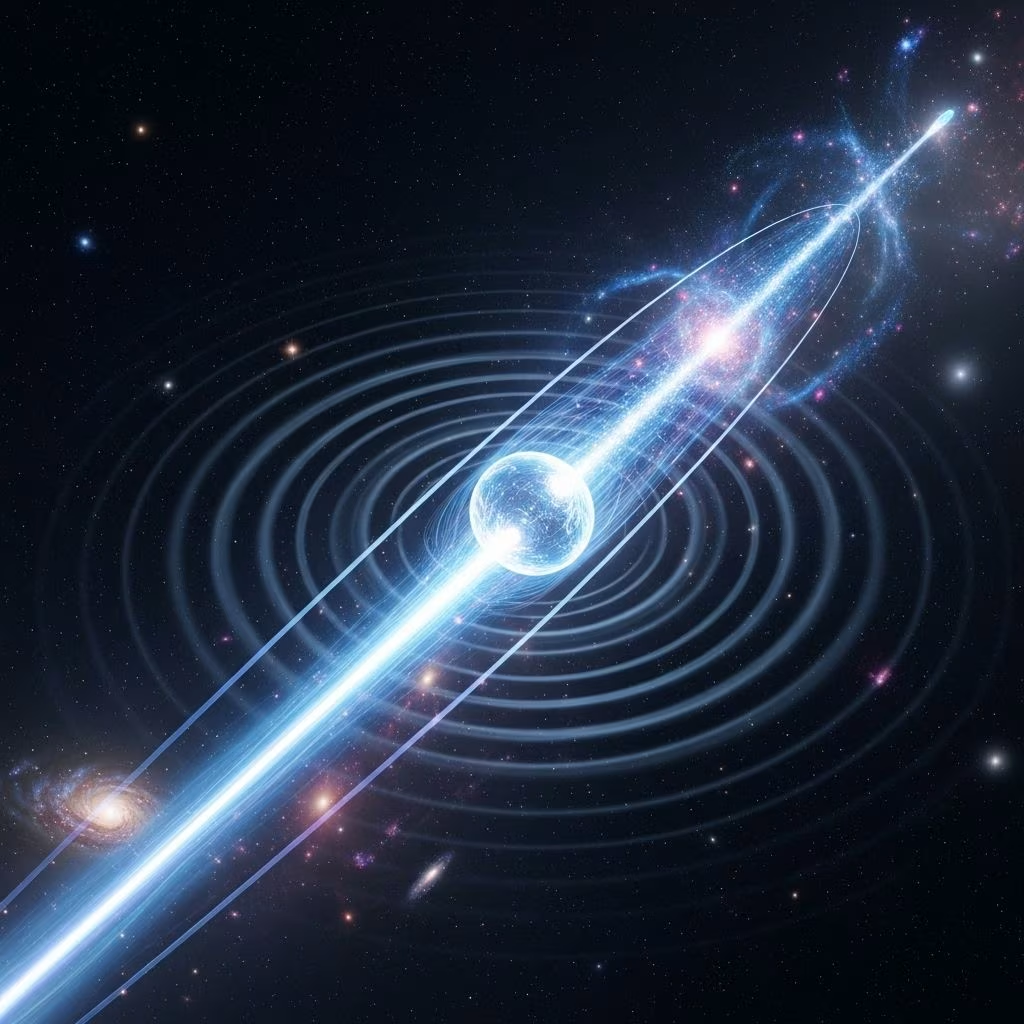
Tachyons, mysterious theoretical particles capable of traveling faster than light, have challenged the boundaries of physics since their conception. Though never observed in nature, they remain a tantalizing topic within theoretical frameworks, quantum mechanics, and popular science fiction.
What Are Tachyons?
Tachyons are hypothetical particles proposed to move faster than the universal speed limit—the speed of light (c), which is approximately 299,792,458 meters per second. The name “tachyon” is derived from the Greek word tachus, meaning “speedy.” Conceived by physicist Arnold Sommerfeld and later theorized in detail by Gerald Feinberg in 1967, tachyons have never been detected and remain purely speculative, existing only in the realm of mathematics and untested physical theories.
- Hypothetical: No experimental evidence supports their existence.
- Superluminal travel: Always travel faster than light if they exist at all.
- Unique properties: Require peculiar mathematics to describe their mass and energy.
The Speed of Light: Nature’s Ultimate Speed Limit
The concept of tachyons dives directly into the heart of Einstein’s theory of special relativity.
- The theory dictates that no object with mass can accelerate to the speed of light, as it would require infinite energy to do so.
- As an object approaches light speed, its kinetic energy and, effectively, its mass, increase without bound, making further acceleration impossible with finite energy.
Therefore, if tachyons exist, they must always exceed light speed and can never slow down to (or below) light speed: they inhabit a realm on the far side of nature’s dividing line.
Origin and Theoretical Foundation
The tachyon concept has roots in both the imagination of physicists and the needs of mathematical symmetry in quantum field theory. Sommerfeld and later Feinberg envisioned tachyons as a logical possibility within relativistic equations, though not as a prediction grounded in observation.
Key theoretical features:
- Imaginary Mass: In relativity equations, tachyons are ascribed “imaginary mass”—a mathematical curiosity meaning their mass squared is negative.
- Energy Dynamics: Paradoxically, as tachyons gain energy, they slow down (but never below the speed of light); as they lose energy, they speed up.
- Role in Physics: Sometimes, the appearance of tachyons in a calculation signifies an instability in the underlying theory, prompting physicists to adjust their models or interpretations.
Why Can’t Ordinary Matter Exceed the Speed of Light?
To approach why tachyons are so strange, it’s helpful to illustrate why regular matter can’t break the cosmic speed limit:
- For any particle with regular, real mass, accelerating towards light speed demands ever-increasing energy, with energy rising to infinity as you near c.
- If such a particle could reach or surpass the speed of light, it would break causality, leading to contradictions in fundamental physics.
- Tachyons, if they exist, reside perpetually on the “faster-than-light” side, mathematically insulated from regular matter’s slow lane.
The Causality Paradox: Tachyons and Time Travel
The biggest issue with tachyons is their startling implications for cause and effect:
- Causality: In Einstein’s framework, the law of causality asserts that causes always precede effects. Tachyons threaten this by enabling, in theory, information to travel back in time.
- A faster-than-light tachyon could allow a message to be sent into the past, leading to temporal paradoxes (e.g., the famous “grandfather paradox” where an action eliminates its own cause).
- This undermines the logical foundation of physical laws and is one major reason physicists doubt tachyons could ever exist in the real universe.
Tachyons in Modern Physics
Though largely a mathematical curiosity, tachyons have featured in several branches of modern theoretical physics:
- Quantum Field Theory (QFT): The appearance of a “tachyonic” mass can suggest an unstable field, not necessarily a real particle. The “tachyon” is then a signal for the field to undergo a transformation to a stable state.
- String Theory: Early versions of bosonic string theory contained tachyons, but these were interpreted as signs that the universe described by the theory was unstable.
In both contexts, the “tachyon” is more often a harbinger of deeper physical structure or a prompt to modify the model, rather than a prediction of a real, observable particle.
Heisenberg’s Uncertainty Principle and Tachyons
Another boundary for understanding tachyons is Heisenberg’s uncertainty principle:
- This principle states that one cannot know both the position and momentum of a particle with perfect precision.
- Tachyons, with their “imaginary mass” and ill-defined characteristics, exist at the extreme limits (or outside) of what quantum mechanics can comfortably describe.
Tachyons in Popular Science and Fiction
Even if they remain unproven, tachyons have embedded themselves in science fiction and speculative technology:
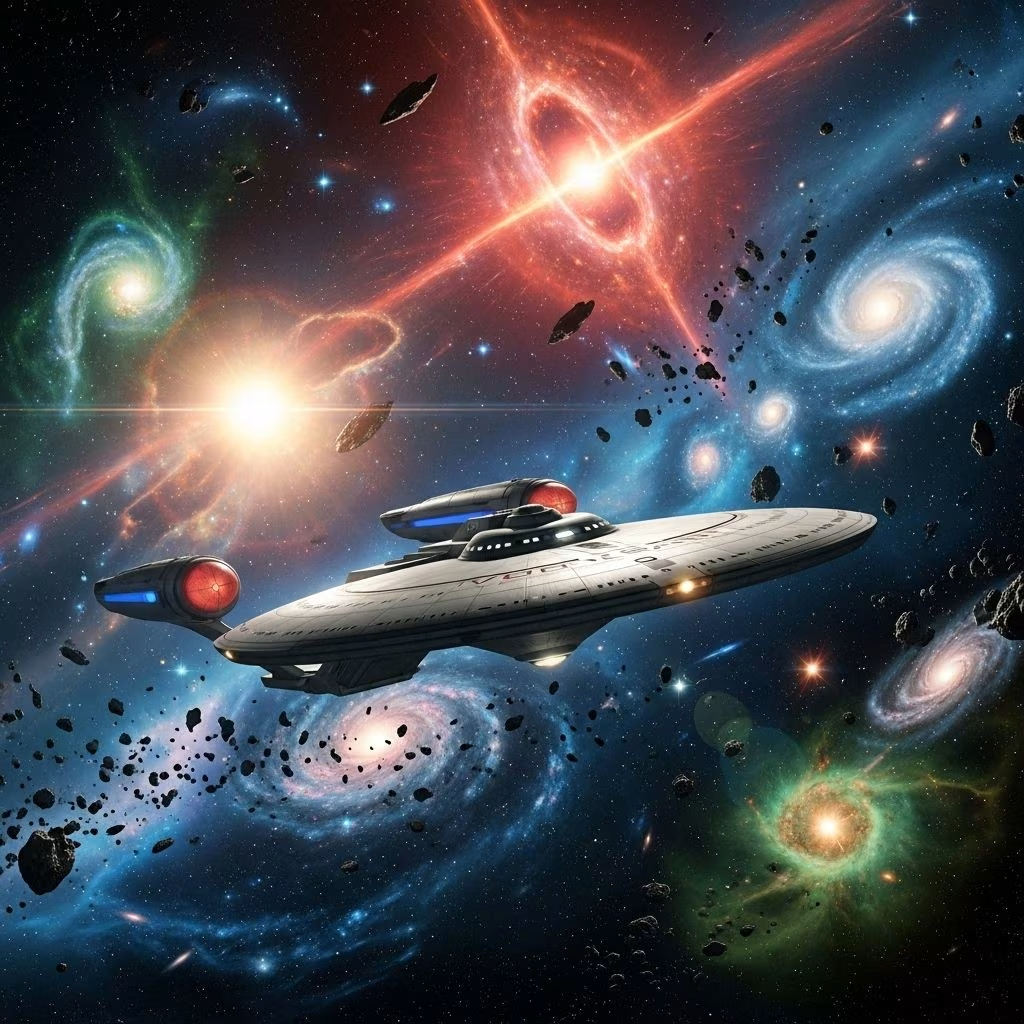
- Science Fiction Uses: Stories and movies (e.g., “Star Trek”) often invoke tachyons as components for faster-than-light communication, time travel, or radical energy sources.
- Speculation on Applications: Some theorists have imagined using tachyons for instantaneous space communication, psychic phenomena, or information transfer across the universe.
While fun in fiction, such uses remain outside the bounds of mainstream science.
Theoretical Implications and Speculative Uses
Suppose, purely hypothetically, that tachyons exist and can be harnessed. Possible revolutionary results might include:
- Superluminal communication: Instantaneous messages across vast cosmic distances, defying the light-speed delay imposed by relativity.
- New energy forms: Energy extraction or manipulation far beyond current means (though at risk of violating established conservation laws).
- Time manipulation: Theoretically, sending information backwards in time—opening a Pandora’s box of paradoxes and causality issues.
Challenges to Experimental Detection
No credible experimental evidence exists for tachyons.
- Despite some reported anomalies in particle accelerator experiments, none have stood up to scrutiny or provided reproducible, unambiguous proof.
- Because tachyons would lose energy as they accelerate, and because their supposed interactions with normal matter are unclear, detecting them is fraught with conceptual and technological hurdles.
Table: Ordinary Matter, Photons, and Tachyons
| Property | Ordinary Matter | Photon | Tachyon (Hypothetical) |
|---|---|---|---|
| Mass | Positive, real mass | Zero (rest mass) | Imaginary (squared mass negative) |
| Typical Speed | Less than c | Exactly c | Greater than c |
| Slows down with energy? | No | No | Yes (gains energy, slows down) |
| Experimental Evidence? | Yes | Yes | No |
| Causality Problems? | No | No | Yes, potentially severe |
Tachyons and Energy: The Paradox of “Imaginary” Mass
The concept of imaginary mass produces strange results in the equations of relativity:
- A tachyon’s energy becomes undefined at exactly light speed (producing a physical barrier).
- The more energy you remove from a tachyon, the faster it goes; add energy, and it slows toward (but never reaches) light speed.
- This flips our ordinary understanding of inertia, force, and acceleration—further complicating the idea of tachyon-based technology.
Tachyons and the Structure of the Universe
Some speculative frameworks have imagined tachyons as underpinning reality:
- Claims are made that tachyons might connect the “zero-point energy” of empty space to the structure of matter itself.
- In these alternative or New Age interpretations, tachyons figure as agents that reduce entropy, harmonize systems, or even enhance health—though there is no scientific evidence for such effects.
Why Most Physicists Doubt Tachyons Exist
- Causality Violations: Allowing faster-than-light particles leads to time paradoxes, violating a fundamental physical law.
- Lack of Detection: Despite theoretical possibilities, no experiment has ever reliably shown a tachyon exists.
- Mathematical Utility: While tachyons appear in certain theoretical contexts, they are often interpreted as signs of instability not real entities.
Frequently Asked Questions (FAQs)
What are tachyons made of?
Tachyons are not made of anything in the conventional sense—they are mathematical solutions to certain equations in relativity that describe hypothetical particles with imaginary mass, not actual matter or energy.
Have tachyons ever been detected?
No, there is no credible experimental evidence for the existence of tachyons. Claims of detection have not withstood scientific scrutiny and are generally regarded as errors or misinterpretations.
Could tachyons enable time travel?
Theoretically, if tachyons were real and their properties could be harnessed, they might enable the transmission of information backwards in time, resulting in causality paradoxes. However, this possibility itself is a major reason why physicists doubt their existence.
What happens if you try to accelerate to the speed of light?
As an object with mass accelerates toward the speed of light, more and more energy is required for ever-smaller increases in speed. At the speed of light, an infinite amount of energy would be needed—making it impossible for anything with real mass to reach or exceed c.
Why do tachyons have “imaginary” mass?
In the mathematics of special relativity, a tachyon’s mass squared is negative. This requires its mass to be an “imaginary” number (involving the square root of -1), which is a mathematical abstraction, not a physical property observed in nature.
Why are tachyons popular in science fiction?
Tachyons imply the ability to travel or send information faster than light, making them attractive for stories about time travel, interstellar communication, and other phenomena impossible with known physics.
Key Takeaways
- Tachyons are purely hypothetical faster-than-light particles, first proposed in the 1960s, never detected in the real world.
- Their existence would violate causality, the rock-bottom rule that causes must precede effects.
- Mathematically, tachyons appear as signals of unstable physical theories, not as predicted real particles.
- Despite their popularity in fiction, there is no scientific consensus supporting their existence.
Further Reading
- Einstein’s Special Relativity: Foundation for understanding universal speed limits
- Quantum Field Theory: The mathematical context where tachyons sometimes emerge
- Tachyons in Pop Culture: Appearances in “Star Trek,” time-travel fiction, and more
References
- https://www.space.com/tachyon-time-travel-relativity
- https://www.space.com/moving-at-twice-the-speed-of-light
- https://www.spacedaily.com/reports/Tachyons_Redefine_Theoretical_Boundaries_in_Modern_Physics_999.html
- https://www.popularmechanics.com/space/a45324140/tachyons-time-travel/
- https://www.1e.com/blogs/what-is-a-tachyon-particle-anyway/
- https://tachyonparis.com/en/tachyons-about-en/
- https://www.astrosafe.co/article/tachyons
- https://armaghplanet.com/what-ever-happened-to-tachyons.html
- https://en.wikipedia.org/wiki/Tachyon
- https://www.astronomy.com/science/if-tachyons-exist-how-might-they-be-detected/
- https://tachyons.fandom.com/wiki/Tachyons_Wiki
- https://www.iflscience.com/what-are-tachyons-and-do-they-even-exist-71018
- https://internationaljournalofresearch.com/2020/06/17/tachyons-and-the-question-of-their-existence/
- https://www.pmsutter.com/shows/askaspaceman-archive/2023/1/17/aas-192-can-tachyons-exist
- https://www.freeastroscience.com/2023/10/what-if-tachyons-are-real.html
- https://www.universetoday.com/articles/tachyon