Mars: The Red Planet – Exploration, Features, and Mysteries
Mars, known as the Red Planet, is one of the most intriguing worlds in our solar system. As Earth’s closest planetary neighbor, Mars has fascinated astronomers, planetary scientists, and dreamers alike for centuries. Its rust-colored surface, unique geological structures, thin atmosphere, and history of water make it a focal point for both robotic and human exploration. This article delves into Mars’s fundamental features, what makes it unique, how scientists have studied it, and the planet’s enduring mysteries.
Mars at a Glance
- Position: Fourth planet from the Sun
- Nickname: The Red Planet
- Diameter: 6,779 km (4,212 miles)
- Length of a Day: 24.6 hours (Martian sol)
- Length of a Year: 687 Earth days
- Moons: Phobos and Deimos
- Main Atmospheric Element: Carbon dioxide (CO2)
Mars: Appearance and Geology
Mars is easily identifiable in the night sky due to its reddish hue, caused by iron-rich dust particles that coat its dry surface. The planet is smaller than Earth yet larger than the Moon—about half Earth’s diameter and twice the Moon’s. Its surface showcases a spectacular array of geological features:
- Olympus Mons: The tallest volcano in the solar system, towering 21.9 km (13.6 miles) above the surface.
- Valles Marineris: One of the largest canyons in the solar system, stretching over 4,000 km (2,500 miles).
- The Martian Dichotomy: The planet is divided between the smooth, flat northern lowlands and the heavily cratered southern highlands.
Frequent dust storms swirl over these regions, sometimes enveloping the entire planet in a haze that can be seen even through amateur telescopes.
Atmosphere and Climate of Mars
The Martian atmosphere is far thinner than Earth’s, with a surface pressure less than 1% of our own. Composed mainly of carbon dioxide and sprinkled with fine dust, the atmosphere produces dramatic temperature swings:
- Temperature Range: From -110°C (-166°F) on polar winter nights, up to 35°C (95°F) at equatorial noon in summer.
- Seasonal Changes: Mars experiences four seasons thanks to its tilt (25°), similar to Earth’s, but has more eccentric (oval-shaped) orbit, leading to extreme seasons in its southern hemisphere.
- Dust Storms: The largest planetary dust storms in the solar system occur on Mars, reaching speeds over 160 km/h (100 mph).
These storms not only obscure the surface from orbit but can also impact temperatures and the operations of robotic explorers on the ground.
Water on Mars: Past and Present
Mars shows strong evidence of once having liquid water:
- Ancient Riverbeds and Lakebeds: Geological formations suggest that rivers and lakes once flowed across Mars’s surface.
- Polar Ice Caps: Mars retains significant water in the form of ice, visible at both poles and, seasonally, as frost and snow.
- Atmospheric Water: Trace levels of water vapor contribute to thin clouds and occasional fog.
However, no large, stable bodies of liquid water remain today. Instead, scientists seek subsurface water and study the history of how Mars’s climate changed from potentially habitable conditions to the arid world seen today.
Magnetic Field and Habitability
Recent discoveries suggest that Mars’s global magnetic field may have persisted for up to 200 million years longer than previously believed. This extended lifespan may have given primitive life a better chance to survive while the surface was shielded from harmful cosmic radiation. Today, Mars lacks a strong magnetic field, leaving its atmosphere vulnerable to solar wind stripping.
Martian Seasons and Orbit
The Martian year is 687 Earth days, almost twice as long as Earth’s. This, combined with a 25° axial tilt, generates seasons. Yet, Mars’s elliptical orbit creates differences:
| Characteristic | Value (Mars vs. Earth) |
|---|---|
| Orbital Eccentricity | Mars: 0.093 (High) / Earth: 0.017 (Low) |
| Seasonal Difference (Southern Hemisphere) | Up to 30°C warmer summers on Mars |
| Day Length | Mars: 24.6 hours / Earth: 24 hours |
These factors lead to longer, harsher seasons in Mars’s southern hemisphere, with more moderate conditions in the north.
Surface Features and Geological History
Mars is geologically active, featuring marsquakes and immense volcanic structures, although most volcanoes are extinct. Erosion, wind-driven dust, and impacts continually reshape the landscape. Major landforms include:
- Impact Craters: Evidence of ancient collisions, especially in the southern hemisphere.
- Volcanoes: Olympus Mons leads in height and breadth, but many smaller cones and calderas cover the planet.
- Canyons: Valles Marineris showcases tectonic rifting and collapse.
- Plains: The northern lowlands may have hosted ancient oceans.
Dust Storms and Martian Weather
Martian weather is notorious for its dust activity. Storms can stretch for thousands of kilometers, at times enveloping the planet so thoroughly that global temperatures shift and visibility drops for months. Such conditions impact both exploration missions and our understanding of climate stability.
Mars’s Moons: Phobos and Deimos
Mars hosts two small, irregular-shaped moons:
- Phobos: Larger, orbits very close (< 6,000 km) and completes a revolution around Mars in just 7.7 hours. It is slowly spiraling inward and may eventually break apart.
- Deimos: Smaller, farther out, takes about 30.3 hours to orbit Mars.
Both moons are likely captured asteroids and have inspired speculation on their origins and potential use in future Mars exploration missions.
Mars Exploration: Probes, Rovers, and Missions
The history of Mars exploration began with telescope observations and continued with ambitious robotic missions. Modern exploration consists of:
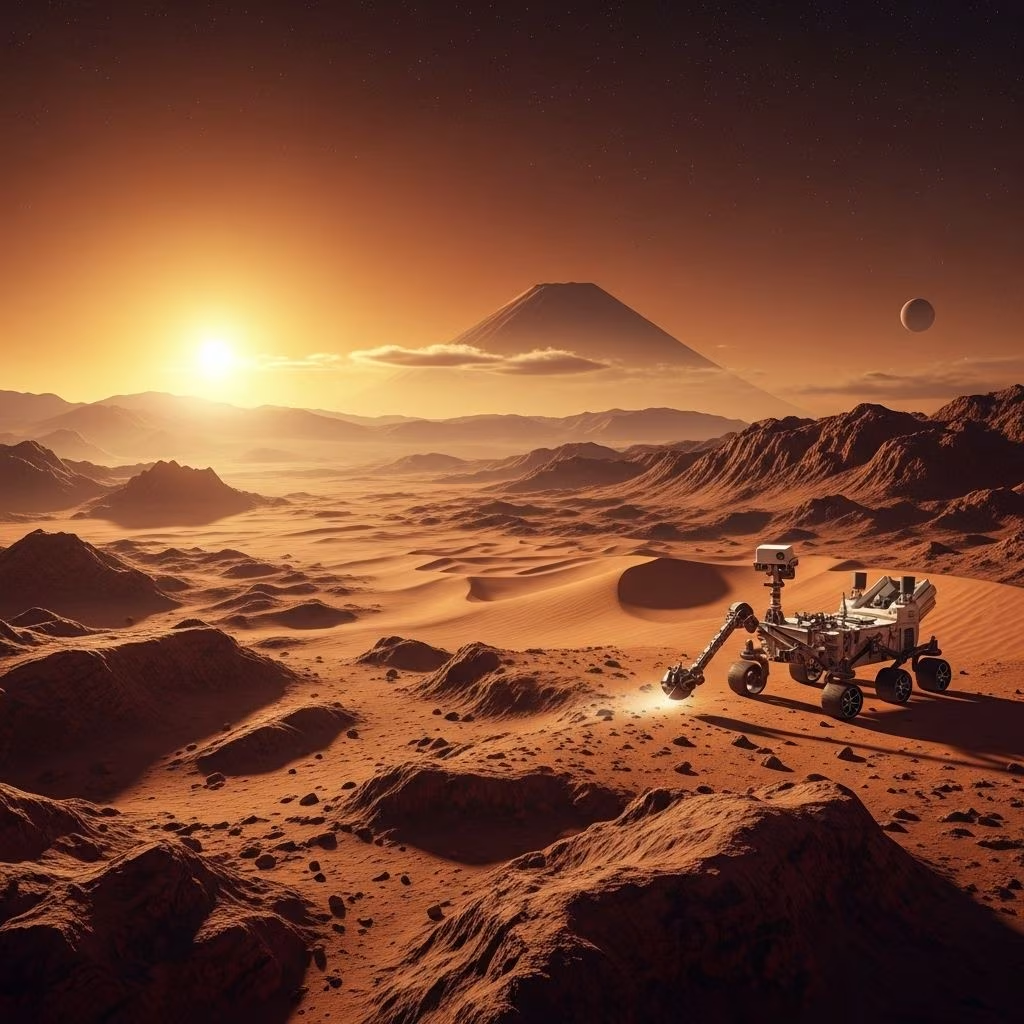
- NASA Rovers: Spirit, Opportunity, Curiosity, and Perseverance have examined geology, atmosphere, and searched for signs of ancient life.
- Orbiters: Missions like Mars Reconnaissance Orbiter and MAVEN study the planet from above, revealing climate data and surface details.
- International Contributions: The European Space Agency’s Mars Express, India’s Mars Orbiter Mission, and others increase our knowledge.
- Upcoming and Ongoing Missions: China’s Tianwen-1 (which includes a rover and orbiter), plus ambitious proposals for sample return missions.
Future Mars exploration includes:
- Mars Sample Return: NASA and ESA are planning to collect surface material and bring it back to Earth. China’s ambitious program may achieve this by 2028, with the U.S. targets set for the 2030s.
- Human Missions: Efforts continue to design safe, sustainable human journeys to and from Mars.
Habitability and the Search for Life
Could Mars host life?
- Ancient Habitability: Evidence of long-standing water and a more protective magnetic field suggest Mars was at least temporarily habitable.
- Modern Challenges: Harsh radiation, thin atmosphere, and extreme temperatures limit the prospects for current surface life.
- Subsurface Possibilities: Researchers propose ‘photosynthetic habitable zones’ beneath radiation-filtering ice, where life could theoretically survive.
As robotic explorers continue to analyze rocks and soil, the question of past or present life on Mars remains one of science’s greatest ongoing mysteries.
Challenges for Colonization
Mars presents formidable obstacles for long-term human habitation:
- Radiation Exposure: Without a magnetic field, cosmic radiation is intense.
- Thin Atmosphere: Difficult to breathe and inadequate for shielding.
- Cold Climate: Requires special habitats and technology for warmth.
- Soil Toxicity: Martian regolith contains perchlorates, which are hazardous for humans.
Despite these challenges, concepts like terraforming and self-sustaining colonies are investigated. Some scientists ask: How much greenhouse warming would be needed for trees to grow on Mars? While such visions remain distant, incremental advances in robotic missions advance our understanding of the planet’s possibilities.
Recent Discoveries and Scientific Insights
- Solar Eclipses: NASA’s Perseverance rover captured solar eclipses as Phobos passed in front of the Sun.
- Climate Change Insights: Curiosity continues to study transitions from a habitable, watery planet to today’s desert landscape.
- Planetary Migration Hypotheses: Some scientists speculate Mars may have once orbited closer to the Sun, leading to warmer and wetter conditions in its past.
Breakthroughs like these deepen our understanding of planetary evolution and what sets Mars apart in the solar system.
Mars in Myth, Science, and Culture
From the earliest civilizations, Mars has been a fixture in myth and legend. Its red color has linked it to war gods in Rome and Greece. In modern times, Mars is the setting for countless works of science fiction, from H.G. Wells’s “The War of the Worlds” to contemporary films and literature concerned with future colonization and adventure.
Frequently Asked Questions (FAQs) about Mars
Q: Why is Mars called the “Red Planet”?
A: Mars’s surface is coated with iron oxide dust, giving it a distinctive reddish hue.
Q: Does Mars have water today?
A: Mars retains water primarily as ice at its poles and in the soil; no large surface bodies of liquid water exist.
Q: Can humans breathe the air on Mars?
A: No. Mars’s atmosphere is mostly carbon dioxide and is far too thin for humans to breathe without specialized gear.
Q: What are the main challenges to living on Mars?
A: Major challenges include high radiation, low temperatures, a lack of breathable air, and toxic soil components.
Q: Are there plans to send people to Mars?
A: Various agencies, including NASA and private companies, are studying how to safely send humans to Mars—possibly as early as the 2030s.
Summary: Mars – The Ongoing Exploration
Mars stands as an iconic destination in our solar system, representing both the allure of cosmic discovery and the complexity of planetary evolution. From its gigantic volcanoes to its whisper-thin atmosphere and dramatic seasonal changes, Mars invites persistent investigation—by robotic explorers today and, perhaps someday, by humans. The mysteries of its ancient water, possible habitability, and the future of life on Mars ensure the Red Planet will remain a scientific frontier for generations to come.
References
- https://www.space.com/the-universe/solar-system/mars/page/2
- https://www.space.com/astronomy/solar-system/mars
- https://en.wikipedia.org/wiki/Solar_System
- https://en.wikipedia.org/wiki/Mars
- https://spacecenter.org/meet-our-solar-system-mars/
- https://www.youtube.com/watch?v=7DlVrwlkOb0
- https://www.popularmechanics.com/space/
- https://www.academicblock.com/science/our-solar-system/solar-system
- https://science.nasa.gov/mars/facts/
- https://www.icr.org/article/solar-system-mars
- https://science.nasa.gov/solar-system/planets/
- https://www.britannica.com/science/space-exploration/Solar-system-exploration
- https://www.spacex.com/humanspaceflight/mars/
- https://scitechdaily.com/lost-in-space-earth-and-mars-were-formed-from-missing-solar-system-material/