Venus’ Mysterious Rotation: When a Day Outlasts a Year
Among all the planets in our solar system, Venus stands out for several enigmas—but perhaps the strangest is that on Venus, a day lasts longer than a year. Much of this phenomenon arises from its dense, tumultuous atmosphere, as new research reveals, providing profound insights into planetary evolution and the likelihood of similar worlds across the galaxy.
Understanding Venus: The Hot, Hostile “Twin” of Earth
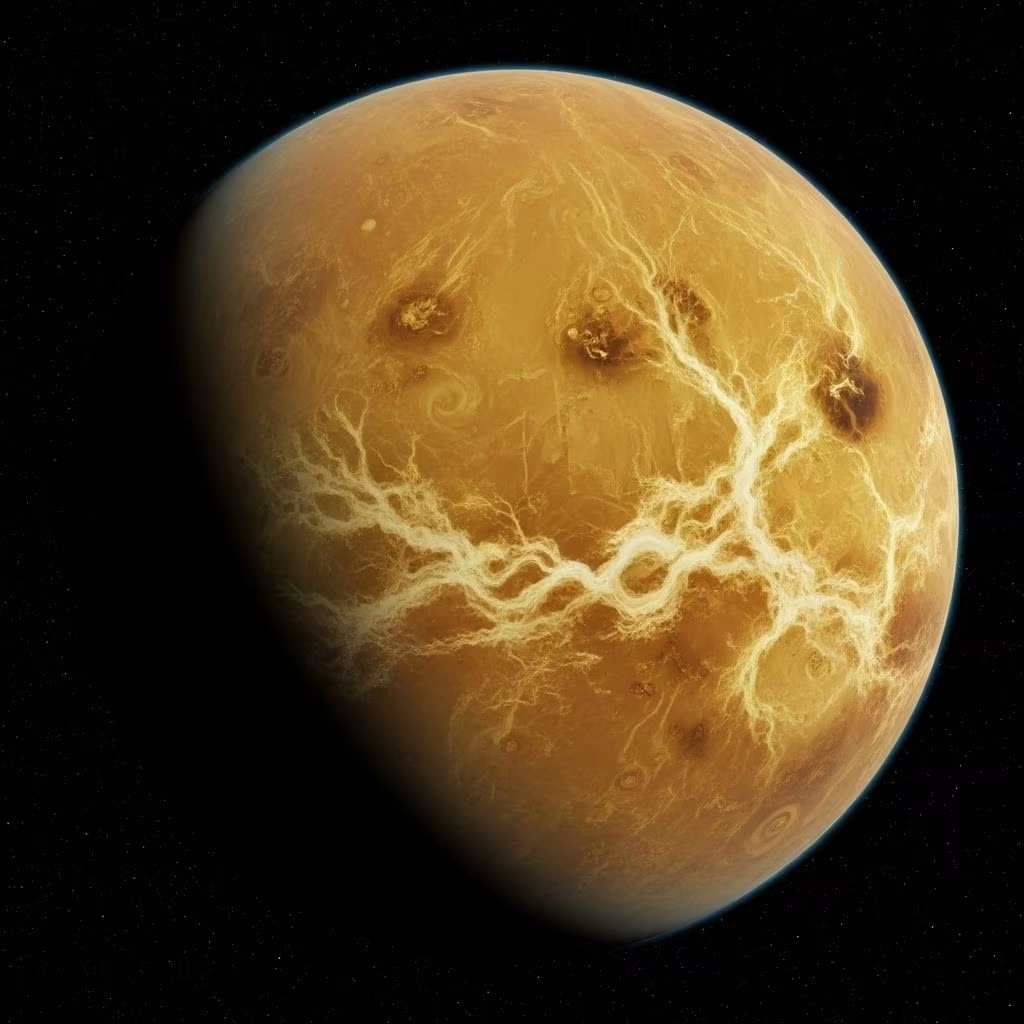
Venus is almost the same size as Earth and orbits the Sun at about two-thirds our own distance. Yet, the similarities end there. Shrouded in a suffocating envelope of carbon dioxide and sulfuric acid, Venus is home to surface temperatures that soar to 900 degrees Fahrenheit (475 degrees Celsius), hot enough to melt lead. This greenhouse effect renders the planet entirely hostile to life as we know it.
- Size: Nearly identical to Earth in diameter
- Distance from Sun: About 67 million miles (108 million km)
- Atmosphere: 96% carbon dioxide, thick clouds of sulfuric acid
- Surface temperature: ~900°F (475°C)
The Oddity of Time on Venus
But why does a day on Venus last longer than its year? Venus completes a single rotation on its axis in 243 Earth days, while it orbits the Sun in just 225 Earth days. This means that before Venus “sees” another sunrise, it has already circled the Sun once—a phenomenon observed nowhere else in our solar system.
| Planet | Rotation Period (Day) | Orbital Period (Year) |
|---|---|---|
| Earth | 24 hours | 365 days |
| Venus | 243 Earth days | 225 Earth days |
The Role of Venus’ Atmosphere: More Than a Blanket
For decades, scientists considered atmospheric layers as largely passive actors—almost separate from the solid planet below. Astrophysicist Stephen Kane and colleagues have upended this view, showing that Venus’ thick, dynamic atmosphere doesn’t just interact with the planet—it fundamentally shapes how its body rotates.
- Fast, persistent winds in the upper atmosphere circulate the planet every four days, far outpacing its rotation.
- Atmospheric drag exerts a frictional force on the surface, physically slowing Venus’ rotation.
- This drag loosens the Sun’s tidal grip, preventing what astronomers call tidal locking.
What Is Tidal Locking?
Tidal locking occurs when a smaller body—orbits so close to a larger one that its rotation slows until it always shows the same face to its companion, like our Moon does to Earth. Without its stormy atmosphere, the Sun’s gravity could have tidally locked Venus long ago, meaning the planet would keep one side perpetually facing the Sun while the other side remained in darkness.
Atmospheric Interplay: Slowing the Clock of Venus
Kane’s study reveals that the interplay between Venus’ atmosphere and its surface is anything but trivial. The atmosphere, filled with extremely fast winds, drags along the surface as it whirls, creating a sort of cosmic friction brake. This slows the planet’s rotation, making Venus one of the slowest spinning objects in the solar system.
- Without atmosphere: Venus could have been tidally locked—one hemisphere in perpetual day, the other eternally night.
- With atmosphere: The winds prevent locking, ensuring slow, but continuous, rotation.
The Sun’s Dual Role
The atmosphere’s motion is driven by solar energy. Curiously, while the Sun’s gravity tries to synchronize Venus’ rotation with its orbit (tidal locking), the Sun’s energy gives rise to the atmospheric motion that disrupts this very process. Thus, the Sun both pushes for tidal locking and, through the atmosphere, prevents it.
Venus’ Alien World: Consequences for Climate and Habitability
The slow spin of Venus results not only in the odd timekeeping but deeply influences its hellish climate. The staggering atmospheric pressure—92 times greater than Earth’s at sea level—combined with abundant greenhouse gases, ensures that heat is trapped efficiently. This produces uniformly scorching temperatures that do not deviate much between day and night, or even between the poles and the equator.
- Average surface temperature: 900°F (475°C)
- Atmospheric pressure: 92 times Earth’s, equivalent to being under nearly a kilometer of water
- Winds in the cloud tops: 200 mph (322 km/h)—much faster than the surface winds
A Walk (or Stand) on Venus
As astrophysicist Kane describes, “Standing on the surface of Venus would be like standing at the bottom of a very hot ocean. You couldn’t breathe on it.” The chemical makeup and pressure make it utterly inhospitable.
Broader Implications: Exoplanet Insights and Planetary Science
Venus doesn’t just challenge scientists’ understanding of our own solar system—it may be a key to interpreting the conditions of planets beyond it. With the advent of powerful exoplanet-hunting missions like the James Webb Space Telescope, researchers will increasingly find planets that are close in size and orbit to Earth and Venus.
- Atmospheric effects influence whether exoplanets might be tidally locked.
- Planetary rotation rate affects surface temperature, climate, and potential for habitability.
- Understanding Venus helps distinguish between Earth-like and Venus-like planets among exoplanets.
“First of all, when we’re looking at exoplanets, we want to make sure that we’re able to distinguish between an Earth similar planet and a Venus similar planet and then we want to understand what effect the atmosphere could be having on the planet and its rotation rate,” says Kane.
Upcoming Missions: A Renaissance for Venus Exploration
The unique properties of Venus are set for renewed focus in coming years, with three major missions on the horizon:
- NASA’s VERITAS—Aims to map the Venusian surface in unprecedented detail.
- NASA’s DAVINCI+—Will study the atmosphere and search for past water.
- ESA’s EnVision—A European mission to probe geology and climate.
These missions are expected to provide critical data—from atmospheric composition to surface geology—that may answer why Venus evolved so differently from Earth and how its atmospheric engine operates so effectively.
Frequently Asked Questions (FAQs)
Q: Why does Venus have such a slow rotation?
A: Venus’s slow rotation is caused by the strong friction from its thick, fast-moving atmosphere, which acts as a brake, slowing the solid surface beneath and preventing the planet from becoming tidally locked to the Sun.
Q: What is tidal locking, and how does it relate to Venus?
A: Tidal locking is when a celestial body’s rotation period matches its orbit, always presenting the same face to its host. Venus escapes this fate because its dynamic atmosphere resists the Sun’s tidal grip.
Q: How does Venus’s atmosphere differ from Earth’s?
A: Venus’s atmosphere is far thicker and richer in carbon dioxide, with clouds of sulfuric acid, exerting immense pressure and supporting winds faster than any on Earth. This difference leads to Venus’s uninhabitable surface conditions and its ultra-slow rotation.
Q: Why does understanding Venus matter for exoplanet research?
A: By unraveling how Venus’s atmosphere affects its rotation and climate, scientists can better interpret the nature of exoplanets, distinguishing potentially habitable worlds from inhospitable ones, and understand if similar atmospheric effects occur elsewhere.
Q: What future missions will study Venus?
A: Missions like NASA’s VERITAS and DAVINCI+, and ESA’s EnVision, are set to explore Venus’s surface and atmosphere in greater detail, which will help unlock secrets of planetary evolution both within and beyond our solar system.
References
- https://www.space.com/venus-atomphere-slows-down-rotation
- https://en.wikipedia.org/wiki/Atmosphere_of_Venus
- https://phys.org/news/2022-04-venus-rotates-slowly-sun-powerful.html
- https://scitechdaily.com/why-venus-rotates-slowly-despite-suns-powerful-gravitational-pull/
- https://news.ucr.edu/articles/2022/04/20/why-venus-rotates-slowly-despite-suns-powerful-grip
- https://www.space.com/venus-atomphere-slows-down-rotation&rut=d66483684e117146be3e0d50de03b268e4c49d0d15d792b5c87286577968cf11
- https://en.wikipedia.org/wiki/Venus
- https://www.universetoday.com/articles/is-venus-rotation-slowing-down
- https://spaceref.com/science-and-exploration/why-venus-rotates-slowly-despite-the-suns-powerful-grip/
- https://www.sci.news/space/venus-atmosphere-dynamics-10732.html
- https://science.nasa.gov/venus/venus-facts/
- https://newatlas.com/venus-rotation-slows/21453/
- https://www.youtube.com/watch?v=KvWzBGsxaSU
- https://www.worldatlas.com/space/why-does-venus-rotate-slowly-despite-being-so-close-to-the-sun.html
- https://observatoiredeparis.psl.eu/the-day-is-lengthening-and-the-planet-is-turning.html
- https://www.iflscience.com/why-does-slowturning-venus-have-such-a-fastmoving-atmosphere-55817
- https://www.ebsco.com/research-starters/astronomy-and-astrophysics/venuss-atmosphere
- https://www.sciencenews.org/article/venus-thick-atmosphere-speeds-planets-spin