


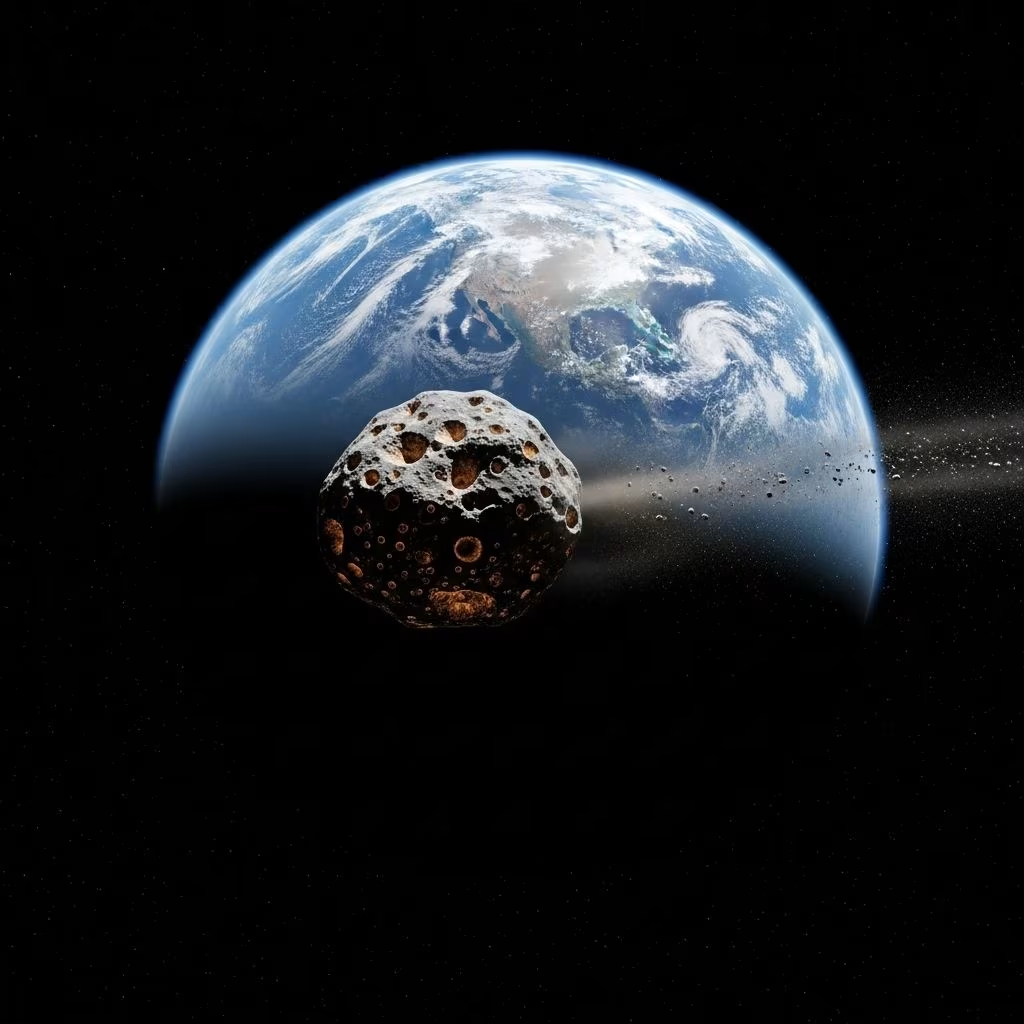
Goodbye to Earth’s Temporary Second Moon: Asteroid 2024 PT5
In a rare and captivating celestial event, Earth recently bid farewell to a visitor from the vastness of space—asteroid 2024 PT5, which graced our planet as a mini-moon for 56.6 days. While its stay was brief, the asteroid’s journey around Earth shines a spotlight on the complexity of orbital mechanics, the dynamic environment of our solar system, and the ever-present need for vigilance in planetary defense. This article explores the story of 2024 PT5, covering its discovery, orbital arc, scientific insights, and why such events matter for astronomers, students, and the future of space exploration.
What is Asteroid 2024 PT5?
2024 PT5 is a small asteroid, measuring approximately 10 meters (about 37 feet) in diameter, classifying it as a mini-moon when temporarily captured by Earth’s gravitational pull. This makes it vastly smaller than the planet’s permanent natural satellite, the Moon, which has a diameter of 3,476 kilometers. Its origin traces back to the Arjuna asteroid belt, a collection of Near-Earth Objects (NEOs) with orbits similar to Earth’s around the Sun. Discovered in August 2024 by astronomers working with NASA’s Asteroid Terrestrial Impact Last Alert System (ATLAS), the asteroid provides an excellent case study in how small celestial bodies interact with Earth’s gravity.
- Diameter: ~10 meters (37 feet)
- Classification: Temporary mini-moon
- Origin: Arjuna asteroid group
- Discovery: August 7, 2024, via ATLAS and South Africa’s Sutherland Observatory
The Arjuna group, named after the mythological archer of the Indian epic Mahabharata, consists of asteroids whose orbits are characterized by swift and occasionally unpredictable proximity to Earth’s own orbital path.
The Brief Visit: Orbital Dynamics and Duration
Asteroid 2024 PT5 was drawn into Earth’s gravitational embrace on September 29, 2024, marking the start of its voyage as a mini-moon. Unlike the Moon’s steady, elliptical circuit, 2024 PT5’s trajectory formed a complex horseshoe-shaped path influenced by both gravitational and orbital resonance effects. Its stay lasted just 56.6 days, ending on November 25, 2024, when the asteroid broke free and resumed its journey around the Sun.
Key Points on 2024 PT5’s Orbital Stay:
- Entry: Captured September 29, 2024
- Departure: November 25, 2024
- Duration: 56.6 days (slightly under two months)
- Orbit Type: Horseshoe-shaped, not completing a full revolution
Unlike our Moon, which completes a revolution every 27.3 days, 2024 PT5 did not make a full orbit. Its twisted trajectory, shaped by complex gravitational forces, underscores the unpredictable nature of these transient companions.
Observing a Mini-Moon: Visibility and Detection
Although dubbed a “second moon,” 2024 PT5’s size and dimness made it impossible to observe with the naked eye. Only professional-grade telescopes, typically located at major observatories, could detect the asteroid. The initial discovery in South Africa was made possible thanks to sensitive instruments deployed by the ATLAS program.
- Standard amateur telescopes were unlikely to capture this faint and small object according to astronomer Jennifer Millard.
- Images and data collected during this period are expected to become available for enthusiasts and researchers interested in the event.
Mini-Moons Through History: Other Notable Temporary Satellites
Asteroid 2024 PT5 is not the first mini-moon to grace Earth. Previous examples highlight how these phenomena are rare yet recurring aspects of our planet’s cosmic neighborhood:
- 2020 CD3: Captured in Earth’s orbit for several years before departing in 2020.
- 2022 NX1: Became a mini-moon in both 1981 and 2022, with predictions suggesting a return by 2051.
- Similar mini-moon events have occurred in 1981, 1997, 2013, and 2018 as Earth continues to intercept small Near-Earth Objects.
As with 2024 PT5, these mini-moons enter and exit Earth’s gravitational proximity, providing astronomers with opportunities to study orbital dynamics in real-time.
Table: Comparison of Earth’s Mini-Moons
| Asteroid Name | Size | Period as Mini-Moon | Origin | Future Return Predicted? |
|---|---|---|---|---|
| 2024 PT5 | ~10 meters | 56.6 days (2024) | Arjuna Asteroid Belt | Predicted in 2055 |
| 2020 CD3 | ~2 meters | ~3 years (2017–2020) | Unknown NEO | Unlikely |
| 2022 NX1 | Unknown | 1981, 2022 | Unknown NEO | Predicted in 2051 |
The Arjuna Asteroid Belt: Origin and Significance
The Arjuna asteroid belt consists of Near-Earth Objects that share orbital characteristics with Earth. Named after the legendary Egyptian warrior Arjuna, these asteroids follow swift and sometimes unpredictable paths through space. 2024 PT5’s membership in this group offers insight into the dynamic conditions that allow such objects to be temporarily captured by Earth and other planets.
- The group’s proximity to Earth means many Arjuna asteroids could, on rare occasions, become mini-moons or even pose impact risks.
- The unpredictable nature of their orbits makes continued observation and cataloging a scientific priority.
Scientific Importance: What Can We Learn from Mini-Moon Events?
Mini-moon encounters like the visit of 2024 PT5 are invaluable to planetary science. As explained by scientists from networks like ISRO’s NETRA and NASA’s ATLAS, tracking such objects:
- Yields data on how asteroids interact with planetary gravity
- Aids in modeling orbital resonances and how small bodies escape, remain, or return to planetary proximity
- Improves understanding of Near-Earth Object population dynamics
- Supports planetary defense initiatives by highlighting the ongoing movement and frequency of NEOs near Earth
Each mini-moon event is a natural experiment, offering real-time evidence for the theories of orbital capture, gravitational effects, and asteroid path prediction.
Why These Events Matter: Beyond Science
For students and aspiring astronomers, the brief presence of a mini-moon like 2024 PT5 demonstrates key concepts in astrophysics and planetary defense. It also highlights the crucial role of international monitoring systems such as ATLAS, capable of discovering and tracking objects that may one day pose risks to Earth. As the solar system continues to challenge and surprise us, such phenomena remind learners of the universe’s vastness and complexity—a cosmic classroom ever in session.
- Mini-moon events provide a direct, practical window into orbital mechanics and gravitational effects.
- The monitoring and cataloging of NEOs is critical for anticipating both future cosmic visitors and potential threats.
- Learning about dynamic interactions between Earth and smaller bodies emphasizes the importance of ongoing investment in astronomical instrumentation and interdisciplinary research.
Frequently Asked Questions (FAQs) about 2024 PT5 and Mini-Moons
Q: What makes an asteroid a “mini-moon”?
A: An asteroid is classified as a mini-moon when it becomes temporarily captured by Earth’s gravitational field and orbits the planet for a short duration, unlike our permanent natural satellite.
Q: Why did 2024 PT5 only stay for about two months?
A: The asteroid’s small mass and high velocity allowed Earth’s gravity to capture it briefly, but its trajectory prevented completion of a full orbit before it escaped and resumed its path around the Sun.
Q: How was 2024 PT5 discovered?
A: The asteroid was detected on August 7, 2024, by the NASA-funded ATLAS system, using instruments located at the Sutherland Observatory in South Africa.
Q: Will 2024 PT5 return to Earth’s orbit?
A: Predictions suggest that 2024 PT5 will return for another close approach in 2055, demonstrating the recurring nature of such mini-moon events.
Q: Can the general public observe mini-moon asteroids like 2024 PT5?
A: Due to their small size and faintness, mini-moons are generally only visible with professional-grade observatories rather than amateur telescopes or the naked eye.
Looking Ahead: The Hunt for Future Mini-Moons
2024 PT5’s brief orbital sojourn highlights a fundamental truth about Earth’s place in the solar system: our planet is constantly interacting with a bustling neighborhood of near-Earth objects. Advances in space-based and terrestrial observatories—ATLAS, NETRA, and similar networks—promise that future mini-moons will continue to be discovered, tracked, and studied. As scientists refine predictive models, each new visitor brings fresh opportunities for both education and defense.
- The next time Earth is visited by a mini-moon, our collective astronomical toolkit will be even more refined.
- Continued engagement and investment in asteroid monitoring will safeguard our planet and expand our knowledge.
Conclusion: The Cosmic Significance of Transient Moons
The brief passage of 2024 PT5 as Earth’s temporary second moon is a compelling reminder of the solar system’s dynamism. Each encounter deepens our understanding of orbital mechanics, the population of NEOs, and the intricacies of gravitational interplay. For astronomers, students, and cosmic enthusiasts alike, the saga of 2024 PT5 is a testament to the importance and wonder of monitoring the universe—a never-ending adventure in discovery and learning.
References
- https://www.space.com/goodnight-second-moon-asteroid-2024PT5
- https://www.space.com/earth-second-moon-2024-PT5-asteroid
- https://www.cbsnews.com/news/earth-second-mini-moon-2024/
- https://en.wikipedia.org/wiki/2024_PT5
- https://www.youtube.com/watch?v=m3r1gcYTaxQ
- https://www.youtube.com/watch?v=KmjOUOAPLmk
- https://timesofindia.indiatimes.com/education/news/earth-gets-second-moon-for-two-months-named-2024-pt5-seven-things-every-student-should-know-about-this-asteroid/articleshow/113799482.cms
- https://news.web.baylor.edu/news/story/2024/newly-discovered-asteroid-2024-pt5-becomes-earths-temporary-mini-moon
- https://www.earth.com/news/2024-pt5-mini-moon-say-goodbye-to-earths-second-moon-we-barely-got-to-know-you/
- https://time.com/7022535/earth-second-moon-temporary/
- https://www.ndtv.com/science/asteroid-2024-pt5-earths-second-moon-set-to-disappear-wont-return-until-2055-7063428
- https://www.businessinsider.com/second-moon-orbiting-earth-when-why-what-to-know-2024-9
- https://www.businesstoday.in/technology/news/story/earth-will-get-a-second-moon-from-september-29-everything-you-need-to-know-about-2024-pt5-446916-2024-09-21
- https://www.earth.com/news/its-official-earth-now-has-two-moons-captured-asteroid-2024-pt5/
- https://www.indiatoday.in/science/story/earth-second-mini-moon-nasa-asteroid-2024-pt5-origin-gravity-2668929-2025-01-23


