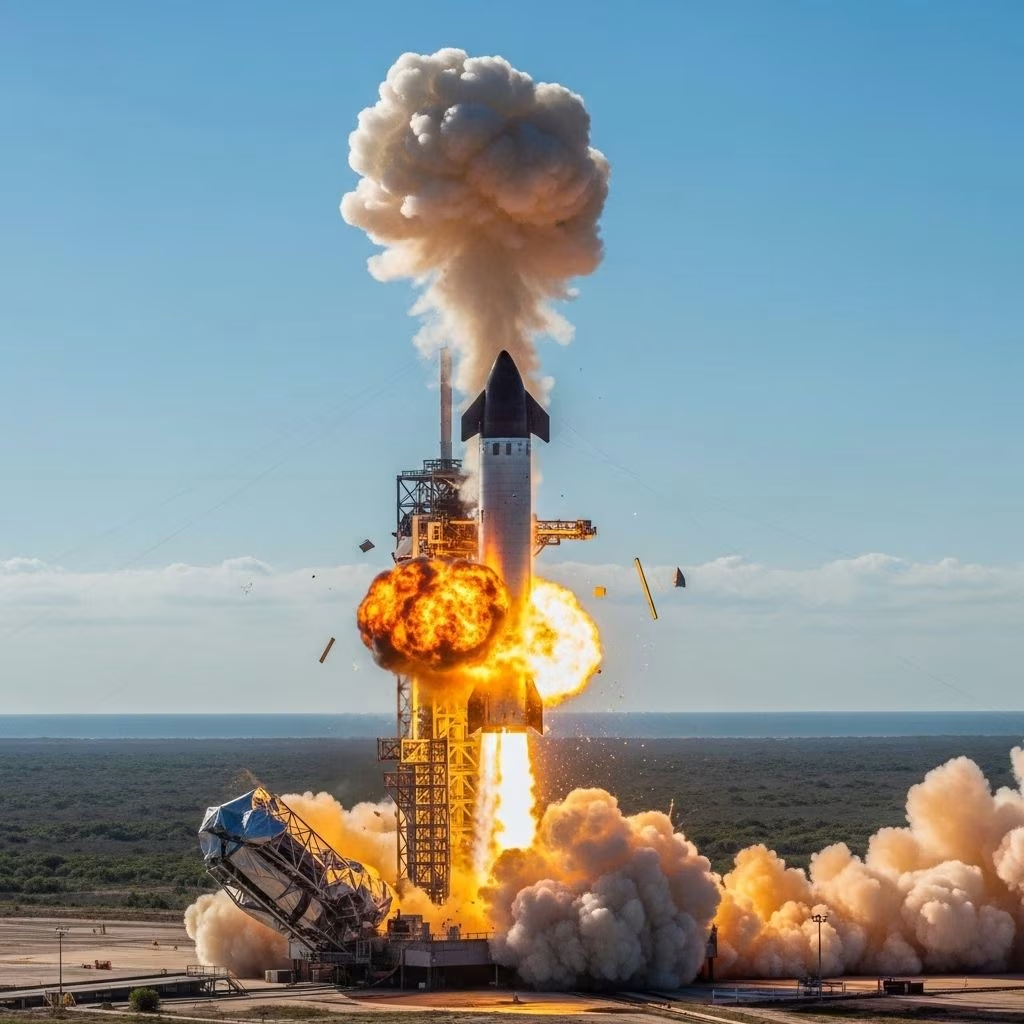
SpaceX Starship Explodes in Texas During Test for 10th Flight
SpaceX’s ambitions for deep space exploration suffered a dramatic blow on Wednesday night as a Starship vehicle exploded at the company’s Starbase facility in South Texas. The blast occurred during preparations for the tenth test flight of the megarocket, raising fresh questions about both the risks and the resilience inherent to the company’s rapid development approach.
Video footage of the incident, captured by observers onsite, showed a massive fireball lighting up the Texas night sky as the Starship upper stage was engulfed in flames, ending the scheduled test in spectacular and unsettling fashion.
What Happened at Starbase?
The explosion occurred during a planned static fire test of the Starship upper stage, known as Ship 36, as teams were preparing for what would be the tenth attempt at flight for SpaceX’s next-generation launch architecture. According to SpaceX’s statement, the incident took place at approximately 11 p.m. local time (midnight EDT, 0400 GMT on June 19).
- Timing: The event happened late on June 18, 2025, during nighttime hours.
- Location: Starbase facility, Brownsville, Texas, situated on the southwestern Gulf Coast.
- Nature: The anomaly occurred just before the static fire — a procedure where engines are fired while the rocket remains anchored to the ground for validation testing.
As video recordings from NASASpaceflight.com and other onsite channels spread across social media, two distinct explosions could be identified: the first near the rocket’s nose, quickly followed by a second explosion on the vehicle’s side.
SpaceX’s Response: Safety and Security
SpaceX was quick to release statements via their official X (formerly Twitter) channel after the incident:
- All personnel at the Starbase site were confirmed safe and accounted for.
- No hazards were reported to residents of the surrounding communities.
- SpaceX coordinated with local authorities to secure the test site and its immediate area.
- The company urged people to avoid the area while safety operations continued, reiterating that no immediate risk existed for nearby residents.
SpaceX’s rapid statement emphasized their commitment to safety, reflecting common protocols established throughout the Starship program, which has involved regular testing of prototype vehicles, often leading to spectacular failures but also critical learning opportunities.
What Led to the Explosion?
As of June 19, 2025, SpaceX and its leadership, including Elon Musk, indicated that the cause of the anomaly remained under investigation. Early analysis suggested a possible fault in a critical component:
- Nitrogen COPV Failure: Musk posted that preliminary data points to a failure in the nitrogen Composite Overwrapped Pressure Vessel (COPV) located in the vehicle bay. The COPV is designed to store nitrogen gas at high pressures, playing a crucial role in stage pressurization and other support functions.
- If confirmed, this would represent the first known failure of this specific COPV design in Starship testing history.
The vehicle was being loaded with high-energy methane and liquid oxygen — both highly volatile propellants — at the time of the anomaly, contributing to the size and intensity of the resulting fireball.
Background: The Starship Program and Its Ambitions
SpaceX’s Starship-Super Heavy system represents the company’s boldest effort to date: the creation of a fully reusable transport system capable of carrying cargo — and eventually crew — to the Moon, Mars, and potentially even further. Starship is the upper portion of the full stack, mounted atop the massive Super Heavy booster for launches. The entire configuration stands nearly 400 feet tall.
Program Milestones and Testing Challenges
- Since beginning integrated test flights, SpaceX has launched nine Super Heavy-Starship flights over the past two years.
- The first three attempts ended in explosions or vehicle breakup. The subsequent three were only partially successful, with the vehicles encountering difficulties after lift-off or during atmospheric re-entry.
- Two more flights ended in explosions, and the latest (in May 2025) saw the rocket reach its planned trajectory but break up during re-entry after a loss of attitude control.
Despite these frequent failures, SpaceX’s philosophy of “fail fast, learn faster” has allowed engineers to iterate quickly, adopting lessons from every malfunction to refine hardware, software, and operational protocols.
Significance of Ship 36 and the 10th Test Flight
The vehicle that exploded, dubbed Ship 36, was set to conduct the tenth major test for Starship. This milestone was highly anticipated, as SpaceX has been moving closer to demonstrating the full capabilities of Starship, a requirement for future moon landings under NASA’s Artemis program and, eventually, missions to Mars.
- Objective of the 10th Flight: To validate upgrades in both the vehicle and its flight systems, further testing Starship’s ability to reach orbit and safely return.
- A successful test would bring SpaceX one step closer to operational human spaceflight beyond Earth orbit.
With this latest explosion, preparations for the tenth flight are paused pending resolution of safety reviews and the completion of technical investigations.
Table: Timeline of Starship Test Flights
| Flight Number | Date | Result | Key Notes |
|---|---|---|---|
| 1-3 | 2023-2024 | Explosions/Breakups | Early vehicle failures on ascent or landing. |
| 4-6 | 2024 | Partially Successful | Some flight milestones achieved, vehicle lost later in flight. |
| 7-8 | Early 2025 | Explosions | Loss of vehicle during or post launch. |
| 9 | May 2025 | Lost on Re-entry | Reached trajectory, broke up re-entering atmosphere. |
| Preparation for 10 | June 2025 | Explosion on Test Stand | Static fire anomaly destroyed Ship 36. |
Elon Musk and SpaceX’s Vision for Starship
Founded in 2002 by tech entrepreneur Elon Musk, SpaceX aims to revolutionize access to space, with the ultimate vision of enabling humanity to become a multiplanetary species. Starship is central to this aspiration. The platform is designed to carry dozens of astronauts or up to 150 metric tons of cargo per flight, making it one of the most ambitious human engineering projects in history.
Starship’s Key Features
- Fully Reusable: Both Starship (upper stage) and Super Heavy booster are intended for rapid reusability, analogous to commercial airliners.
- Methane Engines: Uses methane and liquid oxygen for propulsion (Raptor engines), supporting in-situ resource utilization on Mars.
- Moon and Mars Readiness: Contracted by NASA to serve as a lunar lander under the Artemis program and potentially to ferry humans to Mars in the coming decade.
- Rapid Iteration: Aggressive prototype testing, even on the risk of publicly visible failures, strengthens system robustness over time.
Failures like the Ship 36 anomaly, though dramatic, are regarded by both SpaceX and supporters as crucial learning opportunities on the path to sustainable spaceflight capability.
What’s Next for Starship?
The investigation into the exact technical cause of the Starship explosion is underway. SpaceX engineers are evaluating preliminary data, especially regarding the nitrogen COPV and refueling operations. The incident is expected to delay, but not permanently halt, the schedule for Starship’s next integrated test flight.
SpaceX has historically demonstrated the capability to recover and iterate quickly from failures by:
- Rapidly introducing new hardware builds with modifications based on root cause analyses.
- Updating ground operation procedures to improve safety and reliability.
- Continuously communicating with regulatory authorities and local officials about operational impacts.
Implications for Space Travel and SpaceX’s Goals
The explosion of Ship 36 underscores both the scale of the challenge and the resilience of SpaceX’s approach. Starship remains critical to several key objectives:
- Enabling cost-effective, high-frequency access to orbital space and beyond.
- Supporting NASA’s Artemis program for lunar exploration.
- Making human flights to Mars practical within the next decade.
Every setback adds technical and operational knowledge, strengthening the long-term viability of the program.
Public and Community Impact
In SpaceX’s official communications, the safety and well-being of both staff and the broader community were emphasized:
- There were no reported injuries among SpaceX staff or local residents.
- No hazardous conditions for the community in surrounding areas were identified, as confirmed by both SpaceX and local authorities.
- The company coordinated actively with first responders and municipal agencies to maintain a safety perimeter during and after the incident.
Residents and space enthusiasts continue to show support for SpaceX’s ambitious goals, often gathering around Starbase for launches and tests — a testament to the company’s influence on public excitement for space.
Frequently Asked Questions (FAQs)
Q: Was anyone hurt during the explosion at Starbase?
A: No. SpaceX and local authorities confirmed that all personnel were accounted for, with no injuries reported among staff or the surrounding community.
Q: What caused the Starship explosion?
A: The exact cause is under investigation. Preliminary data suggests a failure in the nitrogen COPV (Composite Overwrapped Pressure Vessel), which stores high-pressure nitrogen gas onboard the vehicle.
Q: Will this delay Starship’s next launch?
A: The incident is likely to delay preparations for the tenth test flight as SpaceX investigates the anomaly, gathers engineering data, and implements safety improvements.
Q: How often do Starship test flights fail?
A: Starship test flights are high-risk and have experienced multiple notable failures, especially in early development. Of nine previous major flights, several ended in explosions or loss of vehicle, with significant engineering progress made after each event.
Q: What is the significance of Starship for future space exploration?
A: Starship is integral to SpaceX’s plans for making space travel more affordable and routine, enabling human missions to the Moon, Mars, and beyond. Its eventual success would mark a paradigm shift in long-duration, high-capacity space missions.
Summary: The Path Forward
The June 2025 explosion of Ship 36 serves as a stark reminder of both the hazards and the high stakes involved in advancing human spaceflight. While setbacks such as this are dramatic, they are also fundamental to SpaceX’s development philosophy. With lessons learned, new hardware iterations, and a still unshaken vision for a multiplanetary future, the Starship program moves forward, continuing to capture the world’s imagination and pushing the boundaries of what is possible in space technology.
References
- https://www.cbsnews.com/news/video-spacex-starship-explosion-texas-launch-site/
- https://www.youtube.com/watch?v=71AwkBt3_ts
- https://www.space.com/space-exploration/launches-spacecraft/spacexs-starship-explodes-in-texas-during-preparations-for-10th-test-flight
- https://spaceflightnow.com/2025/06/19/next-starship-explodes-on-test-stand/
- https://www.usatoday.com/story/news/nation/2025/06/19/spacex-starship-rocket-explodes-texas/84273349007/
- https://www.foxbusiness.com/economy/spacex-starship-explodes-texas-launch-site
- https://www.livescience.com/space/space-exploration/spacexs-starship-explodes-on-texas-launch-pad-in-catastrophic-failure-during-routine-test
- https://www.youtube.com/watch?v=f4tOUsAsSLM
- https://www.cbsnews.com/news/spacex-starship-upper-stage-explosion-expected-engine-test-firing/
- https://phys.org/news/2025-06-spacex-starship-routine.html
- https://www.space.com/space-exploration/launches-spacecraft/spacex-traces-starship-test-stand-explosion-to-failure-of-pressurized-nitrogen-tank
- https://time.com/7296069/spacex-explosion-texas-starbase/
- https://techcrunch.com/2025/06/19/spacexs-starship-blows-up-ahead-of-10th-test-flight/
- https://nextspaceflight.com/starship/
- https://www.dailypioneer.com/2025/top-stories/elon-musk—s-spacex-rocket-being-tested-in-texas-explodes–no-injuries-reported.html