How Far Is Uranus?
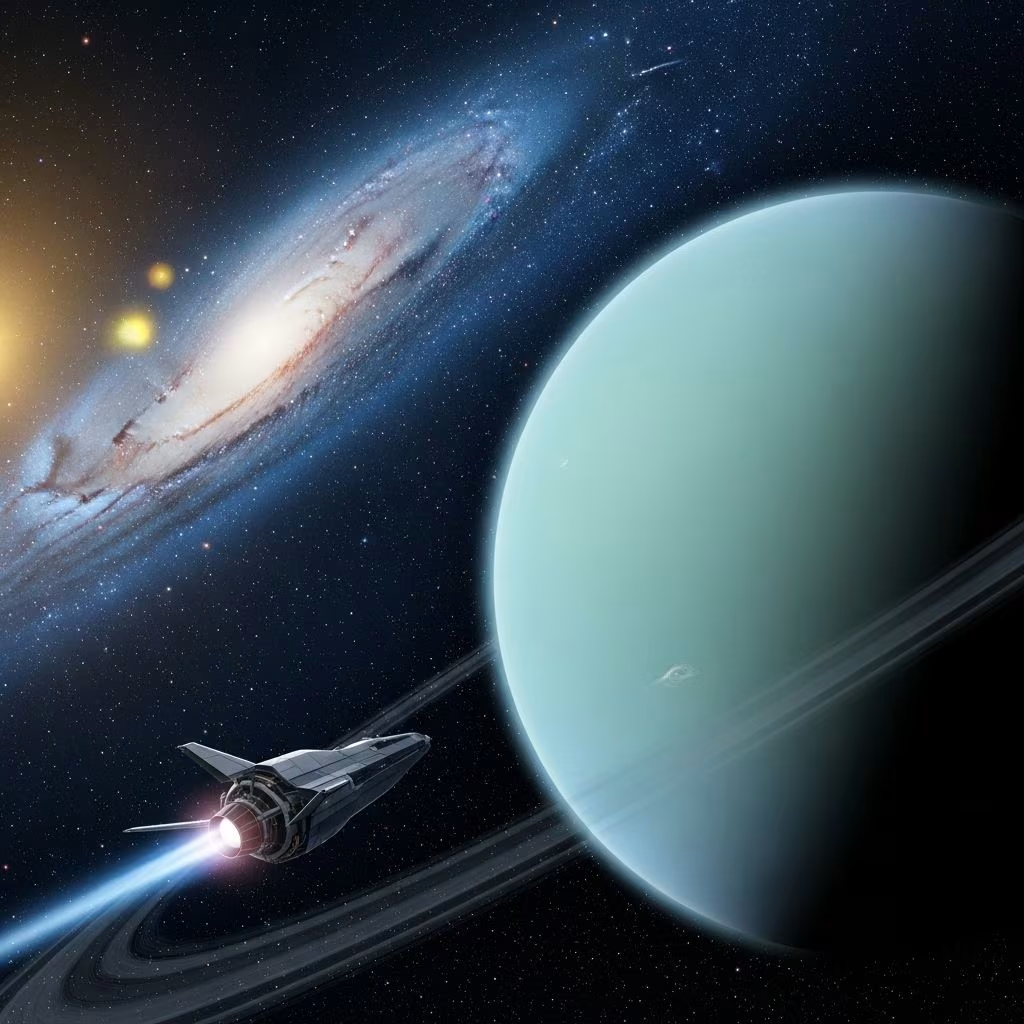
Uranus, the enigmatic ice giant, sits as the seventh planet from the Sun in our solar system. Its remote location piques curiosity: just how far is Uranus from both Earth and the Sun? The answer involves vast distances and dynamic orbital mechanics, making Uranus one of the most isolated planets with dramatic implications for science and exploration.
Uranus Overview
Uranus is classed as an ‘ice giant,’ distinguished by its cold temperature, bluish hue due to methane in its atmosphere, and unique position in the solar system. Located beyond Saturn and before Neptune, Uranus holds a special place as a distant marker of the outer solar frontier.
- Planet type: Ice giant
- Diameter: 31,763 miles (51,118 km)[10]
- Orbital period: 84 Earth years for one Uranus year[10]
- Atmospheric composition: Hydrogen, helium, methane
- Moons: At least 27 known moons
How Far Is Uranus From the Sun?
The vast extent between Uranus and the Sun defines its cold climate and slow orbit. This distance is not static; Uranus moves in an elliptical orbit (not a perfect circle), causing its distance from the Sun to vary slightly throughout its 84-year journey around our star[10].
Key Numbers
- Average distance: About 1.8 billion miles (2.9 billion kilometers)[10]
- Closest point (perihelion): ~1.7 billion miles (2.735 billion kilometers)[10]
- Farthest point (aphelion): ~1.87 billion miles (3.006 billion kilometers)[10]
- Astronomical Units (AU): Typically 19 AU (where 1 AU ≈ 93 million miles, the average Earth-Sun distance)
Because Uranus’s orbit is only mildly elliptical (orbital eccentricity ≈ 0.04), the difference between its closest and farthest approach to the Sun is relatively small compared to other planets with more eccentric orbits[10].
| Month | Distance from Sun (miles) | Distance from Earth (km) |
|---|---|---|
| Jan | 1.828 billion | 2.943 billion |
| Feb | 1.828 billion | 2.942 billion |
| Mar | 1.828 billion | 2.941 billion |
| Apr | 1.827 billion | 2.941 billion |
| May | 1.827 billion | 2.940 billion |
| Jun | 1.826 billion | 2.939 billion |
| Jul | 1.826 billion | 2.938 billion |
| Aug | 1.824 billion | 2.938 billion |
| Sep | 1.825 billion | 2.937 billion |
| Oct | 1.825 billion | 2.936 billion |
| Nov | 1.824 billion | 2.936 billion |
| Dec | 1.824 billion | 2.935 billion |
How Far Away is Uranus from Earth?
Uranus’s distance from Earth is even more variable, as both planets are constantly in motion around the Sun. At close approach (opposition), Uranus is nearest to Earth, while at conjunction, when the planet is on the far side of the Sun, it is at its farthest.
- Closest approach: About 1.6 billion miles (2.6 billion kilometers)
- Farthest distance: Up to 1.8 billion miles (3 billion kilometers)
- Typical range: 2.6–3.0 billion kilometers (1.6–1.8 billion miles)
As of the most recent measurements, the current distance between Uranus and Earth is approximately 2.84 billion kilometers (18.97 AU). In astronomical terms, this means light takes over two and a half hours to travel from Uranus to Earth.
Understanding Uranus’s Orbit
Uranus’s orbit is almost circular, but the slight eccentricity causes small changes in its solar distance throughout its 84-year revolution. This slow orbit makes Uranus’s seasons unusually long and dramatically influences its visibility from Earth.
- Orbital period: 84 Earth years
- Orbital eccentricity: 0.04 (very mild)
- Orbital inclination: 0.77 degrees to the solar system’s plane
Why Do Distances Vary?
- Planets move in elliptical paths, not perfect circles
- Earth’s own orbit is also slightly elliptical
- Relative positions mean distances between planets constantly shift
- Opposition and conjunction cycles determine closest and farthest approaches
How Long Does Light Take to Reach Uranus?
The enormous gap between Uranus and the Sun—and Earth—affects the time it takes for light to travel these distances. This is crucial not just for scientific measurement, but for communications with spacecraft in Uranus’s vicinity.
- Sun to Uranus: Light requires about 2 hours 45 minutes to reach Uranus on average.
- Earth to Uranus: Currently, the light travel time is just under 2 hours, 38 minutes.
By comparison, light from the Sun reaches Earth in only about 8 minutes and 20 seconds. This highlights the sheer scale of the solar system beyond the inner planets.
Travel to Uranus: Spacecraft Challenges
Journeying to Uranus presents formidable engineering and logistical challenges. Even with the fastest spacecraft technology available today, reaching Uranus takes years, and future missions will need to overcome the vast distances and harsh conditions of deep space.
- Average spacecraft speed: Approximately 21 kilometers per second (13 miles per second)
- Estimated travel time: A round-trip mission (with brief study period) could take over 30 years using current propulsion systems
- Optimal transfer orbits: Hohmann transfers can be inefficient for Uranus; advanced trajectory planning is essential
- Solar power viability: Solar energy is impractical at Uranus’s distances; missions must rely on nuclear or alternative power sources
NASA’s Voyager 2 is so far the only spacecraft to have flown by Uranus, passing it in 1986. No dedicated mission has yet reached Uranus, though proposals for orbital missions are in development, leveraging more advanced propulsion and power technologies.
Impact on Observation and Exploration
Uranus’s prodigious distance limits what can be observed from Earth and restricts in-depth exploration:
- Apparent size: Uranus appears as a small disc, often resembling a star or faint dot in telescopes
- Brightness: Its magnitude fluctuates depending on its distance and position, but it remains relatively dim without large telescopes
- Communication delays: Spacecraft signals to or from Uranus encounter a lag of several hours
- Long orbital and seasonal cycles: Scientific observations span decades to capture full seasonal changes
Despite these challenges, Uranus offers scientists insights into ice giant formation, extreme planetary weather, and the solar system’s outer reaches.
Frequently Asked Questions (FAQs)
Q: What is the average distance from Earth to Uranus?
A: The average Earth-Uranus distance is about 2.9 billion kilometers (1.8 billion miles), but this can vary between 2.6 and 3 billion kilometers depending on the planets’ relative positions.
Q: Is Uranus farther from the Sun than Neptune?
A: No, Uranus is the second-farthest planet from the Sun, with Neptune being the most distant in the solar system.
Q: Why does Uranus have such long seasons?
A: Uranus’s unique 84-year orbit and an extreme axial tilt of 98 degrees mean each hemisphere can experience decades of uninterrupted sunlight or darkness, leading to unusually long seasons.
Q: How does Uranus’s distance affect exploration missions?
A: The colossal distance to Uranus makes missions lengthy and costly, demands nuclear power, and ensures a significant communication lag. Engineering challenges are much greater than for Mars or Jupiter missions.
Q: How long would humans take to travel to Uranus?
A: Using current technology, a crewed round trip would require over 30 years, making uncrewed missions the only feasible option for now.
Additional Resources
- Live Position Tracker: High-precision real-time tracking tools visualize Uranus’s position in deep space.
- Distance Calculators: Interactive web calculators reveal Uranus’s current distance from Earth and other planets.
- Ephemeris Tables: Detailed tables forecast Uranus’s position and brightness for astronomers.
- Sky Maps: Visualizations help identify Uranus in the night sky, especially during opposition.
Summary
Uranus, occupying an average distance of 1.8 billion miles from the Sun and up to 2.9 billion kilometers from Earth, stands as a monument to the scale of our solar system. The planet’s nearly circular orbit, immense travel times for light and spacecraft, and its cold, mysterious nature continue to intrigue scientists and stargazers alike. As technology advances, new missions may one day reach Uranus, exploring its secrets in greater depth and illuminating the far reaches of planetary science.
References
- https://www.space.com/18709-uranus-distance.html
- https://www.space.com/3136-uranus-data-sheet.html
- https://news.ycombinator.com/item?id=38696342
- https://www.astronomy.com/science/uranus/
- https://theskylive.com/uranus-info
- https://science.nasa.gov/uranus/facts/
- https://theskylive.com/how-far-is-uranus
- https://worldmetrics.org/uranus-travel-duration-statistics/
- https://www.letstalkstars.com/how-far-is-uranus-from-the-sun/
- https://lovethenightsky.com/how-far-is-uranus-from-the-sun/
- https://en.wikipedia.org/wiki/Exploration_of_Uranus
- https://nssdc.gsfc.nasa.gov/planetary/factsheet/uranusfact.html
- https://en.wikipedia.org/wiki/Uranus
- https://astrophotographylens.com/blogs/astro/uranus-distance-from-sun
- https://spacecenter.org/meet-the-solar-system-uranus/
- https://aircosmosinternational.com/article/uranus-has-never-been-so-beautiful-3774
- https://historyinnumbers.com/places/space/solar-system/planet-uranus/
- https://nineplanets.org/questions/how-far-is-uranus-from-earth/
- https://lco.global/spacebook/solar-system/uranus/
- https://www.encyclopedia.com/science-and-technology/astronomy-and-space-exploration/astronomy-general/uranus-astronomy