Jupiter’s Great Red Spot: The Colossal, Shrinking Storm
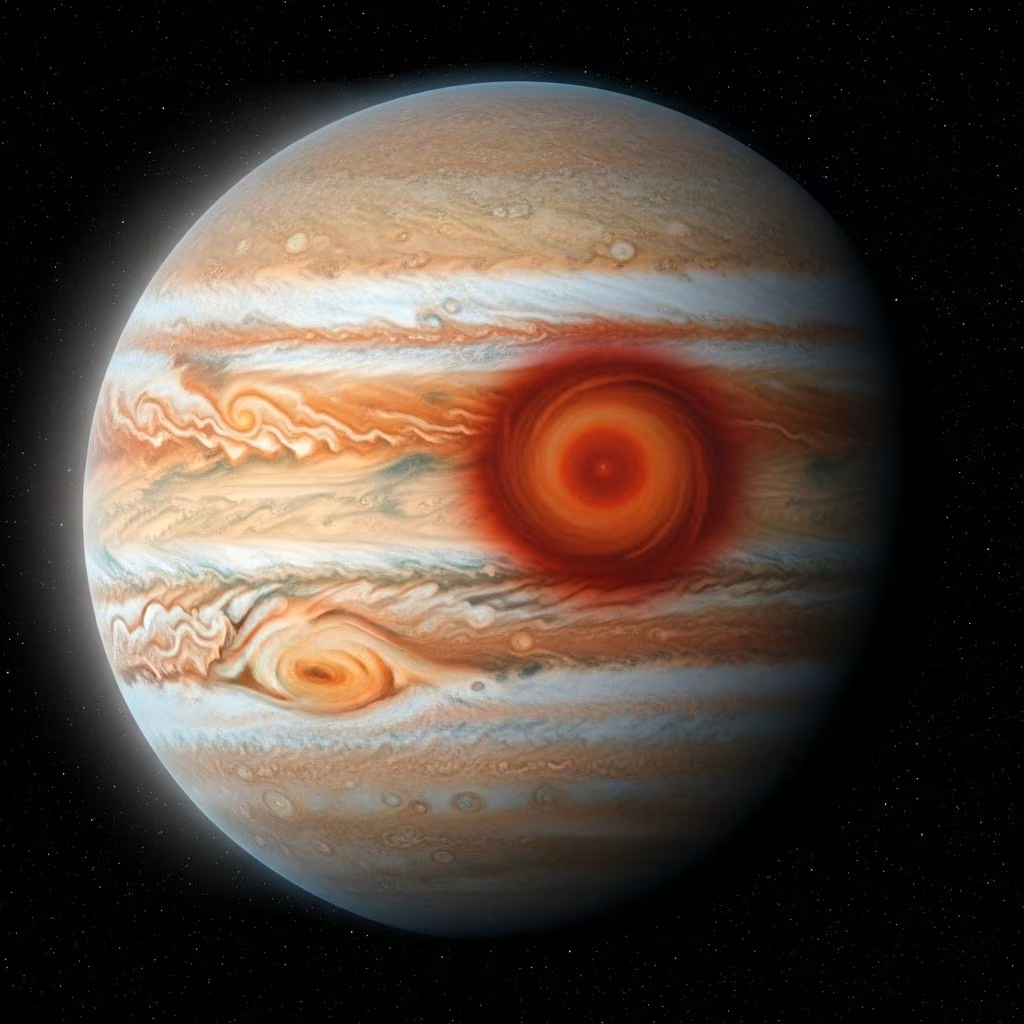
The Great Red Spot on Jupiter is the most prominent and enigmatic storm in our solar system. This gigantic anticyclonic vortex, swirling with winds far faster than any hurricane on Earth, has persisted for centuries, captivating scientists and amateur astronomers alike. Its vibrant color and shrinking size continue to drive research and debate, offering valuable insights into the nature of planetary atmospheres and storms.
What Is the Great Red Spot?
The Great Red Spot is a vast oval-shaped storm found on Jupiter’s southern equatorial belt, centered at about 22° south latitude. It is an anticyclone, meaning winds circulate around a high-pressure area in a counterclockwise direction in Jupiter’s Southern Hemisphere. First officially recorded in the 19th century, the storm may well be the same phenomenon observed as early as 1665 by Gian Domenico Cassini.
- First official record: Drawing from Samuel Heinrich Schwabe (1831).
- Continuous observation: Since 1878, with earlier sightings possibly dating to 1665.
- Notable features: Reddish hue, oval shape, enormous size that can engulf Earth.
Size and Scale: How Big Is the Great Red Spot?
Nothing in Earth’s weather compares to the scale of Jupiter’s Great Red Spot. In the late 1800s, the storm measured a staggering 48,000 km (30,000 miles) in length—more than three times the diameter of Earth. Today, the Spot’s dimensions are still huge, though it is notably smaller than in previous centuries.
| Characteristic | Great Red Spot | Earth (for comparison) |
|---|---|---|
| Diameter | ~16,350 km (10,159 miles) | ~12,742 km (7,918 miles) |
| Maximum wind speed | 430–680 km/h (270–425 mph) | Up to 281 km/h (175 mph for strongest hurricanes) |
| Location | 22° S (Jupiter’s Southern Hemisphere) | Diverse, global |
| Rotation period | 6–7 Earth days (~14 Jovian days) | Varies, typically hours for hurricanes |
At present, about 1.3 Earths could fit within the area of the Great Red Spot.
Color and Composition: Why Is It Red?
One of the most compelling mysteries about the Great Red Spot is the cause of its distinctive red color. The storm’s hue can range from deep brick-red to pale salmon and even white.
- Color variations: Salmon-red, brick-red, pale red, and gray.
- Possible causes: Still uncertain, with theories suggesting reddish chemicals formed by sunlight interacting with ammonium hydrosulfide and other atmospheric compounds.
- High-altitude clouds: Occasionally white clouds form above the Spot, which may make it appear gray from Earth.
Data from spacecraft, including NASA’s Juno and Hubble, continue to probe the Spot’s chemistry and cloud structure, offering clues but not yet definitive answers.
History of Observations
The storm’s enduring presence has made it a popular subject in telescopic and spacecraft studies for centuries. Early records, dating to Cassini’s “Permanent Spot” in 1665, suggest a storm has existed in roughly the same location, with gaps in observation complicating direct lineage.
- Samuel Heinrich Schwabe (1831): Created a drawing that is considered the first official record.
- Continuous study (since 1878): Carr Walter Pritchett described the Spot, leading to regular observation.
- Voyager spacecraft (1979): Measured the length at 23,000 km (14,500 miles).
- Recent years (2012–now): Faster shrinking rate observed, detailed by Hubble and modern missions.
The Shrinking Mystery: Why Is the Great Red Spot Shrinking?
One of the most remarkable changes in the Spot’s recent history is its dramatic shrinkage. Originally over three times Earth’s diameter, the storm now measures only slightly larger than our planet. Observations show an annual decrease of around 900 km (559–580 miles) per year since at least 2012.
- Late 1800s: 48,000 km (30,000 miles)
- Voyager 1 (1979): 23,000 km (14,500 miles)
- 2010s to present: ~16,350 km (10,159 miles) and shrinking
- Shape change: Becoming more circular as it shrinks
Recent research, including findings from Yale in 2024, suggests changes in Jupiter’s atmospheric dynamics—potentially linked to internal planetary processes or the loss of storm energy—may be driving the shrinkage.
Winds and Motion
The winds in the Great Red Spot howl at speeds unmatched by any terrestrial hurricane. Scientists have measured wind speeds in the vortex ranging from 430–680 km/h (270–425 mph), with higher speeds near the edges and somewhat calmer air at the core.
- Direction: Counterclockwise
- Type: Anticyclonic (high-pressure system)
- Rotation period: About 6–7 Earth days
This ferocity is maintained by jet streams in Jupiter’s atmosphere, with a strong westward jet to the storm’s north and a weaker eastward flow to its south, trapping the vortex in place.
Internal Structure and Atmospheric Depth
What powers this ancient storm? Data from NASA’s Juno spacecraft suggest that the vortex extends deep into Jupiter’s atmosphere, possibly as far as 300 kilometers below the visible clouds.
- Atmospheric layers: The storm’s clouds show complex movement and chemistry at different altitudes.
- Dynamics: Studies focus on vertical structure and interactions with underlying atmospheric processes.
- Material: Made primarily of ammonia, ammonium hydrosulfide, water, and other ices and gases.
These studies help unravel how such a storm can persist for centuries, with energy possibly sustained by Jupiter’s massive scale and interior heat.
Why Do Scientists Study the Great Red Spot?
The Great Red Spot is far more than a curiosity: it is a laboratory for atmospheric physics, planetary weather, and the mechanics of giant planet storms. By observing and modeling the Spot, researchers gain insight into:
- Dynamics of anticyclonic storms
- Planetary weather systems and jet streams
- Interactions between atmospheric chemistry and sunlight
- Mechanisms for storm persistence and dissipation
- The broader history and evolution of Jupiter itself
Comparisons: Great Red Spot vs. Earth’s Storms
| Feature | Great Red Spot (Jupiter) | Earth’s Most Powerful Hurricanes |
|---|---|---|
| Type | Anticyclonic vortex | Cyclonic storm |
| Duration | Centuries | Days to weeks |
| Wind speed | 430–680 km/h (270–425 mph) | Up to 281 km/h (175 mph) |
| Size | 16,350 km diameter | Up to 500 km diameter |
| Energy source | Internal heat, atmospheric jet streams | Solar energy, oceanic heat |
Frequently Asked Questions (FAQs)
Q: How long has the Great Red Spot existed?
A: The storm has existed for at least 200 years of continuous observation, with possible sightings as far back as the 17th century.
Q: Why is the Great Red Spot shrinking?
A: The cause remains uncertain, though recent research suggests changes in Jupiter’s atmospheric energy and jet stream interaction.
Q: Could the Great Red Spot disappear?
A: If current shrinking trends continue, the Spot could eventually dissipate or become indistinguishable, but the timeline remains unknown.
Q: What makes the Spot so red?
A: The red color is likely due to complex chemicals formed by atmospheric interactions, but no single theory has confirmed it yet.
Q: Can we see the Great Red Spot from Earth?
A: Yes, the Great Red Spot is visible with medium to large telescopes, often appearing as a prominent oval in Jupiter’s cloud belts.
Conclusion: The Ongoing Fascination
Jupiter’s Great Red Spot remains one of the solar system’s most enduring wonders. It is a window into planetary science, atmospheric phenomena, and the dynamic nature of our universe. Continuing spacecraft missions and Earth-based observations promise to keep unraveling its secrets, inspiring a new generation of explorers and astronomers.
References
- https://en.wikipedia.org/wiki/Great_Red_Spot
- https://theplanets.org/jupiter/jupiter-red-spot-facts/
- https://www.britannica.com/place/Great-Red-Spot
- https://science.nasa.gov/asset/hubble/jupiter-and-the-great-red-spot/
- https://science.nasa.gov/missions/hubble/hubble-shows-that-jupiters-great-red-spot-is-smaller-than-ever-seen-before/
- https://news.yale.edu/2024/07/18/new-explanation-jupiters-great-shrinking-spot
- https://skyandtelescope.org/observing/interactive-sky-watching-tools/transit-times-of-jupiters-great-red-spot/
- https://www.skyatnightmagazine.com/astrophotography/planets/jupiter-great-red-spot
- https://www.space.com/jupiter-great-red-spot-origin
- https://news.virginia.edu/content/shape-shifting-storm-astronomers-scrutinize-jupiters-great-red-spot
- https://esahubble.org/news/heic2412/
- https://skyandtelescope.org/astronomy-news/jupiters-great-red-spot-shimmies-to-a-beat/
- https://spaceunited.com/blog/10-facts-to-know-about-jupiters-great-red-spot
- https://phys.org/news/2024-10-jupiter-great-red-unexpected-size.html