Astronomers Uncover a Rare ‘Cosmic Fossil’ at the Edge of the Solar System
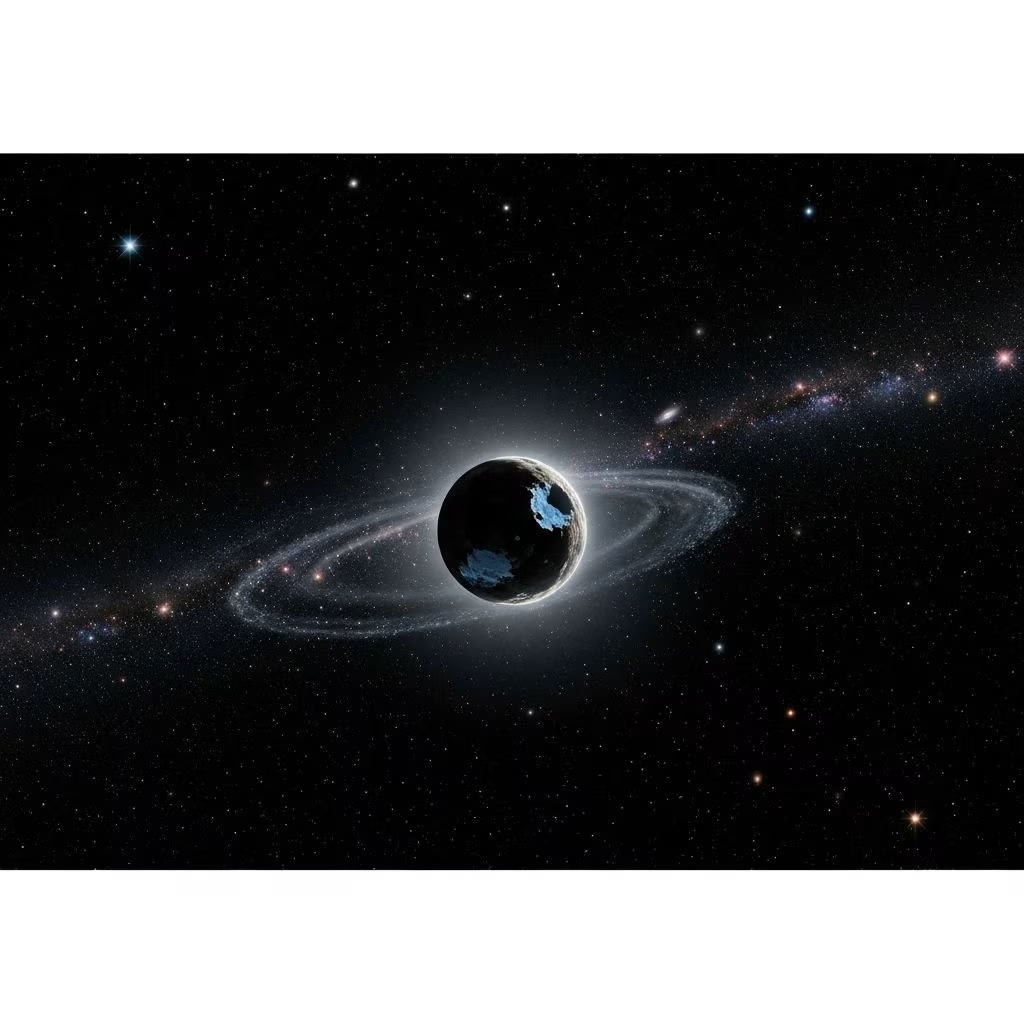
In a remarkable leap for planetary science, astronomers have discovered an extraordinarily distant object at the edge of our solar system. This icy body, designated 2023 KQ14 and nicknamed “Ammonite” by the research team, offers a unique glimpse into the turbulent early history of our planetary neighborhood. More than a scientific curiosity, Ammonite’s discovery could have far-reaching implications for what we know—or think we know—about the mysterious Planet 9 and the processes that shaped our solar system.
Discovery and Identification of 2023 KQ14 (‘Ammonite’)
The discovery of Ammonite was made possible by the powerful Subaru Telescope atop Maunakea, Hawai’i, as part of the FOSSIL Project (Formation of the Outer Solar System: An Icy Legacy). Using Subaru’s wide-field Hyper Suprime-Cam, astronomers captured images in March, May, and August 2023 that led to the initial identification of this object. Subsequent observations with the Canada-France-Hawai’i Telescope (CFHT) in July 2024, as well as painstaking searches through decades of archival data, allowed researchers to track Ammonite’s movement back as far as 19 years.
- Official designation: 2023 KQ14
- Nickname: Ammonite (inspired by fossilized sea creatures, symbolizing its ‘fossil’ status)
- Discovery project: FOSSIL (Formation of the Outer Solar System: An Icy Legacy)
- Lead Investigation Institutions: International collaboration including teams from Japan and Taiwan
What Makes Ammonite Special?
Ammonite’s orbit is both highly stable and highly unusual. It resides in a region far beyond Neptune—a part of the solar system that has barely changed since its formation more than 4.5 billion years ago. Its stability suggests it has survived the tumult of planetary migrations and gravitational disturbances that have occurred since our solar system’s infancy.
- Orbital class: Sednoid (only the fourth such object ever found)
- Orbit stability: Over 4 billion years without significant alteration
- Uniqueness: Orbit is distinct from every other Sedna-like body previously known
What Are Sednoids?
Sednoids are a rare and mysterious group of distant trans-Neptunian objects defined by their extremely remote orbits. These bodies have perihelions—the closest point in their orbit to the Sun—that are much farther than those of typical scattered-disk objects. Before Ammonite’s discovery, only three confirmed sednoids were known: Sedna, 2012 VP113, and 2015 TG387.
| Name | Discovery Year | Approx. Size (km) | Perihelion (AU) | Semimajor Axis (AU) |
|---|---|---|---|---|
| Sedna | 2003 | ~1000 | 76 | 506 |
| 2012 VP113 | 2012 | ~250 | 80 | 265 |
| 2015 TG387 | 2015 | ~300 | 65 | 1170 |
| 2023 KQ14 (Ammonite) | 2023 | Unknown, likely small | >70 | Yet to be precisely determined |
Ammonite’s addition to this short list of cosmic fossils helps scientists understand the forces and events that shaped the outer solar system. Because they are barely affected by the gravity of current giant planets, the sednoids may preserve records of encounters with early solar system features—or even with passing stars or unseen planets.
The Implications: Rethinking the Early Solar System
Objects like Ammonite aren’t just far away; they are time capsules. Their stable, unusual orbits could be evidence of chaotic events in the early solar system’s history, such as:
- Migrations of the giant planets that scattered debris outward
- Possible close encounters with stars or other solar systems
- The gravitational influence of yet-unknown massive objects
As principal investigator Fumi Yoshida summarized, “Ammonite’s orbit and location suggest something extraordinary occurred in our cosmic past, and we’re just beginning to piece the story together.”
Theories: Did Ammonite Form Here or Was It Displaced?
There are two leading hypotheses for the origin of Ammonite’s strange orbit:
- Primordial Formation: Ammonite coalesced in place, undisturbed for billions of years, making it a fossil from the solar system’s birth.
- Gravitational Scattering: It was formed closer in and later kicked to its current location by gravitational interactions—possibly with the giant planets, a migrating Neptune, or even the influence of an as-yet-undetected ninth planet.
Understanding which scenario is correct will offer vital clues about the early arrangement and migration patterns of the planets.
Planet 9: Is This Bad News for the Hypothetical Giant?
For nearly a decade, astronomers have speculated about the existence of Planet 9: a massive planet orbiting far beyond Pluto, invoked to explain the strange clustering of some distant orbits. But Ammonite’s bizarrely solitary path has thrown a wrench into some of these models.
- Planet 9 was proposed because certain distant objects share similar orbital directions and clustering—potentially caused by the pull of an unseen planet.
- However, Ammonite’s orbit does not cluster with these others. It seems to be on its own unique path, out of alignment with the supposed Planet 9 family.
This challenges the most widely used dynamics models and raises several possibilities:
- The Universe Is More Chaotic: Perhaps random forces, like ancient star flybys, arranged these orbits more chaotically than expected—reducing the need for Planet 9 to explain clustering.
- Planet 9 Model Needs Revision: If Planet 9 exists, its mass or orbit may be very different from current predictions.
- Still Missing Data: More discoveries like Ammonite could reveal patterns, or the lack thereof, providing firmer answers about Planet 9’s status.
What Astronomers Are Saying
“Ammonite’s orbit makes us reconsider the predictability of the outer solar system,” said Fumi Yoshida, FOSSIL project principal investigator. “We may need to rethink how we search for Planet 9—or whether it exists at all.”
What Does the Cosmic Fossil Reveal?
Ammonite shows that the far outer solar system is not as orderly as once believed. Its discovery underscores the need for greater observation, deeper surveys, and more advanced modeling. Some insights include:
- The outer solar system likely experienced violent reshuffling during its earliest years.
- Stable, isolated orbits at such distances hint at still-unknown influences in the solar system’s past—including stray stars, rogue planets, or even failed planetary embryos.
- Ongoing searches for similar objects will determine whether Ammonite is a rare exception or the first of many ‘rogue fossils’ at the solar system’s edge.
How Was Ammonite Detected and Characterized?
The discovery was achieved through a combination of innovative techniques and global cooperation:
- Wide-field imaging: Subaru’s Hyper Suprime-Cam covers vast expanses, increasing the chances of spotting slow-moving distant objects.
- Follow-up observations: Additional telescope time from CFHT and archival observatories allowed precise orbital tracking.
- Archival data mining: By searching older images from Chile, Arizona, and beyond, astronomers pieced together Ammonite’s movement over 19 years, confirming its unusual stability and orbit.
Why the Name ‘Ammonite’?
The nickname ‘Ammonite’ recalls famed fossil shells from Earth’s ancient oceans, emphasizing this object’s role as a cosmic relic—a preserved record of conditions billions of years ago.
The Next Frontier: What’s Ahead for Sednoid Research?
The discovery of Ammonite is a watershed moment, but it is only the beginning. Astronomers are planning further sky surveys and detailed observations to:
- Detect more sednoids and distant trans-Neptunian objects
- Search for subtle color, size, and composition differences among these bodies
- Model the dynamical history of the solar system using updated orbits
- Revise or replace theories about Planet 9 and the mechanisms shaping the outer solar system
Any new finds could either reinforce or overturn everything we believe about our solar system’s outermost expanses.
Table: Current Sednoids in the Solar System
| Object | Discovering Team/Institution | Discovery Date | Notes |
|---|---|---|---|
| Sedna | Palomar Observatory | 2003 | Pioneering, very distant orbit |
| 2012 VP113 | Cerro Tololo Observatory | 2012 | Second-known sednoid, tight orbit |
| 2015 TG387 (‘The Goblin’) | Carnegie Institution for Science | 2015 | Extremely elongated path |
| 2023 KQ14 (‘Ammonite’) | Subaru Telescope (FOSSIL Project) | 2023 | Most recently discovered, unique orbit |
Frequently Asked Questions about the Cosmic Fossil and Planet 9
Q: What makes 2023 KQ14 (‘Ammonite’) different from Pluto or other dwarf planets?
A: Ammonite’s orbit is far more distant and stable than Pluto’s. Its perihelion lies much farther from the Sun, and it does not interact with Neptune in the same way as Pluto or other trans-Neptunian objects.
Q: Does the discovery of Ammonite mean Planet 9 doesn’t exist?
A: Not necessarily, but Ammonite’s unique orbit challenges the standard Planet 9 theory. More discoveries and data are needed to reach a consensus.
Q: Why are objects like Ammonite called “cosmic fossils”?
A: Because their orbits and physical states have remained largely unchanged for billions of years, they preserve invaluable clues about the solar system’s formation and evolution.
Q: What technologies enabled the discovery of Ammonite?
A: Subaru’s Hyper Suprime-Cam, archival data integration, long-term tracking with multiple global observatories, and advanced image processing were all key.
Q: What comes next in the search for distant solar system objects?
A: Astronomers will expand wide-field surveys, dig deeper into historical data, and develop improved models for orbits in the solar system’s farthest regions.
Conclusion: The Outer Solar System’s Mystery Deepens
Ammonite’s discovery at the edge of our solar system exemplifies the evolving nature of astronomy. Each new cosmic “fossil” not only gives us a look into the ancient past, but also prompts new questions about colossal planetary migrations, the potential for lost giant planets, and the overall architecture of our home in the cosmos. The ultimate fate of the Planet 9 hypothesis now hangs in the balance, awaiting the sky’s next surprising revelation.
References
- https://www.space.com/astronomy/solar-system/astronomers-discover-a-cosmic-fossil-at-the-edge-of-the-solar-system-is-this-bad-news-for-planet-9
- https://www.youtube.com/watch?v=4xRgo2UTsqw
- https://www.sciencedaily.com/releases/2025/07/250720092541.htm
- https://www.astronomy.com/science/cosmic-fossils-what-meteorites-reveal-about-our-solar-system/
- http://www.sciencedaily.com/releases/2025/07/250720092541.htm
- https://www.nao.ac.jp/en/news/science/2025/20250715-subaru.html
- https://www.skyatnightmagazine.com/news/ammonite-2023-kq14
- https://www.youtube.com/watch?v=vALKp_GuXlk
- https://phys.org/news/2025-07-subaru-telescope-fossil-outer-solar.html
- https://www.tesaaworld.com/en/news/discovery-of-rare-cosmic-fossil-at-the-outskirts-of-the-solar-system-prompts-reevaluation-of-the-ninth-planet-hypothesis
- https://www.hawaii.edu/news/2025/08/05/maunakea-rare-fossil-spotted/
- https://www.tesaaworld.com/fr/news/discovery-of-rare-cosmic-fossil-at-the-outskirts-of-the-solar-system-prompts-reevaluation-of-the-ninth-planet-hypothesis
- https://www.hjkc.de/_blog/25488-astronomie-astronomers-discover-a-cosmic-fossil-at-the-edge-of-our-solar-system-is-this-bad-news-for/
- https://www.bizzbuzz.news/international/astronomers-discover-ancient-cosmic-fossil-at-solar-systems-edge-a-blow-to-planet-nine-theory-1367497
- https://www.tomorrowsworldtoday.com/space/ancient-deep-space-fossil-could-rewrite-solar-system-history/
- https://science.nasa.gov/blogs/planetary-defense/2025/07/02/nasa-discovers-interstellar-comet-moving-through-solar-system/
- https://starlust.org/astronomers-uncover-cosmic-fossil-galaxy-offering-glimpse-into-early-universes-seven-billion-year-history/