Who Discovered Uranus?
In the annals of astronomy, the discovery of Uranus stands out as a transformative moment. On March 13, 1781, William Herschel, a self-taught astronomer and musician, observed a mysterious object through his homemade telescope and forever changed humanity’s view of the solar system. Herschel’s work marked the first time since ancient history that a new planet had been identified, expanding the boundaries of what was known and igniting curiosity across the scientific world. Though Uranus had been documented by earlier astronomers, its planetary nature remained unrecognized until Herschel’s historic night in Bath, England. His story is not just one of discovery, but also of persistence, ingenuity, and scientific revolution.
Key Points
- William Herschel identified Uranus in 1781, initially thinking it was a comet.
- Further observations by other scientists confirmed Uranus as the seventh planet.
- Prior astronomers had catalogued Uranus unknowingly as a star.
- The naming of Uranus sparked international debate before settling on its mythological name.
- The discovery radically expanded the solar system’s known extent and set precedent for future planetary exploration.
The Night of Discovery: March 13, 1781
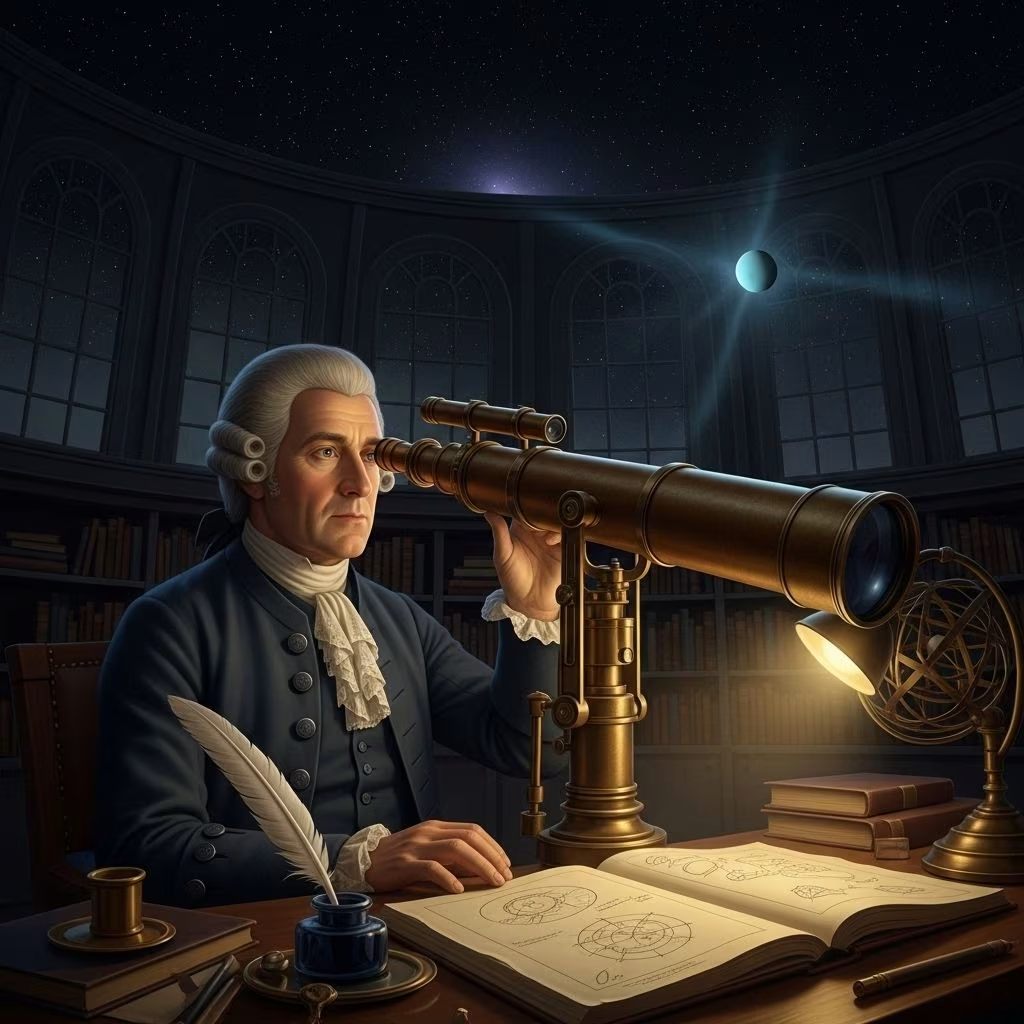
William Herschel (1738–1822), originally a musician, devoted much of his life to astronomy after moving to England. Driven by curiosity and equipped with a homemade telescope, he scanned the night skies from his garden in Bath. On the fateful night, Herschel noticed an object in the constellation Gemini that appeared to be a fuzzy disc, not a pinpoint of light like stars.
At first, Herschel believed the object might be a comet. Its lack of tail and steady movement, however, hinted at a more profound nature. Through meticulous observations and careful recording, he realized he had found something wholly unprecedented: an object that was neither a star nor a comet, but a new planet orbiting the Sun twice the distance of Saturn from the Sun.
William Herschel: The Genius Behind the Discovery
William Herschel was born in Hanover, Germany, and trained as a musician before moving to England. He was a polymath, teaching himself mathematics, mechanics, optics, and astronomy. With his sister Caroline Herschel, he ground mirrors from a special blend of copper and tin and built telescopes far superior to most of those available at the time.
- Herschel’s telescopes could show celestial objects as discs instead of mere points of light.
- His discovery resulted from not only advanced technology but also curiosity and perseverance.
- Caroline Herschel actively assisted her brother and later made significant discoveries herself.
Early Observations: The Long Road to Uranus
Uranus was not entirely unknown before Herschel’s discovery. Astronomers such as John Flamsteed, the first Astronomer Royal, had observed the planet in the late 17th and early 18th centuries. Flamsteed catalogued it as 34 Tauri in the constellation Taurus, believing it to be a star. Successors like James Bradley also recorded similar star objects, as did the French astronomer Pierre Charles Lemonnier. However, none realized these sightings were not stars but a planet slowly wandering across the sky.
- John Flamsteed observed and catalogued Uranus in 1690, 1712, and 1715.
- James Bradley documented it in 1748, 1750, and 1753.
- Pierre Charles Lemonnier recorded Uranus at least twelve times between 1750 and 1769.
All these earlier sightings were limited by telescope technology and the assumption that only six planets existed, causing Uranus to go unrecognized as a planet.
Confirming the Seventh Planet
Herschel shared his observations with prominent astronomers, such as Nevil Maskelyne, then Britain’s Astronomer Royal. Maskelyne and others performed additional studies to determine the nature of the object. Mathematics came into play as Anders Lexell, Jean-Baptiste Saron, and Pierre Laplace calculated its orbit, establishing that it circled the Sun far beyond Saturn.
This confirmation was groundbreaking: for the first time since antiquity, the solar system was recognized as having a seventh planet, and its scope more than doubled overnight.
Naming Uranus: A Clash of Traditions
Following tradition, Herschel proposed the name “Georgium Sidus” (‘George’s Star’) to honor King George III. This name gained popularity in Britain and its colonies but met resistance across continental Europe, where astronomers favored mythological names.
- Johann Elert Bode, a German astronomer, recommended “Uranus” after the ancient Greek sky god, aligning the planet’s name with existing conventions for Mercury, Venus, Mars, Jupiter, and Saturn.
- Other proposed names included “Herschel” in France, but this suggestion never caught on internationally.
- The official acceptance of “Uranus” brought the planet into the fold of mythologically named worlds.
The naming controversy shows how science, politics, and culture often intermingle in the history of discovery.
How Uranus Changed Astronomy
The discovery of Uranus marked a turning point in the field of astronomy:
- It broke the centuries-old pattern of only six known planets, demonstrating that the solar system was much larger than previously thought.
- The find inspired astronomers to search for new planets and led directly to the subsequent detection of Neptune and Pluto.
- It highlighted the power of technological advancement—high-quality telescopes enabled the observation and identification of new worlds.
The Technology Behind the Discovery
Herschel’s success owed much to his craftsmanship. With his sister, Herschel manufactured reflecting telescopes using a speculum metal mirror. His largest, a 6.2-inch diameter instrument, gave him unprecedented power for the time.
- Mirrors crafted from speculum metal produced clearer, brighter images than previous designs.
- Innovative grinding and polishing techniques ensured stable, accurate observations.
- Larger aperture and improved optics allowed for distinguishing planets from stars.
This technical leap directly enabled the discovery of Uranus and changed the tools of astronomy forever.
Legacy of Uranus’s Discovery
Uranus’s discovery rekindled speculation about the cosmos and propelled the study of planetary science. Its unique properties, such as its blue-green color, substantial tilt (it rotates almost on its side), faint rings, and icy atmosphere, continue to intrigue astronomers today.
- Uranus is the third largest planet by diameter and fourth by mass in the solar system.
- Its axial tilt of 98 degrees distinguishes it from every other planet.
- The planet has faint rings and many moons, adding to its scientific interest.
The milestone set by Herschel laid the groundwork for future discoveries, both within and beyond our solar system.
Notable Figures in the Story of Uranus
| Name | Role | Contribution |
|---|---|---|
| William Herschel | Discoverer | Officially identified Uranus as a planet |
| Caroline Herschel | Assistant, Astronomer | Supported William’s work; made her own discoveries |
| John Flamsteed | Astronomer Royal | Observed Uranus as 34 Tauri but did not recognize its planetary nature |
| James Bradley | Astronomer Royal | Documented Uranus on several occasions without awareness |
| Pierre Charles Lemonnier | French Astronomer | Recorded Uranus at least 12 times before Herschel’s discovery |
| Nevil Maskelyne | Astronomer Royal | Confirmed Herschel’s findings |
| Johann Elert Bode | German Astronomer | Suggested the mythological name ‘Uranus’ |
Frequently Asked Questions (FAQs)
Q: Who discovered Uranus?
A: Uranus was discovered by William Herschel on March 13, 1781, in Bath, England.
Q: Did anyone observe Uranus before Herschel?
A: Yes, astronomers such as John Flamsteed and Pierre Charles Lemonnier saw Uranus and catalogued it as a star, but did not recognize its planetary nature.
Q: What technological innovation led to the discovery of Uranus?
A: Herschel’s use of a reflecting telescope with a large speculum metal mirror allowed him to see Uranus as a disc.
Q: Why is Uranus significant in astronomy?
A: It was the first planet discovered in modern times, doubling the known size of the solar system and sparking a new era in planetary search and scientific instruments.
Q: What does the name “Uranus” mean?
A: Uranus is named after the ancient Greek deity of the sky, father of the Titans; the name was chosen to fit the mythological naming convention for planets.
Q: Does Uranus have any unique characteristics?
A: Yes; its extreme axial tilt, blue-green coloration from methane in its atmosphere, faint rings, and large number of moons set it apart from other planets.
Conclusion: Uranus and the Spirit of Discovery
The identification of Uranus by William Herschel and the subsequent realization of its planetary status stands as a testament to human curiosity and ingenuity. Herschel’s work showed that new worlds could be discovered through a blend of technological innovation, careful observation, and open-minded inquiry. The legacy of Uranus’s discovery extends from the technical advances in telescope-making to the ongoing quest for knowledge that defines astronomy today. As we continue to peer into the darkness of the universe, Herschel’s achievement remains a bright beacon for explorers and dreamers alike.
References
- https://www.nasa.gov/history/240-years-ago-astronomer-william-herschel-identifies-uranus-as-the-seventh-planet/
- https://www.rmg.co.uk/stories/space-astronomy/astronomy/discovery-uranus
- https://www.sciencemuseum.org.uk/objects-and-stories/uranus-first-planet-discovered-telescope
- https://science.nasa.gov/uranus/facts/
- https://www.skyatnightmagazine.com/space-science/how-was-uranus-discovered
- https://airandspace.si.edu/explore/stories/uranus
- https://en.wikipedia.org/wiki/William_Herschel
- https://en.wikipedia.org/wiki/Uranus
- https://www.ebsco.com/research-starters/history/astronomers-discover-rings-uranus
- https://www.astronomy.com/science/march-13-marks-240-years-since-william-herschel-discovered-uranus/
- https://eduindex.org/2023/03/29/discovery-of-uranus/
- https://www.youtube.com/watch?v=aGVFwNWu5c0
- https://research.colonialwilliamsburg.org/Foundation/journal/Spring14/uranus.cfm
- https://coolcosmos.ipac.caltech.edu/ask/134-Who-discovered-Uranus-
- https://www.youtube.com/watch?v=qXCmPxVy-QA
- https://paac.ppc.ac.in/2021/03/13/the-story-of-discovery-of-uranus/
- https://www.universetoday.com/articles/discovery-of-uranus
- https://www.missingtheforest.com/1781-discovery-of-uranus/
- https://dayinhistory.org/science/william-herschels-discovery-of-uranus-a-milestone-in/