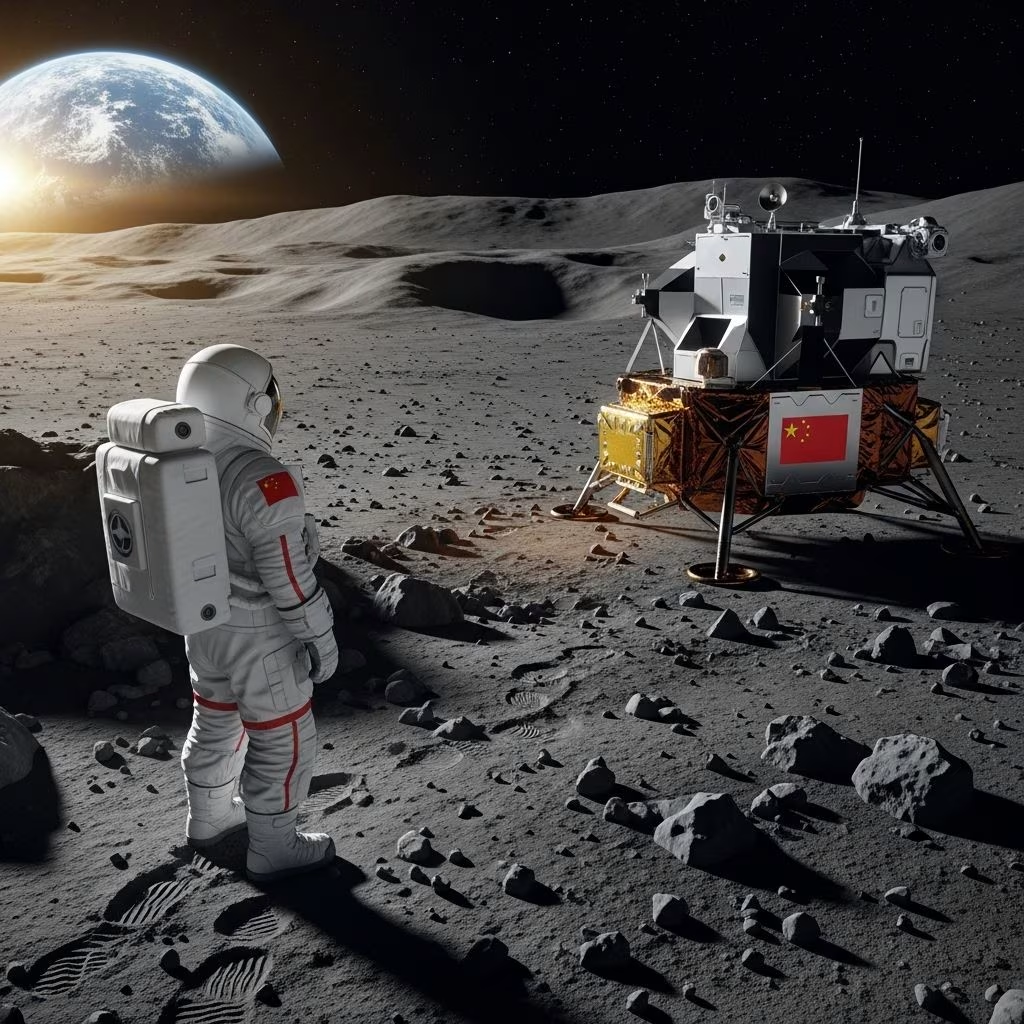
China is rapidly forging ahead in its goal of landing astronauts on the lunar surface before 2030. Bolstered by technological innovation, rigorous astronaut training, and significant investment in new infrastructure, the nation is positioning itself to become the second country in history to achieve a crewed moon landing. This article explores the timeline, technology, training regimens, and international implications of China’s unprecedented lunar program.
Building Toward the Moon: Major Milestones and Program Overview
Over the past decade, China has evolved from robust robotic missions and its own modular space station toward an ambitious and meticulously planned crewed lunar landing. The China Manned Space Agency (CMSA) has articulated a stepwise approach grounded in hardware prototypes, system integration, and astronaut preparation, all mapped against a tight timeline aimed at achieving a lunar landing by 2030.
- Goal: Land Chinese astronauts (taikonauts) on the moon before 2030, complete scientific exploration, and safely return them to Earth.
- Key Agencies: China Manned Space Agency (CMSA), China National Space Administration (CNSA)
- Recent Progress: Successful robotic lunar missions (Chang’e series), crewed space station assembly, and rapid vehicle development
The 2030 Deadline: Timeline and Mission Architecture
China’s manned lunar effort rests on a deliberate, stepwise plan that emphasizes system-level integration and proven prototypes before committing to crewed flights. According to the CMSA, all research and construction related to the program are on track for a 2030 launch window:
- 2023-2025: Concept design, prototype testing of crewed lunar hardware (rockets, landers, rovers, spacesuits)
- 2025-2028: Integration and large-scale ground and flight testing
- 2029: Launch rehearsal and final crew selection
- By 2030: Launch of two Long March 10 rockets with lunar lander and crewed spacecraft for moon landing
Once realized, China will become only the second nation to land a human on the lunar surface, more than five decades after the United States’ Apollo program.
Key Hardware: Rockets, Spacecraft, and Lunar Technology
The backbone of China’s crewed lunar landing effort is a fleet of new or upgraded spacecraft, rockets, and lunar systems. The current mission architecture involves multiple novel vehicles working in precise choreography:
- Long March 10 Heavy-Lift Rocket: Specifically designed to transport both the Lanyue lunar lander and the new Mengzhou crewed spacecraft to lunar orbit, Long March 10 is China’s answer to the U.S. Saturn V and NASA’s modern SLS.
- Mengzhou Crewed Spacecraft: A next-generation deep-space crew module, Mengzhou is engineered for carrying multiple astronauts safely to lunar orbit and back.
- Lanyue Lunar Lander: Responsible for ferrying two astronauts from lunar orbit down to the surface and back, Lanyue is undergoing extensive thermal and system tests.
- Tansuo Lunar Rover: A robotic vehicle to assist astronauts in exploration, transportation, and scientific sampling on the lunar terrain.
- Wangyu Moon-landing Spacesuit: An advanced suit tailored for extended lunar excursions, environmental protection, and mobility.
Each hardware component is in the “preliminary prototype development phase“, according to the CMSA, with design and construction proceeding as scheduled. Comprehensive system integration and ground testing are taking place ahead of flight trials, ensuring mission reliability.
A Two-Launch Strategy: Mission Sequence Step by Step
Unlike the single-vehicle approach of Apollo, China’s crewed lunar landing plan involves two coordinated launches and complex orbital maneuvering:
- First Launch: A Long March 10 rocket sends the Lanyue lunar lander to lunar orbit.
- Second Launch: Another Long March 10 launches the Mengzhou crewed spacecraft with astronauts.
- Orbital Rendezvous: In lunar orbit, the Mengzhou and Lanyue vehicles dock.
- Lunar Descent: Two astronauts enter the lander, undock, and descend to the moon’s surface for a soft (engine-assisted) landing.
- Surface Operations: The crew conducts scientific tasks and sample collection, using the Tansuo rover for mobility and equipment transport.
- Return to Orbit: After completing their assignments, the astronauts re-enter the Lanyue lander, launch back to lunar orbit, and dock with Mengzhou.
- Earth Return: The samples and crew transfer to Mengzhou, which then undocks and returns to Earth with the astronauts.
Supporting Infrastructure: Launch Sites, Testing, and Operations
Preparations are underway at the Wenchang Space Launch Site in Hainan province, the only Chinese launch site capable of accommodating the new generation of heavy-lift rockets. Key developments include:
- Construction of new testing and launch facilities tailored to the lunar program
- Design finalization for ground systems: tracking, telemetry, remote command, and lunar landing zone infrastructure
- Imminent start of site upgrades and system assembly
- Plans for additional landing site infrastructure, ground-based command, and telemetry support
These investments will ensure robust support for both launch and recovery phases of the mission, as well as for astronaut quarantine and sample curation upon return.
Astronaut Selection and Training: Building a Lunar Crew
To prepare for the complexity of lunar exploration, China selected its fourth group of taikonauts for the program. Training is highly specialized, with an emphasis on:
- Simulated lunar landing and surface operations
- Advanced operations of rovers and lunar science tools
- Extravehicular activities (spacewalks) and emergency procedures
- Endurance work for extended surface stays and challenging lunar conditions
- Testing with prototype Wangyu lunar spacesuits
Chinese astronauts are also expected to rehearse each segment of the mission—launch, orbital docking, descent, lunar surface activity, and Earth return—using a combination of computer simulation, ground mockups, and parabolic flights for reduced gravity training.
Global Competition: The United States and the Artemis Program
China’s rapidly advancing lunar program is in direct competition with the United States, which also aims to send astronauts back to the moon in the coming years via the NASA-led Artemis program. A comparison highlights key dynamics:
| Program | Country | First Crewed Landing (Projected) | Main Vehicle |
|---|---|---|---|
| Artemis | United States | 2026-2028 | Orion, SLS, Starship HLS |
| Chinese Lunar Program | China | By 2030 | Mengzhou, Lanyue, Long March 10 |
While the U.S. remains ahead in terms of launch timeline and mission frequency, China’s rapid and methodical progress could reshape the balance of lunar exploration and international prestige. If successful, China would become the first nation to land humans on the moon in the 21st century, and for the first time since 1972.
Legacy and Influence: Scientific and Strategic Implications
China’s crewed moon mission is more than a coming-of-age moment for its space program. It embodies the nation’s ambition to lead in science, technology, and geopolitical influence beyond Earth. Key implications include:
- Scientific Return: New geological samples from untouched lunar regions, in-situ resource utilization studies, and technology demonstration for future bases
- Technological Spin-off: Advancements in materials, robotics, artificial intelligence, energy storage, and remote operation
- Geopolitical Prestige: Symbolic leadership in the emerging field of space resources and off-world settlement
Frequently Asked Questions (FAQs)
Q: What are the main components of China’s lunar landing system?
A: The mission uses the Long March 10 heavy-lift rocket, Mengzhou crewed spacecraft, Lanyue lunar lander, Tansuo rover, and Wangyu spacesuit—each built or modified specifically for deep-space operation.
Q: How will the astronauts get from Earth to the lunar surface and back?
A: Two Long March 10 rockets separately launch the crewed spacecraft and lunar lander. After rendezvous in lunar orbit, astronauts transfer into the lander, descend, complete their tasks, and repeat the process in reverse to return.
Q: How does China’s crewed lunar timeline compare to NASA’s?
A: NASA’s Artemis is targeting crewed lunar landings in the late 2020s, potentially ahead of China’s by several years, but program delays are possible on both sides. China’s first landing is targeted for before 2030.
Q: What science will Chinese astronauts do on the moon?
A: Tasks include geological sample collection, in-situ experiments, technology tests for future human or robotic presence, and studying lunar surface processes.
Q: Will China’s mission be conducted alone or with international partners?
A: The initial missions are expected to be domestic, but China has signaled interest in broader lunar cooperation for future phases, including long-term bases and resource use.
Lunar Legacy: What Comes After 2030?
If China’s initial moon landing succeeds, momentum could build for long-term projects like permanent lunar bases and international research outposts. The nation’s public statements, policy white papers, and international outreach all hint at sustained lunar presence, not just a single mission milestone.
- Possible construction of an International Lunar Research Station (ILRS), with Russia and potential additional partners
- Robotic and crewed missions for resource prospecting and ISRU (in-situ resource utilization)
- Joint commercial, scientific, and even strategic projects on Earth’s only natural satellite
The race for the next footprints on the moon is well underway, and China is moving purposefully to ensure its taikonauts will be among them before the decade ends.
References
- https://en.wikipedia.org/wiki/Chinese_Lunar_Exploration_Program
- https://www.space.com/astronomy/moon/china-is-making-serious-progress-in-its-goal-to-land-astronauts-on-the-moon-by-2030
- https://www.scmp.com/news/china/science/article/3307624/chinas-moon-shot-2030-crewed-lunar-mission-tests-pace-space-agency-says
- https://global.chinadaily.com.cn/a/202503/03/WS67c55e07a310c240449d8414.html
- https://english.www.gov.cn/news/202503/03/content_WS67c57e96c6d0868f4e8f041c.html
- https://www.space.com/the-universe/moon/how-china-plans-to-put-astronauts-on-the-moon-by-2030-video
- https://www.scmp.com/news/china/science/article/3321150/china-completes-key-lander-test-preparation-crewed-moon-mission-2030
- https://asiatimes.com/2025/06/china-steps-closer-to-landing-on-moon-by-2030/
- https://english.www.gov.cn/news/202411/21/content_WS673f331fc6d0868f4e8ed4aa.html
- https://www.youtube.com/watch?v=IJva2cvtF9k
- https://www.chinadaily.com.cn/a/202503/03/WS67c55e07a310c240449d8414.html
- https://www.youtube.com/watch?v=Bgh73THlG1w
- https://www.china-in-space.com/p/chinas-crewed-lunar-program-progressing
- https://www.moondaily.com/reports/China_progresses_in_full_scale_efforts_for_manned_Moon_landing_by_2030_999.html