Hubble Space Telescope: Celebrating a Visionary Legacy
Since its launch in 1990 aboard the space shuttle Discovery, the Hubble Space Telescope has revolutionized astronomical research and public appreciation for the wonders of our universe. Elevated above Earth’s turbulent atmosphere in low Earth orbit, Hubble’s unobstructed view has yielded images of extraordinary detail and beauty, capturing phenomena ranging from our Solar System to the farthest reaches of the cosmos. Across three billion miles of orbital travel and five critical servicing missions, Hubble has transformed both scientific discovery and our understanding of space.
Astronomical Impact: Science, Data, and Repair
- Hubble has produced over 1 million images of about 40,000 celestial objects throughout three decades of operation.
- Researchers have published more than 12,000 peer-reviewed scientific papers based on Hubble’s data, including studies leveraging the 100+ terabytes of archival information.
- The telescope’s famous initial glitch—a misgrounded primary mirror—was remedied thanks to five dedicated servicing missions, which also upgraded scientific instruments and enhanced observational capability.
Beyond its technical and scientific feats, Hubble’s greatest contribution may be sharing breathtaking vistas of nebulae, galaxies, and star clusters—images that introduce us to the raw aesthetic power of deep space.
Iconic Hubble Images: Cosmic Wonders Unveiled
This curated selection celebrates some of the most important and visually stirring Hubble images, each telling a story of cosmic formation, evolution, and mystery.
Cosmic Reef Nebula
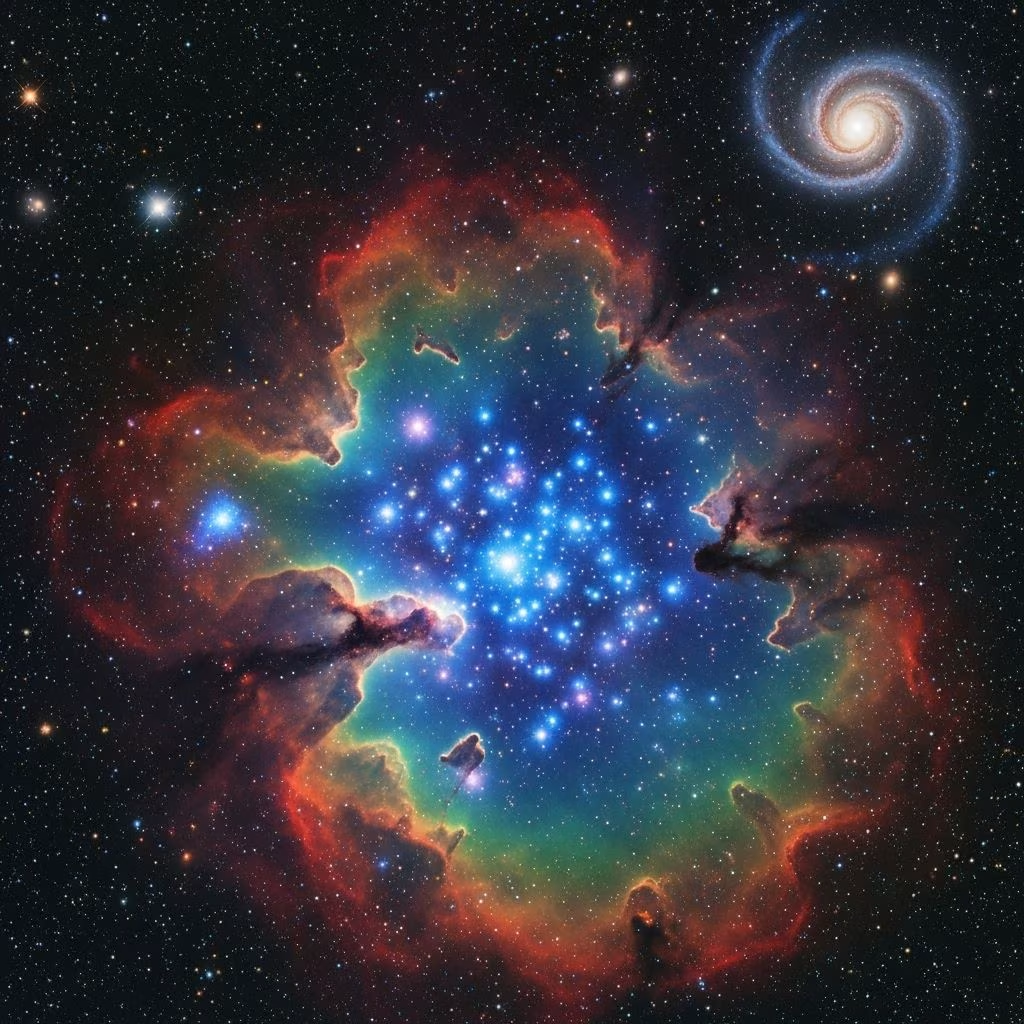
This vibrant, colorful nebula marks the 30th anniversary “Cosmic Reef” image, exemplifying Hubble’s ability to reveal vast interstellar nurseries. The contrasting regions of ionized gas and dust highlight sites of ongoing star formation where young stars emit energetic radiation that sculpts their environments.
The Lagoon Nebula
Located in the constellation Sagittarius, the Lagoon Nebula exhibits dramatic clouds of gas illuminated by a massive, newly formed star. Hubble’s images depict the intricate interplay between dark dust lanes and glowing ultraviolet starlight, shedding light on the birthplaces of suns within our galaxy.
NGC 6397: Globular Star Cluster
This dense star cluster, visible as a sparkling concentration of stars, reveals insights into stellar evolution and the lifecycles of ancient sun-like stars. Hubble’s sharp imaging separates individual stars and uncovers variable stars crucial for calibrating cosmic distances.
Westerlund 2: Star Cluster
One of Hubble’s celebrated images for its 25th anniversary, Westerlund 2 shows newborn stars blasting away the surrounding gas with powerful winds, revealing intricate details about stellar birth and the evolution of clusters.
Orion Nebula
One of the closest and brightest star-forming regions, the Orion Nebula is a turbulent cradle of new stars. Hubble’s observations have unraveled the birth of planetary systems and the dynamic interactions within the heart of our galaxy’s nursery.
Pillars of Creation: Eagle Nebula
Perhaps Hubble’s most iconic image, the “Pillars of Creation” displays towering columns of interstellar dust sculpted by energetic star formation. These structures, in the Eagle Nebula (M16), are among the most widely recognized photographs in the world, offering a literal look at stars being born within dusty cocoons.
Whirlpool Galaxy (M51)
Spiral arms of the Whirlpool Galaxy stretch across intergalactic space. Hubble’s high-resolution view unveils the fine structure of star-forming regions, spiral density waves, and tidal interactions between galaxies.
Butterfly Nebula
The Butterfly Nebula reveals a dying star in its final stages, casting symmetrical lobes of expanding gas. Hubble’s ultraviolet camera uncovers the complex details of this bipolar planetary nebula, a hallmark of stellar death throughout our galaxy.
Horsehead Nebula
This dark, horse-shaped column of dust silhouetted against bright hydrogen gas serves as a stunning example of interstellar clouds sculpted by starlight and stellar winds.
Galactic Marvels: Evolution, Collision, and Shape
- Spiral Galaxy NGC 3432: A dynamic spiral, NGC 3432’s distinctive arms and evolving features reveal galactic rotation and interaction.
- Spiral Galaxy Pair NGC 4302 and NGC 4298: Twin spirals caught in a cosmic dance, showing tidal effects and mutual gravitational influence.
- Southern Pinwheel Galaxy (M83): Flamboyant pink star-forming regions and graceful spiral arms highlight ongoing stellar birth.
- Giant Spiral Galaxy UGC 2885: One of the largest known spirals, UGC 2885 demonstrates the scale and structure of galactic systems.
- Centaurus A Galaxy: A peculiar elliptical with a dust lane, Centaurus A tells a tale of galactic mergers.
- Antanae Galaxies: This pair of interacting galaxies shows tidal tails and starburst activity.
Cosmic Oddities and Phenomena
- Cat’s Eye Nebula: A complex planetary nebula, the Cat’s Eye is known for its delicate concentric shells and jets formed by the dying central star.
- Veil Nebula: Remnants of a supernova, the Veil Nebula’s gossamer filaments are sharply defined by shock waves from an ancient stellar explosion.
- Bubble Nebula: This nebula is formed by winds from a hot, massive star, sculpting the surrounding gas into a bubble-like appearance.
- Molten Galaxy (Einstein Ring): Demonstrating gravitational lensing, Hubble captured a perfect ring of light formed by the warping of space-time around a massive galaxy, confirming aspects of Einstein’s relativity.
Stellar Birth and Death: Nebulae Unveiled
- Trumpler 14 Star Cluster: This dense group of hot, young stars showcases the immense energy released during stellar birth.
- Mystic Mountain Nebula: Towers of gas and dust rise above a glowing region, revealing dynamic processes of star formation.
- Helix (Eye of God) Nebula: Hubble’s view of this dying star’s debris resembles a cosmic eye, offering insight into the fate of sun-like stars.
- Sombrero Galaxy: Edge-on, this galaxy’s prominent dust lane creates a striking hat-like silhouette.
- Celestial Flower Galaxy (ARP 273): Interacting galaxies create a floral spiral motif.
Hubble’s Influence on Science and Culture
- Scientific Contributions: Hubble’s images have enabled groundbreaking discoveries about the expansion of the universe, the existence of supermassive black holes at galaxy centers, and the lifecycle of stars.
- Educational Impact: Hubble images populate textbooks, lectures, and digital materials across the world, fostering public interest and scientific literacy.
- Cultural Legacy: Hubble imagery is inspirational—appearing in museums, art, films, and documentaries, it deepens humanity’s sense of place in the cosmos.
Key Technical Insights: Operating in Orbit
| Hubble Fact | Details |
|---|---|
| Launch Year | 1990 |
| Orbit | Low Earth orbit, above atmospheric distortion |
| Primary Mirror | 2.4 meters; famously repaired post-launch |
| Imaging Capabilities | Optical, ultraviolet, infrared |
| Servicing Missions | Five (1993–2009) |
| Image Archive | Over a million images |
Frequently Asked Questions (FAQs)
How does Hubble capture such detailed images?
Hubble orbits outside Earth’s atmosphere, avoiding air turbulence and distortion. Its advanced cameras and spectrographs record sharp, high-resolution images across optical, ultraviolet, and infrared wavelengths.
Can the public access Hubble’s images?
Yes. NASA and ESA make thousands of Hubble images available through online galleries and educational websites, allowing both scientists and enthusiasts to appreciate its discoveries.
What are servicing missions and why were they important?
Servicing missions conducted by astronauts replaced faulty hardware, upgraded instruments, and corrected Hubble’s initial optical error, dramatically increasing the telescope’s lifespan and scientific output.
Has Hubble shaped modern astronomy?
Absolutely. Hubble’s data has been crucial for measuring the universe’s expansion rate, mapping dark matter, and observing galaxy evolution, making it one of the most productive scientific instruments in history.
When will Hubble be retired?
No exact end date has been set, but Hubble is expected to operate through the 2020s and beyond, complementing newer telescopes like the James Webb Space Telescope.
Conclusion: A Window to the Universe
For astronomers and the general public alike, the Hubble Space Telescope has turned the cosmos into a living gallery of art and science. Its images offer not just data, but storytelling—a legacy that continues to expand our understanding and appreciation of the universe. As the telescope enters its fourth decade, Hubble remains an enduring icon of exploration, vision, and cosmic wonder.
References
- https://science.nasa.gov/mission/hubble/multimedia/hubble-images/
- https://esahubble.org/images/archive/top100/
- https://esahubble.org/images/
- https://science.nasa.gov/gallery/hubble-images/
- https://www.astronomy.com/science/hubbles-best-images-35-years-since-its-launch/
- https://www.youtube.com/watch?v=SUI7kwjPTAg
- https://www.youtube.com/watch?v=veCbk8oKhyg
- https://www.astronomy.com/space-exploration/27-best-hubble-images-on-its-27th-birthday/
- https://esawebb.org/images/
- https://www.space.com/29211-hubble-in-pictures-astronomers-top-picks-photos.html
- https://www.rocketstem.org/2015/04/23/the-top-100-images-of-the-universe-captured-by-the-hubble-space-telescope/
- https://time.com/3772495/see-hubble-best-photos-25th-anniversary/
- https://www.sciencefocus.com/space/beautiful-hubble-space-telescope-images
- https://www.vice.com/en/article/the-hubble-space-telescopes-25-most-mind-boggling-photos/
- https://www.smithsonianmag.com/science-nature/the-hubble-space-telescopes-finest-photos-131037153/