Neptune’s Atmosphere: An Overview
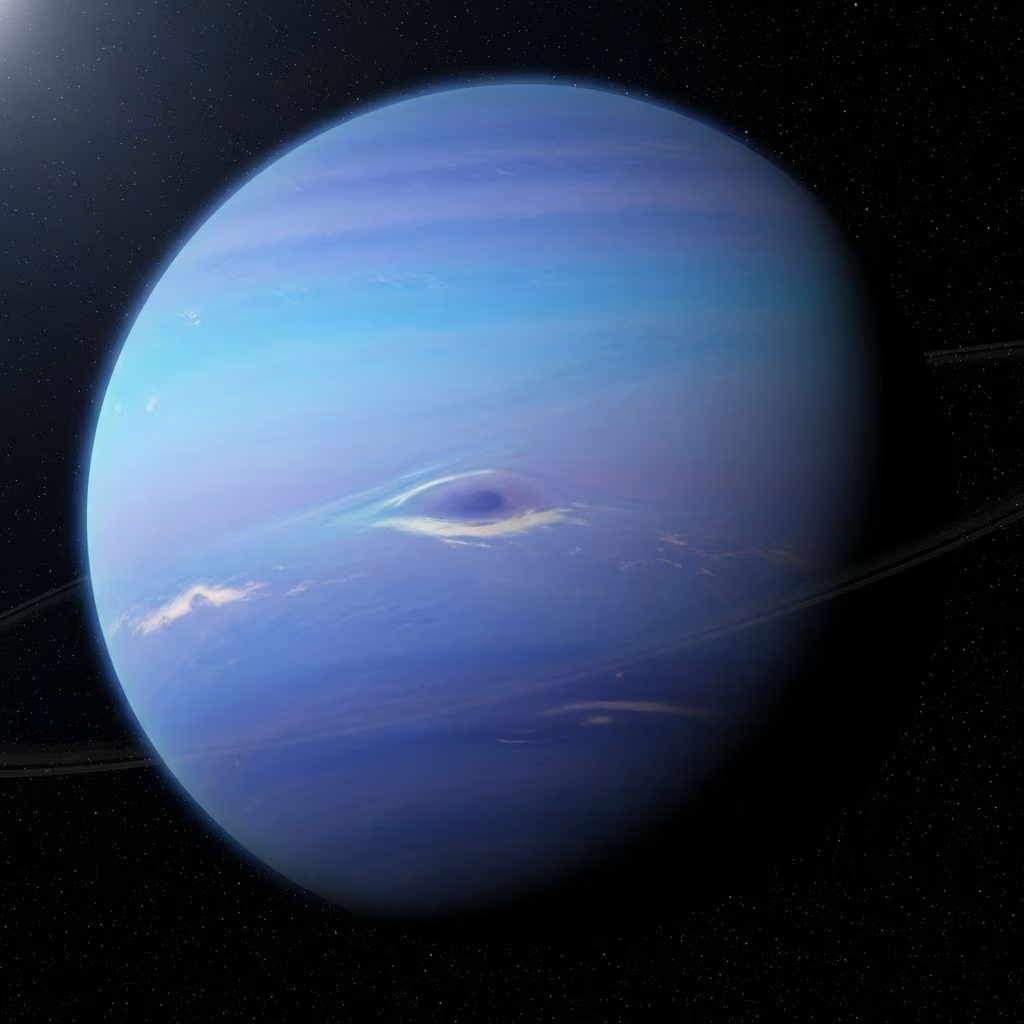
Neptune, the eighth planet from the Sun, possesses a dynamic and enigmatic atmosphere that continues to captivate astronomers and planetary scientists. Distinguished by a vivid blue coloration and turbulent weather systems, Neptune’s atmospheric characteristics both resemble and differ markedly from those of its neighboring ice giant, Uranus. In this article, we explore the structure, composition, phenomena, and key mysteries of Neptune’s atmosphere, as well as recent research and frequently asked questions.
Key Facts About Neptune
- Position: Eighth planet from the Sun
- Diameter: Fourth-largest planet in the solar system
- Mass: Third most massive planet, approximately 17 times that of Earth
- Orbital Period: Approximately 165 Earth years
- Discovery: 1846, using mathematical prediction and telescopic observation
Composition of Neptune’s Atmosphere
The atmospheric makeup of Neptune is primarily hydrogen (about 80%) and helium (about 19%), with a smaller but critically important fraction of methane and trace amounts of other gases. This composition gives rise to many of Neptune’s distinctive features.
| Gas | Approximate Percentage | Role in Atmosphere |
|---|---|---|
| Hydrogen | ~80% | Main constituent, supports atmospheric pressure |
| Helium | ~19% | Second major component |
| Methane (CH4) | ~2.3% by volume | Gives planet its blue color, influences cloud formation |
| Ammonia | <1% | Participates in cloud chemistry |
| Ethane, Acetylene | Trace | Produced via methane photolysis |
| Carbon Monoxide | Trace | Contributes to temperature structure |
| Water Vapor | Trace | May exist in deeper layers and influence cloud dynamics |
The presence of methane, even in relatively low concentrations, is essential for Neptune’s visual appearance and chemistry. Ultraviolet light acts on methane molecules to produce ethane, acetylene, and other hydrocarbons, which help create haze and stratified cloud layers[11].
Structure of Neptune’s Atmosphere
Neptune’s atmosphere can be divided into several notable layers:
- Troposphere: The lowest atmospheric region, where temperature generally decreases with altitude. Weather phenomena such as clouds, storms, and winds are most active here.
- Stratosphere: Above the troposphere, characterized by a temperature increase with altitude. Here, photochemical reactions driven by solar ultraviolet light produce hazes and hydrocarbons.
- Thermosphere: A region with much lower pressures, extending upwards and gradually transitioning into the exosphere. Trace gases such as carbon monoxide and hydrogen cyanide contribute to heating in this layer, making Neptune’s stratosphere unexpectedly warm compared to Uranus.
- Exosphere: The uppermost layer, where atmospheric particles can escape to space.
The transition between the troposphere and stratosphere—the tropopause—occurs at a pressure of about 0.1 bars (10 kPa). In total, the atmosphere comprises roughly 5–10% of Neptune’s mass, extending 10–20% of the way toward the center.
Weather and Climate: Extreme Conditions
Neptune is renowned for its fierce and ever-changing weather phenomena. It is the windiest planet in the solar system, with prevailing winds that often exceed 1,200 miles per hour (2,000 kilometers per hour)[12]. These winds whip up storms and cloud bands, giving rise to dramatic visual features.
- Storms and Vortices: The most famous are the Great Dark Spot and Small Dark Spot, both observed by Voyager 2 in 1989. These are enormous anticyclonic storms, comparable to but shorter-lived than Jupiter’s Great Red Spot. The Great Dark Spot measured roughly 13,000 kilometers—about the size of Earth—and vanished within several years after its discovery, indicating rapid atmospheric changes.
- Cloud Bands and High-Altitude Clouds: Neptune’s bright, white clouds—primarily composed of methane ice—appear against the planet’s blue background and form a dynamic, ever-shifting pattern. Some clouds are so high in the atmosphere that they cast shadows on lower cloud decks.
- Temperature Structure: Neptune’s upper atmosphere is cold, with average temperatures around –218°C (–360°F). However, deeper atmospheric layers and the stratosphere are warmed by both solar input and Neptune’s internal heat, which is unusually strong compared to Uranus.
Unlike Uranus, Neptune radiates more than twice as much energy as it receives from the Sun. This substantial internal heat source drives convection, powers storms, and ensures that Neptune’s atmosphere is highly active and fickle[10].
Why Is Neptune Blue?
The deep blue hue of Neptune is a direct result of methane in its upper atmosphere. Methane absorbs red light and reflects blue light, making the planet’s appearance strikingly vivid. However, optical measurements indicate that Neptune is a darker blue than Uranus, which has a similar methane content. This suggests the presence of another, yet unidentified, atmospheric component that enhances Neptune’s characteristic color[11].
- Methane’s role: Absorbs red wavelengths, allows blue to pass through
- Unknown factor: Causes Neptune to appear darker than Uranus, despite similar methane abundance
- Photochemical Hazes: UV radiation on methane produces hydrocarbon hazes, which may play a role in color modulation
Clouds and Atmospheric Phenomena
Neptune’s clouds are primarily composed of methane ice crystals, but lower cloud layers may contain ammonia and hydrogen sulfide. Cloud features are remarkably dynamic, with complex banding and rapidly shifting structures.
- Bright Methane Clouds: These clouds, often found in the upper troposphere, are highly reflective and can be tracked as they swirl around the planet.
- Dynamic Banding: Atmospheric circulation produces alternating bands of higher and lower pressures, similar to those found on Jupiter and Saturn, but generally less regular.
- Occasional Giant Storms: Large storms form quickly and can dissipate within a few years, indicating extremes in Neptune’s weather system.
Atmospheric Chemistry and Photolysis
Solar ultraviolet radiation interacts with methane, driving a series of photochemical reactions that yield compounds such as:
- Ethane (C2H6)
- Acetylene (C2H2)
- Ethylene (C2H4)
- Carbon Monoxide (CO)
- Hydrogen Cyanide (HCN)
These products condense into hazes in the stratosphere, modifying the thermal structure and impacting local temperature gradients. Trace gases, particularly carbon monoxide and hydrogen cyanide, lead to a warmer stratosphere than would be expected solely from solar heating—partly explaining why Neptune’s upper atmosphere is warmer than Uranus’s.
Atmospheric Pressure and Density
Pressure in Neptune’s atmosphere increases rapidly with depth, reaching up to 10 GPa (about 100,000 Earth atmospheres) as one approaches the transition to mantle layers. The atmospheric density varies strongly with altitude and temperature, affecting cloud formation and storm energy.
Comparison with Uranus
| Feature | Neptune | Uranus |
|---|---|---|
| Atmospheric Composition | 80% H2, 19% He, ~2.3% CH4, trace gases | Similar, with slightly more methane by volume |
| Blue Color | Vivid, darker blue | Paler blue-green |
| Internal Heat | Strong; radiates more than twice solar energy received | Very weak |
| Storms & Winds | Strong, dynamic, fastest in solar system | Less active, slower weather changes |
Internal Structure: Connection to Atmosphere
Beneath Neptune’s atmosphere lies a deep mantle, comprising a hot, dense, supercritical fluid rich in water, ammonia, and methane—sometimes called a water–ammonia ocean. Below this is a rocky core of iron, nickel, and silicates. The enormous internal heat generated in the mantle powers the planet’s atmospheric dynamics and convection.
Mysteries and Ongoing Research
Though Voyager 2’s 1989 flyby revolutionized our understanding of Neptune, many atmospheric mysteries remain.
- Unknown Coloring Agent: What deepens Neptune’s blue color beyond what methane alone produces?
- Storm Mechanics: Why do giant storms like the Great Dark Spot form and dissipate so swiftly compared to those on Jupiter?
- Internal Heat Source: What specific mechanisms produce Neptune’s potent internal energy?
- Temperature Inversion: Why is Neptune’s stratosphere warmer than expected, while Uranus’s is cooler?
Continued observations with terrestrial telescopes, the Hubble Space Telescope, and future missions are probing these questions, offering new insights into atmospheric chemistry and weather dynamics[12].
Frequently Asked Questions (FAQs)
Q: What gives Neptune its blue color?
A: Neptune’s blue appearance results from methane in its upper atmosphere, which absorbs red light, but additional unidentified factors may deepen its hue beyond that of Uranus[11].
Q: How fast are winds on Neptune?
A: Winds on Neptune reach up to 1,200 miles per hour (2,000 kilometers per hour)—the fastest in the solar system[12].
Q: What causes Neptune’s storms?
A: Storms are powered by Neptune’s strong internal heat and swift atmospheric circulation; their formation and short lifespan are still being researched.
Q: How is Neptune’s atmosphere different from Uranus’s?
A: While both have similar compositions, Neptune’s atmosphere is much more dynamic and violent, owing to its greater internal heat and more intense winds, which result in more frequent and larger storms.
Q: What is the temperature in Neptune’s atmosphere?
A: The upper atmosphere temperatures can be as low as –218°C (–360°F), yet the lower layers and stratosphere are significantly warmer due to internal heating[10].
Conclusion: Neptune’s Atmospheric Frontier
Neptune’s atmosphere remains a frontier of planetary science. Its vivid blue coloration, powerful winds, and tumultuous storms make it both a marvel of nature and a source of ongoing scientific investigation. As astronomers probe deeper with new instruments and future missions, Neptune promises to reveal further insights into atmospheric mechanics—not only of ice giants, but of distant exoplanets throughout the galaxy.
References
- https://www.lpi.usra.edu/education/IYPT/Neptune.pdf
- https://en.wikipedia.org/wiki/Neptune
- https://www.universetoday.com/articles/what-is-neptune-made-of-1
- https://pmc.ncbi.nlm.nih.gov/articles/PMC7658780/
- https://www.britannica.com/place/Neptune-planet
- https://spacemesmerise.com/en-us/blogs/planets/exploring-neptunes-atmosphere-composition-and-characteristics
- https://planetfacts.org/the-atmosphere-of-neptune/
- https://science.nasa.gov/asset/hubble/neptunes-dynamic-atmosphere/
- https://www.universetoday.com/articles/atmosphere-of-neptune
- https://study.com/learn/lesson/neptune-moons-composition.html
- https://spacemesmerise.com/en-us/blogs/planets/exploring-neptunes-atmosphere-composition-and-characteristics?srsltid=AfmBOorTuSX-LI9xDFRwm79KAbUvt26RUNNNti7isIW8N1WikutlLNK6
- https://www.planetary.org/worlds/neptune
- https://www.youtube.com/watch?v=ArFIMGS9BhY
- https://nerdyneptune.weebly.com/atmosphere-composition.html
- https://astroingeo.us/solar-system/neptunes-atmosphere-explained
- https://nssdc.gsfc.nasa.gov/planetary/factsheet/neptunefact.html