


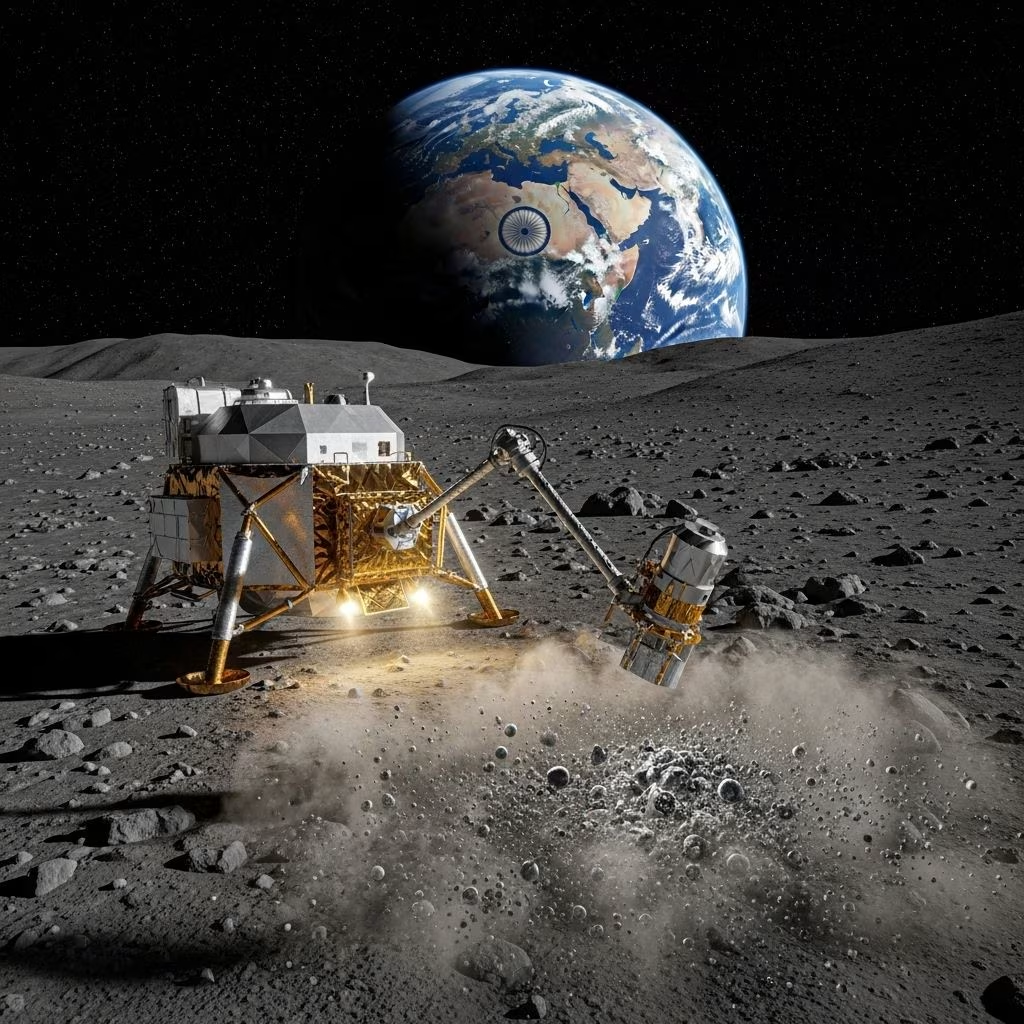
India’s Chandrayaan-3 Lunar Lander: Unlocking the Secrets of Moon Dust
The Chandrayaan-3 mission, led by the Indian Space Research Organisation (ISRO), made global headlines in August 2023 after its Vikram lander successfully touched down near the lunar south pole. This achievement not only placed India among the elite group of nations capable of soft lunar landings—following the Soviet Union, the United States, and China—but also marked the first-ever landing in this challenging, resource-rich region. Beyond technological prowess, Chandrayaan-3 equipped India’s scientists with the unprecedented opportunity to study lunar dust up-close, providing new insights into the Moon’s geology and surface processes that carry broad implications for future exploration.
Historic Lunar South Pole Landing
On August 23, 2023, the Vikram lander concluded a meticulously-planned descent and soft-landed on the Moon’s southern pole. This milestone offers not just national pride but strategic scientific access to a region hypothesized to harbor water ice—a key resource for future crewed missions and lunar outposts.
- First soft landing at the lunar south pole: Previously uncharted, posing unique engineering and scientific challenges.
- India joins lunar elite: Becoming fourth country to achieve soft lunar touchdown, and first at the Moon’s southern pole.
- Mission objectives:
- Demonstrate safe landing and rover mobility.
- Conduct in-situ lunar surface scientific experiments.
- Probe for water ice and analyze lunar regolith properties.
Chandrayaan-3 Mission Overview
Chandrayaan-3 was ISRO’s third lunar venture, following Chandrayaan-1 (2008) and Chandrayaan-2 (2019). The latter’s landing attempt failed, but Chandrayaan-3 built on those lessons to ensure success this time. The mission was launched on July 14, 2023, atop the Geosynchronous Satellite Launch Vehicle Mark III (LVM3), and entered lunar orbit before deploying the Vikram lander and Pragyan rover.
| Component | Function |
|---|---|
| Vikram Lander | Touchdown; scientific payload deployment |
| Pragyan Rover | Mobility; surface analysis |
| Propulsion Module | Earth-lunar transfer; houses SHAPE payload |
- Mission duration: One lunar day (approx. 14 Earth days).
- Budget: ₹615 crore (approx. $75 million USD).
- Purpose: Strengthen India’s space science; enable lunar surface studies and future exploration.
Scientific Instruments: Studying Lunar Dust and Geology
One of the key scientific drivers for Chandrayaan-3 was to examine the characteristics of lunar regolith—the layer of dust, loose rock, and soil covering solid bedrock. Understanding how moon dust behaves is essential for future missions, as it affects lander safety, astronaut health, and resource utilization.
Main Payloads and Experiments
- Chandra’s Surface Thermophysical Experiment (ChaSTE):
- Measures thermal conductivity and temperature of the lunar surface.
- Provides insights into dust layer thickness and how it reacts to sunlight and temperature swings.
- Instrument for Lunar Seismic Activity (ILSA):
- Monitors lunar tremors, including those caused by natural impacts or the lander’s own touchdown.
- Helps identify subsurface layering and mechanical properties of lunar regolith.
- Langmuir Probe (LP):
- Studies plasma density and how charged lunar dust interacts with solar wind.
- Laser Retroreflector Array: Provided by NASA for precise distance and location measurements, assisting in lunar laser ranging.
Rover Pragyan’s Scientific Capabilities
- Alpha Particle X-ray Spectrometer (APXS):
- Reveals elemental composition of rocks and dust at the landing site.
- Traces distribution of magnesium, aluminum, silicon, and other minerals in regolith.
- Laser Induced Breakdown Spectroscope (LIBS):
- Performs rapid on-site analysis using powerful laser pulses to detect chemical elements.
- Crucial for identifying rare elements and assessing potential for water or ice within lunar dust.
Key Discoveries: Unraveling Moon Dust Mysteries
Despite operating for just one lunar day, Chandrayaan-3’s instruments sent back valuable data.
- Temperature Profiles: ChaSTE measured surface and subsurface temperature variations, revealing that the thin lunar dust layer experiences dramatic swings—from -10°C to 60°C over short distances. These readings help model how future equipment and habitats might cope with dust and heat on the Moon.
- Thermal Conductivity: Measurements indicated the upper layer of lunar regolith is extremely insulating, with poor heat transfer. This affects both lander design and plans for utilizing lunar soil as construction material.
- Elemental Surveys: Rover’s APXS and LIBS identified major rock-forming elements near the landing site, confirming the presence of aluminum, magnesium, calcium, silicon, titanium, and iron. Such data informs planetary formation models and the prospect of using local resources for building lunar infrastructure.
- Seismic Activity: ILSA detected minor tremors, revealing the mechanical properties of the lunar surface and providing clues about subsurface layering and stability.
Significance of Lunar Dust Findings
- Operational Safety: Lunar dust is electrostatically charged and can cling to machinery, posing challenges for future missions. Chandrayaan-3’s real-time dust dynamics observations will inform new engineering safeguards.
- Future Exploration: Understanding dust and regolith is crucial for site selection, habitat construction, and mining efforts, especially near the Moon’s poles where ice may be present.
Implications for India and Global Lunar Science
Chandrayaan-3’s successful experiments have broad ripple effects across both national and international scientific communities.
- Space Weathering Studies: Data from ChaSTE and Langmuir Probe help researchers track how solar radiation and micrometeorite impacts alter lunar surface and dust over millions of years.
- Technology Demonstration: ISRO’s ability to deploy, operate, and retrieve data from a rover and instruments in the harsh lunar polar environment sets a precedent for future, more complex missions.
- International Collaboration: Inclusion of NASA’s Laser Retroreflector Array and data-sharing with other agencies foster global lunar science partnerships.
Comparing Chandrayaan-3 to Past and Parallel Missions
| Mission | Year | Landing Site | Major Science Achievement |
|---|---|---|---|
| Chandrayaan-1 | 2008 | Lunar orbit | Water ice detected via crash probe |
| Chandrayaan-2 | 2019 | Landing attempt (failed) | Orbital mapping; failed lander |
| Chandrayaan-3 | 2023 | South pole (soft landing) | Lunar dust, regolith, elemental analysis |
| Luna 24 (USSR) | 1976 | Near side | Lunar soil returned |
| Chang’e 4 (China) | 2019 | Far side | Regolith studies; biological experiment |
Why the Lunar South Pole Matters
The lunar south pole is a prime target for exploration because:
- Water Ice: Permanently shadowed regions could harbor ice—a game-changing resource for life support and fuel.
- Extreme Environment: Sunlight angles and surface composition differ from more-studied equatorial regions, providing unique laboratory conditions.
- Site for Future Bases: Polar regions are favored for long-term lunar habitats, making Chandrayaan-3’s dust and surface data crucial for planning.
Legacy and Future Prospects
Chandrayaan-3’s dust and regolith measurements form the backbone of future Indian and global lunar missions.
- Data Archive: The surface temperature, elemental surveys, and plasma measurements will inform decades of future work.
- Spacecraft Engineering: Lessons learned about dust behavior support design improvements for landers, rovers, and human habitats.
- Global Science Partnerships: India’s willingness to share findings and collaborate sets a model for international lunar research.
Frequently Asked Questions (FAQs)
Q: What makes Chandrayaan-3’s lunar south pole landing unique?
A: It is the first-ever soft landing at the lunar south pole, a region considered critical for future scientific research and human settlement due to its potential water ice reserves and harsh, unexplored environment.
Q: What did Chandrayaan-3 discover about moon dust?
A: Science instruments measured temperature, thermal conductivity, and elemental composition of lunar dust, revealing that the regolith near the south pole is highly insulating and comprised of common planetary minerals crucial for building habitats and mining resources.
Q: How does Chandrayaan-3 contribute to future lunar missions?
A: Mission data improve understanding of dust dynamics, regolith properties, and environmental risks, directly aiding safer landings, sustainable bases, and mining uses for subsequent Moon missions.
Q: What scientific payloads were on board Chandrayaan-3?
A: The mission included ChaSTE for temperature analysis, ILSA for seismic measurements, Langmuir Probe for plasma studies, and NASA’s Laser Retroreflector Array. The Pragyan rover was equipped with APXS and LIBS for onsite elemental investigations.
Q: Will India send more missions to the Moon?
A: Yes, ISRO has expressed plans for future lunar missions focused on further exploring the polar regions and advancing both robotic and eventual crewed lunar outposts, building on insights gained from Chandrayaan-3.
References
- https://en.wikipedia.org/wiki/Chandrayaan-3
- https://www.isro.gov.in/Chandrayaan3_Details.html
- https://science.nasa.gov/mission/chandrayaan-3/
- https://en.wikipedia.org/wiki/Chandrayaan_programme
- https://www.youtube.com/watch?v=UjX5MnCa2f8
- https://vajiramandravi.com/upsc-exam/chandrayaan-3/
- https://www.planetary.org/space-missions/chandrayaan-3
- https://byjus.com/current-affairs/chandrayaan-3/
- https://www.eoportal.org/satellite-missions/chandrayaan-3
- https://www.nextias.com/blog/chandrayaan-3/
- https://www.youtube.com/watch?v=DLA_64yz8Ss
- https://www.isro.gov.in/media_isro/pdf/Missions/LVM3/LVM3M4_Chandrayaan3_brochure.pdf
- https://www.space.com/chandrayaan-3-indian-moon-mission-rover
- https://www.space.com/india-chandrayaan-3-lunar-lander-moon-dust
- https://sscspace.com/ssc-and-indias-historic-lunar-landing/
- https://static.pib.gov.in/WriteReadData/specificdocs/documents/2023/aug/doc2023825244401.pdf


