


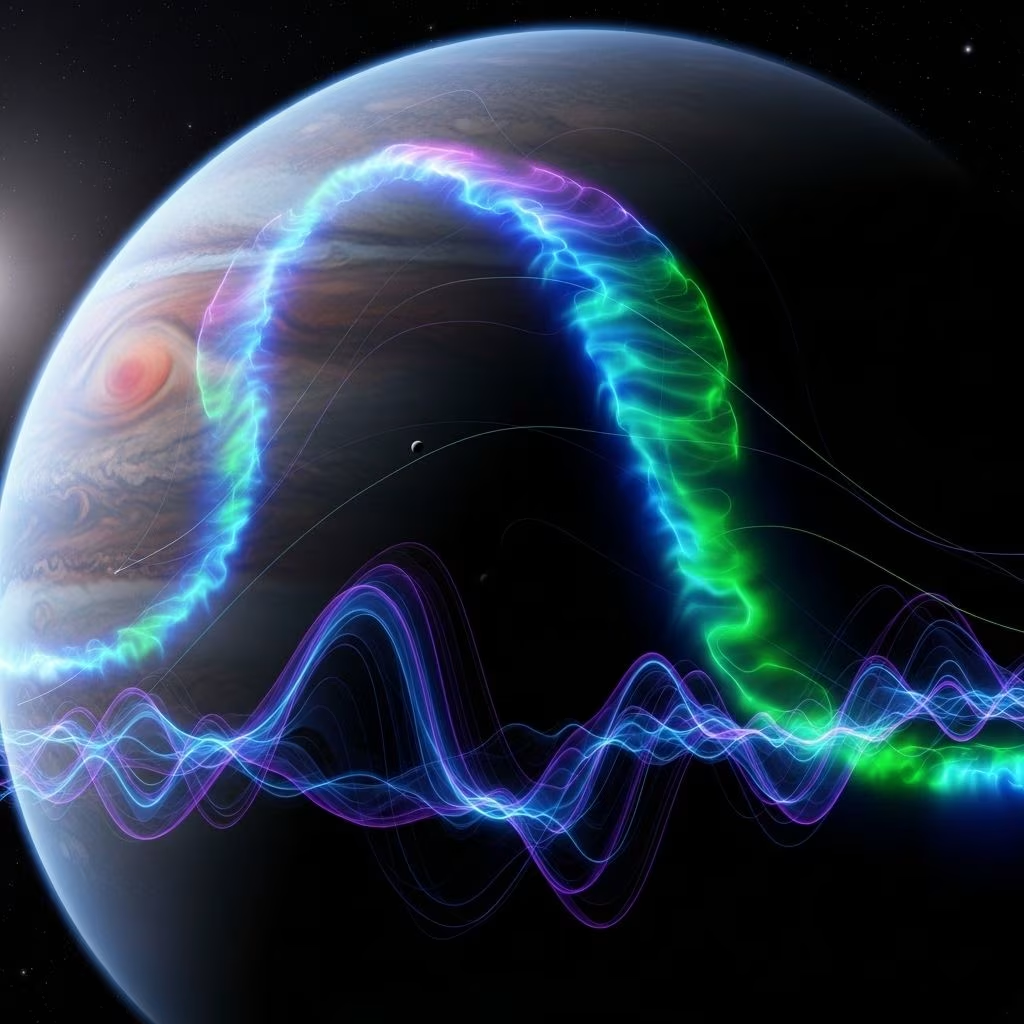
Alien Auroras on Jupiter Reveal a New Kind of Plasma Wave
In a groundbreaking development in planetary science, scientists have detected an entirely new kind of plasma wave within Jupiter’s spectacular auroras. Utilizing data from NASA’s Juno spacecraft, this discovery illuminates previously hidden processes at play in one of the solar system’s most extreme environments, changing how researchers understand both Jupiter’s magnetosphere and auroral phenomena across the cosmos.
What Are Auroras and Why Are Jupiter’s Unique?
Auroras, commonly known as the Northern or Southern Lights on Earth, are dazzling displays produced when charged particles collide with a planet’s upper atmosphere. Earth’s auroras shimmer in green and blue hues, plainly visible to the naked eye. However, Jupiter’s auroras differ dramatically:
- Invisible to Human Eyes: Unlike Earth’s, Jupiter’s auroras glow predominantly in ultraviolet (UV) and infrared (IR) wavelengths, invisible without advanced instruments.
- Immense Power and Scale: Jupiter’s magnetic field is about 20,000 times stronger than Earth’s, resulting in auroras that are brighter and more energetic by orders of magnitude.
- Persistent Activity: While Earth’s auroras appear primarily during periods of strong solar activity, Jupiter’s auroras are continuous, driven by unique interactions between its magnetic field, fast rotation, and volcanic moon Io.
Juno’s Mission: A Unique Polar Perspective
The Juno spacecraft is the first to enter a polar orbit around Jupiter, enabling it to fly directly over the planet’s north and south poles. This low-altitude vantage point granted:
- Unprecedented access to data above Jupiter’s polar caps, distinctly different from equatorial orbits of prior missions.
- Observation of the plasma environment and magnetic dynamics that drive Jupiter’s intense auroras.
According to Dr. Ali Sulaiman, an assistant professor at the University of Minnesota School of Physics and Astronomy, this unique location allowed researchers to apply new data analysis techniques to one of the solar system’s most challenging environments, paving the way for discoveries previously impossible from Earth or earlier space missions.
Discovery: A Hidden Plasma Wave in Jupiter’s Auroras
Scientists have detected a new kind of plasma wave embedded within the auroral zones above Jupiter’s north pole. This plasma regime exhibits properties distinct from any previously documented within the solar system.
- Very Low-Frequency Plasma Wave: The wave’s frequency is much lower than those seen in Earth’s magnetic environment.
- Extreme Conditions: The phenomenon occurs where extremely low-density plasma interacts with Jupiter’s extraordinary magnetic field strength.
This discovery was made possible through Juno’s plasma and wave detectors, and the results have been peer-reviewed and published in Physical Review Letters in July 2025, indicating the significance and novelty of the finding.
Table: Comparing Jupiter’s and Earth’s Auroras
| Feature | Earth | Jupiter |
|---|---|---|
| Light Type | Visible (green/blue) | Ultraviolet & Infrared (invisible) |
| Key Drivers | Solar wind | Moon Io, solar wind, rapid rotation |
| Magnetic Field Strength | ~0.3–0.6 Gauss | ~4.3 Gauss (average), up to 20,000x Earth’s |
| Frequency of Plasma Waves | Higher (well studied) | Much lower (unique, newly discovered) |
| Form of Auroras | Oval/donut pattern | Includes broad polar cap region |
Explaining Plasma and Its Mysterious Behavior
Plasma is a superheated, electrically charged state of matter in which electrons are stripped from atoms, creating a fluid of charged particles (ions and electrons). It is highly susceptible to magnetic and electric fields:
- Plasma flows along and is shaped by a planet’s magnetic field lines.
- On Jupiter, the interactions are especially exotic due to the planet’s sheer size and field strength.
Dr. Robert Lysak, professor at the University of Minnesota, notes: “While plasma can behave like a fluid, it is also influenced by its own magnetic fields and external fields.” The newly discovered wave exhibits characteristics unseen in Earth’s magnetosphere, suggesting that Jupiter’s polar region harbors plasma dynamics unique in the solar system.
Particle Acceleration: Powering the Alien Auroras
The Juno data show that Jupiter’s intense magnetic field accelerates charged particles toward the atmosphere, producing persistent, invisible auroras. Specifically:
- Jupiter’s magnetic field lines funnel energetic electrons at high speeds into the planet’s poles.
- The low-density plasma wave seems to channel and enhance this particle acceleration within the polar cap, rather than in an auroral oval as on Earth.
This means that instead of forming a contained, ring-shaped auroral belt, Jupiter’s auroras can spread across the entire polar region, flooding it with particle activity.
New Data, New Understanding: Redefining Magnetospheric Science
The implications of this discovery reach far beyond Jupiter:
- Planetary Diversity: This plasma regime could exist on other giant planets, or exoplanets with strong magnetic fields.
- Improved Models: The finding challenges existing theories on how planetary magnetospheres work, especially regarding particle transfer into polar caps.
- Aurora Formation: Sheds light on why Jupiter’s aurora is so different in both appearance and behavior relative to Earth’s.
Continued analysis of Juno’s polar passes may yield even more surprises and could offer clues to unexplained auroral processes throughout the solar system and beyond.
The Role of Jupiter’s Moons: Aurora Footprints
Another intriguing aspect of Jupiter’s auroras is the phenomenon of auroral “footprints”:
- Jupiter’s largest moons — especially Io, Europa, and Ganymede — create traveling marks or “footprints” where their own interactions with Jupiter’s field create localized auroral activity.
- For years, Callisto’s auroral footprint remained elusive; recent NASA Juno observations finally confirmed its presence, showcasing how these interactions further enrich Jupiter’s dynamic auroral environment.
Instruments and Future Missions
The discovery would not have been possible without the sophisticated payload on Juno, including:
- Waves Instrument: Directly samples electric and magnetic fields in Jupiter’s polar environment.
- UVS and JIRAM: Specialized tools for detecting UV and IR aurora emissions, respectively.
Looking forward, mission scientists plan to:
- Continue collecting close-up data during polar flybys.
- Compare Jupiter’s plasma dynamics to those of other magnetized bodies, including Saturn and exoplanets.
- Enhance ground-based observing campaigns with support from next-generation space telescopes.
Frequently Asked Questions (FAQs)
Q: What makes Jupiter’s auroras different from Earth’s?
A: Jupiter’s auroras are brighter, operate in ultraviolet and infrared wavelengths (invisible to the human eye), and are much more powerful due to the planet’s extremely strong magnetic field. They are also continuous, compared to the periodic nature of Earth’s auroras.
Q: What is a plasma wave?
A: Plasma waves are oscillations found within plasma—a state of matter comprised of freely moving charged particles (ions and electrons). These waves can transport energy and particles across a magnetized environment like Jupiter’s auroral zones.
Q: How did the Juno spacecraft discover the new plasma wave?
A: By flying directly over Jupiter’s polar caps, Juno’s instruments measured very low-frequency plasma waves that had never before been detected in planetary magnetospheres, revealing a new regime of plasma behavior.
Q: Why is this discovery important for planetary science?
A: The finding challenges current models of how auroras and magnetospheres work, particularly how planetary fields guide particle flow and create persistent auroral displays at the poles. It also opens new research avenues for gas giants and exoplanets.
Q: Will further discoveries be made at Jupiter?
A: Yes. As Juno continues to orbit over the poles, new data are expected to shed more light on these exotic plasma processes, and may reveal even more surprises in Jupiter’s atmosphere and magnetosphere.
Key Takeaways
- A brand new type of low-frequency plasma wave has been discovered by NASA’s Juno mission in Jupiter’s polar auroras.
- This plasma regime is unique due to the planet’s enormous magnetic field and extremely low plasma densities in the polar cap.
- The discovery fundamentally alters our understanding of magnetospheric and auroral science on giant planets.
Explore More: Understanding Aurora Science
- Earth’s auroras are only the starting point—many planets have auroras powered by different drivers and occurring at different wavelengths.
- Plasma physics is crucial for understanding not just auroras, but the behavior of winds, radiation belts, and space weather across the universe.
References
- https://www.space.com/astronomy/jupiter/alien-auroras-on-jupiter-reveal-a-new-kind-of-plasma-wave-scientists-say
- https://phys.org/news/2025-08-alien-aurora-plasma-jupiter.html
- https://www.universetoday.com/articles/scientists-discover-unusual-plasma-waves-in-jupiters-aurora
- https://www.tunisiesoir.com/science/jupiters-alien-aurora-scientists-detect-unprecedented-plasma-waves-32245-2025/
- https://scitechdaily.com/alien-aurora-scientists-spot-never-before-seen-plasma-waves-in-jupiters-polar-lights/
- https://thedebrief.org/nasas-juno-mission-reveals-exotic-plasma-behavior-in-jupiters-aurora/
- https://dailygalaxy.com/2025/09/alien-plasma-waves-erupt-jupiter-auroras/
- https://www.sci.news/space/juno-unusual-plasma-waves-jupiters-aurora-14150.html
- https://www.gadgets360.com/science/news/alien-aurora-scientists-spot-first-new-plasma-wave-in-jupiter-s-auroral-display-9157114
- https://www.eurekalert.org/news-releases/1095076
- https://dailygalaxy.com/2025/08/unprecedented-discovery-jupiters-auroras/
- https://www.miragenews.com/researchers-unveil-new-plasma-wave-in-jupiters-1517503/
- https://phys.org/tags/aurora/
- https://www.youtube.com/watch?v=8vGxy6TK6rg
- https://turbo.gadgets360.com/science/news/alien-aurora-scientists-spot-first-new-plasma-wave-in-jupiter-s-auroral-display-news-9157114
- https://www.youtube.com/watch?v=o6iNpcjmwsg
- https://news.ssbcrack.com/researchers-discover-new-plasma-wave-type-in-jupiters-aurora-through-juno-mission/
- https://news.ssbcrack.com/university-of-minnesota-researchers-discover-new-plasma-wave-in-jupiters-aurora/


