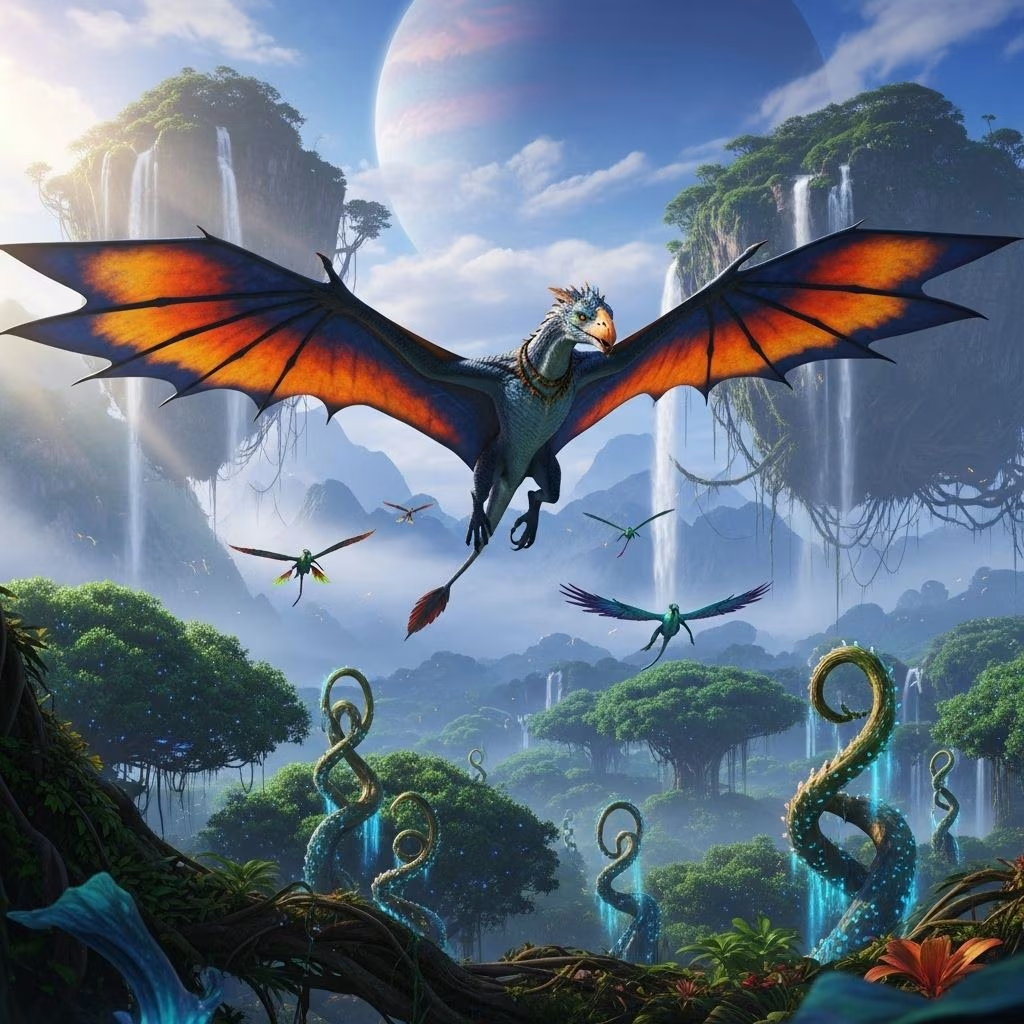
The Creatures of ‘Avatar’: Wonders of Pandora’s Wildlife
James Cameron’s ‘Avatar’ films introduced audiences to Pandora, a moon teeming with breathtakingly original creatures and ecosystems. As much a triumph of worldbuilding as a visual spectacle, the alien animals of Pandora play a key role in the immersive experience. This guide explores the notable fauna depicted across ‘Avatar’ and ‘Avatar: The Way of Water,’ the design philosophy behind their creation, their scientific plausibility, and their effect on filmgoers’ imagination.
Pandora: An Alien Earth
Pandora, the lush habitable moon orbiting Polyphemus in the Alpha Centauri system, is the stage on which humans and the Na’vi interact with an astonishing array of lifeforms. Cameron’s team crafted Pandora as a planet with robust evolutionary principles, leading to surprisingly cohesive and believable biology, even within the film’s fantasy setting.
- Bioluminescence: Many organisms glow, serving both as a visual signature and a plausible adaptation to the moon’s unique environmental conditions.
- Shared Anatomy: Six limbs is the norm, not the exception. Both predators and prey exhibit this trait.
- Networked Ecosystem: Life on Pandora is interconnected—biologically and in some ways spiritually—through the planet’s neural-like network.
A Brief History of Creature Design
Creating Pandora’s wildlife was a monumental design challenge. Director James Cameron began sketching creatures as early as the 1990s, working with a team of visionary artists and designers. When digital technology caught up to Cameron’s ambitions, creature designer Neville Page led a team that included Wayne Barlowe, Jordu Schell, and many others, with Stan Winston Studio bringing the digital monsters to life in 3D.
- Biological consistency: All creatures—herbivores, carnivores, and flying beasts—must fit plausible evolutionary lineages.
- Alien, yet familiar: Inspiration was drawn from real Earth species but pushed into new configurations.
- Visual storytelling: Each creature serves to further narrative, showcase danger, or illustrate the philosophy of Pandora’s biosphere.
The Six-Legged Formula: Anatomy of Pandoran Fauna
One of Pandora’s distinguishing biological traits is the prevalence of hexapods—six-limbed creatures that dominate both the skies and land. This feature is rooted in the evolutionary logic Cameron applied to his world, setting Pandora apart while providing visual consistency.
- Most animals—predators, prey, and even many birds—have two pairs of forelimbs and one pair of hind limbs.
- Body plans include extra joints and novel musculature, enabling a range of movements unseen in terrestrial wildlife.
Pandora’s Herbivores: Giants Among Aliens
Hammerhead Titanothere (Angtsìk)
The Hammerhead Titanothere is an imposing, six-legged behemoth reminiscent of a rhinoceros on a grander scale. Its most distinctive feature is a broad, hammer-shaped bony projection on its skull, used for threat display and combat—a clear parallel to Earth’s rams and hammerhead sharks.
Key traits:
- Towering mass, formidable size exceeding real earth megafauna.
- Vivid coloration on the crest for display—both for intimidation and mating rituals.
- Relatively peaceful, but dangerous when provoked or threatened, especially by predators.
Hexapede (Yerik)
The Hexapede is a fleet, six-legged herbivore, much smaller and more deer-like than the Titanothere. Sleek and gentle, these animals fill the same ecological niche as Earth’s ungulates, serving as vital prey for Pandora’s predators.
- Six slender legs for speed and agility.
- Distinctive spiral horns and markings.
- Common in herds, contributing to the dynamic ecosystem.
Pandora’s Deadliest Predators
Thanator (Palulukan)
The Thanator is the unrivaled apex terrestrial predator of Pandora—a horrifying blend of armored reptile and panther, with features borrowed from ancient aquatic placoderms and cutting-edge science fiction. With six muscular limbs, an armored carapace, and a mouth ringed with savage teeth, this creature ranks among the most feared on the planet.
- Athletic frame with six powerful legs for charging and climbing.
- Armored head and distensible jaws capable of delivering crushing bites.
- Hunts both the largest herbivores and small prey, ruling Pandora’s forests.
| Predator | Key Features |
|---|---|
| Thanator | Six limbs, armored head, immense jaws, pitch-black coloration |
| Viperwolf | Sleek, pack-hunting, bioluminescent green stripes, marsupial traits |
Viperwolf (Nantang)
Viperwolves are smaller, lithe pack predators. Their bioluminescent markings and keen intelligence make them formidable, echoing terrestrial canids and marsupials but with eerie alien aesthetics.
- Six agile limbs and whip-like tails.
- Pack cooperation in hunts, sophisticated communication.
- Bioluminescence provides camouflage and intimidation advantages at night.
Masters of the Sky: Pandora’s Flying Predators
Mountain Banshee (Ikran)
The Ikran, or Mountain Banshee, is perhaps Pandora’s most iconic flying beast. Used by the Na’vi as partners for hunting and war, these creatures combine raptor-like grace with a skin stretched between slender, multi-jointed wings. Their neural queues bond directly with those of the Na’vi, deepening the moon’s themes of biological connection.
- Vividly colored, with butterfly-inspired membrane patterns.
- Multiple wing segments for advanced maneuverability in mountain terrain.
- Symbiotic bond with Na’vi riders—a rite of passage for the people.
Great Leonopteryx (Toruk)
The Toruk, or Great Leonopteryx, stands as the monarch of the skies, dwarfing even the fierce banshees. With crimson and black striping and an elegant, beaked head inspired by tropical parrots and Monarch butterflies, the Toruk is feared and revered in Na’vi mythology. Few have ever tamed it, adding to its legendary status.
- Enormous wingspan, estimated at over 80 feet.
- Striking coloration for identification and threat display.
- Absolute dominance in aerial predation, feeding even on banshees.
Majesty Beneath the Waves: New Aquatic Life
In ‘Avatar: The Way of Water,’ audiences ventured into Pandora’s oceans—home to an entirely new collection of aquatic giants and marvels. Designers embraced marine biology to craft animals both plausible and wondrous.
Tulkun
Tulkun are massive, intelligent whale-like beings bonded spiritually and emotionally with the Metkayina clan of the Na’vi. They communicate using complex vocalizations and share deep, individual relationships with Pandora’s oceanic people, reflecting the film’s themes of empathy and stewardship.
- Gigantic size, comparable to Earth’s largest whales.
- Demonstrated intelligence, tool use, and moral codes in some interpretations.
- Central to the plot of ‘The Way of Water.’
Ilu and Skimwing
- Ilu: Small, dolphin-like riders for the Na’vi, displaying playful behavior and tight familial groups, with streamlined forms for speed.
- Skimwing: Larger, more fearsome marine creatures—part fish, part flying fish—capable of leaping above water, used as steeds by warriors.
Creatures and Culture: Symbolism and Significance
Pandoran animals are not just ecosystem players—they’re entwined with the Na’vi’s social structure and belief systems. From aerial rites of passage to oceanic bonds, each form of life on Pandora illustrates the unity of biological function and cultural meaning.
- Ikran: Bonding marks the passing to adulthood among Omaticaya clan Na’vi.
- Toruk: Taming one brings ultimate honor—the rider becomes Toruk Makto, a prophesied leader.
- Tulkun: Considered siblings by the reef-dwelling Na’vi; their songs are a form of history and ritual.
Real-World Science: Biological Inspiration
While Pandora is a work of science fantasy, its creatures are informed by real biological principles.
- Hexapod symmetry is plausible if evolution on Pandora took a distinct turn from Earth’s tetrapod lineage.
- Bioluminescence mirrors deep-sea and jungle adaptations on Earth, facilitating communication, camouflage, and mating displays.
- Behavior and social structure echo real-world animals, lending credibility to cinematic wildlife.
Frequently Asked Questions (FAQs)
Q: Why do so many Pandora creatures have six limbs?
A: The six-limbed body plan reflects an evolutionary lineage distinct from Earth’s tetrapods, enhancing the moon’s alien feel and biological cohesion.
Q: Are any Pandora creatures based directly on real animals?
A: Many animals borrow elements from Earth species—such as hammerhead sharks, big cats, and parrots—but each is remixed into unique, otherworldly forms.
Q: Are the aquatic creatures in ‘The Way of Water’ scientifically plausible?
A: Though exaggerated, the aquatic fauna draw from actual marine biology, including communication, intelligence, and hydrodynamics.
Q: Do the creatures’ bioluminescence serve real survival purposes?
A: Yes. Bioluminescence aids in communication, deterrence of predators, and mating, akin to its functions in various Earth ecosystems.
Q: How did the filmmakers design such convincing alien wildlife?
A: Through a combination of direct observation of Earth life, evolutionary thought experiments, and advanced digital artistry, the team achieved unprecedented verisimilitude.
Final Thoughts: The Legacy of Pandora’s Fauna
The creatures of ‘Avatar’ are a testament to the power of imagination grounded in science. Their dazzling realism and narrative function have inspired new standards in worldbuilding, blending plausible biology with cinematic magic. As future Avatar sequels explore additional realms of Pandora, fans and scientists alike anticipate even more captivating additions to this fictional bestiary.
References
- https://www.space.com/creatures-of-avatar-movies
- https://www.space.com/avatar-spaceships-and-vehicles
- https://www.youtube.com/watch?v=0yPKwF420hg
- https://tetzoo.com/blog/2022/12/21/avatar-updated-for-2022
- https://james-camerons-avatar.fandom.com/wiki/Avatar_(species)
- https://www.avatar.com/movies
- https://en.wikipedia.org/wiki/Fictional_universe_of_Avatar
- https://en.wikipedia.org/wiki/Avatar_(2009_film)
- https://james-camerons-avatar.fandom.com/wiki/Pandora
- https://www.youtube.com/watch?v=Bi8eqdVwLQw
- https://monsterlegacy.net/2015/09/27/avatar-pandora-thanator-ikran-toruk-fauna/
- https://screenrant.com/avatar-all-movie-animals-pandora-explained/
- https://web.archive.org/web/20230408004507/https:/tetzoo.com/blog/2022/12/21/avatar-updated-for-2022
- https://www.avatar.com/pandorapedia
- https://scienceblogs.com/tetrapodzoology/2010/01/14/creatures-of-avatar
- https://www.imdb.com/title/tt0499549/faq/
- https://www.cbr.com/best-creatures-in-avatar-ranked/
- https://phys.org/news/2010-03-avatars-space.html