Scientists Unveil a New Timeline for the Universe’s End
For centuries, humanity has gazed at the cosmos, pondering not only its origins but also its fate. The persistent chill of deep space, the slow dimming of starlight, and the enigmatic behavior of black holes have fired imaginations and driven scientific inquiry. Now, a newly-published study led by Heino Falcke of Radboud University in the Netherlands claims the universe’s ultimate demise may come much sooner—on cosmic scales—than previously believed.
While this timeline remains unfathomably distant, the revised calculation dramatically shortens our universe’s ‘life expectancy.’ The fate of all matter and energy, predicted at 1078 years from now, stands in stark contrast to the older estimate of 101100 years. Despite this ‘sooner’ end, the sheer magnitude of the numbers involved places these events far beyond anything humanity, or even our galaxy, will ever witness.
The Ever-Evolving Story of Cosmic Fate
To understand the new prediction and its profound implications, it’s essential to explore:
- The lifecycle of stars and the fate of their remnants
- The role of Hawking radiation and black holes in cosmic decay
- The difference between previous and current estimates
- What these insights tell us about the future of the cosmos
How Do Scientists Calculate the Universe’s End?
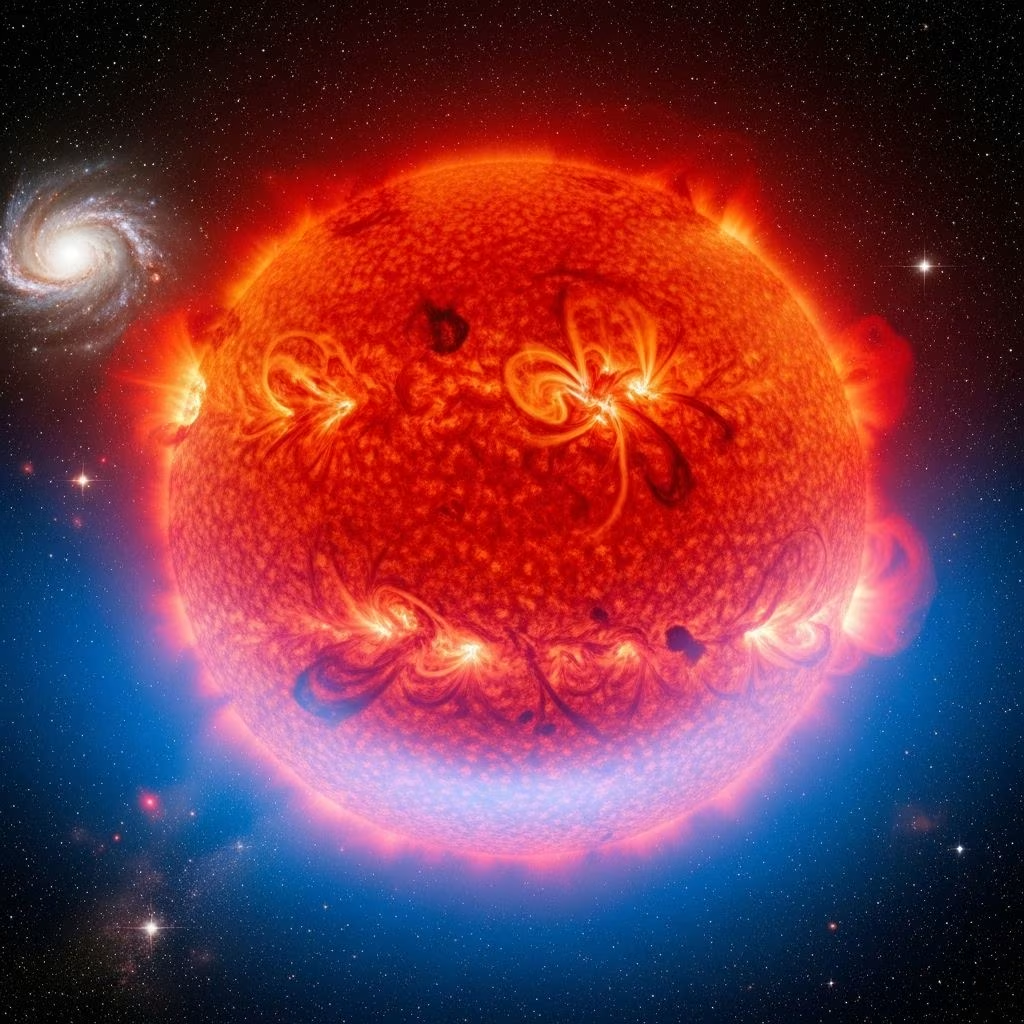
Predicting the end of the universe is no easy feat. It involves heavy mathematics, sophisticated physics, and a good measure of scientific humility. The most recent breakthrough comes from analysis of the fate of the universe’s longest-lived objects: the embers left behind by dead stars—such as white dwarfs, neutron stars, and black holes. These objects persist long after ordinary stars like our Sun cease to shine.
Key Concepts in Cosmic Prediction
- Stellar Remnants: When stars exhaust their fuel, they leave behind dense cores: white dwarfs, neutron stars, or, if massive enough, black holes.
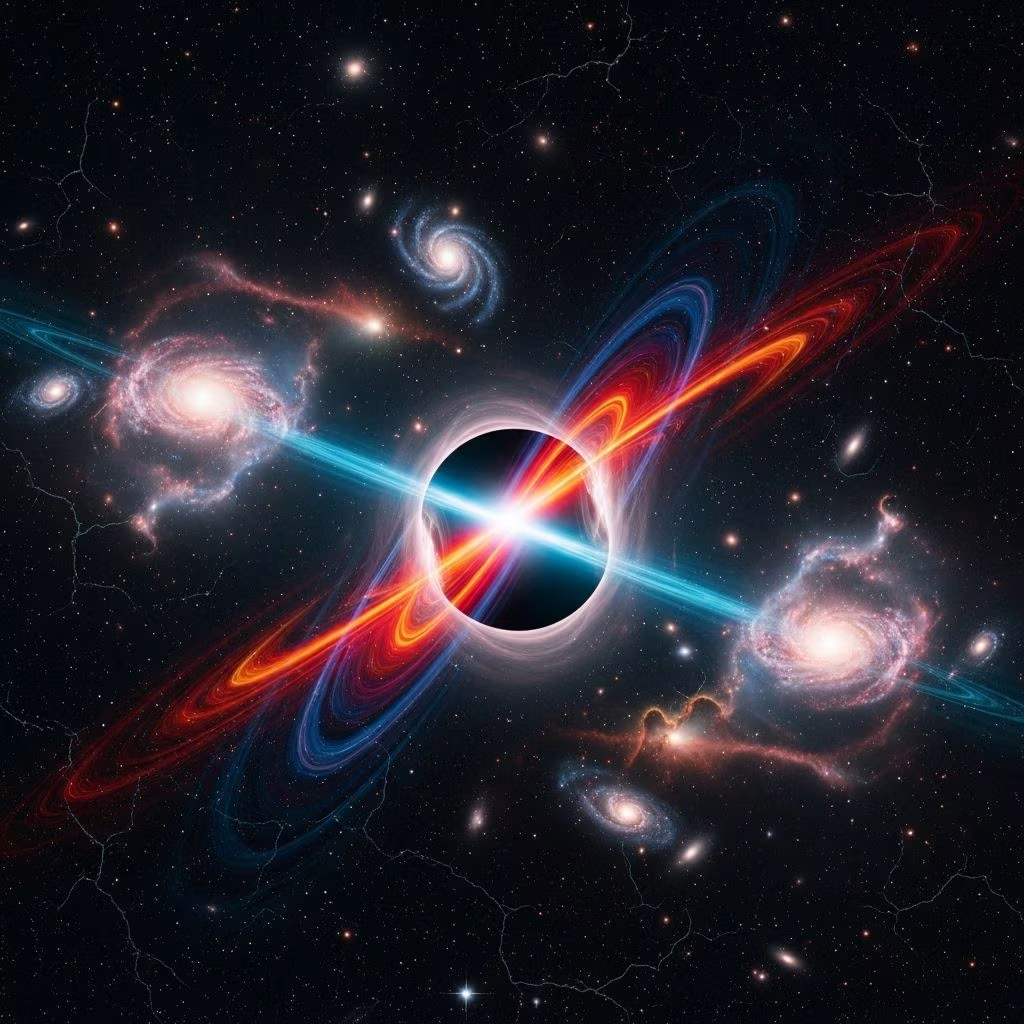
- Black Holes: These gravitational behemoths slowly lose mass over time due to a phenomenon called Hawking radiation, theoretically evaporating over astronomical timescales.
- Entropy and Heat Death: The universe trends toward maximum entropy, meaning it will eventually reach a state where no useful energy remains—referred to as ‘heat death.’ Here, even black holes would have faded into a cold, dark expanse.
Past Predictions: A Universe With an Even Longer Future
Traditionally, the far future of the universe was described using numbers so vast they dwarf comprehension. Earlier estimates—such as those from Falcke’s own 2023 team—suggested the universe would persist for 101100 years. This calculation relied on the slow, steady evaporation of black holes via Hawking radiation, assumed to be the last act in the cosmic drama.
Those earlier numbers painted a future in which even the deepest cold and the farthest decay would unfold at a glacial pace, with stellar embers persisting eons beyond the brief spark of star formation and galactic evolution.
What’s Changed? The ‘Sooner’ End: New Calculations and Their Significance
The research team led by Falcke made use of more refined models to predict how and when the final luminous objects in the universe would vanish. Their conclusion is striking: instead of a universe decaying over more than a googolplex of years (101100), everything collapses to darkness by 1078 years.
To put this in context, if previous estimates were the cosmic equivalent of saying the universe had trillions of years left, the new data suggests it’s ‘only’ trillions of trillions—a minuscule span by comparison, though still beyond anything imaginable.
| Prediction | Timeline | Context (Human Perspective) |
|---|---|---|
| Previous Prediction | 101100 years | Far outlasting even black holes; a cosmic eternity |
| New Prediction | 1078 years | Shorter, but still mind-bogglingly remote in the future |
Why Such a Big Difference?
The shorter timescale arises from a deeper understanding of the physics of stellar remnants and Hawking radiation. The key updates include:
- Recognition that ultra-massive objects may fade faster than once thought due to quantum effects.
- Improved modeling of how white dwarfs and neutron stars eventually decay—not just by slow cooling, but through rare but critical quantum events that hasten their dissolution.
How Will the Universe End?
Imagining the end of everything is a deeply philosophical and scientific challenge. According to the prevailing models, the steps leading to the universe’s demise look like this:
- Stars burn out: Nuclear fusion ceases, leaving behind white dwarfs and neutron stars.
- Planets freeze: With no sun-like stars to warm them, planets become icy remnants.
- Black holes reign: The last sources of energy, black holes, persist as they slowly evaporate via Hawking radiation.
- All light fades: As black holes evaporate, so does the last source of light, plunging the universe into darkness.
- Heat death: The cosmos reaches maximum entropy, an expanse where nothing new can occur.
This ultimate fate—sometimes called the ‘Big Freeze’—differs from other end scenarios like the ‘Big Crunch’ or ‘Big Rip.’ Here, the universe grows ever colder, lonelier, and darker until it is effectively dead.
The Role of Hawking Radiation
The notion that black holes could evaporate at all was first put forth by Stephen Hawking. His theory predicts that quantum mechanical processes at a black hole’s event horizon generate faint, persistent radiation—Hawking radiation—that causes black holes to gradually lose mass and ultimately disappear.
This process is staggeringly slow for massive black holes. But modern refinements of the theory show that when you tally up all stellar remnants and factor in the rare but theoretically possible quantum tunneling events, the overall decay of the universe should occur much more quickly (on cosmic scales) than earlier imagined.
What Does This Mean For Us?
It can be unsettling—or strangely comforting—to know that scientists have put a rough number on the universe’s expiration date. Yet, in human terms, 1078 years means that civilizations, stars, and even galaxies will have come and gone untold times before the cosmic clock winds down.
- No known biological process, structure, or form of information could survive so long as to witness these final acts.
- Even black holes, sometimes dubbed ‘eternal prisons,’ are evanescent on such scales.
The precision of these predictions reminds us of how much remains uncertain in cosmology. While our measurements and models improve, the future remains rich with scientific mystery and awe.
Frequently Asked Questions (FAQs)
Q: What exactly will happen when the universe ends?
A: According to current models, the universe will slowly decay into darkness as even the last remnants of starlight fade. Eventually, the cosmos experiences heat death, reaching maximum entropy where no useful energy remains and nothing can happen. Black holes evaporate, and all matter either decays or becomes inert.
Q: If the universe will end in 1078 years, do we need to worry?
A: No. Even the revised prediction is so distant it dwarfs the current age of the universe (13.8 billion years), providing trillions upon trillions of years before the final fade-out occurs.
Q: Why is there such a big difference between previous and current estimates?
A: New models incorporate refined quantum physics and the fate of stellar remnants, showing decay can accelerate via rare events such as proton decay or quantum tunneling as well as Hawking radiation, leading to the shorter predicted timeline.
Q: Are there any other theories about how the universe might end?
A: Yes. Alternate theories include the Big Crunch (the universe collapses back in on itself) and the Big Rip (cosmic expansion tears everything apart). However, current measurements of cosmic expansion and entropy favor the slow ‘heat death’ scenario.
Q: How confident are scientists about these predictions?
A: Predictions about the universe’s ultimate fate are highly theoretical, depending on assumptions about physics at energies and timescales we may never directly observe. As our understanding of quantum mechanics, dark energy, and the nature of space-time deepens, these predictions will continue to evolve.
Summary Table: Cosmic Timeline to Darkness
| Epoch | Duration | Key Events |
|---|---|---|
| Stellar Era | 109 – 1014 years | Stars burn out; white dwarfs, neutron stars, black holes remain |
| Degenerate Era | 1014 – 1040 years | Stellar remnants cool and fade; protons may decay |
| Black Hole Era | 1040 – 1078 years | Black holes slowly evaporate via Hawking radiation |
| Dark Era | >1078 years | Universe is cold, dark, and lifeless; all matter decayed or inert |
Conclusion: The Fading Future of All Things
The universe’s ultimate fate, though now understood to arrive ‘sooner’ in cosmic terms, remains unimaginably remote. This new estimate stands as both a triumph of scientific ingenuity and a humbling reflection of our transient place in a vast, evolving cosmos. As models are refined and new phenomena uncovered, humanity’s deep questions about the universe’s destiny continue to inspire, reminding us that even the coldest, farthest future is a frontier for curiosity and discovery.
References
- https://www.space.com/astronomy/scientists-calculate-when-the-universe-will-end-its-sooner-than-expected
- https://en.wikipedia.org/wiki/Ultimate_fate_of_the_universe
- https://phys.org/news/2025-05-universe-decay-years-sooner-previously.html
- https://en.wikipedia.org/wiki/Age_of_the_universe
- https://www.livescience.com/space/cosmology/when-will-the-universe-die
- https://www.earth.com/news/study-predicts-when-universe-will-end-scientists-claim-sooner-than-expected/
- https://www.rmg.co.uk/stories/space-astronomy/how-will-universe-end
- https://www.cbsnews.com/news/universe-end-much-sooner-than-expected-researchers-say/
- https://www.space.com/astronomy/astronomers-calculate-that-the-universe-will-die-in-33-billion-years-much-sooner-than-we-thought
- https://physicsworld.com/a/universe-may-end-much-sooner-than-predicted-say-theorists/
- https://dailygalaxy.com/2025/06/scientists-reveal-startling-new-timeline-for-the-end-of-the-world-far-sooner-than-predicted/
- https://www.youtube.com/watch?v=_gz4VgZftLI
- https://www.iflscience.com/updated-prognosis-the-universe-may-end-10-years-sooner-than-we-thought-79165
- https://www.unilad.com/technology/space/universe-end-date-sooner-than-expected-366590-20250513
- https://www.livescience.com/space/cosmology/the-universe-may-start-dying-in-just-10-billion-years-alarming-new-model-predicts
- https://www.sciencedaily.com/releases/2025/05/250512105214.htm
- https://dailygalaxy.com/2025/05/shocking-new-study-universe-end-10%E2%81%B7%E2%81%B8-years/
- https://www.skyatnightmagazine.com/news/end-universe-sooner-than-expected
- https://www.sciencealert.com/the-end-of-the-universe-may-not-be-as-far-off-as-once-thought