


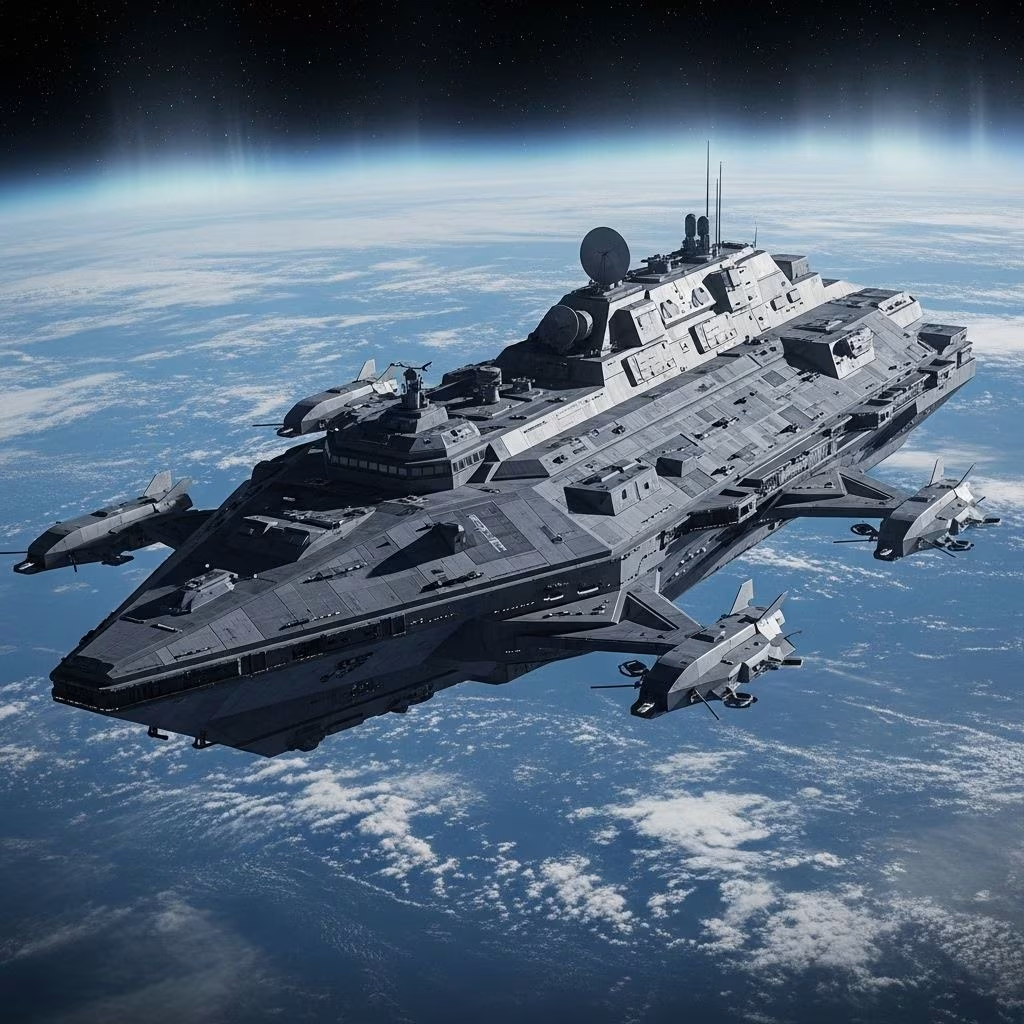
US Space Force’s Orbital Carrier: Launching a New Era in Space Defense
The U.S. Space Force has embarked on an ambitious plan that promises to transform the paradigm of space defense, security, and operational flexibility. The focus of this initiative is the development of the Orbital Carrier, a spacecraft designed to function as an in-orbit launch pad capable of rapidly deploying satellites and other space vehicles whenever and wherever they are needed. This innovation stands to reshape both military operations and the broader context of space utilization by addressing challenges never previously met at this scale.
Background: The Need for a Flexible Space Response
As space becomes an arena for both technological innovation and geopolitical rivalry, the U.S. Space Force has risen to prominence as the branch tasked with securing America’s interests in orbit. Recent conflicts have underscored the dependence of modern defense and communication systems on satellite infrastructure. Vulnerabilities in these systems—such as the threat of satellite ‘blindness,’ electronic jamming, or kinetic attacks—have led planners to search for new ways to safeguard and sustain orbital assets.
Traditional satellite launches, planned months or years in advance, often lack the flexibility to adapt to urgent threats or sudden gaps in orbital coverage. This has driven the demand for more responsive, adaptive spacecraft operations that can ensure persistent, resilient access to critical orbital positions.
The Orbital Carrier Concept
The Orbital Carrier is a bold answer to these challenges. Conceived as a space-based equivalent of an aircraft carrier, the Orbital Carrier is envisioned to serve as a pre-positioned launch pad in Earth orbit, ready to deploy satellites or maneuverable spacecraft at a moment’s notice.
- Rapid Response: Allows for the swift replacement or augmentation of satellites, maintaining operational continuity even in contested or degraded environments.
- Maneuverable Deployments: Hosts multiple, independently maneuverable space vehicles to be deployed as dictated by mission demands.
- Orbital Flexibility: Enables a choice of deployment orbits, unconstrained by ground launch windows or locations, upon operator command.
Gravitics, the Seattle-based aerospace company selected by SpaceWERX (the Space Force’s innovation arm), has been awarded up to $60 million to design and develop this pioneering system.
Technical Features and Mission Design
The Orbital Carrier is far more than a simple platform. Its architecture is being designed with scalability, autonomy, and mission redundancy in mind. Key characteristics include:
- Satellite Storage and Launch: Contains multiple bays or docking points for holding satellites or compact space vehicles until deployment is ordered.
- Pre-Positioning: Orbital Carriers can be stationed at strategic points—geosynchronous, low Earth, or even cislunar space—where threats or needs are anticipated to arise.
- Autonomous Mission Control: Advanced on-board systems enable remote or pre-programmed deployment actions, minimizing operator burden and response delay.
- Redundancy for Resilience: By storing spares and replacements in orbit, Orbital Carriers allow rapid response if assets are lost or compromised.
- Modular Expansion: The concept is extensible: future versions could support logistics pods, repair drones, or even refueling for reusable spacecraft.
As Gravitics CEO Colin Doughan noted, “The Orbital Carrier is a game-changer, acting as a pre-positioned launch pad in space, bypassing traditional launch constraints and enabling rapid, on-demand orbital deployments.”
The Strategic Advantages of a Space-Based Launch Pad
- Bypassing Terrestrial Constraints: Eliminates bottlenecks associated with ground launches, including weather, geopolitics, and scheduling.
- Rapid Reconstitution: If a critical satellite is lost, an Orbital Carrier can replace it immediately, preserving operations and reducing adversary impact time.
- Dynamic Orbit Selection: Ability to deploy satellites into optimal orbits for surveillance, communication, or defense without waiting for the right ground-based launch window.
Military Applications and Strategic Importance
The Orbital Carrier enables tactical and strategic advantages that are currently unattainable by conventional means. Its development responds directly to the evolving threat environment in space, including risks posed by rival nations’ anti-satellite capabilities and potential ‘dogfighting’ between satellites.
Major Military Use Cases
- Sustaining Situational Awareness: Immediate replacement or repositioning of reconnaissance, navigation, or communication satellites if attacked or disabled.
- Counter-Threat Capability: Rapid deployment of sensor or interceptor spacecraft to shadow, assess, or neutralize hostile assets.
- Operational Security: Keeping reserve or specialized satellites off enemy targeting lists until they are urgently required.
This flexibility equates to a significant leap in space deterrence, ensuring that American and allied capabilities cannot be compromised as easily as in the past. Recent joint military exercises have highlighted the increasing sophistication of space ‘maneuver warfare,’ including Chinese and Russian satellites practicing complex rendezvous, proximity operations, and even simulated attacks in orbit.
In the words of Vice Chief of Space Operations Gen. Michael Guetlein, events in 2024 saw “five objects in space maneuvering in and out and around each other in synchronicity.” This is what the Space Force refers to as “dogfighting in space”—and the Orbital Carrier is designed to deliver effective countermeasures when and where needed.
Table: Orbital Carrier vs. Traditional Launch Platforms
| Characteristic | Orbital Carrier | Terrestrial Launch |
|---|---|---|
| Deployment Speed | Minutes to hours (pre-positioned) | Weeks to months (launch scheduling) |
| Flexibility (Orbit Selection) | High (dynamic repositioning) | Limited (fixed by launch site/orbit geometry) |
| Threat Response | Immediate (in-theater deployment) | Delayed (mission planning and preparation) |
| Redundancy | Multiple spares in orbit | One payload per launch |
| Vulnerability | Distributed/hidden until deployed | Exposed to pre-launch targeting |
Key Stakeholders: Gravitics and SpaceWERX
The Orbital Carrier project exemplifies growing collaboration between private industry and the U.S. military in tackling the future of space operations.
- Gravitics: Founded in Seattle, Gravitics specializes in modular space infrastructure and has emerged as a pivotal new space company. Their contract—valued up to $60 million—marks a significant endorsement of both their technical capability and vision for in-orbit logistics and asset deployment.
- SpaceWERX: The innovation branch of the U.S. Space Force, SpaceWERX focuses on rapidly prototyping and fielding cutting-edge space technologies by partnering with agile commercial firms.
This trend reflects a larger shift across the defense sector: speed, flexibility, and innovation are now prioritized, as the pace of potential conflict in space increases and traditional procurement cycles prove too slow.
Future Implications and the Road Ahead
The commissioning and future deployment of the Orbital Carrier stand to impact not just military doctrine but the very topology of space operations:
- Space as a Contested Domain: As near-peer adversaries invest in their own counter-space technologies, the presence of orbital carriers will act as both deterrence and defense.
- Diversification of Space Activities: Beyond defense, the ability to pre-position logistics, repair tools, and even research payloads could evolve the role of orbital carriers into vital space stations or platforms for civil use.
- International Collaboration and Competition: America’s leading position will almost certainly provoke responses from other spacefaring nations, accelerating a new era of space infrastructure development.
- Reduced Satellite Vulnerability: The distributed, modular approach reduces the risks of catastrophic loss in space, enabling smarter, more dynamic constellation management.
The timeline and final technical details for operational deployment have not yet been publicly disclosed, reflecting both the sensitivity and strategic significance of the program.
Frequently Asked Questions (FAQs)
What is the purpose of the Orbital Carrier?
The Orbital Carrier is designed to act as a space-based launch pad. It stores multiple satellites or maneuverable space vehicles in orbit, ready for rapid deployment if needed, particularly in response to threats to US or allied spacecraft.
How is the Orbital Carrier different from a typical satellite?
Unlike a single-purpose satellite, the Orbital Carrier is a platform capable of launching multiple independent vehicles or satellites on demand. It provides ongoing logistical support, replacement, or augmentation capabilities, making it a new class of space infrastructure.
Who is building the Orbital Carrier?
The Orbital Carrier is being designed and developed by Seattle-based Gravitics, a private space technology company, under contract and funding provided by the US Space Force’s SpaceWERX initiative.
What are the strategic advantages for the military?
The Orbital Carrier enables immediate satellite replacement, on-demand deployment of counter-space assets, and flexibility to adapt to new threats, thus strengthening American space deterrence and resilience.
Is the technology only for military use?
While the initial concept is designed to serve national security interests, the technology could evolve for broader civil, scientific, or commercial uses such as disaster response, scientific research, or future space logistics hubs.
How much has been invested in the program?
Up to $60 million has been allocated by SpaceWERX (the innovation branch of the U.S. Space Force) for the development of the Orbital Carrier by Gravitics.
When will the Orbital Carrier be operational?
As of now, detailed schedules and deployment timelines remain undisclosed due to security and competitive concerns. However, rapid development is expected, reflecting the urgency of the strategic requirements.
References
- https://www.space.com/us-space-force-orbital-carrier-spacecraft-launch-pad-in-space
- https://en.wikipedia.org/wiki/Cape_Canaveral_Space_Force_Station
- https://www.gravitics.com/news/orbital-carriers-stratfi
- https://www.washingtonexaminer.com/policy/defense/3395528/space-force-orbital-aircraft-carrier-satellites/
- https://www.defenseone.com/defense-systems/2025/03/space-force-plans-put-multisatellite-carrier-orbit/404073/
- https://www.spacelaunchschedule.com/space-news/gravitics-secures-space-force-contract-to-develop-responsive-space-orbital-spacecraft-carrier/
- https://www.floridatoday.com/story/news/2025/04/29/space-force-aircraft-carrier-orbital/83340370007/
- https://keeptrack.space/space-brief/space-brief-2025-04-01/
- https://thearsenale.com/blogs/magazine/us-space-force-to-fund-orbital-aircraft-carrier-for-satellite-defense
- https://www.youtube.com/watch?v=nMbzLpnRIwY
- https://blackhaysgroup.com/us-space-force-wants-a-new-orbital-carrier-to-be-a-satellite-launch-pad-in-space/
- https://www.space.com/space-exploration/launches-spacecraft/watch-spacex-launch-us-space-forces-classified-x-37b-space-plane-august-21
- https://www.youtube.com/watch?v=1DsMW0NONbk
- https://ground.news/article/firm-wins-space-force-funding-to-provide-an-aircraft-carrier-in-orbit
- https://nationalsecurityjournal.org/orbital-aircraft-carriers-could-be-the-u-s-militarys-next-super-weapon/
- https://en.wikipedia.org/wiki/Boeing_X-37


