Polaris and Earth’s Changing North Star: A 26,000-Year Cycle
Polaris, commonly known today as the North Star, has inspired and guided humankind for centuries. However, few realize that THE NORTH STAR is not a permanent fixture and has shifted over millennia due to Earth’s cosmic dance. This article explores why Polaris currently marks north, how Earth’s axial precession shapes celestial navigation, and what stars have taken or will take its place as the pole star.
What is a Pole Star?
A pole star is a star positioned nearly above one of Earths celestial poles. This simple fact gives it outsized significance: as Earth rotates, the pole star appears almost stationary in the night sky while other stars trace circles around it. Navigators and astronomers have relied on the North Star for orientation and mapping for millennia[10][12].
- Polaris: The current North Star, located within the constellation Ursa Minor[12].
- Historical Pole Stars: Past millennia have seen other stars serve as pole stars due to Earth’s changing orientation.
Why is Polaris the North Star?
Polaris is almost directly aligned with Earth’s northern rotational axis. Currently, the Earths rotation axis points very close to this stars position, so it appears almost motionless overhead for observers in the northern hemisphere[12].
- The star sits less than a degree from the north celestial pole, making it an excellent tool for navigation.
- It marks true north and does not noticeably move from its position even as other stars wheel around it nightly.
- Polaris is not the brightest star in the sky, but its location makes it crucial for latitude calculations.
However, this alignment is not permanent. The reason lies in one of the most majestic processes affecting our planet: axial precession.
Earths 26,000-Year Precession Cycle
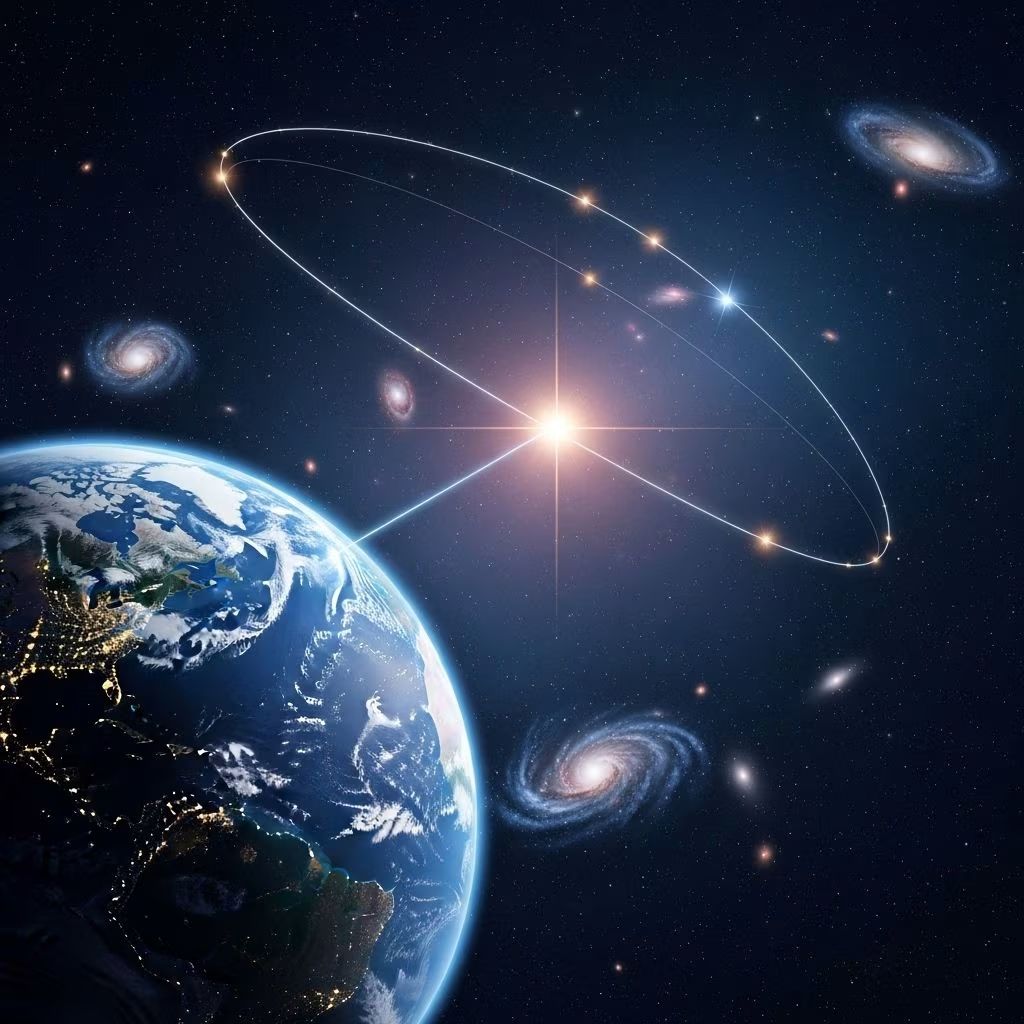
Earth spins on its axis, but this axis itself traces out a slow circular motion called precession, taking about 26,000 years to complete one cycle.
| Aspect | Description |
|---|---|
| Precession Cause | Gravitational forces from the Moon and Sun acting on Earth’s equatorial bulge nudge the axis, causing it to trace a cone in space. |
| Cycle Length | 26,000 years for a full rotation of the axis orientation. |
| Immediate Effect | The axis slowly points to different locations in the sky, moving away from its current alignment with Polaris. |
Ancient Greek astronomer Hipparchus was one of the first to mathematically describe precession around 130 B.C. As Earths axis tilts gradually, our celestial north moves, causing the North Star to change in identity over time.
Has Polaris Always Been the North Star?
NoPolaris is only the most recent in a succession of North Stars. As Earth’s axis precesses, the northern pole points to different stars over cycles of thousands of years[12].
Past and Future North Stars
- Thuban (Alpha Draconis): Around 2600 B.C., Thuban was the North Star during the era the Egyptian pyramids were built. It was much dimmer than Polaris[12].
- Vega (Alpha Lyrae): About 14,000 years ago, Vega marked the north pole and will do so again in roughly 13,000 years.
- Polaris: Became the North Star around 500 A.D., gradually getting closer to the pole. On March 24, 2100, Polaris will be at its closest point to the north celestial pole, marking the peak of its reign[12].
The pole will continue shifting, and in about 13,000 years Vega will take center stage again, while Thuban will return in another cycle. In essence, the title of North Star continually moves from star to star over Earth’s precession cycle[12].
How Earth’s Precession Affects Celestial Navigation
Celestial navigation relies on fixed points in the sky. For millennia, navigators used the North Star’s position to orient themselves. Ships at sea could determine latitude by measuring the North Star’s altitude above the horizon[12].
- When the pole star changes, navigators must learn to recognize and use the new pole star.
- During transitional periods, when no bright star is near the pole, navigation can become more difficult.
- Historically, cultures have responded to these changes with myth, mathematical astronomy, and innovations in celestial cartography.
Cultural and Historic Significance of the North Star
Throughout history, the North Star has inspired myth, lore, and technical observation:
- Ancient Egyptians: Associated the North Star with Isis and protection in the afterlife.
- Norse Mythology: Polaris was interpreted as a jewel at the end of a celestial spike anchoring the universe.
- Mongolian and Arabic Stories: The North Star held together the world or marked the burial site of mythical heroes.
- Navigation and Discovery: Polynesian cultures, explorers, and early mariners used the unchanging position of the North Star for safe passage across oceans and deserts[12].
- Astronomy and Science: The study of precession gave rise to more accurate calendars, navigation methods, and a deeper understanding of Earth’s motion.
The unique steadiness and position of Polaris has made it a central figure in star lore, yet its prominence is a cosmic coincidence, not a permanent truth.
Finding the North Star in the Sky
Polaris sits at the tip of the handle of Ursa Minor (the Little Dipper), making it easy to spot for many observers in the northern hemisphere[11].
- Locate the Big Dipper (Ursa Major): Draw a line through the two outermost stars of the bowl (Merak and Dubhe).
- Follow the line away from the bowl’s opening: The next prominent star you see is Polaris.
- Polaris itself forms the end of the handle of the Little Dipper.
Using this simple method, anyone can find true north from almost anywhere with a clear view of the northern sky.
Pole Stars in the Southern Hemisphere
Unlike the North, the southern celestial pole does not currently boast a bright, easily visible star directly in its vicinity. This lack complicates southern navigation and creates a different set of observational traditions.
Frequently Asked Questions (FAQs)
Has Polaris always been the North Star?
No. Earth’s precession cycle means Polaris is only the pole star for a part of its 26,000-year cycle. In ancient times, Thuban and Vega have served as pole stars, and in the future Vega will take on the role again[12].
Why does Earth undergo precession?
Earth’s equatorial bulge is acted upon by gravitational forces from the Sun and Moon, causing the axis to slowly wobble in a circle over thousands of years similar to a spinning top.
How much closer will Polaris get to the North celestial pole?
Polaris will be closest to the pole on March 24, 2100, and afterward, the pole will gradually begin shifting away due to continuing precession[12].
Will there ever be a “South Star”?
Not currently. There is no bright star near the southern celestial pole analogous to Polaris.
How do astronomers use the North Star?
Astronomers use Polaris as a calibration point for telescopes and timekeeping, while navigators use it to determine latitude and direction in the northern hemisphere[12].
Summary Table: North Star Through the Ages
| Star | Era (approximate) | Constellation | Notes |
|---|---|---|---|
| Thuban (Alpha Draconis) | 2600 B.C. | Draco | North Star during pyramid construction |
| Polaris | ~500 A.D. – Present | Ursa Minor | Current pole star; closest approach in 2100 |
| Vega (Alpha Lyrae) | 14,000 years ago & next in ~13,000 years | Lyra | Will be North Star again in the distant future |
The Future of Earth’s Pole Star
Earth’s ongoing precession guarantees that the pole star will continue to change. After Polaris peakes in proximity to true north, the axis will move away, making way for new stars to fulfill the role for future generations. Each cycle connects ancient, present, and future astronomers and navigators in the shared cosmic journey of our planet.
In summary, the identity of the North Star is ever-changing across deep time, shaped by the fundamental physics of Earths motion and gravity. Polariss reign is significant but temporary in the grand celestial dance above our heads.
References
- https://en.wikipedia.org/wiki/Polaris
- https://answersingenesis.org/astronomy/stars/polaris-brief-history-of-current-north-star/
- https://www.space.com/stargazing/has-polaris-always-been-the-north-star-how-earths-26-000-year-cycle-changes-the-pole-star
- https://answersingenesis.org/astronomy/stars/polaris-brief-history-of-current-north-star/?srsltid=AfmBOooefU1GNkx6OSArsYR36d3WtpPyF17Ls7J_yH8OEWyj8d10OXmJ
- https://starchild.gsfc.nasa.gov/docs/StarChild/questions/question64.html
- https://www.maloriesadventures.com/blog/the-fascinating-history-of-the-north-star
- https://explainingscience.org/2020/09/25/the-changing-pole-star/
- https://www.rmg.co.uk/stories/space-astronomy/ursa-minor-little-bear-polaris
- https://news.umich.edu/north-star-changes-over-time/
- https://en.wikipedia.org/wiki/Pole_star
- https://science.nasa.gov/solar-system/what-is-the-north-star-and-how-do-you-find-it/
- https://starwalk.space/en/news/polaris-north-star
- https://skyandtelescope.org/astronomy-news/meet-polaris-the-north-star/
- https://theplanets.org/stars/polaris-star/
- https://www.youtube.com/watch?v=6on9LioN64E
- https://www.britannica.com/place/Polaris-star
- https://www.space.com/stargazing/has-polaris-always-been-the-north-star-how-earths-26-000-year-cycle-changes-the-pole-star&rut=c22f9ca11b7434b93838bac235c541dbb058d7298f441c0f7e489c5a8b325414