Canine Constellations: Night Sky Goes to the Dogs
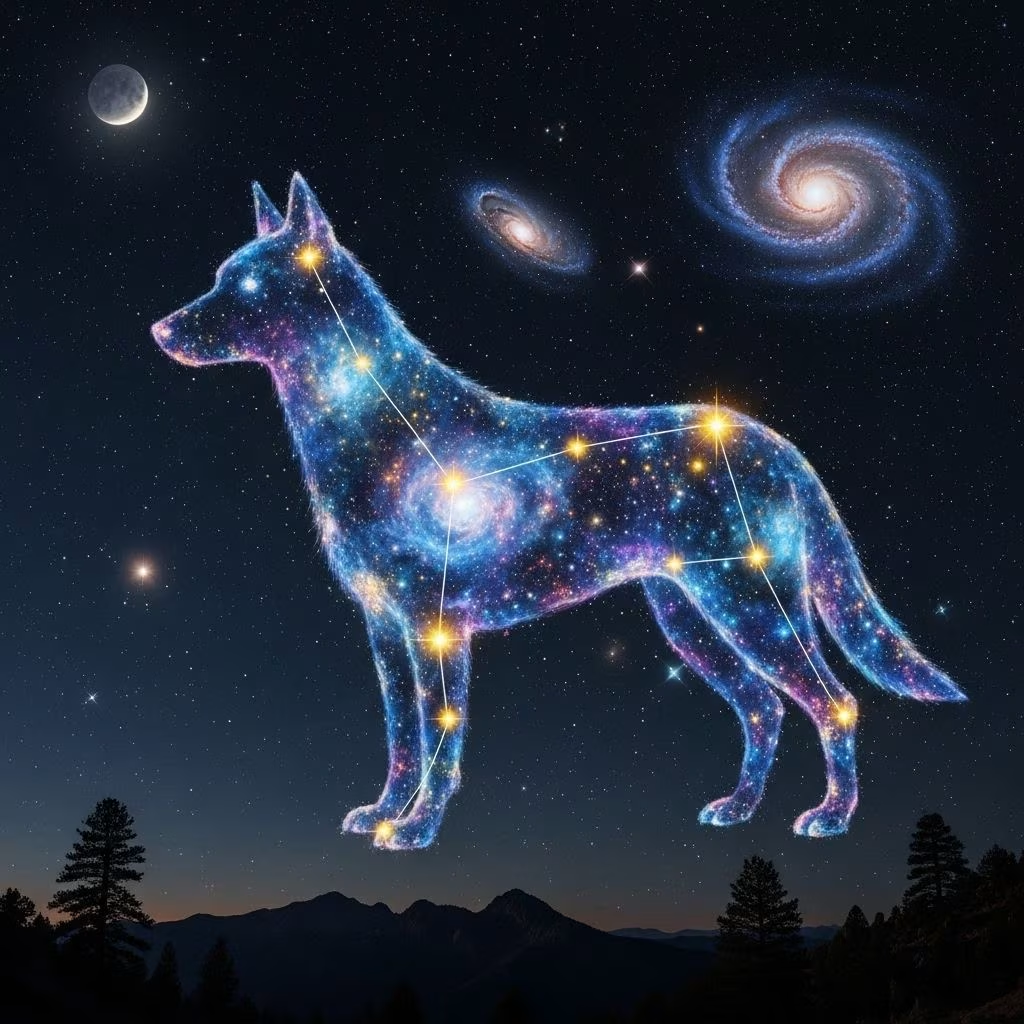
For millennia, the night sky has enthralled humans, serving as both a cosmic calendar and a tapestry for legendary tales. Among the myriad constellations, a select group captures the imagination through their association with dogs—our loyal companions on Earth, forever immortalized above. This article explores the origins, myths, cultural impact, and astronomical significance of the three main dog constellations: Canis Major, Canis Minor, and Canes Venatici, examining both their ancient stories and their scientific relevance today.
Table of Canine Constellations
| Constellation | Translation | Brightest Star | Mythological Role | Visibility |
|---|---|---|---|---|
| Canis Major | Greater Dog | Sirius | Orion’s hunting companion | Winter (Northern Hemisphere) |
| Canis Minor | Lesser Dog | Procyon | Orion’s second dog | Winter/Spring |
| Canes Venatici | Hunting Dogs | Cor Caroli | Dogs of Boötes | Spring/Summer |
Legend and Lore: Dogs in the Heavens
Stories of dogs tracking across the sky abound in cultures worldwide. For the ancient Greeks, the sight of bright stars near Orion represented his tireless canine companions pursuing celestial prey. Romans and Egyptians attributed divine qualities to these stars, intertwining their risings with agriculture, seasonal rituals, and omens. The dog constellations remain among the 48 originally listed by Ptolemy in his Almagest, underscoring their lasting cultural resonance.
Canis Major: The Mighty Dog and Sirius, the Dog Star
Canis Major – Latin for “Greater Dog” – gleams in the southern sky, trailing Orion, the famed hunter. Its alpha star, Sirius, reigns as the brightest star visible from Earth after the Sun, delivering an arresting blue-white sparkle that has guided navigators and inspired legends for millennia.
- Sirius: Often called the “Dog Star,” Sirius is located just 8.7 light years away. It shines with exceptional brilliance and, in ancient Egyptian mythology, its dawn rising predicted the annual flooding of the Nile—the life artery of Egypt. This earned Sirius names like “Nile Star” or “Star of Isis.” Its summer ascension accompanied sweltering days known since antiquity as the “Dog Days”. Early observers believed Sirius contributed to the season’s heat and associated it with fever and madness.
- Mythological Role: In Greek tales, Canis Major represents the hunting dog of Orion, sometimes depicted as chasing Lepus, the celestial hare. Roman stories suggest connections to various mythic and real dogs, including Laelaps, a dog said to never fail in catching its prey.
- Additional Celestial Jewels: Canis Major hosts several deep-sky wonders:
- Messier 41 – Bright open star cluster.
- VY Canis Majoris – One of the largest known stars (a red hypergiant).
- NGC 2360 and Tau Canis Majoris Cluster – Rich star fields visible through binoculars and telescopes.
- Canis Major Dwarf Galaxy, colliding spiral galaxies, and emission nebulae like Thor’s Helmet (NGC 2359)
Historical and Cultural Insight: Sirius and the Dog Days
The significance of Sirius permeates both ancient science and cultural belief:
- Egyptians timed their agricultural activities and religious ceremonies by Sirius’ heliacal rise, linking it with prosperity and renewal.
- In Greco-Roman tradition, the period when Sirius and the Sun rise together was believed to cause heat exhaustion and star-induced delirium, influencing language—hence the phrase “dog days of summer”.
- In contemporary astronomy, Sirius remains a reference point for calibrating star charts, navigation, and astrophotography.
Canis Minor: The Little Dog and Procyon
Just northeast of Canis Major lies Canis Minor—”the Little Dog.” Though its form is simple and contains only two main stars, its chief luminary, Procyon, ranks among the brightest in the sky[13].
- Procyon: With a name meaning “Before the Dog” in Greek (because it rises before Sirius), Procyon serves as a vital marker for stargazers and denotes Canis Minor’s spot in the celestial lineup.
- Mythological Role: Procyon and Sirius together are mythologized as Orion’s two hunting dogs. Scholars debate whether the smaller dog is associated with mythic creatures or if it was simply added to balance Orion’s cosmic retinue[13].
- Constellation Structure: Canis Minor’s small size makes it less prominent than its larger sibling, but it remains an important part of sky lore and is frequently used by astronomers as a navigational aid.
Canes Venatici: The Hunting Dogs on the Heels of Boötes
The relatively faint constellation Canes Venatici—the “Hunting Dogs”—was not recognized until the 17th century, when astronomer Johannes Hevelius carved out this space from the area near the handle of the Big Dipper[12]. Its role is distinctly mythological, as the two dogs are imagined assisting Boötes, the Bear Driver, in rounding up the Great Bear (Ursa Major).
- Main Stars:
- Cor Caroli (Heart of Charles): The brightest star of Canes Venatici, named in honor of King Charles II of England, also historically tied to Charles I. Its chemical makeup includes numerous rare earth elements, leading astronomers to create a class of similar stars, known as Alpha Canum Venaticorum stars[12].
- Asterion and Chara: These are the mythological names for the two hunting dogs marked by stars within the constellation. Chara is represented by Cor Caroli, and Asterion is the fainter companion.
- Deep Sky Objects: Canes Venatici is home to notable galaxies such as Messier 51 (the Whirlpool Galaxy) and Messier 63 (the Sunflower Galaxy), making it a favorite for amateur astronomers[12].
- Seasonal Appearance: Best viewed in late spring and throughout summer in the Northern Hemisphere.
Spotting the Celestial Canines: Practical Observing Tips
Locating these stellar dogs enriches stargazing. Here are actionable tips:
- Canis Major: Begin at Orion’s belt (three bright stars in a row), trace downward to locate Sirius shining brightly to the south-southwest in winter evenings.
- Canis Minor: Find Procyon northeast of Sirius. It completes a prominent triangular asterism with Sirius and Betelgeuse, Orion’s shoulder.
- Canes Venatici: Look below the handle of the Big Dipper (Ursa Major) in spring, about a third of the way down the arc. Cor Caroli is the brightest point in the area.
- Equipment: Binoculars and small telescopes reveal star clusters, nebulae, and galaxy detail, especially in Canis Major and Canes Venatici.
Night Sky Observing: When to Look
- Canis Major & Canis Minor: Best seen from November through March in the northern hemisphere.
- Canes Venatici: Peaks in visibility from April through August.
Dogs and Diversions: Popular Culture & Modern Science
The allure of dog constellations lives on not only in scientific study and amateur astronomy, but in popular culture as well.
- Dog Days: The popularity of the “Dog Days of Summer” persists as a cultural marker for hot, lazy days. Its origin lies in astronomical observations of Sirius rising alongside the sun.
- Navigation and Calendars: Sirius remains a critical celestial marker for ancient calendars, marine navigation, and contemporary star mapping.
- Astronomical Research: Modern space telescopes investigate deep sky objects found within dog constellations, from star clusters to distant galaxies, enriching our understanding of stellar evolution and the structure of the universe.
FAQs: Frequently Asked Questions about Canine Constellations
Q: What is the brightest star in the night sky?
A: Sirius, found in Canis Major, is the brightest star visible from Earth, after our Sun.
Q: Why are Canis Major and Canis Minor called Orion’s dogs?
A: In Greek mythology, both constellations represent Orion’s loyal hunting dogs, perpetually pursuing celestial prey across the night sky.
Q: When can I see the dog constellations?
A: Canis Major and Canis Minor are visible primarily in winter and early spring evenings, while Canes Venatici shines in spring and summer.
Q: What is the “Dog Days of Summer?”
A: The phrase refers to the period when Sirius rises with the sun, historically believed to cause extra summer heat and lethargy.
Q: Are there any galaxies in the dog constellations?
A: Yes. Canis Major contains the Canis Major Dwarf Galaxy and several nebulae, while Canes Venatici includes the Whirlpool Galaxy (M51) and Sunflower Galaxy (M63).
Key Takeaways: Why the Night Sky Goes to the Dogs
- Canine constellations unite human myth, culture, and modern science in the tapestry of night.
- They serve as guides for celestial navigation, agricultural cycles, and seasonal change.
- The stories of Sirius, Procyon, and Cor Caroli chronicle humanity’s ancient connection to the cosmos and our enduring love for dogs—on Earth and in the stars.
- Dog constellations remind us that the night sky is both a window to scientific discovery and a living archive of legend.
Further Reading & Stargazing Tips
- Consult star charts or astronomy apps to trace these constellations seasonally.
- Take advantage of clear, moonless nights for deep-sky observation.
- Binoculars and beginner telescopes offer excellent views of bright dog stars and the deeper wonders in their constellations.
References
- https://www.space.com/1018-canine-constellations-night-sky-dogs.html
- https://en.wikipedia.org/wiki/Canis_Major
- https://www.space.com/mighty-dog-constellations-of-the-spring-night-sky
- https://en.wikipedia.org/wiki/Canes_Venatici
- https://www.youtube.com/watch?v=FOYudAigtRY
- https://theskylive.com/sky/constellations/canis_major-constellation
- https://www.constellation-guide.com/constellation-list/canis-major-constellation/
- https://chandra.harvard.edu/photo/constellations/canismajor.html
- https://starwalk.space/en/news/canis-major-constellation-guide
- http://www.seasky.org/constellations/constellation-canis-major.html
- https://www.youtube.com/watch?v=5FzasigbExE
- https://www.skyatnightmagazine.com/advice/canes-venatici-hunting-dogs-constellation
- https://www.constellation-guide.com/constellation-list/canis-minor-constellation/
- https://knottytoysforgooddogs.blog/2017/08/21/good-dog-constellations/
- https://theplanets.org/constellations/canis-minor-constellation/
- https://starinastar.com/how-many-animal-constellations/
- https://www.sciencefocus.com/space/orion-the-hunter-dogs-canis-major-minor
- https://theplanets.org/constellations/canis-major/