The Theory of Everything: Unifying the Universe’s Forces
The Theory of Everything (TOE) is a term used in physics to describe a hypothetical framework capable of explaining and connecting all fundamental physical forces and particles in the universe. This ambitious quest aims to bridge the disparate realms of physics — from the motion of galaxies to the mysterious activities inside atoms — through a single, elegant theory.
Throughout history, scientists have strived for deeper understanding by unifying natural phenomena under comprehensive models. The TOE represents the pinnacle of this effort, aspiring to provide a complete, consistent description of the universe’s underlying laws.
What Is the Theory of Everything?
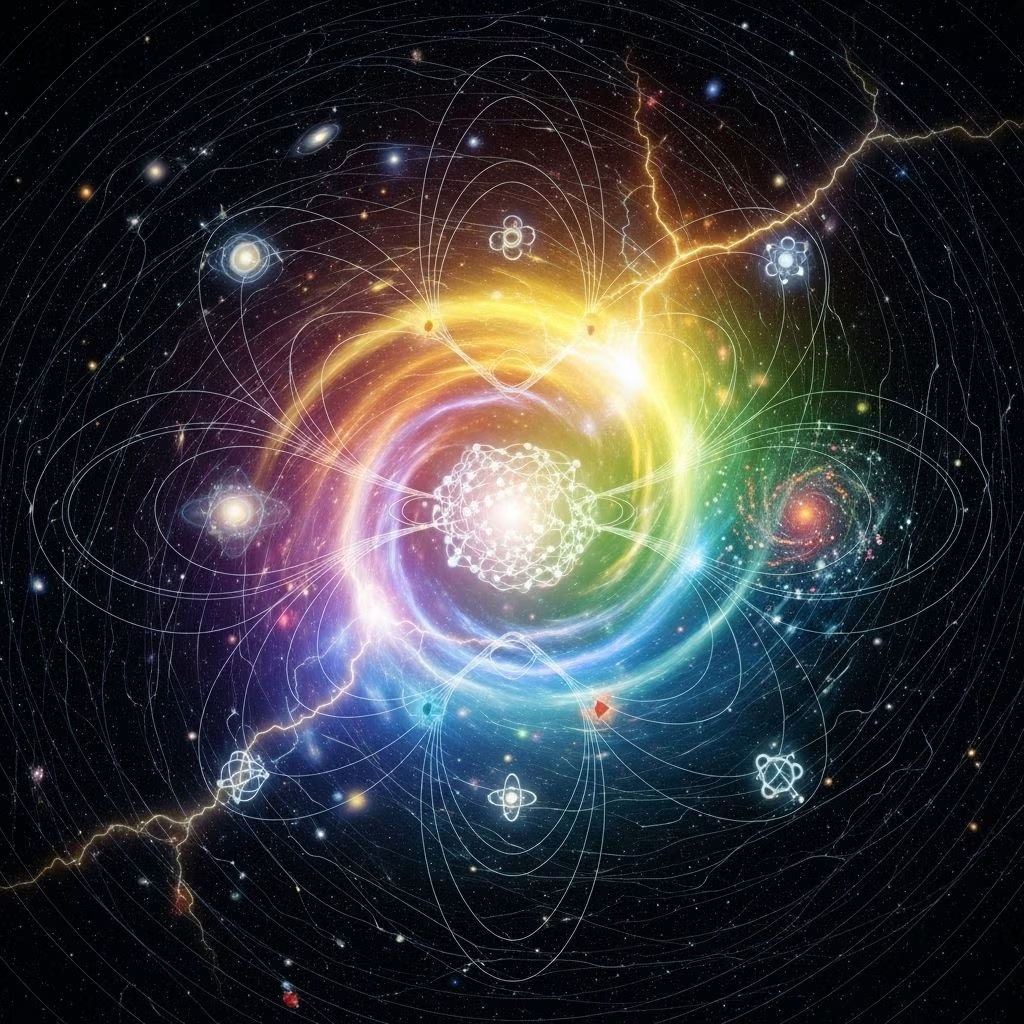
The Theory of Everything, also known as a final theory or unified field theory, seeks to unite the four fundamental forces of nature — gravity, electromagnetism, the strong nuclear force, and the weak nuclear force — under a single theoretical umbrella.
Historically, physics has achieved several powerful unifications: Isaac Newton connected planetary motion and falling apples with universal gravity, James Clerk Maxwell merged electricity and magnetism into electromagnetism, and the Standard Model put together three of the four known forces. Completing this unification by including gravity is the outstanding challenge.[10][12]
- Gravity: Governs the attraction between masses, dominating at large scales such as planets, stars, and galaxies.
- Electromagnetism: Manages interactions between electrically charged particles, responsible for light and electricity.
- Strong Nuclear Force: Binds protons and neutrons together in atomic nuclei.
- Weak Nuclear Force: Responsible for radioactive decay and other subatomic processes.
Physicists’ inability to harmonize the force of gravity (described by General Relativity) with the Standard Model fields of Quantum Mechanics remains the principal obstacle to a true Theory of Everything.
The Pillars of Modern Physics
To appreciate the significance of the Theory of Everything, it is essential to understand the current foundations of physics: General Relativity and Quantum Mechanics.
| Framework | Scope | Strengths | Limitations |
|---|---|---|---|
| General Relativity | Large-scale, massive objects (e.g., planets, stars, galaxies) | Accurately predicts gravitational behavior, black holes, and cosmic evolution | Does not explain quantum phenomena or incorporate the other three forces |
| Quantum Mechanics / Standard Model | Very small-scale phenomena (e.g., atoms, subatomic particles) | Describes electromagnetism, strong and weak nuclear forces; explains atomic structure, particle interactions | Fails to include gravity; uncertainty in extreme conditions (black holes, Big Bang) |
While both frameworks have been confirmed by extensive experiment, they operate in fundamentally different ways. Their incompatibility in domains such as black holes or the early universe highlights the urgent need for a unified theory.[10]
The Four Fundamental Forces
Nature’s behavior, from the grandest cosmic scales to the tiniest particles, is governed by four fundamental forces. The search for a Theory of Everything is the search for a single mathematical description that unifies:
- Gravity – Weakest but with infinite range, acts on mass.
- Electromagnetic force – Acts on charged particles, responsible for light and electricity.
- Strong nuclear force – Holds atomic nuclei together, extremely strong but short-range.
- Weak nuclear force – Responsible for certain types of radioactive decay, short-range.
The Standard Model successfully encapsulates the electromagnetic, strong, and weak nuclear forces. However, gravity remains an outlier, described by a separate theory: General Relativity.[10]
The Standard Model: Successes and Gaps
The Standard Model of particle physics is one of science’s crowning achievements, accurately describing the behavior and interactions of fundamental particles like quarks, leptons, and gauge bosons, as well as the forces that act upon them — excluding gravity. The Higgs boson’s discovery in 2012 was the last major unconfirmed prediction of the Standard Model.[12]
- Explains three out of four forces.
- Predicts existence and interactions of known particles.
- Lacks an explanation for gravity and dark matter.
Why Do We Need a Theory of Everything?
At its heart, the quest for a Theory of Everything is motivated by the drive to find a single, coherent law — or set of laws — from which all physical phenomena can be derived. Such a theory would:
- Answer fundamental questions: How did the universe begin? What are space, time, and matter really made of?
- Unify forces: Explain the relationship between all forces and particles, eliminating the current gaps in physics.
- Enable technological advances: Historical unifications have driven major advances (e.g., electromagnetism led to electrical engineering).
- Deepen philosophical understanding: Offer insights into the interconnectedness of all things in the cosmos.
Despite its conceptual beauty, the pursuit of a TOE faces substantial challenges, as current models resist complete integration.
Major Approaches to a Theory of Everything
Physicists have developed several frameworks in pursuit of a TOE. The most prominent proposals are:
String Theory
String Theory suggests that all particles are, at the most basic level, tiny vibrating strings. Different vibration modes give rise to different particles. Significantly, string theory naturally includes a particle with the properties of gravity’s quantum carrier (the graviton), making it a leading contender.
- Requires extra spatial dimensions.
- Has not yet produced testable predictions.
- Mathematically elegant but experimentally unproven.
Loop Quantum Gravity
Loop Quantum Gravity (LQG) is another attempt to quantize gravity without unifying all forces. It suggests that space is made up of tiny, discrete loops, giving space itself a granular structure at the smallest scales.
- Focuses specifically on integrating quantum mechanics with gravity.
- Does not unify all forces but addresses the quantum structure of spacetime.
- Has led to new insights about black holes and the early universe.
Other Proposed Unifications
- Grand Unified Theories (GUTs): Try to merge the electromagnetic, weak, and strong forces; gravity generally remains separate.
- Supersymmetry (SUSY): Proposes a symmetry between known particles and hypothetical partners; may resolve some Standard Model issues if confirmed experimentally.
Challenges and Controversies
The search for a Theory of Everything is not without contention. Several major challenges include:
- Lack of Experimental Evidence: Most TOE proposals, such as string theory, remain largely untestable with current technology.
- Mathematical Complexity: The mathematics required is often extremely intricate and abstract, making predictions difficult to falsify or confirm.
- Philosophical Debate: Some philosophers and scientists argue that a complete, all-encompassing TOE may be unattainable or even conceptually meaningless.
- Incorporation of Dark Matter & Energy: To be truly comprehensive, a TOE must also account for the mysterious dark components that dominate the universe’s energy budget.
Implications of Discovering a Theory of Everything
If achieved, a Theory of Everything would be a monumental leap for both physics and humanity’s broader search for knowledge.
- Intellectual Unification: Reveal the fundamental unity underpinning all phenomena.
- Technological Impact: As with past breakthroughs, could enable unforeseen innovations (e.g., quantum computing, new energy sources).
- Philosophical Ramifications: Challenge or refine our notions of reality, determinism, and the limits of human understanding.
Frequently Asked Questions (FAQs)
Q: Has a Theory of Everything been discovered?
A: No, while there are several leading candidates (e.g., string theory), no complete, experimentally verified Theory of Everything exists yet.[10]
Q: Why can’t general relativity and quantum mechanics be unified easily?
A: At their core, these theories rest on incompatible assumptions about space, time, and energy. For example, quantum mechanics operates probabilistically and assumes a fixed spacetime background, while general relativity treats spacetime as a dynamic, curved entity influenced by mass and energy.
Q: What would a successful Theory of Everything look like?
A: In principle, a TOE would be a single (possibly elegant) set of equations or principles from which all the interactions, particles, and properties in the universe could be derived.
Q: Is it possible we’ll never find a Theory of Everything?
A: It’s possible. Some theorists propose that physical reality might be such that no single, unified model can describe it exhaustively. Others point to Gödel’s incompleteness theorems in mathematics as suggesting limits to formal systems.
Q: What are the main alternatives if a single TOE does not exist?
A: Physics could continue as a patchwork of highly effective, but domain-specific theories (sometimes called an ‘effective field theory’ approach), or eventually discover a deeper structure we do not yet envision.
Conclusion
The quest for a Theory of Everything is one of modern science’s most captivating and difficult challenges. While enormous progress has been made in describing the universe’s laws through frameworks such as General Relativity and the Standard Model, a full unification — bringing gravity and quantum mechanics together — remains unfinished.
Regardless of the outcome, the effort to find a final, all-encompassing physical theory continues to drive new discoveries, deeper understanding, and the spirit of curiosity at the heart of scientific inquiry.
References
- https://en.wikipedia.org/wiki/Theory_of_everything
- https://www.khanacademy.org/college-careers-more/bjc/2015-challenge/2015-physics/v/breakthrough-junior-challenge-2015-the-theory-of-everything-an-introduction
- https://www.pnas.org/doi/10.1073/pnas.97.1.28
- https://www.youtube.com/watch?v=u8R6YMf_j0M
- https://www.youtube.com/watch?v=Ql0pP4TLwFw
- https://nautil.us/do-we-need-a-theory-of-everything-237888/
- https://pmc.ncbi.nlm.nih.gov/articles/PMC26610/
- https://en.wiktionary.org/wiki/theory_of_everything
- https://en.wikipedia.org/wiki/Everything
- https://www.britannica.com/science/theory-of-everything
- https://www.cambridge.org/engage/coe/article-details/641c3ee362fecd2a834d5d07
- https://everything.explained.today/Theory_of_everything/
- https://wikipedia.nucleos.com/viewer/wikipedia_en_all/A/Theory_of_everything
- https://consensus.app/questions/what-significance-theory-everything-physics/
- https://consensus.app/questions/theory-of-everything-physics/
- https://www.scientificlib.com/en/Physics/LX/TheoryOfEverything.html