If you have ever looked up at the night sky and wondered why it appears so dark, despite being filled with billions upon billions of stars, you are not alone. This ancient enigma—officially known as Olbers’ paradox—has perplexed astronomers and philosophers for centuries. The answer weaves together classic thought experiments, cosmic scale, and the very nature of our evolving universe.
Understanding the Darkness: The Basics
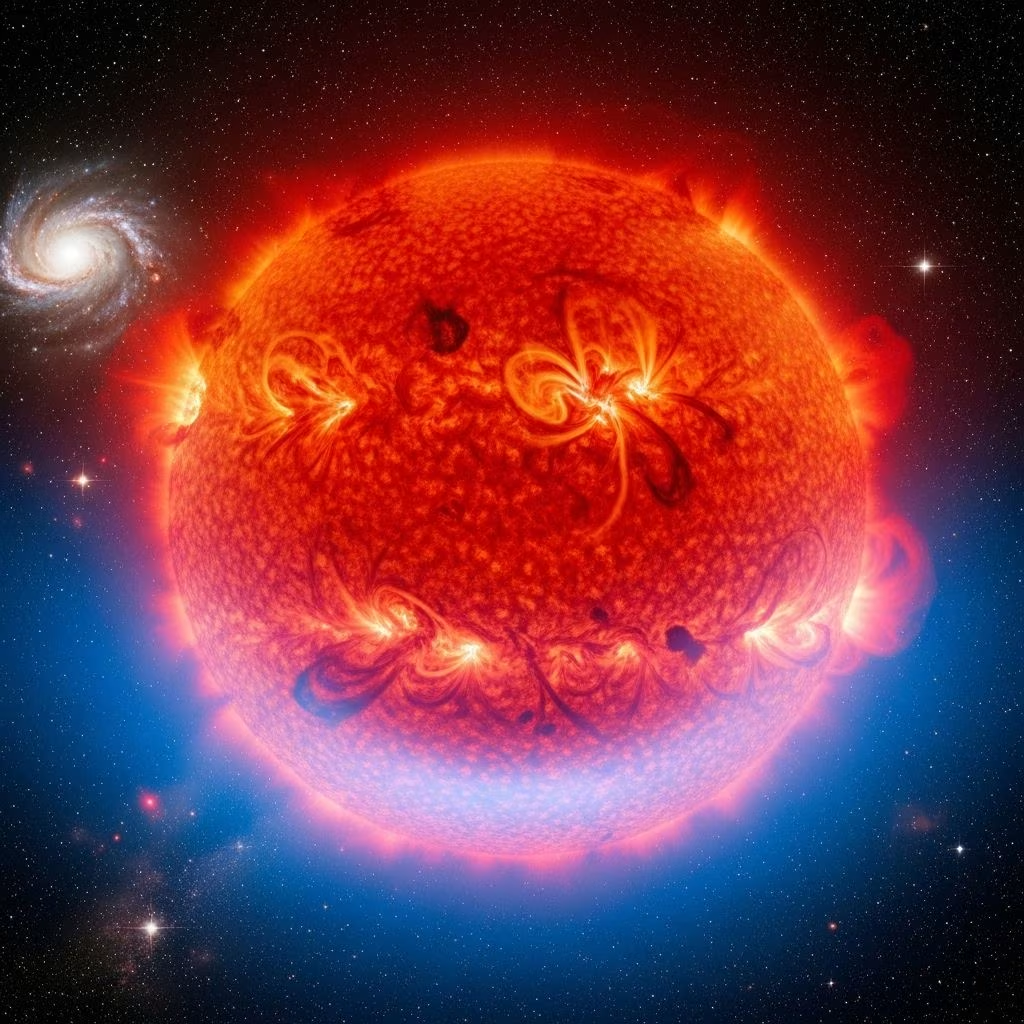
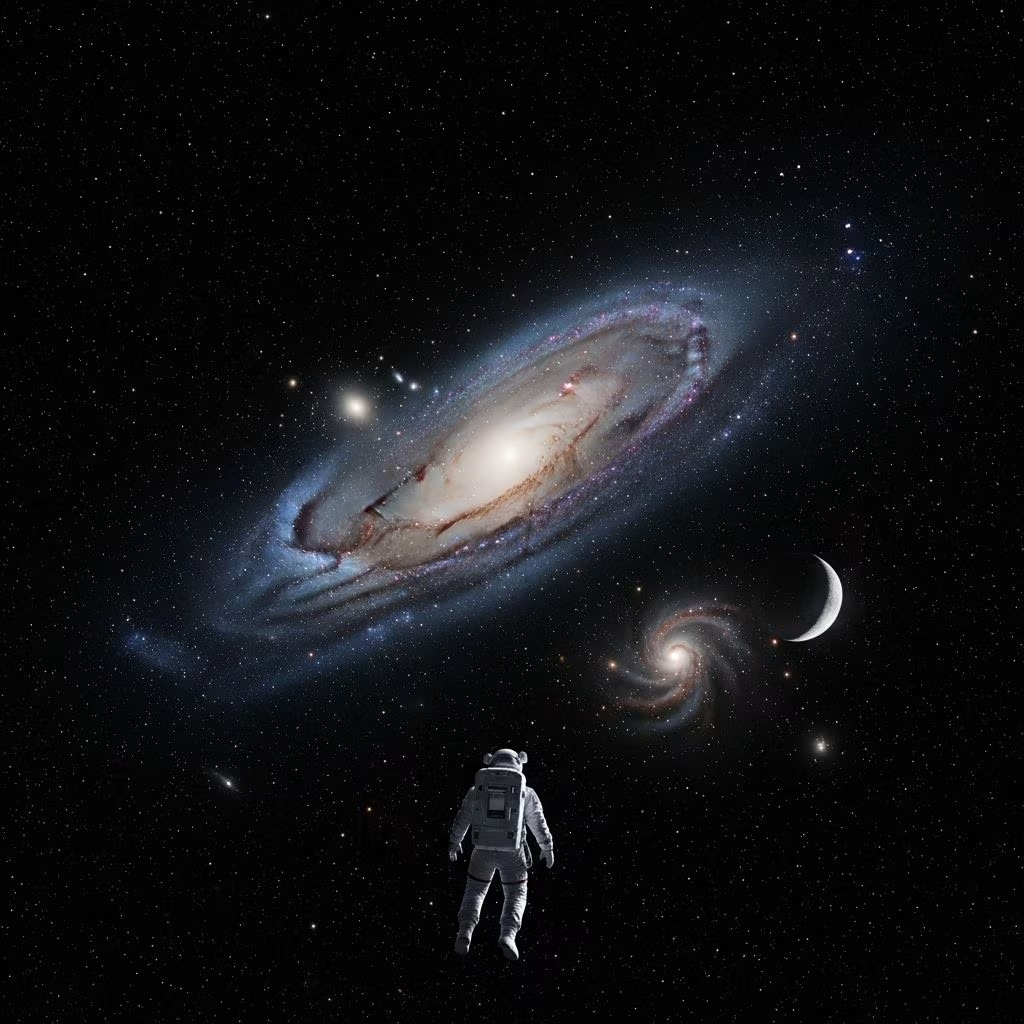
On clear, moonless nights, Earth’s sky is a tapestry dotted with bright stars, planets, and the pale streak of the Milky Way. Yet, space itself—the backdrop to all this cosmic brilliance—remains profoundly dark. Considering the universe contains about 200 billion trillion stars in the observable cosmos, many as bright or brighter than our sun, one might expect an overwhelming wall of dazzling white light.[11]
- The night sky’s darkness is an age-old scientific puzzle, named Olbers’ paradox in the 19th century.
- The solution requires exploring both the physical distribution of stars and fundamental aspects of modern cosmology.
What Is Olbers’ Paradox?
Originally articulated by the German astronomer Heinrich Wilhelm Olbers in 1823, Olbers’ paradox asks: If the universe is infinite and eternally filled with stars, why isn’t every point in the sky as bright as the surface of the sun?
The paradox is commonly explained through the following thought experiment:
- Imagine standing in a dense forest—close by, you see gaps between tree trunks, but the deeper you go, your line of sight is filled by trunks in every direction.
- Translate this to space: if stars are distributed throughout an infinite universe, eventually, every line of sight should end at the surface of a star.
- From this logic, the entire sky should blaze as brightly as a star’s surface—yet reality is very different.
Many leading thinkers, from Johannes Kepler in the 1600s to Olbers and others, have grappled with this contradiction. What assumptions could possibly be wrong?
Playing with Scale: The ‘Bubble’ Analogy
To clarify the paradox, modern astronomers often use a helpful analogy: imagine the Earth at the center of a giant cosmic bubble.
- If the bubble is just 10 light-years across, it contains a dozen or so stars; most appear faint.
- Expand the bubble to 1,000 light-years, 1 million, or 1 billion, and within each enlargement vast numbers of additional, more distant stars are included. While they get fainter with distance, sheer numbers might seem to compensate.
- Mathematically, if space stretches on infinitely, multiplying the rising quantity of stars by the diminishing brightness would mean the night sky should be awash in starlight.
However, as we observe, the night sky is mostly black. Understanding why demands a closer look at cosmic history and physics.
Why Distance Alone Isn’t the Answer
It’s true: a star ten times farther away from us appears a hundred times dimmer. Yet, even if most stars are extremely distant, an infinite static universe would still offer infinite opportunities for starlight to fill the sky.[11]
- If the universe had no beginning and was infinitely old, light from even the most distant stars should have reached us by now—each patch of sky should be filled with star surfaces.
- The dimming effect from distance just spreads energy over a larger area, but also more stars fill in every gap as you look deeper into space.
Key Cosmological Solutions
The resolution of Olbers’ paradox required breakthroughs in understanding both stellar physics and the cosmic timeline. Scientists eventually pinpointed three core reasons for the universe’s enduring darkness:
1. The Universe Had a Beginning (Finite Age)
- The universe began with the Big Bang about 13.8 billion years ago.
- There simply hasn’t been enough time for the light from all observable stars to reach us—many lie so far that their light is still en route.
- We only see the fraction of the universe within our “observable bubble.”
2. The Universe Is Expanding
- As the universe expands, distant galaxies race away from us, and their light is stretched to longer wavelengths in a process known as redshift.
- Many faraway stars and galaxies emit light that is now shifted out of the range of visible light, often into infrared or microwave bands, rendering it invisible to our eyes.
3. Stars and Galaxies Are Not Eternal
- Stars are born, shine for millions to billions of years, then die out as they exhaust their fuel.
- At any given moment, only a subset of all possible stars are shining; the universe is not filled by a static, eternal field of luminous points.
- Interstellar dust can absorb and reemit some light, but not nearly enough to account for the darkness.
What About All the Light We Can’t See?
Space is not truly empty of energy; it teems with radiation at every wavelength. However, most of this light is not visible to human eyes. For example:
- The Cosmic Microwave Background (CMB) fills all space, the leftover glow from the Big Bang, but it is only detectable with special instruments, not sight.
- Starlight from early galaxies, stretched by the expansion, lies in the infrared and microwave regions.
Finite Light Speed and the Observable Universe
Because light travels at a finite speed (about 300,000 km/s), we see distant objects not as they are now, but as they were when their emitted light began its journey. There exists a cosmic “horizon”: the maximum distance from which light has had time to reach us since the beginning of the universe.
- The universe outside our “observable bubble” remains invisible, forever expanding away from our reach.[10]
Dispelling Other Myths: Dust and Blocking Effects
It’s sometimes suggested that the darkness of space is due to dust clouds blocking starlight. While interstellar dust absorbs some energy, it cannot fully explain the darkness:
- If enough dust blocked all starlight, the dust itself would heat up and glow brightly from absorbed radiation, creating a luminous background.
- In reality, dust scatters and re-emits light, but the overall effect is minimal compared with the infinity hypothesis.
Olbers’ Paradox in the Light of Modern Science
| Solution Component | Role in Resolving the Paradox |
|---|---|
| Finite Age of Universe | Limits how much light has had time to reach us, so not all stars contribute to night sky brightness. |
| Expanding Universe | Redshifts distant starlight out of the visible range, dimming their contribution. |
| Stellar Life Cycles | Stars are not everlasting; only a fraction shine at any given moment. |
| Limited Observable Universe | There is a cosmic horizon—stars beyond this are invisible to us. |
| Interstellar Medium | Dust absorbs light, but not enough to account for a dark sky alone. |
Analogies: Forests and Light
A classic analogy is the comparison with a forest:
- In a sparse grove, gaps between trees let you see through. In an infinite, dense forest, you’re surrounded by trunks in every direction.
- If the universe were infinite, old, and static, your night sky, like the view in a dense forest, would be blocked by a “solid wall” of starlight.
- But the universe is not infinite in age, nor static, nor ever-illuminated—hence, the dark sky.
Scientific and Philosophical Insights
Olbers’ paradox is more than just a curiosity—it was an early clue that our universe had a dynamic, finite history. The black expanse overhead is strong evidence of the Big Bang and cosmic evolution. It shows us the limits of observation and the vast, fascinating scope of modern cosmology.
- Every patch of darkness is evidence of the universe’s youth and evolution.
- The night sky is a window not just into remote space, but into deep time.
Frequently Asked Questions (FAQs)
What is Olbers’ paradox in simple terms?
It is the question of why the night sky is dark, even though an infinite universe filled with stars should appear uniformly bright everywhere we look.
Is space truly black, or is it an illusion?
Space appears black because the visible light from stars is sparse and distant, while most radiation is outside human visual sensitivity or from regions beyond our observable universe.[10]
Will the night sky ever get brighter?
No; as the universe continues to expand, distant starlight will become even more redshifted and faint. The night sky may actually become darker over cosmic time.
What is the cosmic microwave background?
The cosmic microwave background (CMB) is relic radiation from the early universe, detectable with special radio telescopes—not visible light, but a faint afterglow at microwaves.
How does redshift make space dark?
Redshift stretches the light from distant stars into lower, invisible frequencies (infrared, microwave), reducing the total visible light that reaches Earth.
Could dust clouds in space cause the darkness?
No; while some light is absorbed and scattered, a perfectly absorbing dust cloud would itself heat up and reradiate energy, failing to keep the sky dark indefinitely.
What’s beyond the observable universe?
We cannot know for certain—light from those regions has not had time to reach us, and may never do so if space expands fast enough. They are currently, and may remain, forever invisible to us.
Key Points at a Glance
- Space is dark because: The universe has a finite age, is expanding, and light from most stars has not reached us or is too faint/redshifted for human eyes.
- Olbers’ paradox highlights the need to consider the universe’s past, not just its immense size.
- The darkness of the night sky is direct evidence of a dynamic, evolving cosmos, not an everlasting, static one.
Further Exploration
- Is there anything beyond the observable universe? Scientists hypothesize the cosmos extends far beyond what we can see, but what lies beyond the observable horizon remains one of the deepest mysteries of astronomy.
- New astronomical missions, like the James Webb Space Telescope, are studying the earliest galaxies and cosmic background, shining more light on the universe’s first moments and its ongoing expansion.
Next time you gaze at the stars scattered across the velvet black of space, remember: what you are seeing is the beautiful and humbling signature of a universe still unfurling its story—one dark night at a time.
References
- https://en.wikipedia.org/wiki/Olbers’s_paradox
- https://www.space.com/why-is-space-so-dark-with-so-many-stars
- https://starchild.gsfc.nasa.gov/docs/StarChild/questions/question52.html
- https://www.youtube.com/watch?v=oWBBrArcUJg
- https://www.britannica.com/video/energy-space-stars-night-sky/-204078
- https://www.livescience.com/why-does-space-look-black.html
- https://www.amnh.org/exhibitions/journey-to-the-stars/educator-resources/stars/olbers-paradox
- https://www.youtube.com/watch?v=a5XoMGEq2G8
- https://www.nasa.gov/missions/hubble/new-horizons-spacecraft-answers-question-how-dark-is-space/
- https://www.sciencefocus.com/space/why-is-space-dark
- https://www.discovermagazine.com/why-is-space-so-dark-even-though-the-universe-is-filled-with-stars-45474
- https://byjus.com/question-answer/there-are-so-many-stars-in-space-but-still-why-is-it-dark-in-there/
- https://davidson.weizmann.ac.il/en/online/askexpert/why-night-sky-dark
- https://www.sciencefocus.com/space/why-the-sky-is-dark-at-night
- https://wonderdome.co.uk/dark-space-explained/
- https://scitechdaily.com/stars-are-everywhere-so-why-is-the-sky-still-dark/
- https://www.pagosasun.com/premium/theconversation/stories/why-is-space-so-dark-even-though-the-universe-is-filled-with-stars,89560