What Is Mercury Made Of?
\n
Mercury, the solar system’s innermost planet, presents scientists with puzzles both dazzling and profound. Unlike its planetary siblings, Mercury’s composition is distinguished by a disproportionately large metallic core, a volatile-rich rocky crust, and an exosphere awash with rare elements. Decades of space missions and laboratory analysis have pieced together a story that spans from the earliest solar system to today’s harsh, sun-scorched world. This article explores Mercury’s structure, elemental makeup, atmospheric peculiarities, and what these reveal about planetary formation.
\n\n
Mercury’s Position and Significance in the Solar System
\n
Situated closest to the Sun and completing an orbit every 88 Earth days, Mercury is a terrestrial planet with traits both familiar and exotic. It has no substantial moon, barely any atmosphere, and experiences temperature extremes from blazing sunlight to freezing darkness. Yet, its diminutive size hides a complexity that continues to surprise astronomers, chemists, and planetary scientists alike.
\n\n
Mercury’s Internal Structure
\n
The internal makeup of Mercury is dominated by a core that distinguishes it among rocky planets.
\n
- \n
- Core: Up to 70% of Mercury’s total mass—more than twice the core proportion of Earth, Venus, or Mars—is metallic iron and nickel. This core has a radius of approximately 2,000 kilometers, leaving far less space for the rocky outer layers[14].
- Mantle: Above the core is a relatively thin silicate mantle estimated to be about 400 kilometers thick. The mantle consists primarily of magnesium- and silicon-rich silicates with a high proportion of sulfide minerals, a feature that is unusual for a body of Mercury’s size and proximity to the Sun[14].
- Crust: Mercury’s crust is surprisingly rich in volatiles such as sulfur, sodium, potassium, and chlorine—elements that one would expect to have evaporated away due to the planet’s high temperatures and its proximity to the Sun[14][12]. The crust is likely between 35 and 370 kilometers thick, formed largely from ancient volcanic and impact-driven processes[11].
\n
\n
\n
\n\n
Table 1: Mercury’s Interior Compared with Other Terrestrial Planets
\n
| Planet | Core (as % of planetary mass) | Mantle/Crust (%) | Key Elements |
|---|---|---|---|
| Mercury | ~70 | ~30 | Fe, Ni, S, Mg, Si |
| Earth | ~33 | ~67 | Fe, Ni, O, Si, Mg |
| Venus | ~30 | ~70 | Fe, Ni, O, Si, Mg |
| Mars | ~20 | ~80 | Fe, Ni, O, Si, Mg |
\n\n
The Puzzle of Mercury’s Core: Why So Much Iron?
\n
Mercury’s oversized iron-nickel core has sparked years of debate. Researchers propose several possible scenarios for its formation:
\n
- \n
- Giant impact hypothesis: Mercury may have once been larger, with a thick rocky mantle similar to Earth, but a colossal collision early in solar system history could have stripped away much of its rocky material, leaving a metal-dominated core behind[14][12].
- Solar formation bias: Mercury might have formed from solar nebula material already rich in metal and poor in silicates, the leftover dust from the early Sun favoring metallic condensation close to the star[14].
- Vaporization hypothesis: Intense solar winds or proximity to the hot young Sun could have incinerated and blown away lighter, rocky minerals from Mercury’s surface while leaving heavier metals intact[14].
\n
\n
\n
\n
The MESSENGER mission’s data suggest that some chemical anomalies—such as the presence of sulfur—support either a reduced, low-oxygen environment during formation, or conditions where much of the initial silicate material was lost in the planet’s violent infancy[14][12].
\n\n
Mercury’s Surface: Composition of the Crust
\n
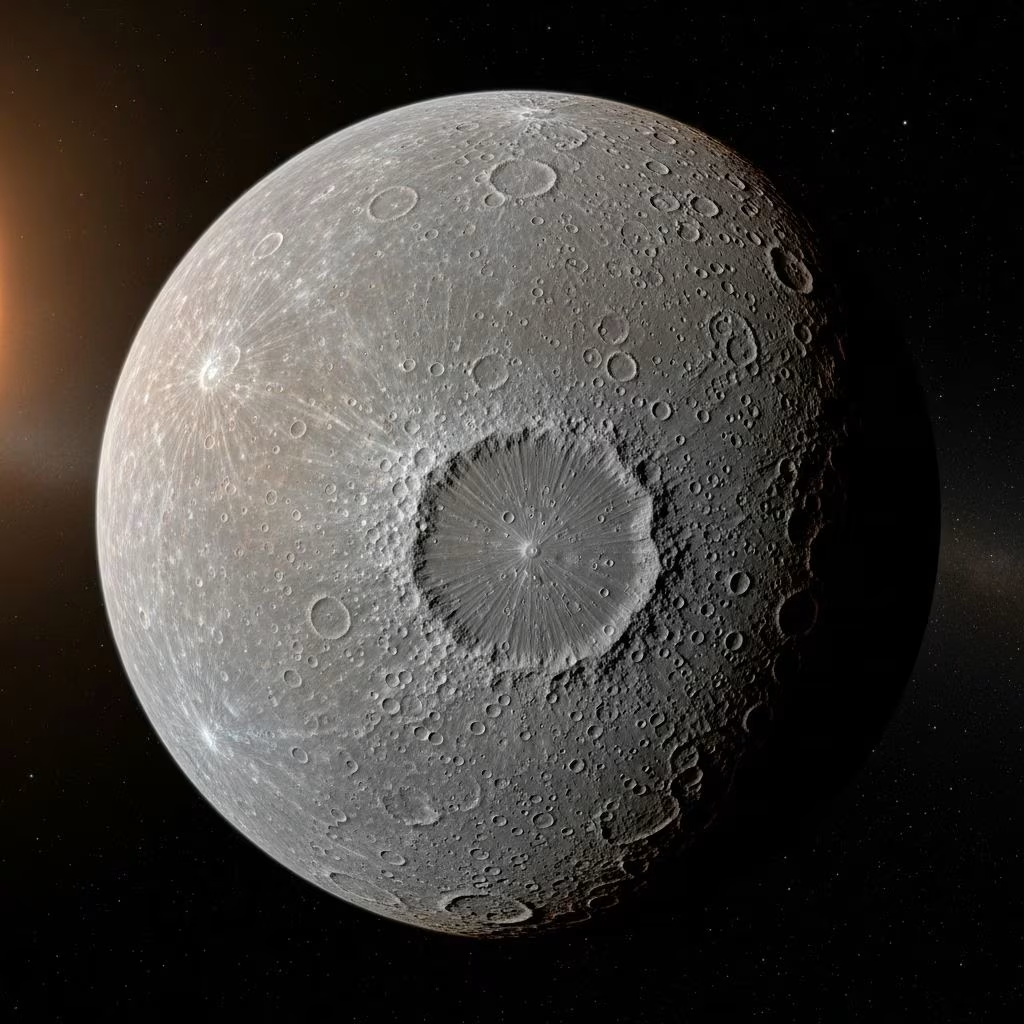
The planet’s crust is largely volcanic in origin, interspersed with massive impact basins such as the Caloris Basin. Surprisingly, Mercury’s surface is not dominated by the iron expected from its core, but rather by an array of dark, volatile-rich minerals and rocks:
\n
- \n
- High sulfur content: Surface rocks contain much more sulfur than found on Earth or other inner planets. Estimates from the MESSENGER spacecraft put Mercury’s surface sulfur content at up to 10 times higher than typical for planetary crusts[14].
- Magnesium and calcium sulfides: The presence of sulfide minerals like magnesium and calcium sulfide is a telltale sign of formation under oxygen-poor, chemically “reduced” conditions[14].
- Sodium, potassium, and chlorine: Mercury’s surface is rich in sodium and potassium, both considered highly volatile and easily lost to space, suggesting these elements were somehow retained despite Mercury’s proximity to the Sun[14].
- Carbon: Recent data hints at a carbon-rich “darkening” material, possibly graphite, that gives the planet its muted, grayish color[14].
\n
\n
\n
\n
\n\n
Comparing Mercury’s Composition with Meteorites
\n
To understand how Mercury formed and why it is so different, scientists compare its elemental makeup to meteorites, particularly \nenstatite chondrites. These meteorites are formed under low oxygen conditions, similar to what is suspected for Mercury’s environment, and contain similar types of sulfides and a comparable breakdown of metallic and rocky phases[14]:
\n
- \n
- Chondritic similarity: Mercury shares a closer chemical fingerprint with enstatite chondrites than with more oxygen-rich carbonaceous meteorites or even the bulk of Earth’s composition[14].
- Implications: This relationship suggests that, despite its proximity to the Sun, Mercury accreted from primitive, low-oxygen building blocks similar to those that formed these rare meteorites[14].
\n
\n
\n\n
Mercury’s Exosphere: A Planet Without a True Atmosphere
\n
Mercury lacks what traditional planetary science would call an atmosphere. Instead, it features an incredibly thin “exosphere”—a cloud of atoms and ions dancing above the surface, constantly replenished by solar wind, meteoroid impacts, and surface evaporation.
\n
- \n
- Major exospheric components: Atomic hydrogen, helium, oxygen, sodium, potassium, calcium, and water vapor have all been detected, with concentrations varying widely depending on time of day, solar activity, and meteoroid showers.
- Source of gases: Many of these gases are sputtered from the surface by solar wind; some, like sodium and potassium, are vaporized during meteoroid impacts or direct solar heating[14].
- No atmospheric retention: Mercury’s weak gravity and intense solar radiation prevent it from retaining a stable atmospheric envelope. Most atomized gases escape rapidly into space, forming a vague tail pointing away from the Sun.
\n
\n
\n
\n\n
Table 2: Key Components of Mercury’s Exosphere
\n
| Element | Typical Source | Feature/Role |
|---|---|---|
| Hydrogen (H) | Solar wind | Forms a thin envelope around Mercury, quickly escapes |
| Helium (He) | Solar wind | Very low abundance, rapidly escapes |
| Oxygen (O) | Surface minerals, solar wind | Sometimes forms oxides, detected in trace amounts |
| Sodium (Na) | Surface vaporization, meteoroid impact | Forms bright spots near poles and dawn areas |
| Potassium (K) | Surface vaporization, meteoroid impact | Lower abundance than sodium, similar distribution |
| Calcium (Ca) | Surface vaporization, meteoroid impact | Mostly near the equator, least abundant major element |
\n\n
How Mercury Retains Volatiles in a Harsh Environment
\n
One of the profound mysteries is how Mercury holds onto volatile materials, such as sulfur, sodium, and potassium, when surface temperatures soar to over 430°C (800°F) in sunlight and plummet below −180°C (−290°F) at night. Several factors may play a role:
\n
- \n
- Rapid formation in a reduced environment: Mercury may have formed and differentiated quickly, locking away volatiles in sulfide minerals before they could be lost to space[14].
- Planetary protection via crust: Early crustal layers may have shielded volatiles from solar heating, or impact events could have brought new volatiles from space[14].
- Unusual chemistry: Mercury’s reduced state (low oxygen) allows unusual minerals to form and persist, trapping elements otherwise rare on planetary surfaces[14].
\n
\n
\n
\n\n
Radioactive Heat Production and Geological Evolution
\n
Unlike Earth, where heat from radioactive decay powers long-lived volcanism and plate tectonics, Mercury’s heat flow is dominated by a smaller inventory of radioactive elements. Its unique composition, including enrichment in potassium, thorium, and uranium, directly affects its long-term geologic evolution:
\n
- \n
- Internal cooling: Mercury’s large core and small mantle allowed it to cool rapidly after formation, curtailing major tectonic activity relatively early in its history[14].
- Surface contractions: As the core shrank and cooled, Mercury’s surface wrinkled like a dried apple, creating spectacular cliffs known as “lobate scarps” visible today[10].
\n
\n
\n\n
Comparing Mercury to Other Terrestrial Planets
\n
Although all inner planets share some rocky characteristics, Mercury’s structure, chemical environment, and physical behavior make it exceptional. Key differences include:
\n
- \n
- Much higher iron content than Venus, Earth, or Mars.
- More reduced surface chemistry, richer in sulfur and volatile elements.
- Lack of atmosphere compared to Venus (thick CO₂ atmosphere) and Earth (nitrogen/oxygen-rich air).
- No active geology, in contrast to the tectonically active Earth or volcanically dynamic Venus.
\n
\n
\n
\n
\n\n
The Broader Context: Mercury’s Formation and Solar System Connections
\n
Mercury is both a planetary outlier and a touchstone for understanding the chemistry of early planet-building. Comparing Mercury’s composition to chondritic meteorites bridges cosmic scales, revealing that conditions near the Sun could yield planets with highly metallic interiors, volatile-rich crusts, and unique mineral chemistries. As new missions probe Mercury’s mysteries, its story illuminates how varied—and surprising—planetary formation can be even in our own solar system.
\n\n
Frequently Asked Questions (FAQs)
\n
Q: Why is Mercury’s core so large compared to its size?
\n
A: Mercury’s core occupies about 70% of its planetary mass due to processes like giant impacts, formation from metal-rich primordial material, and possibly silicate evaporation near the early Sun[14][12].
\n\n
Q: Is there water or ice on Mercury?
\n
A: Despite intense surface heat, water ice has been detected at Mercury’s poles, permanently shadowed within deep craters that never receive sunlight.
\n\n
Q: Does Mercury have an atmosphere?
\n
A: Mercury lacks a traditional atmosphere, but has a thin exosphere of atoms like hydrogen, helium, sodium, potassium, and calcium, replenished by the solar wind and meteoroid impacts.
\n\n
Q: How do we know what Mercury is made of?
\n
A: Data primarily come from space missions—especially Mariner 10 and MESSENGER—which used remote sensing, X-ray fluorescence, and neutron spectrometry to map Mercury’s surface and infer the internal structure[14].
\n\n
Q: Why is Mercury’s surface rich in sulfur and other volatiles?
\n
A: Mercury’s surface chemistry reflects formation under oxygen-poor conditions, rapid cooling, and retention of volatile elements that have mostly been lost from other inner planets[14].
\n
References
- https://www.space.com/18643-mercury-composition.html
- https://en.wikipedia.org/wiki/Mercury_(planet)
- https://www.britannica.com/place/Mercury-planet/Surface-composition
- https://spaceplace.nasa.gov/all-about-mercury/en/
- https://www.universetoday.com/articles/composition-of-mercury
- https://study.com/learn/lesson/mercury-surface-atmosphere-composition.html
- https://nssdc.gsfc.nasa.gov/planetary/factsheet/mercuryfact.html
- https://en.wikipedia.org/wiki/Atmosphere_of_Mercury
- https://www.britannica.com/place/Mercury-planet/The-atmosphere
- https://www.space.com/36-mercury-the-suns-closest-planetary-neighbor.html
- https://www.nhm.ac.uk/discover/planet-mercury.html
- https://www.universetoday.com/articles/what-is-mercury-made-of
- https://airandspace.si.edu/explore/stories/mercury
- https://astrobiology.com/2023/10/the-origin-of-mercurys-structure-and-chemical-composition-and-their-astrobiological-implications.html
- https://lovethenightsky.com/what-is-mercury-made-of/
- https://www.astro22.com/what-are-the-chemical-components-of-mercury/
- https://starwalk.space/en/news/facts-about-mercury-all-you-need-to-know
- https://www.planetary.org/worlds/mercury
- https://spacemesmerise.com/en-us/blogs/planets/uncovering-the-mysteries-of-mercurys-interior-composition-and-structure