


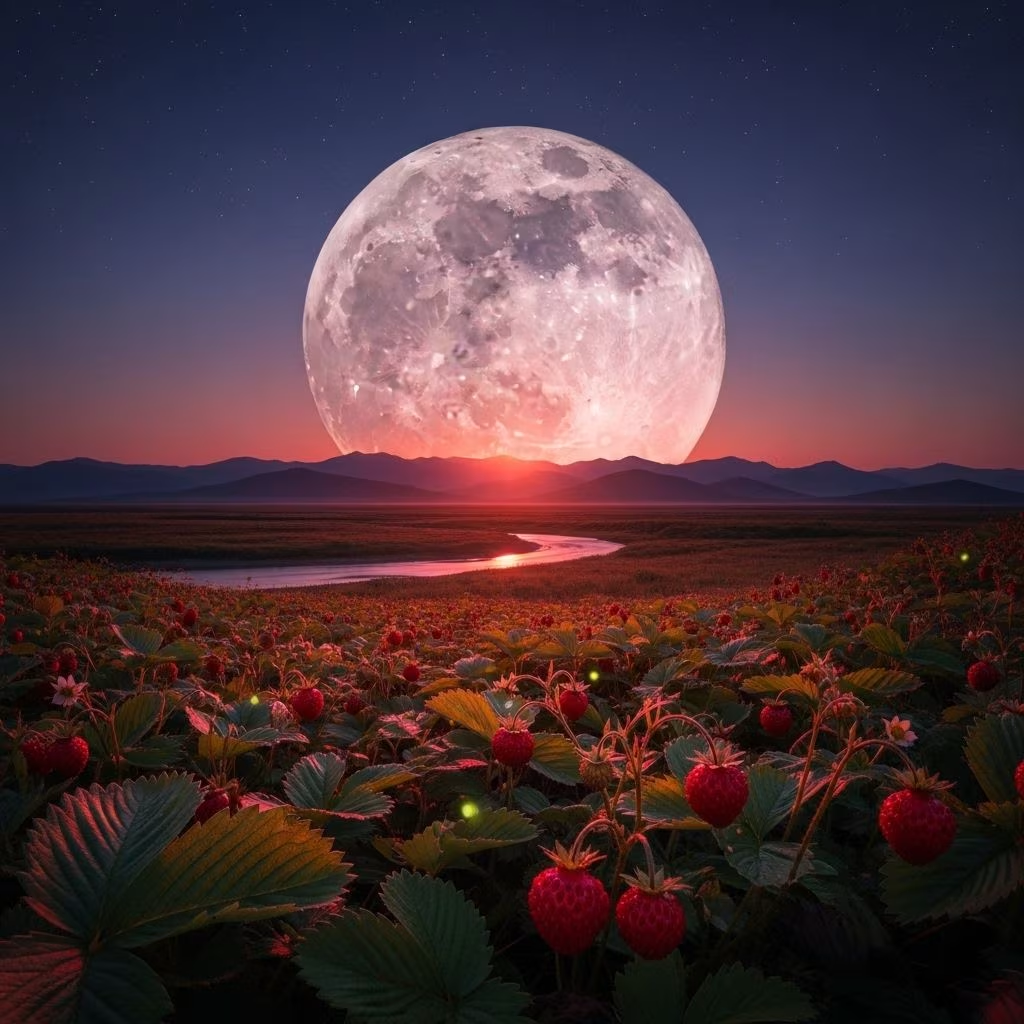
June’s Strawberry Moon: A Celestial Event Steeped in Science and Tradition
June 2025 brings skywatchers a remarkable celestial phenomenon — the Strawberry Moon, notable for being the lowest full moon in nearly two decades due to a rare orbital occurrence known as the major lunar standstill. In addition to its astronomical intrigue, this event offers a blend of folklore, striking visual opportunities, and a special place on the lunar calendar for observers in both hemispheres.
Overview: What is the June Strawberry Moon?
The Strawberry Moon is the name given to the full moon appearing in June. For 2025, it occurs on June 11 at 07:44 GMT, illuminating the sky with a special distinction: it is the lowest full moon until 2043 for those in the Northern Hemisphere. In contrast, observers in the Southern Hemisphere will see the highest full moon for almost two decades.
The phenomenon behind this low trajectory is a synergy of the moon’s tilted orbit and its timing near the summer solstice.
The Major Lunar Standstill Explained
Every 18.6 years, astronomers witness a “major lunar standstill,” a result of how the Moon’s orbit tilts relative to Earth’s equator. During this period:
- The Moon rises and sets at more extreme positions on the horizon.
- The full moon’s path through the sky becomes unusually high or low depending on the time of year and your location.
In June 2025, this standstill combines with the seasonal effect near the solstice, causing the lunar disk to skirt unusually close to the southern horizon for observers in northern latitudes.
| Hemisphere | Full Moon Height | Visibility Impact |
|---|---|---|
| Northern | Lowest until 2043 | Rises/set close to southern horizon |
| Southern | Highest until 2043 | Travels high overhead |
Moon Phases in June 2025
- First Quarter: June 3, 03:41 GMT
- Full Moon (Strawberry Moon): June 11, 07:44 GMT
- Last Quarter: June 18, 19:19 GMT
- New Moon: June 25, 10:31 GMT
The Strawberry Moon is the last full moon before the June solstice, which this year falls on June 21.
Observing tip: While a full moon dazzles with its brightness, it’s not ideal for stargazing, as its glare washes out fainter celestial objects. The New Moon on June 25 marks the darkest nights, offering the best sky conditions for observing planets, meteors, and deep-sky objects.
Observing and Photographing the Full Moon
The low-hanging position of June’s full moon intensifies its golden coloring and creates dramatic photographic opportunities. To make the most of this rare spectacle:
- Select a vantage point with a clear southern horizon (for northern observers) to increase your chances of capturing the moonrise or moonset against terrestrial landmarks.
- Use longer focal length lenses or binoculars to emphasize the “Moon illusion” — the tendency for the moon to appear larger near the horizon due to optical effects.
- Try photographing the nearly full moon on subsequent nights as it transitions to a waning gibbous phase. The illuminated lunar disk will remain almost complete for several evenings.
- Check for local lunar occultations of bright stars (like Antares), which sometimes occur around this full moon.
Astrophotographers worldwide capture remarkable images of the Strawberry Moon, leveraging its low angle for creative compositions juxtaposed with city skylines, natural wonders, or cultural landmarks.
Cultural Significance & Origin of the Name
The name “Strawberry Moon” comes from the Algonquian peoples of North America, who used the full moon in June to mark the short harvesting season of wild strawberries.
- The Old Farmer’s Almanac cites a variety of lunar names formed by Native American tribes, each reflecting seasonal agricultural or environmental cues.
- Other cultures have called June’s full moon by different names, such as the “Rose Moon” (Europe), “Hot Moon,” or “Mead Moon,” depending on traditional observances and local conditions.
While the Strawberry Moon doesn’t actually look red or pink, its association with the fruit-picked time remains a cherished tradition in lunar folklore.
Astronomical Features of the June Full Moon
- Constellation Spotlight: The June 2025 full moon shines within the constellation Ophiuchus, sometimes referred to as the “13th constellation” along the Sun’s annual path.
- Antares Proximity: On June 10, the moon passes near Antares, the brightest star in Scorpius. Depending on your location, it can even occult (cover) Antares, an impressive event for telescopic observers.
Moonrise and moonset times, lunar position, and visibility will vary by location. Astronomy apps can provide personalized guides, allowing users to track the moon’s path and plan their observations accordingly.
Upcoming Lunar Events
If you miss observing the 2025 Strawberry Moon, there are other full moons and lunar events to anticipate:
- Next Full Moon (Buck Moon): July 10, 2025
- Next Strawberry Moon: June 29, 2026
For ongoing lunar tracking, many astronomers and enthusiasts recommend using sky chart apps that post notifications for rare astronomical phenomena, such as eclipses, occultations, and significant planetary conjunctions.
Frequently Asked Questions (FAQs)
Q: Why is the June 2025 Strawberry Moon so low in the sky?
A: The combination of the Moon’s tilted orbit and the timing near the solstice during a major lunar standstill directs the full moon’s path close to the southern horizon for northern observers, making it the lowest full moon until 2043.
Q: Where does the June full moon get its name?
A: “Strawberry Moon” was named by Algonquian tribes to signal the brief wild strawberry harvest season in June. Similar seasonal names are found across the world’s cultures.
Q: Is the Strawberry Moon red or pink in color?
A: The Strawberry Moon doesn’t actually appear red or pink. However, its low angle may cause atmospheric scattering, sometimes creating a golden or amber hue, especially near the horizon.
Q: What constellation will the June 2025 full moon occupy?
A: The Moon will be visible in the constellation Ophiuchus, just above the bright star Antares in Scorpius.
Q: Will the moon cover (occult) any stars during this event?
A: On June 10, the Moon may occult Antares, depending on your location. This is best seen with binoculars or a small telescope.
Q: When is the next Strawberry Moon?
A: After 2025, the next Strawberry Moon will be on June 29, 2026.
Q: How can I photograph the Strawberry Moon?
A: Choose a spot with a clear southern horizon, use a telephoto lens for dramatic moon shots, and experiment with composition, such as including trees, buildings, or water reflections.
Q: Is the Strawberry Moon important for agriculture?
A: Historically, lunar phases marked major agricultural cycles. The Strawberry Moon indicated the ideal time for picking wild strawberries, reflecting a close relationship between astronomy and traditional farming.
Tips for Skywatchers
- Plan outings for moonrise or moonset, when atmospheric colors are richest.
- Use apps or almanacs for precise lunar timings and directions.
- Combine moon viewing with other June sky treats, such as planetary alignments or meteor showers like the June Bootids (visible around the new moon).
Further Reading & Resources
- Consult astronomical calendars for additional lunar and planetary events.
- Explore local observatories or astronomy clubs for group events.
- Check astrophotography communities for tips and stunning moon images.
June’s Strawberry Moon in 2025 stands as a rare convergence of celestial geometry and cultural heritage — a glowing reminder to look up, observe, and savor the wonders of our shared night sky.
References
- https://www.space.com/stargazing/junes-strawberry-moon-treats-skywatchers-to-a-rare-low-riding-show-photos
- https://www.space.com/stargazing/junes-full-strawberry-moon-illuminates-the-night-sky-next-week-heres-how-to-see-it
- https://www.livescience.com/space/the-moon/strawberry-moon-2025-junes-full-moon-is-about-to-break-an-annual-record
- https://starwalk.space/en/news/full-moon-june
- https://www.astronomy.com/observing/full-moon-calendar-dates-times-types/
- https://science.nasa.gov/solar-system/skywatching/whats-up-june-2025-skywatching-tips-from-nasa/
- https://www.moongiant.com/calendar/june/2025/
- https://griffithobservatory.org/explore/observing-the-sky/whats-in-the-sky/the-moon/2025-phases-of-the-moon/
- https://www.rmg.co.uk/stories/space-astronomy/full-moon-calendar-2025
- https://time.com/7291518/strawberry-moon-june-2025-how-when-you-can-see-it/
- https://www.livescience.com/space/the-moon/strawberry-moon-2025-junes-full-moon-is-about-to-break-an-annual-record&rut=0356fb85ffbdb2d6ac29911c032b38ef9086b4bacdb9fbd0a1613cbff9ee49eb
- https://starwalk.space/en/news/full-moon-calendar-2025
- https://www.fullmoonology.com/news/full-moon-june-2025/
- https://www.astronomy.com/observing/sky-this-month-june-2025/
- https://www.timeanddate.com/moon/phases/@2297536
- https://www.timeanddate.com/moon/phases/
- https://www.deseret.com/education/2025/06/10/everything-to-know-about-the-strawberry-moon/


