The Sun: Formation, Facts, and Characteristics
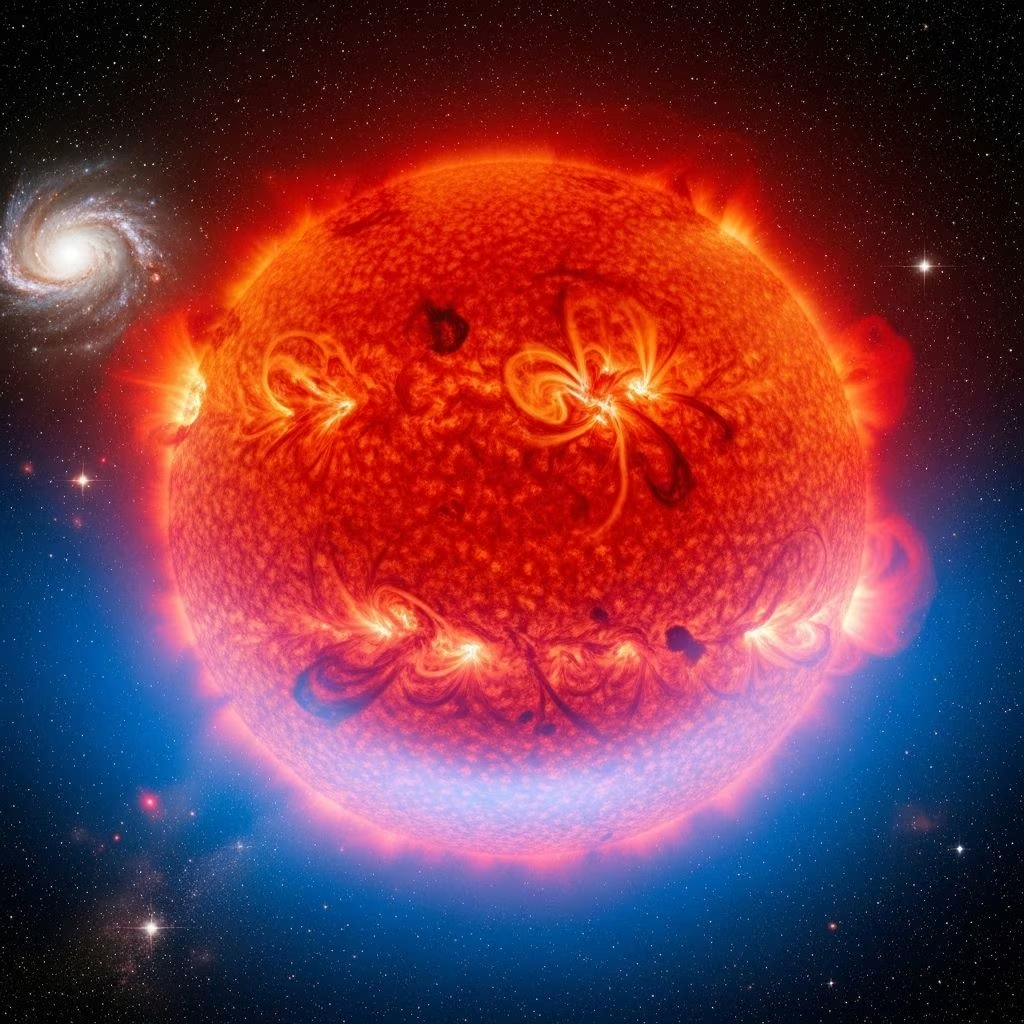
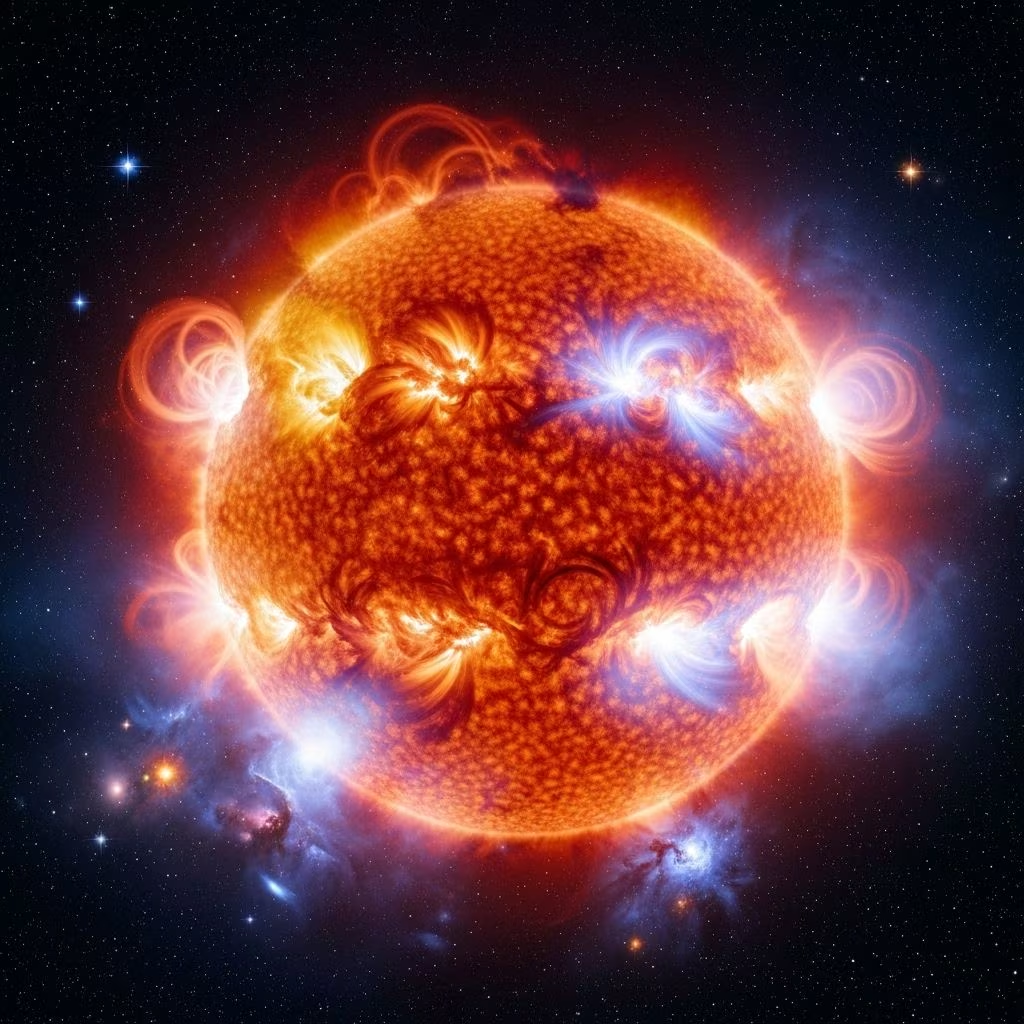
The Sun stands as the central object in our solar system—a blazing sphere of plasma responsible for the existence and sustenance of life on Earth. Its vast energy powers our climate, enables photosynthesis in plants, and influences many phenomena observable from our planet. Dive into the Sun’s intricate story, from its fiery birth to its ongoing legacy as a G-type main-sequence star.
Quick Facts about the Sun
- Age: Approx. 4.6 billion years old
- Diameter: About 1,391,400 km (864,600 miles), 109 times Earth’s diameter
- Mass: About 330,000 times Earth’s mass; 99.86% of the solar system’s total mass
- Distance from Earth: ~149.6 million km (93 million miles)
- Composition: ~73% hydrogen, ~25% helium, with traces of heavier elements
- Spectral Type: G2V (yellow dwarf)
- Surface Temperature: Approx. 5,770 K (9,930°F)
Origin and Formation of the Sun
The Sun emerged from the gravitational collapse of a dense molecular cloud composed mainly of hydrogen and helium, with small amounts of heavier elements. This process began approximately 4.6 billion years ago and marks the birth of not only the Sun itself but the entire solar system. Most of the cloud’s mass converged at the center, ultimately igniting nuclear fusion and giving rise to the Sun. The leftover material formed the protoplanetary disk from which planets would coalesce[13][14].
Step-by-Step Formation
- Collapse of a giant molecular cloud due to gravity.
- Material concentrated at the center forms a protostar—the early Sun.
- Intense pressure and temperature in the core initiate hydrogen fusion, releasing vast amounts of energy.
- The Sun reaches equilibrium: outward pressure from fusion balances inward pull of gravity.
- Residual gas and dust form a rotating disk, from which planets, moons, and other solar system bodies develop.
Observations of young stars like HL Tauri—circled by planet-forming disks—provide compelling evidence of this process playing out elsewhere in the galaxy[13].
Structure and Composition
The Sun’s structure is divided into distinct layers, each critical for energy generation and transport. Its composition is dominated by hydrogen and helium, with minor but crucial traces of heavier elements like oxygen, carbon, neon, and iron[10].
| Layer | Description |
|---|---|
| Core | The source of the Sun’s energy—nuclear fusion converts hydrogen into helium at extreme pressures and temperatures. |
| Radiative Zone | Energy from the core travels outward as electromagnetic radiation, moving slowly due to dense material. |
| Convective Zone | Hot plasma rises and cool plasma sinks in cycles, transporting energy to the surface. |
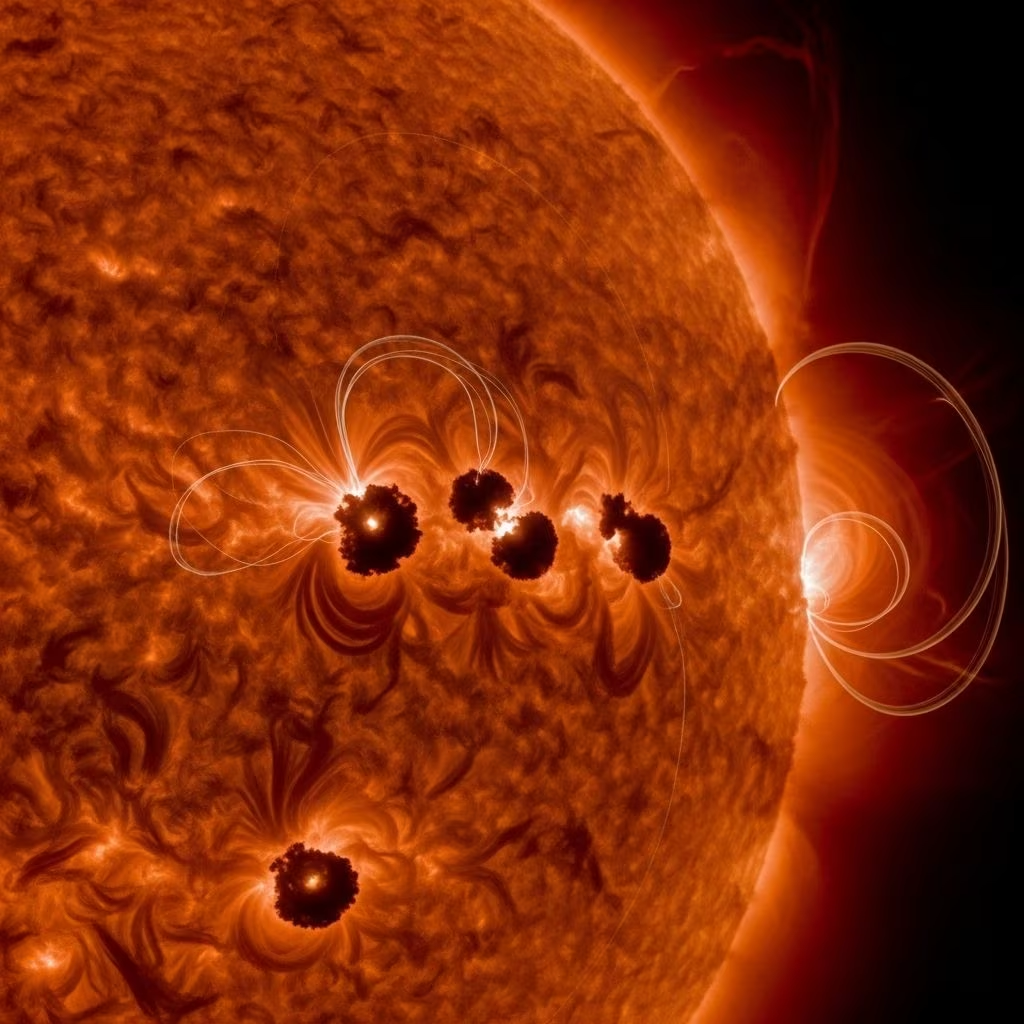
| Photosphere | The visible surface, where sunlight escapes. Features include sunspots—cooler areas linked to magnetic activity. |
| Chromosphere | Above the photosphere; displays spicules and emits reddish glow during solar eclipses. |
| Corona | The Sun’s outer atmosphere, seen as a halo during eclipses; extremely hot and the source of solar wind. |
Energy Production: Nuclear Fusion
At the heart of the Sun, nuclear fusion powers the star. Every second, about 600 billion kg of hydrogen are fused into helium, converting roughly 4 billion kg of matter into energy via the equation E = mc²[10].
- Fusion occurs under extreme pressure (about 340 billion times Earth’s atmospheric pressure) and temperature (15 million Kelvin in the core).
- This process releases photons and neutrinos, which travel through the Sun and eventually radiate outward as sunlight and heat.
- Fusion is so efficient that the Sun has converted about 100 times the mass of Earth into energy since its formation.
Main Sequence Stage
The Sun is classified as a G-type main-sequence star (G2V), also known as a yellow dwarf—though its light is actually white, not yellow. It has spent about 4.6 billion years on the “main sequence,” with roughly 5 billion years left before major changes begin.
- During its main-sequence phase, the Sun steadily fuses hydrogen in its core.
- The Sun is about halfway through this stage, gradually increasing in brightness and temperature as the core contracts and helium accumulates.
- The Sun’s luminosity has increased by approximately 48% since the start of its main-sequence life.
- The core is shrinking as helium builds up, leading to a hotter, brighter star over time.
Solar Activity: Sunspots, Flares, and Solar Wind
The Sun is far from tranquil. Magnetic activity gives rise to phenomena observable from Earth, often with tangible effects:
- Sunspots: Temporary dark spots on the photosphere caused by intense magnetic fields. These can affect solar output and are linked to the 11-year sunspot cycle.
- Solar flares: Powerful bursts of energy from the Sun’s surface, resulting from the sudden release of magnetic energy. These flares can disrupt satellites and communications on Earth.
- Coronal Mass Ejections (CMEs): Massive bubbles of solar plasma hurled into space, sometimes directed toward Earth, leading to geomagnetic storms.
- Solar Wind: A continuous flow of charged particles from the corona that permeates the solar system, influencing planetary magnetospheres and space weather.
Solar Influence on Earth
The Sun’s impact on Earth cannot be overstated:
- Drives weather, climate, and ocean currents.
- Provides the energy for photosynthesis—basis of most life.
- Triggers the Aurora Borealis and Australis (Northern/Southern Lights).
- Solar activity can affect modern technology: satellite operations, GPS, and power grids.
Solar System Origins: The Sun’s Role
The solar system’s architecture owes everything to the Sun’s formation. Its massive gravitational pull sculpted the disk from which inner rocky planets and outer gas giants emerged. The precise distribution of heat, radiation, and gravity determined the chemical and physical attributes of worlds orbiting our star[12][14].
- Protoplanetary disks around young stars are observed to have rings and gaps—precursors to planet formation.
- Heavier elements forged in ancient stars enriched the Sun’s natal cloud, enabling planet diversity.
- The Sun’s early “solar wind” likely stripped away lighter gases from inner planets, explaining their rocky composition versus the gaseous giants further out.
The Sun’s Lifespan & Future
Stellar evolution models provide a roadmap for the Sun’s life stages:
- Main Sequence: Ongoing hydrogen fusion; the current stage, lasting about 10–11 billion years in total.
- Red Giant: When core hydrogen is depleted (~5 billion years from now), the core contracts and heats up, the outer layers expand, and the Sun becomes much brighter and cooler in surface temperature.
- Planetary Nebula: The Sun will shed its outer envelope, creating a glowing shell of gas.
- White Dwarf: The remnant core, no longer capable of fusion, will slowly cool over trillions of years.
- Black Dwarf: Ultimately, the Sun will cease emitting heat and light—a fate that lies far beyond the age of the universe.
| Phase | Timeframe (from now) | Characteristics |
|---|---|---|
| Main Sequence | 0 – ~5 billion years | Stable hydrogen fusion, gradual increase in luminosity |
| Red Giant | ~5 billion years | Expansion, increased brightness, outer layers shed |
| White Dwarf | ~5–6+ billion years | Dense, Earth-sized core cooling slowly |
| Black Dwarf (theoretical) | Trillions of years | No light or heat emission |
Scientific and Cultural Significance
The Sun’s influence permeates human history, science, and mythology. Ancient civilizations venerated the Sun as a deity, while modern science recognizes it as a fundamental cosmic engine. Advances in spectroscopy, solar physics, and space missions continually expand our understanding of our star.
- Culture: The Sun has been a prominent figure in myth, religion, and art across the globe.
- Astronomy: Solar research aids our understanding of other stars and the galaxy’s evolution.
- Space Missions: Observatories like SOHO, Parker Solar Probe, and others gather data on solar activity, inner workings, and the sun-Earth relationship.
Frequently Asked Questions (FAQs)
Q: What is the Sun made of?
A: The Sun is composed of about 73% hydrogen, 25% helium, and traces of heavier elements such as oxygen, carbon, neon, and iron.
Q: How old is the Sun?
A: The Sun is approximately 4.6 billion years old, formed from the collapse of a giant molecular cloud.
Q: How does the Sun produce energy?
A: The Sun’s energy arises from nuclear fusion in its core, where hydrogen atoms combine to form helium, releasing light and heat.
Q: What will happen to the Sun in the future?
A: In about 5 billion years, the Sun will exhaust its core hydrogen, expand into a red giant, shed its outer layers, and finally become a white dwarf.
Q: Why is the Sun vital for Earth?
A: The Sun’s energy drives Earth’s climate and ecosystems, supports photosynthesis, and sustains all known life forms.
Additional Insights and Solar Facts
- The Sun orbits the Milky Way’s center, currently about 25,000–28,000 light-years away.
- The astronomical unit (AU)—the standard measure for distances within the solar system—is defined by the Sun-Earth distance.
- Its magnetic cycle drives dramatic changes in sunspot frequency and solar activity every 11 years.
- The Sun’s corona is far hotter than its visible surface, a phenomenon still under energetic scientific investigation.
- Solar eclipses, auroras, and climate patterns are directly linked to solar phenomena.
Conclusion
The Sun’s story—its origin, structure, and eventual destiny—defines much of what we observe and experience in the solar system. It remains an object of perpetual curiosity, the ultimate source of warmth and illumination, and a reminder of our profound connection to the cosmos. As scientific exploration continues, each new discovery about our star deepens our understanding of the universe and our place within it.
References
- https://en.wikipedia.org/wiki/Sun
- https://science.nasa.gov/sun/facts/
- https://en.wikipedia.org/wiki/Formation_and_evolution_of_the_Solar_System
- https://www.lpi.usra.edu/education/skytellers/sun/
- https://www.space.com/58-the-sun-formation-facts-and-characteristics.html
- https://science.nasa.gov/sun/
- https://www.amnh.org/exhibitions/permanent/the-universe/planets/formation-of-our-solar-system
- https://www.youtube.com/watch?v=VSKSyZh3FOU
- https://www.ndtv.com/world-news/explained-how-sun-was-formed-4-6-billion-years-ago-5399524
- https://science.howstuffworks.com/sun.htm
- https://www.cltruth.com/2019/science-proof-sun-formed-before-earth/
- https://www.planetary.org/worlds/the-sun
- https://www.sciencenewstoday.org/how-was-the-sun-formed-the-fiery-birth-of-our-star
- https://www.nhm.ac.uk/discover/how-our-solar-system-was-born.html
- https://erc.europa.eu/projects-statistics/science-stories/discovering-origin-our-sun
- https://www.britannica.com/place/Sun/Evolution
- https://space.mindofamadman.com/2017/10/31/how-was-the-sun-formed/
- https://www.youtube.com/watch?v=2HoTK_Gqi2Q