The Moment That Made History: John Glenn’s Request
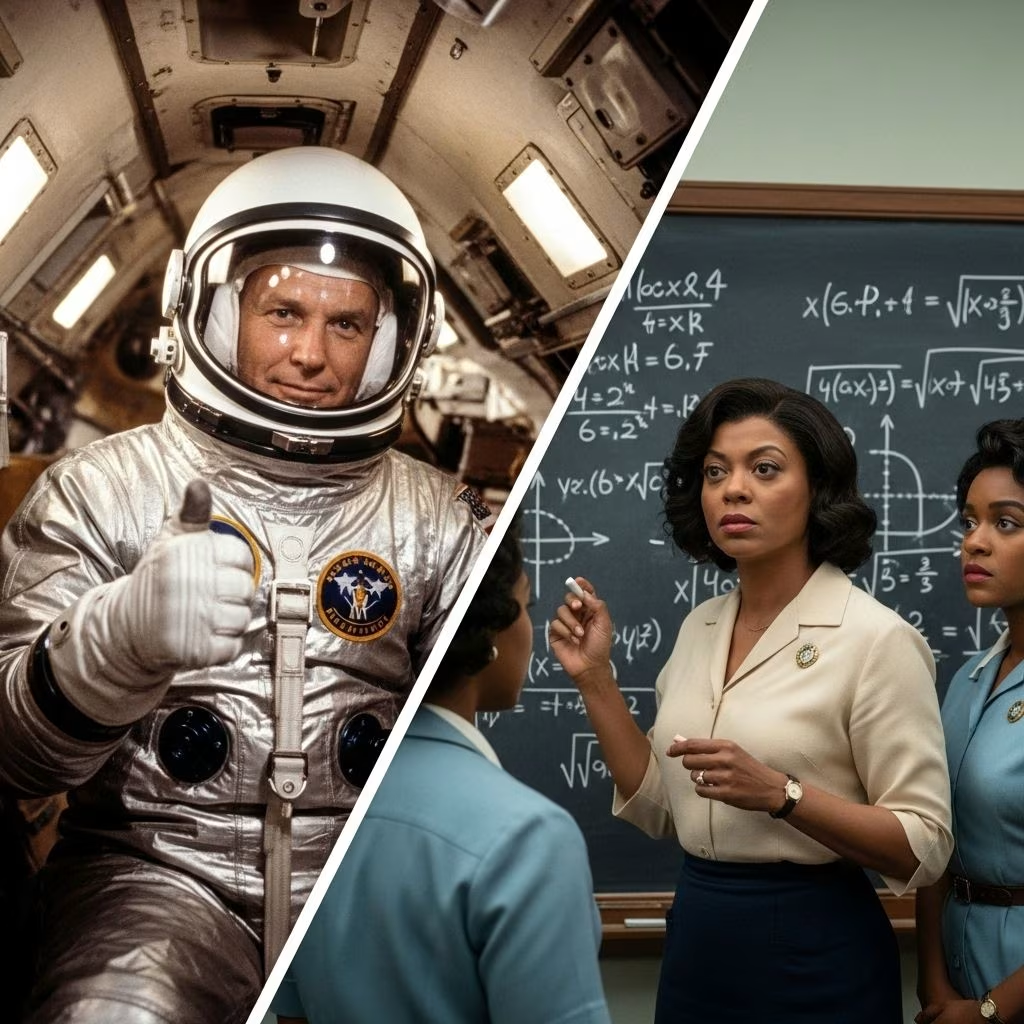
“Get the girl to check the numbers.” With these seven words, John Glenn, in 1962, called for one of NASA’s most groundbreaking yet unsung heroes: Katherine Johnson. Glenn, preparing to become the first American to orbit the Earth, wanted assurance that the new IBM computer calculations were correct—and he trusted Johnson’s math above all else.
Johnson, a 44-year-old African-American mathematician at NASA’s Langley Research Center, was not just another team member. As a “human computer,” she had gained a reputation for both accuracy and the courage to speak her mind in rooms dominated by white men. Glenn’s confidence was unwavering: “If she says the numbers are good, I am ready to go.” This pivotal event is a dramatic highlight in both Hidden Figures, the book by Margot Lee Shetterly, and the 2016 feature film adaptation.
The Role of NASA’s Human Computers
Before the digital age, NASA and its forerunner, NACA (National Advisory Committee for Aeronautics), relied heavily on teams of human calculators, known as “computers.” Originally, this was a job title for women—many of whom were white—who carried out tedious, meticulous calculations on bulky mechanical adding machines.
- Women as Computers: From the 1940s onward, women served as the backbone of NASA’s computation divisions, calculating trajectories, flight paths, and engineering formulas by hand.
- Segregated Groups: At Langley, African-American women were assigned to a segregated group known as the “West Area Computers.”
- Katherine Johnson: Johnson joined the West Area Computers and quickly rose to prominence for her precision and intellectual rigor.
Why Did Glenn Trust Katherine Johnson?
Glenn’s request reflected more than personal preference—it spoke to a culture of burgeoning reliance on machines and the parallel skepticism they inspired. The new IBM 7090 computer, installed at NASA’s Goddard Space Flight Center, was a technological marvel but not immune to error or misconfiguration. Glenn wanted a human he trusted to “check the numbers”—and Johnson’s reputation for identifying errors and her methodical calculations made her the clear choice.
What Really Happened: Fact vs. Hollywood
The 2016 film Hidden Figures turns the checking sequence into a rapid-fire moment of mathematical brilliance lasting mere seconds. In reality, the calculations took much longer. The real sequence of events is more nuanced and more dramatic in its own right:
- Time Required: According to both Margot Lee Shetterly’s book and NASA oral histories, Johnson’s checking of Glenn’s mission trajectory actually spanned about a day and a half—not a few movie minutes—but possibly as many as three days depending on the source.
- Stakes: The calculations involved verifying the entire launch and re-entry trajectory, ensuring Glenn’s spacecraft, Friendship 7, would safely return to Earth.
- Why Johnson? Director Ted Melfi clarified, “Those calculations for John Glenn took three days. … even though [Johnson] is a math genius, she is not that much a genius.”
Yet, the central truth holds: Katherine Johnson’s approval was the final go-ahead Glenn wanted before his historic flight.
Reconstructing the Dialogue
Margot Lee Shetterly’s Hidden Figures book reconstructs the conversation. Glenn asked the engineers to “get the girl to check the numbers.” Johnson would later recall, “You tell her to check the trajectory,” he said. “If she says they’re good, then I’m ready to go.” Johnson’s hand calculations matched the computer’s results, giving the mission the necessary confidence to proceed.
The Impact of Johnson and the Human Computers
The calculations at stake were not minor details; they determined whether Glenn would survive re-entry or perish in the Atlantic Ocean. Johnson calculated—by hand—the launch window, verified the orbital sequence, and assured the accuracy of re-entry coordinates. The room-sized IBM 7090 computer was revolutionary, but Johnson’s verification remained the gold standard.
- Flight Readiness: Johnson’s calculations were critical to both Friendship 7’s success and the trust astronauts placed in their support teams.
- Cultural Legacy: Her work paved the way for recognition of women and minorities in STEM and inspired generations of mathematicians and scientists.
Behind the Scenes: Segregation at NASA
The story of Johnson and her peers is inseparable from the context of the segregated South. African-American women at NASA, including Dorothy Vaughan and Mary Jackson, faced institutionalized racism and sexism. Segregated restrooms and lunches were the norm. These obstacles only make Johnson’s achievements more remarkable.
- Pioneering Integration: Despite barriers, Johnson became the first African-American woman to attend meetings at the highest levels of NASA, often as the only woman or person of color in the room.
- Advocacy by Necessity: The urgency and complexity of the space race compelled NASA to break down some boundaries; the willingness to rely on Johnson marks a turning point in the agency’s culture.
Friendship 7: The Mission and Its Significance
Launched on February 20, 1962, John Glenn’s Friendship 7 mission marked America’s entry into manned orbital spaceflight. Previous suborbital flights by Alan Shepard and Gus Grissom were vital precursors, but only Glenn matched Soviet cosmonaut Yuri Gagarin’s achievement of circling the Earth.
Key Milestones of the Friendship 7 Mission
- Date: February 20, 1962
- Duration: Just under 5 hours
- Orbits: 3 circuits around the Earth
- Spacecraft: Mercury capsule, code-named ‘Friendship 7’
- Historical Achievement: First American orbital flight, boosting American morale in the Cold War era
Technical Details: Human Calculations vs. Computers
| Method | Strengths | Weaknesses |
|---|---|---|
| Human Calculation | Manual cross-check Instinct for anomalies Trusted by astronauts | Time-consuming Prone to fatigue errors Dependent on individual expertise |
| IBM 7090 Computer | Speed Handles complex calculations Can be reprogrammed for multiple missions | Prone to input/output errors Trust in new technology not yet established Dependent on correct program implementation |
The collaboration of human expertise and emerging computing technology was central to Glenn’s successful mission.
Fact-Checking the Film “Hidden Figures”
Hidden Figures has brought renewed attention to the achievements of Johnson and her colleagues, but also dramatized events for cinematic effect. Here is what the movie got right, and what it embellished:
- Accuracy: The essence of Glenn’s trust and Johnson’s expertise is historically grounded—her work was crucial to the success of Friendship 7.
- Hollywood Additions: The time taken for calculations, the dialogue, and certain dramatic confrontations were condensed or invented for the sake of storytelling.
- Legacy: The film nevertheless started important public conversations about race, gender, and unrecognized contributions to science.
Katherine Johnson’s Enduring Legacy
Although Johnson’s calculations helped assure the safe return of a national hero, her greatest legacy may be her role as an inspiration for future generations of women and minorities in STEM fields. In 2015, President Barack Obama awarded her the Presidential Medal of Freedom for her contributions to aeronautics and the American space program.
- Breaking Barriers: Johnson opened doors for others and proved that excellence transcends gender and racial barriers.
- Educational Impact: Schools and science institutions across the US use her story to motivate students and highlight the importance of diversity in STEM.
The Conversation That Changed NASA
John Glenn’s famous, simple request not only built confidence in the historic moment but also spotlighted a quiet revolution within NASA—a shift toward recognizing and relying on previously marginalized talent. The short phrase, “get the girl to check the numbers,” became a rallying point for re-examining how contributions from all team members count in high-stakes endeavors, whether or not they receive initial public acknowledgment.
Frequently Asked Questions (FAQs)
Q: Was it common for astronauts to ask human computers to verify calculations?
A: By the early 1960s, trust in electronic computers was growing, but astronauts remained cautious. Glenn’s request for a manual check from someone he trusted was uniquely personal and highlighted lingering skepticism of new technology.
Q: Did Katherine Johnson work alone on Glenn’s calculations?
A: Johnson was a key figure, but she was part of a larger team of mathematicians and engineers. Still, her work on Glenn’s trajectory is particularly well-documented and lauded for its direct impact on the mission’s success.
Q: How accurate is the ‘Hidden Figures’ film?
A: The film captures the spirit and essential truth of Johnson’s impact but condenses timelines and invents or dramatizes some events for narrative effect.
Q: What changed for women and minorities at NASA after Glenn’s flight?
A: The mission’s success, and the newfound spotlight on Johnson and her colleagues, contributed to gradual changes in NASA’s hiring, promotion, and recognition policies, helping pave the way for more diversity in space science and engineering fields.
Q: How was Johnson recognized in her lifetime?
A: In addition to the Presidential Medal of Freedom, Johnson’s story is now included in educational curricula, and NASA named a research facility in her honor, finally acknowledging her vital contributions to the space program.
Conclusion: Why This Story Endures
John Glenn’s spaceflight was a watershed moment for both the American space program and for civil rights and inclusion at NASA. Katherine Johnson’s story epitomizes the value of overlooked genius, demonstrating that in moments of greatest consequence, trust in skill and character can change history. While Hollywood’s version may add sparkle, the real story behind Glenn’s request is both more complex and more inspiring than fiction alone could convey.
References
- https://www.space.com/35218-hidden-figures-when-did-john-glenn-ask-for-the-girl-to-check-the-numbers.html
- https://www.space.com/35430-real-hidden-figures.html
- https://airandspace.si.edu/stories/editorial/glenn-johnson-hidden-figures
- https://www.collectspace.com/news/news-010517b-hidden-figures-john-glenn-mystery.html
- https://www.youtube.com/watch?v=gZbRowZKLUw
- https://www.popularmechanics.com/space/rockets/a24429/hidden-figures-real-story-nasa-women-computers/
- https://www.youtube.com/watch?v=LMEJcvwPf5A
- https://www.imdb.com/title/tt4846340/goofs/
- https://time.com/4594571/hidden-figures-john-glenn-space-race/
- https://www.scmp.com/culture/film-tv/article/2053839/pioneering-astronaut-john-glenn-remembered-hidden-figures-cast
- https://abcnews.go.com/Politics/nasa-honors-hidden-figures-helped-john-glenn-orbit/story?id=63672902
- https://www.nasa.gov/from-hidden-to-modern-figures/
- https://www.cbsnews.com/news/nasa-hidden-figures-movie-team-honors-john-glenn-and-female-pioneers/
- https://www.autostraddle.com/fact-or-fiction-the-true-story-behind-hidden-figures-365285/
- https://en.wikipedia.org/wiki/Hidden_Figures
- https://www.imdb.com/title/tt4846340/goofs/?item=gf3409300
- https://www.sfgate.com/news/politics/article/hidden-figures-of-the-space-race-receive-19774648.php