Solar Mass: The Standard Astronomical Unit Explained
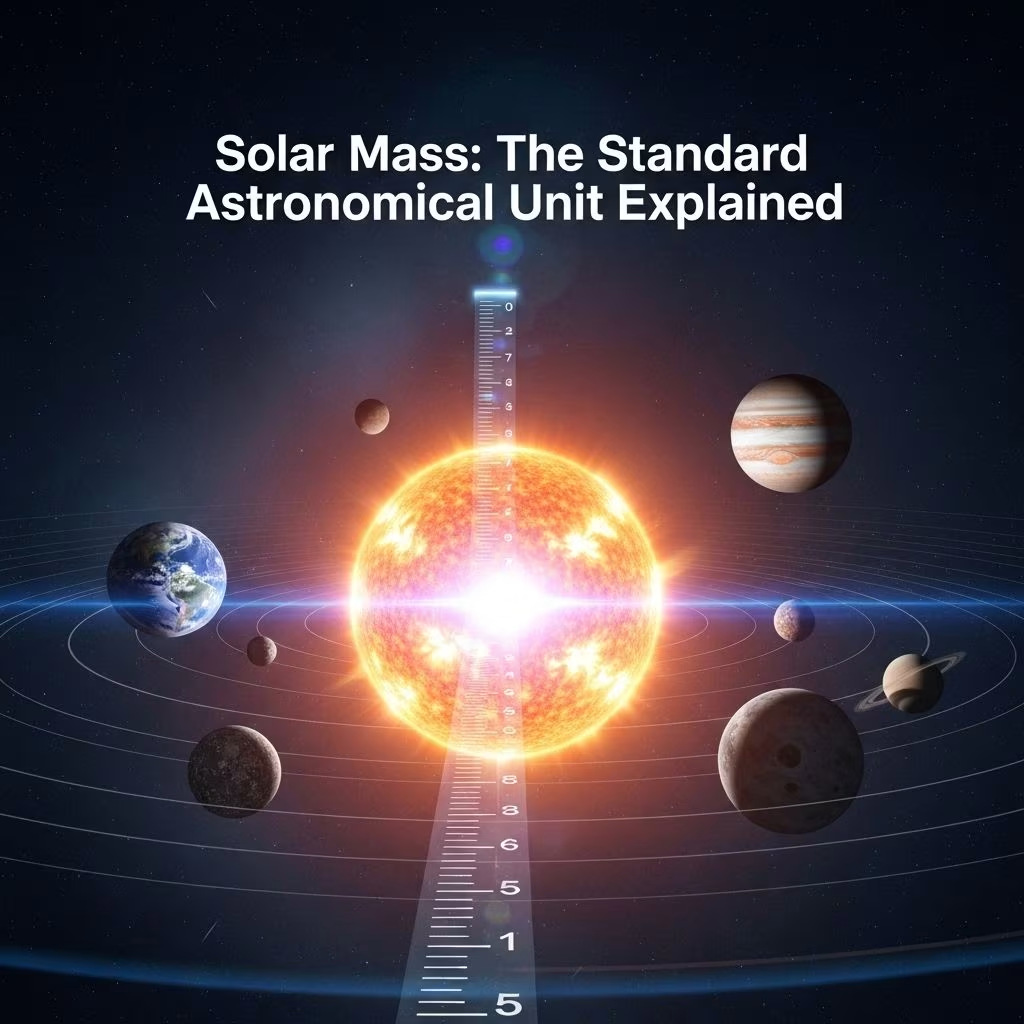
The term solar mass is fundamental to the way astronomers measure and understand the universe. As a standard unit that represents the mass of our Sun, it serves as a powerful comparison tool for the diverse masses of stars, black holes, planets, and even entire galaxies. This article explores what a solar mass is, how it’s determined, and why it remains crucial to astrophysics and cosmology.
What Exactly Is a Solar Mass?
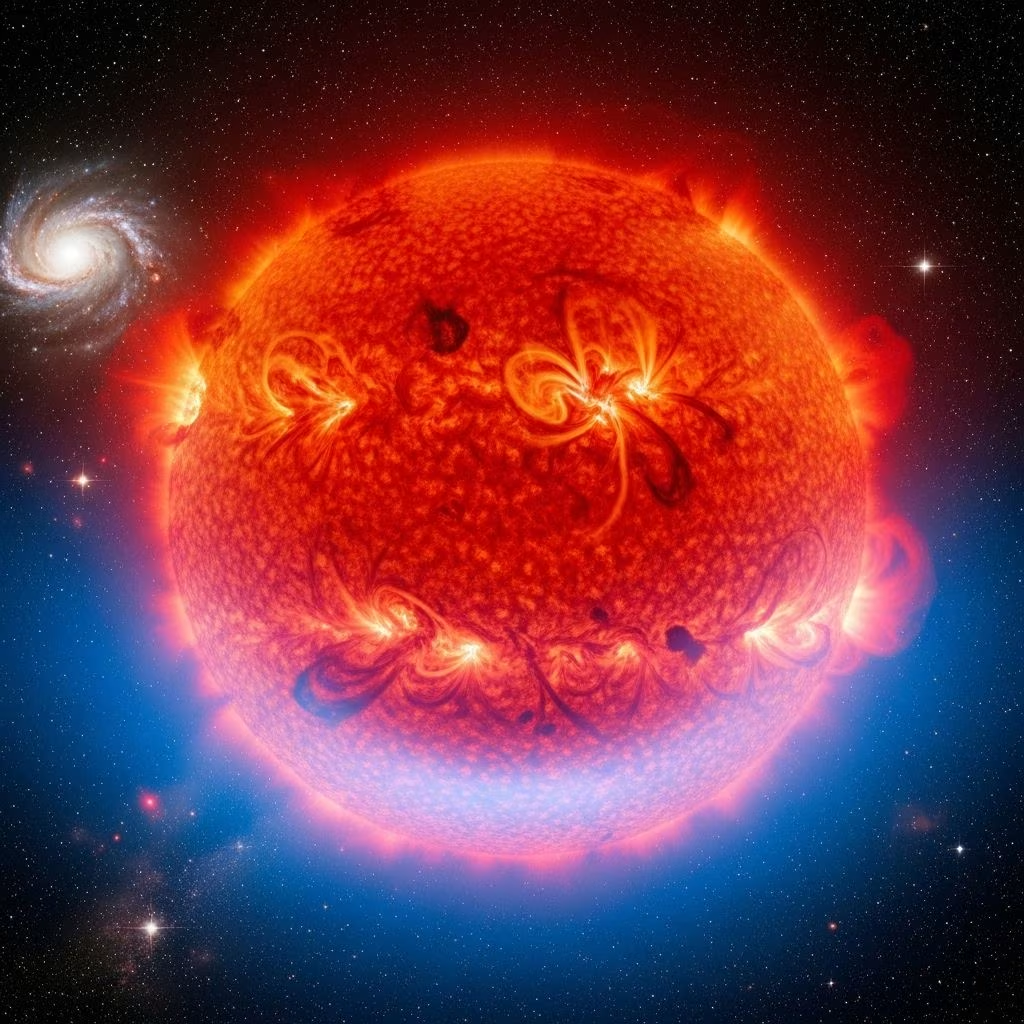
Solar mass is the unit of mass equivalent to the mass of our Sun. Denoted by the symbol M☉, it is defined as exactly 1.98847 × 1030 kilograms (kg). This vast figure—roughly 333,000 times the mass of the Earth—serves as a practical way to describe the immense masses of astronomical objects without resorting to overwhelming numbers of kilograms or pounds.
- Symbol: M☉
- Value: 1.98847 × 1030 kg (or about 4.385 × 1030 pounds)
- Relative to Earth: The Sun is about 333,000 times the mass of our planet
Why Do Astronomers Use Solar Mass?
Astronomical objects—stars, black holes, galaxies—are far more massive than anything encountered on Earth. Comparing these objects in conventional units like kilograms quickly becomes impractical due to the scale involved. For example:
- A neutron star may have a mass of about 1.4 M☉.
- The supermassive black hole at our galaxy’s core, Sagittarius A*, is around 4.3 million M☉.
- Large galaxies may total up to trillions of M☉.
Thus, the solar mass provides an accessible and consistent frame of reference for discussions in astrophysics.
How Is the Sun’s Mass Determined?
Although no one can place the Sun on a scale, astronomers use basic principles of physics to determine its mass quite accurately. The key comes from observing the orbits of the planets—particularly the Earth itself.
- Newton’s law of universal gravitation governs the motion of objects under gravity.
- By measuring the distance of the Earth from the Sun and the time it takes to complete one orbit (i.e., one year), scientists can infer the mass of the Sun using mathematical formulas.
- Over time, more accurate measurements of planetary positions and refined observations have improved the precision of the solar mass value.
The Calculation in Brief
| Parameter | Value |
|---|---|
| Earth’s orbital radius (average distance from Sun) | 1 AU (Approx. 1.496 × 10¹¹ m) |
| Earth’s orbital period (1 year) | 365.25 days (≈ 31,557,600 seconds) |
| Gravitational constant (G) | 6.674 × 10⁻¹¹ m3 kg-1 s-2 |
| Derived solar mass (M☉) | 1.98847 × 1030 kg |
Note: These values are averaged and refined continually as observations improve and measurement technologies advance.
The Sun’s Mass Compared to Other Celestial Objects
The solar mass is so great that it dwarfs not only the Earth but all the other planets in our solar system combined. In fact, the Sun contains about 99.8% of the entire mass of the solar system!
- The mass of Jupiter, the largest planet, is only about 0.001 M☉.
- Earth’s mass is approximately 3 × 10⁻⁶ M☉, or 1/333,000 of the Sun.
- The mass of all planets plus the asteroid belt forms only a tiny fraction compared to the solar mass.
| Object | Approximate Mass (M☉) |
|---|---|
| Sun | 1.0 |
| Jupiter | 0.001 |
| Earth | 0.000003 |
| Milky Way Galaxy | ~1.5 trillion |
Historical Perspective: From Newton to Today
Historically, the concept of measuring masses by comparison began in the 17th century, soon after Isaac Newton formulated the law of universal gravitation. Using Newton’s equations and Kepler’s observations of planetary motion, scientists could estimate the mass of the Sun centuries before spacecraft or modern telescopes.
- Johannes Kepler’s laws described planetary orbits in precise mathematical terms.
- Isaac Newton developed the equation of gravitational attraction.
- Together, these tools enabled the first realistic solar mass estimates.
Today, with advanced space missions and astronomical observatories, our precision continues to improve as we probe the details of our own star and countless others across the universe.
Solar Mass Across the Universe
The concept of solar mass is applied throughout astronomy to describe a stunning range of objects.
- Stars: Main sequence stars typically range from about 0.08 to 100 M☉ (although the most massive, rare stars may exceed that).
- Black Holes:
- Stellar-mass black holes usually weigh between 3 and 10 M☉.
- Supermassive black holes at galactic centers can tip the scales at millions or even billions of M☉.
- Galaxies: The Milky Way’s total stellar mass is estimated at about 60 billion M☉, but factoring in dark matter and all contents, it may exceed 1.5 trillion M☉.
Why Solar Mass Matters in Modern Astronomy
Solar mass isn’t just a convenient unit—it’s pivotal for understanding how the universe works. Here’s why it matters:
- Stellar lifecycles: A star’s mass determines its temperature, lifespan, and ultimate fate (whether it ends life as a white dwarf, neutron star, or black hole).
- Classification: Stars and other celestial bodies are classified by mass because it directly influences physical processes such as nuclear fusion and luminosity.
- Galaxy dynamics: The behavior of galaxies, including gravitational interactions and evolutionary paths, is largely governed by the mass of their constituent stars and central black holes.
When astronomers report a newly discovered exoplanet’s host star as “2.3 M☉,” or a distant supernova progenitor as “about 15 M☉,” they immediately convey a world of information about its physical properties and likely fate.
The Changing Value of Solar Mass
The value assigned to the solar mass is not absolutely fixed; as measurement technologies and astronomical data improve, the best estimate is periodically revised. Most authoritative references use the International Astronomical Union’s latest recommendation. Scientists now quote the solar mass as exactly 1.98847 × 1030 kg, a value updated most recently in 2015.
This stable reference simplifies calculations and comparisons while allowing for minor refinements as new research emerges.
Key Facts About Solar Mass
- The solar mass is a foundational unit in all of astrophysics.
- It provides a standard by which all other galactic-scale objects are measured.
- Massive stars and supernova progenitors are often reported relative to M☉.
- Supermassive black holes may span from millions to over 1010 M☉.
- Entire galaxies and even galaxy clusters are weighed in terms of solar masses.
Related Astronomical Units: Beyond Solar Mass
Astronomers make use of other solar-centric units for convenience:
- Solar radius (R☉): Used for stellar diameters—one R☉ = 696,340 km.
- Solar luminosity (L☉): Used for brightness—one L☉ = 3.828 × 1026 watts.
These, along with solar mass, help characterize the properties of celestial objects relative to our own Sun, making the vast universe just a bit more comprehensible.
FAQs About Solar Mass
Q: Why is the Sun’s mass used as a standard?
A: Because the Sun is the most massive object in our solar system and representative of an average star, it offers a practical, relatable standard for measuring other cosmic masses.
Q: Can the value of a solar mass change?
A: The defined value is refined with improved measurements, but it remains effectively constant for practical purposes in astronomy.
Q: How does solar mass help in classifying stars?
A: A star’s mass largely determines its evolution, structure, and end fate—making solar mass critical for star classification and prediction.
Q: What are other important solar units?
A: Solar radius (R☉) for size, and solar luminosity (L☉) for brightness, both as measured from the Sun.
Q: Are there objects lighter or heavier than the Sun?
A: Most stars are lighter than the Sun, spanning down to only 0.08 M☉, while the most massive black holes and galaxies can reach billions or trillions of solar masses.
References
- https://www.space.com/parker-solar-probe-coronal-mass-ejection-image
- https://www.space.com/38057-sun-unleashes-decades-strongest-solar-flare.html
- https://space.fandom.com/wiki/Solar_mass
- https://thespacestore.com/blogs/blog/an-in-depth-look-at-solar-mass?srsltid=AfmBOorhL_Fng1abv6L5y2ndDENb3ZQzIa2YFIFZoEzX7eIGXoZLXSSd
- https://en.wikipedia.org/wiki/Solar_mass
- https://space.fandom.com/wiki/List_of_solar_system_objects_by_mass
- https://cosmosmagazine.com/space/astronomy/solar-system-2023/
- https://en.wikipedia.org/wiki/Formation_and_evolution_of_the_Solar_System
- https://www.youtube.com/watch?v=TOarTLtWf24
- https://www.skyatnightmagazine.com/space-science/reducing-sun-mass-save-earth-in-the-future
- https://science.nasa.gov/solar-system/solar-system-facts/
- https://www.iflscience.com/nasa-creates-incredible-visualization-of-one-of-the-largest-solar-storms-observed-in-space-80370
- https://www.iflscience.com/as-the-sun-officially-hits-solar-maximum-we-are-studying-our-star-like-never-before-75483
- https://indianexpress.com/article/trending/trending-globally/nasa-coronal-mass-ejections-footage-instagram-reactions-7429950/
- https://www.britannica.com/science/solar-system