


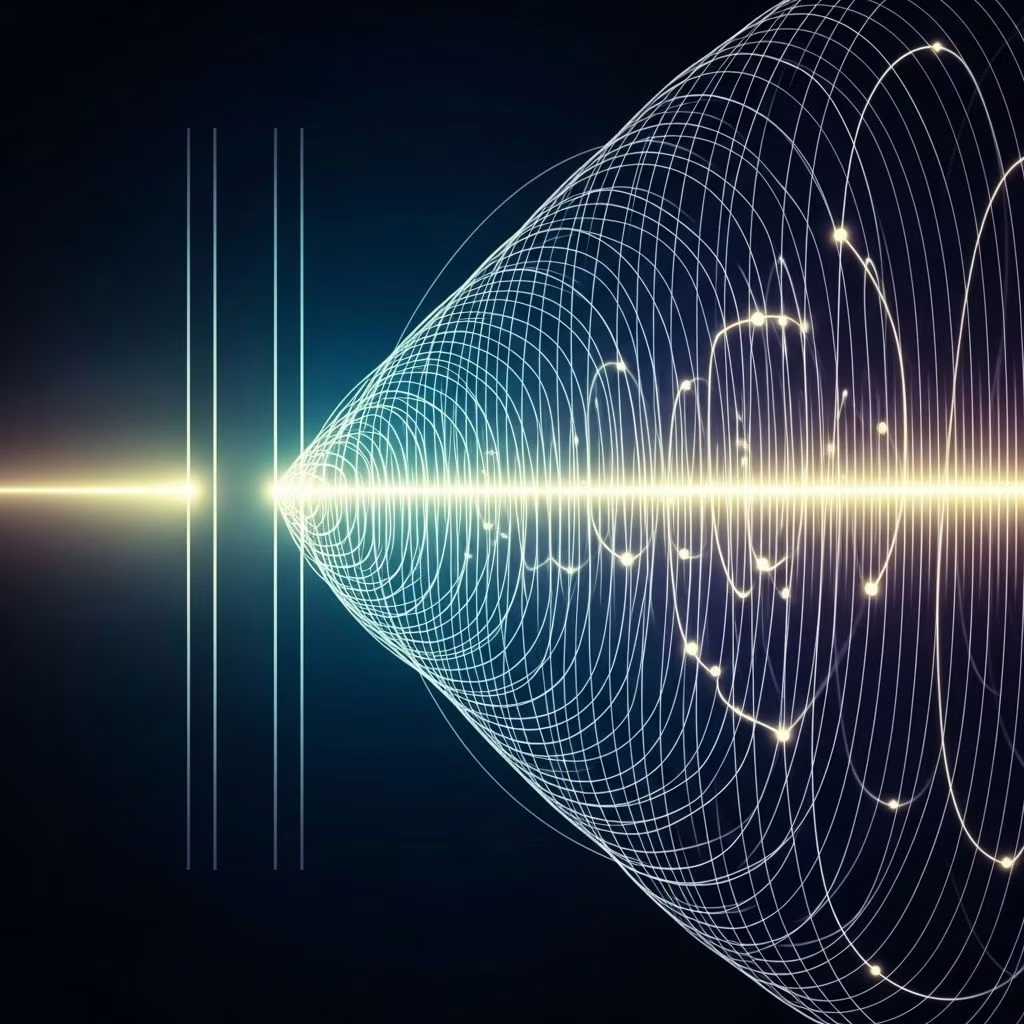
The Double-Slit Experiment: Unveiling Quantum Mysteries
The double-slit experiment stands as one of the most iconic and mind-bending experiments in physics. Not only did it settle the long-standing debate about whether light behaves as a wave or a particle, but it also revealed the profound strangeness at the heart of quantum mechanics. From its humble beginnings in the early 19th century to today’s high-tech iterations, this experiment continues to shape our understanding of reality itself.
What Is the Double-Slit Experiment?
At its core, the double-slit experiment involves shining a coherent light source, such as a laser, at a barrier containing two parallel slits. The light that passes through the slits then falls onto a screen behind the barrier. This setup allows physicists to observe whether light behaves more like a wave or a particle, making the experiment a central demonstration of wave-particle duality.
- Invented by Thomas Young in 1801
- Originally resolved the debate on the nature of visible light
- Repeated with electrons, atoms, and large molecules
- Now a classic tool for exploring quantum phenomena
Historical Context: The Debate on Light
In the 17th century, Isaac Newton proposed that light consisted of a stream of tiny particles. This view dominated scientific thought for over a century. Thomas Young’s double-slit experiment challenged Newton’s particle theory in 1801, providing compelling evidence that light could also behave as a wave.
- Newton: Light as particles
- Young: Light as waves
- Photoelectric effect later shows light’s particle properties
- The rise of quantum theory leads to the concept of wave-particle duality
How the Double-Slit Experiment Works
To appreciate the experiment’s implications, let’s examine its basic structure and the surprising results it reveals.
Step-by-Step Experimental Setup
- 1. Prepare a Coherent Light Source: Typically a laser is used to ensure all light waves have the same wavelength and phase.
- 2. Place a Barrier with Two Parallel Slits: These slits must be precisely spaced apart, usually close to the wavelength of the light.
- 3. Point the Light at the Slits: Light passes through both slits toward a detection screen.
- 4. Observe the Pattern on the Screen: The detection screen shows where light lands after passing the slits.
Expected Outcomes: Particles Versus Waves
Imagining light as particles (like tennis balls):
- If one slit is open, the screen shows a single band of light matching the slit.
- If both slits are open, you expect two bands corresponding to each slit.
However, imagining light as a wave:
- If both slits are open, the light passes through both and interferes.
- An interference pattern of alternating bright and dark bands appears, resulting from constructive and destructive interference.
Visualizing Classical and Quantum Results
| Scenario | Screen Pattern | Interpretation |
|---|---|---|
| Particle (One Slit) | One band | Light acts like particles |
| Wave (Both Slits) | Alternating bright and dark bands | Light acts like waves (interference) |
Wave-Particle Duality: The Heart of Quantum Mechanics
Perhaps the most astonishing outcome of the double-slit experiment is its demonstration of wave-particle duality. Light behaves like a wave when both slits are open, producing an interference pattern. Yet, when you observe or measure which slit the photon passes through, the pattern disappears, and the photon acts more like a particle.
- Light and electrons: Both create interference patterns when unobserved
- Observation collapses behavior: Measurement forces particles to behave classically
- Individual photon detection: Each photon hits the detector at a discrete point, but collectively form the interference pattern
As physicist Richard Feynman put it, the double-slit experiment “contains the only mystery” of quantum mechanics.
Superposition and Probability
Quantum mechanics suggests that particles like photons and electrons can exist in a superposition of states, potentially passing through both slits simultaneously. The pattern they create on the screen reflects a probability distribution that can only be explained by wave interference.
- Superposition: Ability to be in multiple states at once
- Probabilistic detection: Every impact is random but fits the distribution
Extending the Double-Slit Experiment Beyond Light
While Young used light, later experiments extended the double-slit method to electrons, atoms, and even large molecules. These entities, when fired at the slits, exhibit the same interference effect—confirming the universality of wave-particle duality.
- Electrons: Interference pattern confirmed in 1927 by Davisson and Germer
- Atoms and molecules: Patterns observed, with largest entities being molecules of 2000 atoms (total mass 25,000 daltons!)
Quantum Strangeness Continues
Even for these larger entities, the act of observing which slit they pass through collapses the interference pattern, illustrating a core postulate of quantum mechanics: the observer effect.
Variations and Modern Versions
Modern variations, such as the Mach–Zehnder interferometer, use beam splitters and mirrors to achieve similar interference effects. These versions further probe quantum phenomena and underpin technologies such as quantum computing and encryption.
- Mach–Zehnder Interferometer
- Quantum eraser experiments
- Matter wave interference in large molecules
Implications: From Mysteries to Technologies
The double-slit experiment stands as a “central puzzle” of quantum mechanics, forcing physicists to confront the non-intuitive nature of the quantum realm and inspiring countless theoretical and technological advances.
Philosophical and Scientific Impact
- Quantum mechanics: Foundational for the field, culminating in concepts like the collapse of the wave function
- Quantum computing: Superposition, interference, and observer effects directly relate to qubit operation
- Quantum cryptography: Security protocols depend on observation effects at quantum scales
The Observer Effect and Reality Itself
The experiment demonstrates that measurement or observation influences physical systems at the quantum level. The simple question “Which slit did the particle pass through?” dramatically changes possible outcomes. This challenges our traditional notions of reality, causality, and the role of the observer in the universe.
Frequently Asked Questions (FAQs)
Q: Who first conducted the double-slit experiment?
A: Thomas Young performed the first double-slit experiment with light in 1801 to argue for the wave theory of light.
Q: What does the double-slit experiment prove?
A: It proves that light and matter possess both wave-like and particle-like properties (wave-particle duality) and that observation affects quantum behavior.
Q: Can the experiment be done with particles other than light?
A: Yes, it has been reproduced using electrons, atoms, and even large molecules, all displaying interference patterns.
Q: What is the ‘observer effect’ in quantum mechanics?
A: It is the phenomenon where observing or measuring a quantum system fundamentally changes its behavior, often collapsing superpositions to definite states.
Q: Why is the double-slit experiment considered so strange?
A: Because when unobserved, particles seem to act as waves, interfering with themselves. When observed, the interference pattern disappears, and particles act classically.
Summary Table: Double-Slit Experiment Concepts
| Concept | Description | Key Figures/Discoveries |
|---|---|---|
| Wave-Particle Duality | Light and matter show wave and particle traits | Young, Davisson & Germer |
| Interference Pattern | Alternating bright and dark bands from waves | Result of superposition |
| Observer Effect | Observation changes outcome | Quantum theory |
| Superposition | Particles exist in multiple states until measured | Quantum mechanics |
Further Reading & Resources
- Wikipedia: Double-slit experiment, quantum mechanics overview
- Physics textbooks: Young’s double-slit setup and quantum theory explanations
- Online lectures: Famous physicists like Richard Feynman and Jim Al-Khalili explain the experiment
Conclusion: The Window into Quantum Reality
The double-slit experiment remains the clearest illustration of quantum mechanics’ bizarre and beautiful departure from classical expectations. By simply shining light through two slits, physicists were able to glimpse the dual nature of reality, opening the door to both deep philosophical exploration and practical technological revolutions.
Its legacy endures—not just as a staple of physics education, but also as a constant challenge to our understanding of what the universe truly is, and of our place as observers within it.
References
- https://en.wikipedia.org/wiki/Double-slit_experiment
- https://www.youtube.com/watch?v=uva6gBEpfDY
- https://news.mit.edu/2025/famous-double-slit-experiment-holds-when-stripped-to-quantum-essentials-0728
- https://www.youtube.com/watch?v=A9tKncAdlHQ
- https://courses.lumenlearning.com/suny-physics/chapter/27-3-youngs-double-slit-experiment/
- https://plus.maths.org/content/physics-minute-double-slit-experiment
- https://www.techtarget.com/whatis/definition/double-slit-experiment
- https://www.discovery.com/science/Double-Slit-Experiment
- https://www.space.com/astronomy/einstein-was-wrong-slightly-about-quantum-physics-new-version-of-the-famous-double-slit-experiment-reveals
- https://chem.libretexts.org/Bookshelves/Physical_and_Theoretical_Chemistry_Textbook_Maps/Quantum_Tutorials_(Rioux)/01:_Quantum_Fundamentals/1.37:_The_Double-Slit_Experiment
- https://en.wikipedia.org/wiki/Double_slit
- https://brilliant.org/wiki/double-slit-experiment/
- https://www.nasa.gov/stem-content/double-slit-experiment-9-12/
- https://photonterrace.net/en/photon/duality/
- https://www.britannica.com/science/light/Youngs-double-slit-experiment
- https://profmattstrassler.com/2025/01/16/double-trouble-the-quantum-two-slit-experiment-1/


