Meteorite Impact: A Rare Lunar Event Caught on Video
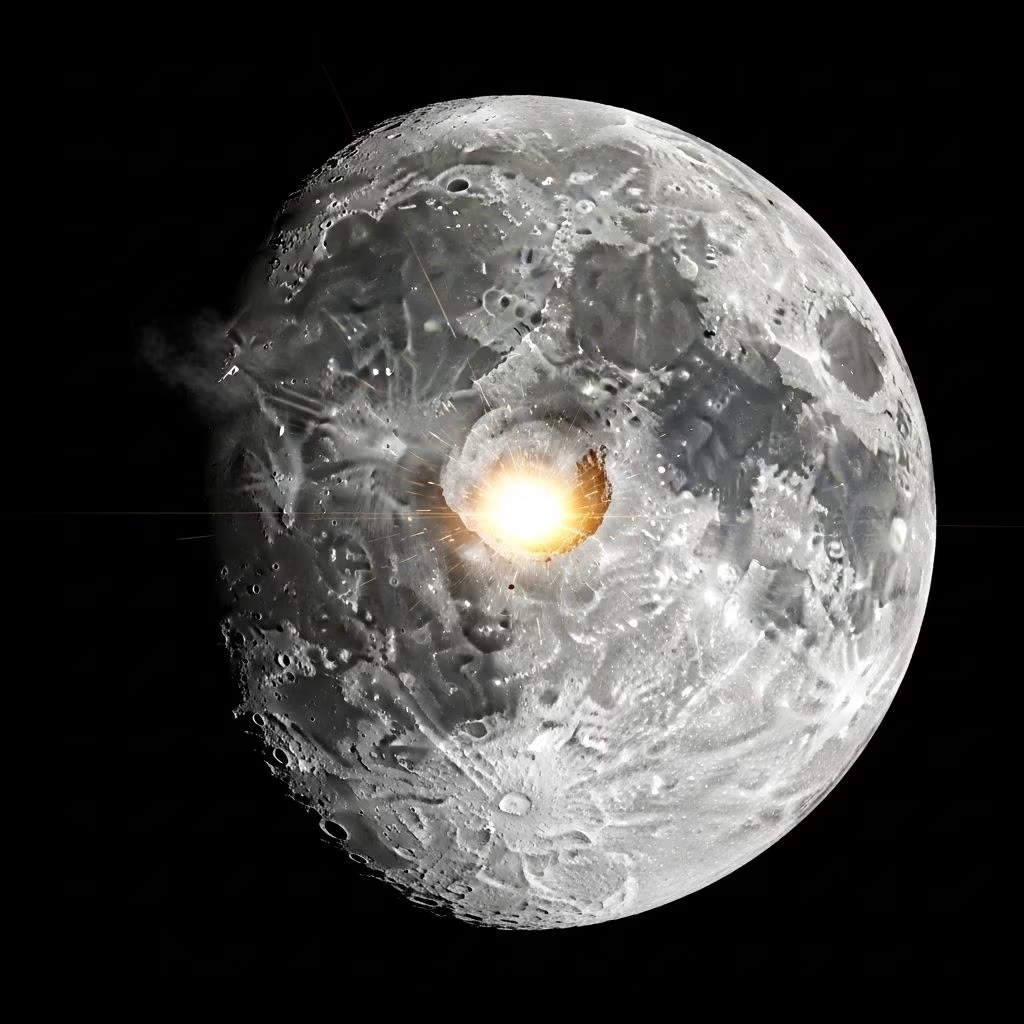
On February 23, 2023, the astronomy community witnessed a remarkable event: a meteorite smashing into the lunar surface, producing a visible and brief flash. This rare impact was captured by Daichi Fujii, curator of the Hiratsuka City Museum in Japan, who recorded the moment from his observatory in Hiratsuka using specialized cameras dedicated to lunar monitoring. Fujii’s video offers an extraordinary glimpse into the dynamic processes constantly shaping our Moon — processes that remain largely hidden from casual observers on Earth.
How the Impact Was Captured
Observing meteorite impacts on the Moon presents unique challenges. Unlike Earth, where meteors entering the atmosphere produce brilliant fireballs due to friction, the Moon’s lack of a significant atmosphere means that meteoroids strike the surface unimpeded, yielding only a brief, telltale flash visible from afar if the timing and conditions are just right.
- Daichi Fujii uses cameras routinely set to monitor the Moon, scanning for transient events.
- At 20:14:30.8 Japan Standard Time (7:14 a.m. EST, 1114 GMT), a bright spark appeared on the nightside of the lunar disk — the moment of impact.
- Video evidence replayed at actual speed shows a brilliant flash visible for over a second, unprecedented in Fujii’s personal observation history.
- The event occurred near the Ideler L and Pitiscus craters, slightly northwest of Pitiscus, on the lunar surface.
What Happened: Physics of the Impact
The meteorite responsible for this flash struck the Moon at a high velocity, characteristic of such impacts on airless bodies. Without atmospheric friction to slow it down, the incoming rock maintained great speed and kinetic energy, producing:
- A powerful explosion as the meteorite hit, leading to a burst of visible light.
- An immediate formation of a crater, possibly around dozens of meters (39 feet) in diameter, although confirmation awaits high-resolution orbital imaging.
Most lunar impacts occur at typical speeds of about 30,000 mph (48,280 kph), or 8.3 miles/s (13.4 km/s), causing intense heating and vaporization at the moment of collision.
Lunar Impacts: Frequency and Rarity of Observations
The heavily cratered face of the Moon attests to its violent history. Unlike Earth, the Moon’s lack of a protective atmosphere means it is far more exposed to impacts:
- The Moon is struck by about 20 asteroids for every one that hits Earth, with most Earth-bound rocks burning up harmlessly in our atmosphere.
- Lunar impacts are common, but capturing the flash of impact on video is extremely rare.
- Observations are more likely when the impact occurs on the Earth-facing hemisphere of the Moon during lunar night, maximizing contrast against the darkened surface.
Events such as Fujii’s video typically make headlines because, despite the high rate of impacts, the combination of timing, visibility, and recording equipment required to witness one is unusual.
Where Did the Meteorite Strike?
According to Fujii, the meteoroid impacted the lunar surface near two notable craters:
| Location | Details |
|---|---|
| Ideler L Crater | Southeast quadrant, facing Earth, site of the observed flash |
| Pitiscus Crater | Northwest of Ideler L, reference landmark for exact impact region |
Precise coordinates for the new crater are not yet confirmed; further investigation by orbital spacecraft such as NASA’s Lunar Reconnaissance Orbiter or India’s Chandrayaan 2 may someday identify and study the fresh impact mark.
Why Don’t We See Meteor Trails on the Moon Like on Earth?
Earth’s meteor showers dazzle observers with glowing streaks as rocks burn and ionize in the atmosphere, but on the Moon, the process is very different:
- No atmosphere means no frictional heating, fireballs, or long glowing trails.
- The only observable sign from afar is the brief, intense flash during the formation of the new crater, as kinetic energy is instantly released as light and heat.
The Science Behind Impact Frequency
Lunar craters come in all sizes, bearing witness to billions of years of bombardment by meteoroids and asteroids:
- Researchers estimate the Moon receives meteoroid impacts 20 times more frequently than Earth.
- This higher rate is due to the Moon’s lack of an atmosphere, which cannot incinerate or decelerate incoming projectiles.
- These collisions continuously grind the surface into a fine, dusty layer known as lunar regolith or lunar soil.
Continuous monitoring of these impacts provides insights into both present and past rates of bombardment — information crucial for lunar geology and the design of habitats for future explorers.
How Lunar Impact Observations Aid Scientific Exploration
Beyond their spectacle, capturing meteorite impacts on the Moon offers scientifically valuable data:
- Gauging impact frequency: Helps scientists refine estimates of how often dangerous impacts occur, guiding risk assessments for future lunar missions.
- Crater formation studies: By observing flash size and duration, researchers can estimate the size and energy of the impactor, deepening our understanding of lunar surface evolution.
- Planning for future missions: Knowing impact rates aids agencies like NASA in developing shielding and protective measures for both surface equipment and astronauts.
- Correlating video and orbital images: When fresh craters are located by orbiting spacecraft following a recorded flash, researchers can compare ground-based and orbital data to refine modeling techniques.
Impact recordings like Fujii’s make direct connections between real-time events and the physical traces evident from high above the Moon’s surface.
Lunar Impacts and the Future of Human Exploration
The Artemis program and other international missions aim to return humans to the Moon. These efforts depend on a clear understanding of lunar hazards:
- Meteorite impacts pose risks to both human life and robotic equipment.
- By measuring current impact rates, agencies can develop structures capable of withstanding frequent, if generally small, collisions.
- The formation of fresh craters and the persistence of lunar regolith shape planning for safe construction, maintenance, and resource extraction.
- Understanding bombardment frequencies helps engineers design habitats, research stations, and vehicles that can survive the lunar environment.
Key Facts and Figures About Lunar Meteorite Impacts
| Parameter | Value (Typical) | Impact Event (Feb 23, 2023) |
|---|---|---|
| Speed of Impact | ~30,000 mph (48,280 kph) | Estimated at similar speeds |
| Flash Duration | Fractions of a second | Over 1 second |
| Crater Size | Varies widely; small meteoroids ~10m | Estimated ~39 feet (dozen meters) |
| Location | Anywhere, most observed on Earth-facing side | Ideler L, near Pitiscus crater |
| Atmospheric Effects | None on Moon; no streaks or fireballs | Brief glowing flash only |
Comparing Impacts: Moon vs. Earth
| Aspect | Moon | Earth |
|---|---|---|
| Protective Atmosphere | None | Thick, shields against most meteors |
| Crater Formation | Common, all sizes visible | Rare, most meteors burn up, craters quickly eroded |
| Impact Frequency | 20x higher than Earth | Lower; 1 large impact for every 20 on Moon |
| Observability | Direct flashes, visible only during lunar night | Fireballs, meteor showers, sonic booms |
Frequently Asked Questions (FAQs)
Q: Why is Fujii’s video considered rare?
Most lunar impacts cannot be seen from Earth, as the flashes are short and only visible under specific lighting; only a handful of such events have ever been recorded.
Q: How large was the meteorite that caused the February 2023 impact?
Estimates suggest a size sufficient to create a crater at least a dozen meters (39 feet) wide, but detailed measurements will require further spacecraft imaging.
Q: Can meteorites hit Earth with the same frequency as the Moon?
Earth’s atmosphere burns up the majority of incoming meteors, making large impacts rare compared to the airless Moon.
Q: How are these impacts studied after the event?
Researchers use orbital spacecraft (like NASA’s Lunar Reconnaissance Orbiter) to identify fresh craters and compare ground observations with satellite imagery for validation.
Q: Why do impacts matter for lunar exploration?
Meteorite collisions help scientists evaluate the risks for equipment and crew stationed on the Moon and guide engineering solutions for long-term safety.
The Legacy of Lunar Impacts in Astronomy
Each meteorite collision on the Moon is a unique data point in the story of planetary science:
- Understanding lunar impacts aids researchers in reconstructing the solar system’s history and dynamic processes.
- Real-time observations allow direct study of phenomenon otherwise inferred from ancient crater counts.
- Such discoveries energize public interest in astronomy, often sparking renewed debate about planetary defense and the future of human spaceflight.
Conclusion: Watching the Moon’s Living Surface
Daichi Fujii’s spectacular video of the February 2023 meteorite impact underscores the Moon as a site of ongoing, vibrant geological activity. From crater formation and regolith evolution to hazards facing future lunar explorers, every flash tells a story of cosmic forces in motion. Continued monitoring, coupled with advanced orbital surveys, will yield deeper understanding and safer pathways as humanity ventures ever further from Earth.
References
- https://www.space.com/meteorite-impacts-moon-february-2023-video
- https://www.youtube.com/watch?v=VNjycZDCfcU
- https://www.space.com/meteorite-impacts-moon-february-2023-video&rut=dfcc5eb07b2cd23ec5707cee8d41ab6483ad33586902f298bd8178d49401a8c9
- https://www.youtube.com/watch?v=VyV86nuFo2E
- https://www.iflscience.com/japanese-astronomer-captures-video-of-meteor-slamming-into-the-moon-67952
- https://www.abccolumbia.com/2023/03/16/video-of-meteorite-crashing-into-the-moon/
- https://www.sciencetimes.com/articles/42795/20230313/meteorite-slams-moon-japanese-astronomer-captured-telltale-flash-impact-lunar.htm
- https://www.ndtv.com/feature/japanese-astronomer-captures-meteorite-smashing-into-the-moon-3858116
- https://www.nasa.gov/meteoroid-environment-office/lunar-impact-monitoring/videos/
- https://www.hindustantimes.com/trending/meteor-crashes-into-the-moon-s-surface-japanese-astronomer-records-fascinating-video-101678774524307.html
- https://www.nasa.gov/meteoroid-environment-office/lunar-impact-monitoring/publications/
- https://nasaspacenews.com/2025/07/a-billion-year-secret-in-stone-how-one-lunar-meteorite-is-rewriting-the-moons-fiery-past/
- https://telegrafi.com/en/Japanese-astronomer-recorded-the-impact-of-a-meteor-on-the-moon/
- https://www.sciencealert.com/brilliant-flash-reveals-the-moment-a-meteor-smacks-hard-into-the-moon
- https://www.livescience.com/space/meteoroids/meteor-strikes-on-the-moon-astronomer-captures-possible-geminid-lunar-impacts
- https://en.mehrnews.com/news/198346/VIDEO-Footage-shows-Meteorite-impact-on-Moon
- https://www.amnh.org/exhibitions/permanent/meteorites/meteorite-impacts/on-the-moon