Space Hurricanes: Plasma Tempests Above Earth’s Poles
When picturing hurricanes, most people think of swirling clouds, torrential rain, and howling winds churning over warm oceans. But far above, at the edge of our planet’s atmosphere, a very different and newly examined phenomenon is stirring: the space hurricane. Discovered only recently through satellite observations, these electromagnetic vortexes composed of plasma are vast in scale and capable of unleashing disruptions as profound as any terrestrial storm—especially for the satellites and communication systems our lives depend on.
What is a Space Hurricane?
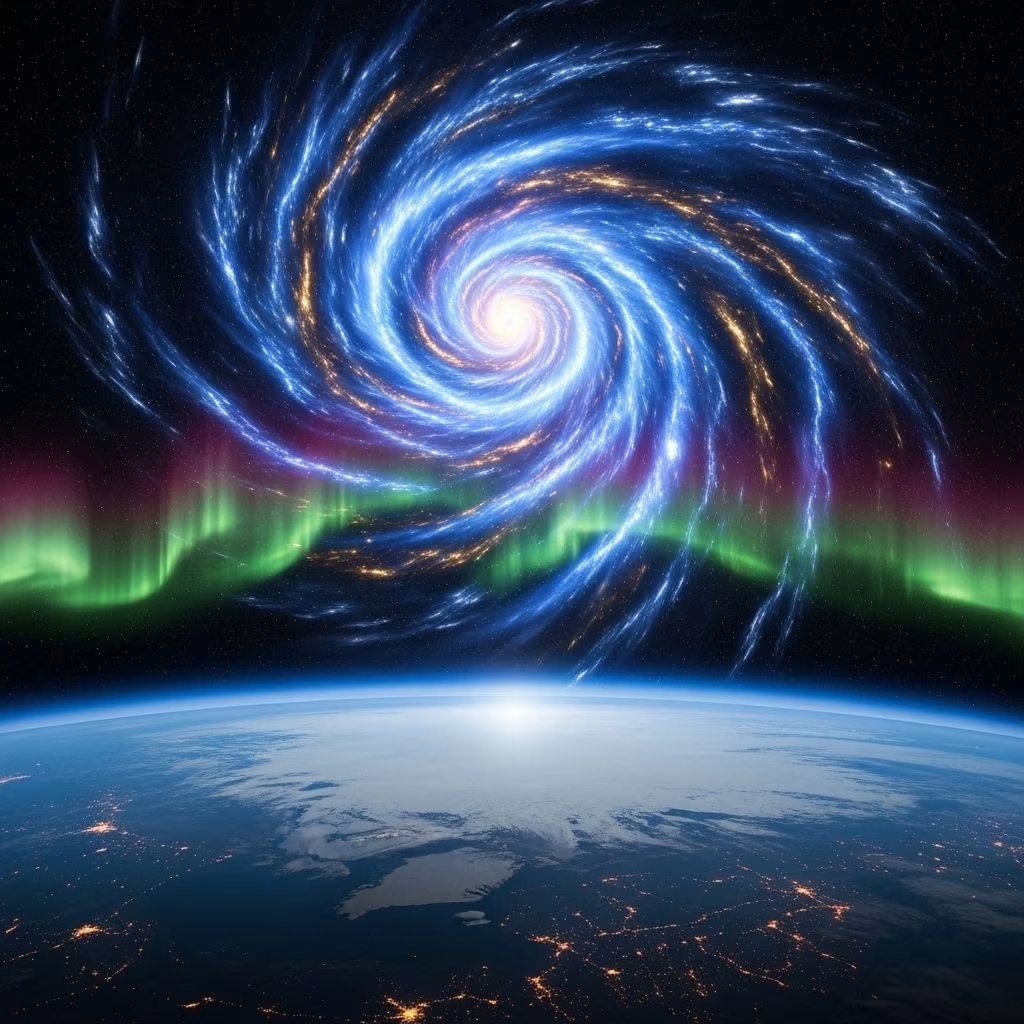
A space hurricane is a giant, spiral-shaped plasma storm—hundreds to over a thousand kilometers in diameter—that occurs within Earth’s polar ionosphere. Unlike atmospheric hurricanes, which form from thunderstorms drawing up energy from the ocean’s surface, space hurricanes are composed of charged particles, mainly electrons and ionized gases called plasma, manipulated by Earth’s magnetic field and driven by the solar wind.
- Visible structure: Like tropical hurricanes, they feature a broad, spiraling structure and an ‘eye’ at their center. However, instead of clouds and water, the spiral arms are crafted from plasma and precipitation of electrons.
- Unique ingredients: No wind or rain—just electromagnetic forces, magnetic field lines, high-energy electrons, and swirling plasma hundreds of miles across.
- Polar phenomena: So far, space hurricanes have been observed mainly over the polar regions, especially above the North Pole.
Discovery and Observation
The concept of a space hurricane had been hypothetical until satellite data from August 20, 2014 revealed and documented the first space hurricane, hovering above the Earth’s North Pole. This storm, which was invisible to the naked eye, persisted for nearly eight hours and spanned about 1,000 kilometers (620 miles) in diameter. Contemporary analysis of satellite and ground-based data has allowed researchers to understand both its scale and its impacts for the first time.
- Pioneering study: The first known event was identified by a team led by Sheng Lu of Shandong University, China.
- Active during calm space weather: Remarkably, the storm erupted during a period of what researchers called “very quiet conditions,” contrasting with prior assumptions that such phenomena required strong solar activity.
- Eye-like center: Like their atmospheric counterparts, space hurricanes have a calm central ‘eye,’ surrounded by plasma arms swirling counterclockwise (in the Northern Hemisphere).
Characteristics of Space Hurricanes
Space hurricanes differ fundamentally from their lower-atmosphere cousins in both structure and cause.
| Feature | Terrestrial Hurricane | Space Hurricane |
|---|---|---|
| Medium | Moist air, water vapor | Plasma (ionized gas) |
| Energy Source | Heat from ocean surface | Solar wind (charged particles from the sun) |
| Location | Earth’s troposphere/oceans | Ionosphere above polar regions (~110–860 km altitude) |
| Precipitation | Rain | Electrons |
| Observable Feature | Clouds, wind, rain bands, and ‘eye’ | Spiraling auroras, calm eye, plasma arms |
- Rotation and Size: The hurricane spins counterclockwise (in the Northern Hemisphere) with rotational speeds up to 7,560 km/h (4,700 mph).
- Auroral link: The precipitation of high-energy electrons through the storm’s ‘funnel’ produces massive, cyclone-shaped auroral displays, blending the storm visually into phenomena like the aurora borealis.
- Eye and Magnetic Signature: Zero horizontal flow in the storm’s center, paired with a persistent auroral spot and a unique, bipolar circular magnetic field pattern.
- Altitude: The main storm structure sits in the ionosphere between 110 and 860 kilometers, but its influence stretches upward along geomagnetic field lines well into the magnetosphere.
How Do Space Hurricanes Form?
Unlike “regular” geomagnetic storms—which are usually triggered when the solar wind interplanetary magnetic field (IMF) points south—space hurricanes have been observed forming under otherwise calm magnetic conditions. This surprising twist shows that:
- Solar Wind Source: The main driver is the steady, unbroken stream of charged particles (solar wind) encountering Earth’s magnetic field.
- Magnetic Field Interaction: The solar wind twists and stretches polar magnetic field lines, injecting energy and plasma into the upper atmosphere.
- Extreme Rotation: Instead of compressing and releasing like a classic geomagnetic storm, the plasma swirls into a cyclone-like pattern, forming multiple spiral plasma arms.
The result is a gigantic plasma vortex, which can persist for several hours, raining energetic electrons and destabilizing the high-latitude ionosphere.
Why Are Space Hurricanes Important?
Although happening far above where commercial jets or even weather balloons fly, space hurricanes are not just a curiosity; they can have serious real-world consequences.
- GPS and Satellite Disruption: The energetic electron precipitation and sudden magnetic field disturbances can degrade or disrupt GPS navigation, communication satellites, and other spacecraft electronics.
- Power Grid Risks: For stronger storms, the resulting electromagnetic fluctuations may cause power surges in long electrical transmission lines stretching across high-latitude regions, similar to more familiar geomagnetic storms.
- Unpredictable Effects: Because these storms can emerge even when traditional space weather indicators signal calm, they pose a hidden risk for critical systems reliant on space-based assets.
- Auroral Displays: These storms lead to unusual, cyclone-shaped auroras, offering potential scientific and visual insights into the dynamics of polar plasma and Earth’s magnetic field.
Space Hurricanes Beyond Earth
Researchers suspect that space hurricanes may not be unique to Earth. Any planet with a magnetic field and an atmosphere, especially gas giants like Jupiter and Saturn, or even some exoplanets, could experience similar plasma tempests. The essential ingredient is the interaction between solar (or stellar) wind and a strong enough planetary magnetic field.
Current Research and Future Outlook
Our understanding of space hurricanes is in its infancy, with only a handful of directly observed cases, all above the North Pole. Key questions that remain include:
- How often do space hurricanes occur both on Earth and in the wider cosmos?
- Can these phenomena appear over the South Pole or at lower latitudes?
- What role do they play in the broader context of space weather, solar storms, and the auroral cycle?
- How can we better forecast them to protect satellites, astronauts, and ground-based infrastructure?
Further studies, especially with the next generation of polar-orbiting satellites, will be crucial in answering these questions and unveiling the true frequency and global impacts of space hurricanes.
Frequently Asked Questions (FAQs)
Q: Are space hurricanes dangerous to humans on the ground?
A: Directly, no—space hurricanes occur high above the surface in the ionosphere, far above where humans live. However, they can disrupt navigation systems and cause power grid instability in high-latitude regions through their electromagnetic effects.
Q: How do space hurricanes compare to terrestrial hurricanes?
A: Both are large, swirling storms with a central eye, but while terrestrial hurricanes form in the lower atmosphere with wind and rain, space hurricanes occur in the ionosphere, consist of plasma, and ‘rain’ electrons instead of water. Their impacts are mostly electromagnetic rather than meteorological.
Q: Can space hurricanes be seen from the ground?
A: Not directly. However, their electron precipitation can create massive, spiral-shaped auroras visible in the polar sky during the event.
Q: How can we protect satellites and infrastructure from space hurricanes?
A: Understanding and early detection are vital. Satellite designers use shielding and redundancy to protect electronics, while satellite operators can take preventive measures if a space hurricane is detected. Improved space weather monitoring will help anticipate such events.
Q: Are there space hurricanes on other planets?
A: Theoretically, yes. Any planet with a substantial magnetic field and ionosphere—such as Jupiter, Saturn, or some exoplanets—could host similar plasma storms.
Key Takeaways
- Space hurricanes are newly documented, massive plasma storms above Earth’s polar ionosphere.
- They form during otherwise “quiet” space weather, challenging previous ideas about storm formation.
- Though high above the surface, their electromagnetic impacts can disrupt satellites, navigation, and power grids.
- Further research is critical to understand their frequency, impacts, and to develop better monitoring capabilities.
References
- https://en.wikipedia.org/wiki/Space_hurricane
- https://byjus.com/free-ias-prep/space-hurricane/
- https://weatherology.com/trending/articles/Space-Hurricane.html
- https://www.space.com/astronomy/earth/space-hurricanes-are-real-and-they-wreak-more-havoc-than-we-thought
- https://science.howstuffworks.com/nature/climate-weather/atmospheric/space-hurricane.htm
- https://pmc.ncbi.nlm.nih.gov/articles/PMC7900228/
- https://eos.org/research-spotlights/space-hurricanes-swirl-in-the-southern-hemisphere-mostly-in-summer
- https://astronomy.yale.edu/news/what-hurricanes-and-space-storms-have-common
- https://www.frontiersin.org/journals/astronomy-and-space-sciences/articles/10.3389/fspas.2022.1047982/full
- https://omny.fm/shows/brainstuff/how-do-space-hurricanes-work
- https://www.sciencenews.org/article/space-hurricanes-earth-magnetic-poles
- https://physicsworld.com/a/space-hurricane-observed-in-the-earths-upper-atmosphere/
- https://spaceplace.nasa.gov/hurricanes/en/
- https://theweek.com/science/space-hurricanes-affect-navigation
- https://spaceyv.com/space-hurricanes/
- https://testbook.com/ias-preparation/space-hurricane
- https://www.snexplores.org/article/space-hurricanes-above-magnetic-poles
- https://orbitaltoday.com/2022/12/28/hostile-swirl-what-is-a-space-hurricane-and-how-does-it-affect-earth/
- https://upfront.scholastic.com/issues/2022-23/040323/space-hurricanes.html