Black Hole Burps Out Stellar Remains: The AT2018hyz Event
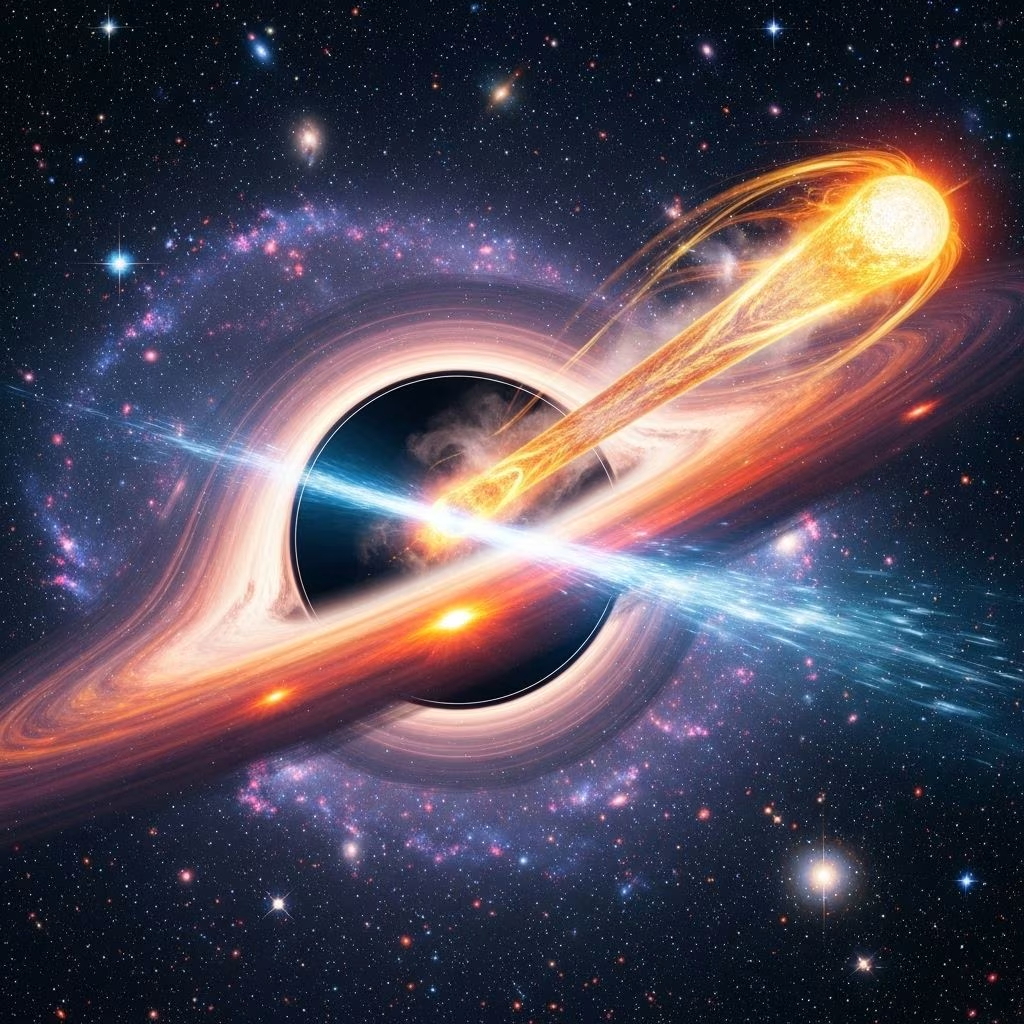
In 2018, astronomers observed a remarkable cosmic event: a black hole in a distant galaxy, roughly 665 million light-years away from Earth, tore apart a small star that ventured too close. Such destruction, called a tidal disruption event (TDE), is not uncommon in the universe. But what happened after was unlike anything observed before—the black hole began ejecting stellar material, or “burping” out matter, three years after its meal.
Understanding Tidal Disruption Events (TDEs)
- TDEs occur when a star approaches a black hole and is torn apart by massive gravitational forces.
- The star’s material is “spaghettified”—stretched and squashed due to intense tidal forces.
- This material forms a bright flare as it heats up while falling onto the black hole.
- Some of the shredded material is occasionally ejected into space.
Typically, the outflow of ejected material happens during or immediately after the TDE, with the black hole quickly emitting a flash visible across light-years. The event observed in 2018, dubbed AT2018hyz, defied this timeline by expelling material years after the initial disruption.
The Cosmic Burp: An Unprecedented Delay
Astronomers led by Yvette Cendes at the Harvard & Smithsonian Center for Astrophysics reported an unprecedented delay between the black hole’s devouring of the star and the subsequent outflow of material. Cendes described the moment:
“This caught us completely by surprise — no one has ever seen anything like this before. It’s as if this black hole has started abruptly burping out a bunch of material from the star it ate years ago.”
Study co-author Edo Berger emphasized the uniqueness of this event:
“This is the first time that we have witnessed such a long delay between the feeding and the outflow.”
The black hole had not consumed anything else in the intervening years before ejecting material from its previous meal—a star estimated to be about one-tenth the mass of our Sun.
Extraordinary Speed: Ejected Material
What further astonished scientists was the velocity at which the black hole spat out the debris. Cendes and her team measured the expelled material moving at approximately 300 million mph (480 million kph)—roughly half the speed of light.
- Normal TDEs eject material at around 10% the speed of light.
- AT2018hyz’s outflow speed is five times greater than typical TDE emissions.
This violent ejection lit up the night sky, making it possible for astronomers to study the lingering effects of a black hole’s meal long after its consumption.
What Are Black Holes?
Black holes are regions of space where gravity is so strong that nothing—not even light—can escape. They form from the remnants of massive stars that collapse under their own gravity at the end of their life cycles. Black holes display distinctive behaviors that set them apart from other cosmic entities:
- Event Horizon: The boundary beyond which nothing returns.
- Accretion Disk: Matter spiraling inward heats up, often emitting X-rays and other radiation.
- Messy Eaters: Not all material gets consumed—some is ejected in energetic outflows.
Spaghettification: How Black Holes Shred Stars
When a star passes close to a black hole, it experiences tidal forces that stretch it into long, thin strands—a process known as spaghettification. The star is squeezed and elongated, its material ripped apart and funneled into the black hole’s accretion disk.
Table: Summary of TDE Process
| Stage | Description |
|---|---|
| Approach | Star nears black hole, entering its tidal radius. |
| Disruption | Star is stretched and torn apart—”spaghettification” occurs. |
| Accretion | Stellar material forms a disk, emits radiant flares, and is partly swallowed by black hole. |
| Ejection | Some material is flung back into space in high-velocity jets or outflows. |
The Mystery: Why the Long Delay?
While TDEs are known for their violent and immediate emissions following destruction, the delay in AT2018hyz’s “burp” is unique. Astronomers do not yet fully understand the mechanisms that led to the late release of material.
- Hypotheses include:
- Possible buildup of material in the accretion disk, eventually ejected by magnetic or relativistic effects.
- Unusual interactions between disrupted stellar material and the black hole environment.
- Unique properties of the black hole’s spin or magnetic fields.
Further observations and modeling will be required to understand this strange phenomenon.
Implications for Black Hole Science
The surprising behavior of AT2018hyz opens new questions for black hole astrophysics. For decades, astronomers have believed that TDE outflows occur relatively quickly, within months of the black hole’s feast. This event challenges those models and suggests:
- Black holes may store disrupted material for years before ejecting it.
- Outflows can reach much higher velocities than previously considered possible.
- TDEs could offer ongoing sources of energy and radiation for years after the primary event.
- This phenomenon may require updates to current theories about black hole accretion and emission.
How Do Astronomers Detect TDEs?
Detecting and studying TDEs requires advanced observational tools capable of tracking faint and distant cosmic phenomena. The flare produced by spaghettified material is typically observed in various wavelengths, including:
- Optical telescopes for visual and infrared signals.
- Radio telescopes to catch later outflows and emissions.
- X-ray observatories for energetic events close to the black hole.
For AT2018hyz, astronomers were able to monitor the event over several years, revealing the delayed “burp” through multi-wavelength observations.
Why Are TDEs Important?
Tidal disruption events provide valuable insights into:
- The growth and evolution of black holes.
- Properties of stars and accretion disks.
- Extreme conditions in the universe.
They also help astronomers understand stellar death processes, galaxy evolution, and the fundamental physics of gravity and relativity.
Other Related Phenomena: Stars Born in Black Hole Jets
Recent studies have also revealed stars forming inside intensely energetic jets ejected by supermassive black holes in merging galaxies. These discoveries show that black holes are not just cosmic destroyers—they can also catalyze the birth of new stars in hostile environments.
- Infant stars have been observed in jets from black holes some 600 million light-years away.
- These stars are younger, brighter, and often hotter than stars born in calmer galactic regions.
- Such findings expand the role of black holes from purely destructive forces to cosmic engines that can foster creation.
Black Holes: Messy Eaters with Lasting Impact
This “cosmic burp” illustrates that black holes do not always consume their meals neatly. The delayed ejection from AT2018hyz demonstrates their unpredictable behavior and influences our understanding of how energy and matter circulate across the cosmos.
Frequently Asked Questions (FAQs)
Q: What is a tidal disruption event (TDE)?
A: A TDE occurs when a star gets close enough to a black hole that intense tidal forces tear it apart, often resulting in bright flares and, occasionally, material ejected back into space.
Q: Why is the AT2018hyz event unique?
A: Unlike previous TDEs, the black hole expelled material three years after consuming a star, rather than during or soon after the event.
Q: How fast did the black hole eject the material?
A: The ejected material traveled at about half the speed of light—five times faster than typical TDE emissions.
Q: What does this event suggest about black holes?
A: It implies that black holes can store disrupted material and release it long after initial consumption, challenging current theoretical models of black hole accretion and outflow mechanisms.
Q: How do scientists study delayed outflows from black holes?
A: By monitoring black holes with telescopes across multiple wavelengths over extended periods, astronomers can catch unexpected delayed emissions such as those in AT2018hyz.
Conclusion
The delayed ejection of stellar material from the black hole AT2018hyz is a groundbreaking discovery in astrophysics. It challenges existing models of how black holes consume and process stellar matter, revealing new complexities in cosmic behavior. As scientists continue to analyze TDEs and related events, our understanding of these mysterious objects deepens, pushing the boundaries of space science and cosmology.
References
- https://www.space.com/black-hole-spews-star-devoured-years-ago
- https://www.space.com/36220-stars-born-inside-black-hole-jets-spotted.html
- https://www.cfa.harvard.edu/news/weve-never-seen-anything-black-hole-spews-out-material-years-after-shredding-star
- https://www.youtube.com/watch?v=jYTt3zHkHBg
- https://www.livescience.com/black-hole-pukes-up-star-three-years-later
- https://www.cbsnews.com/news/giant-black-hole-eats-star-fires-beams-at-earth/
- https://www.youtube.com/watch?v=p6RWUT8fEW8
- https://www.jpl.nasa.gov/news/nasa-gets-unusually-close-glimpse-of-black-hole-snacking-on-star/
- https://scitechdaily.com/supermassive-black-hole-violently-rips-star-apart-launches-relativistic-jet-toward-earth/
- https://www.astronomy.com/science/black-hole-burps-up-remains-of-shredded-star-it-ate-3-years-prior/
- https://www.techtimes.com/articles/282012/20221014/black-hole-burps-out-materials-star-devoured-three-years-ago.htm
- https://science.nasa.gov/universe/black-holes/
- https://www.livescience.com/black-hole-giving-birth
- https://www.discovermagazine.com/the-sciences/black-hole-rips-a-cosmic-burp-as-it-swallows-a-star
- https://news.harvard.edu/gazette/story/2022/10/black-hole-burps-up-shredded-star-years-after-consuming-it/
- https://www.sciencealert.com/for-the-first-time-scientists-have-watched-a-black-hole-eating-a-star-and-then-spitting-it-back-out