


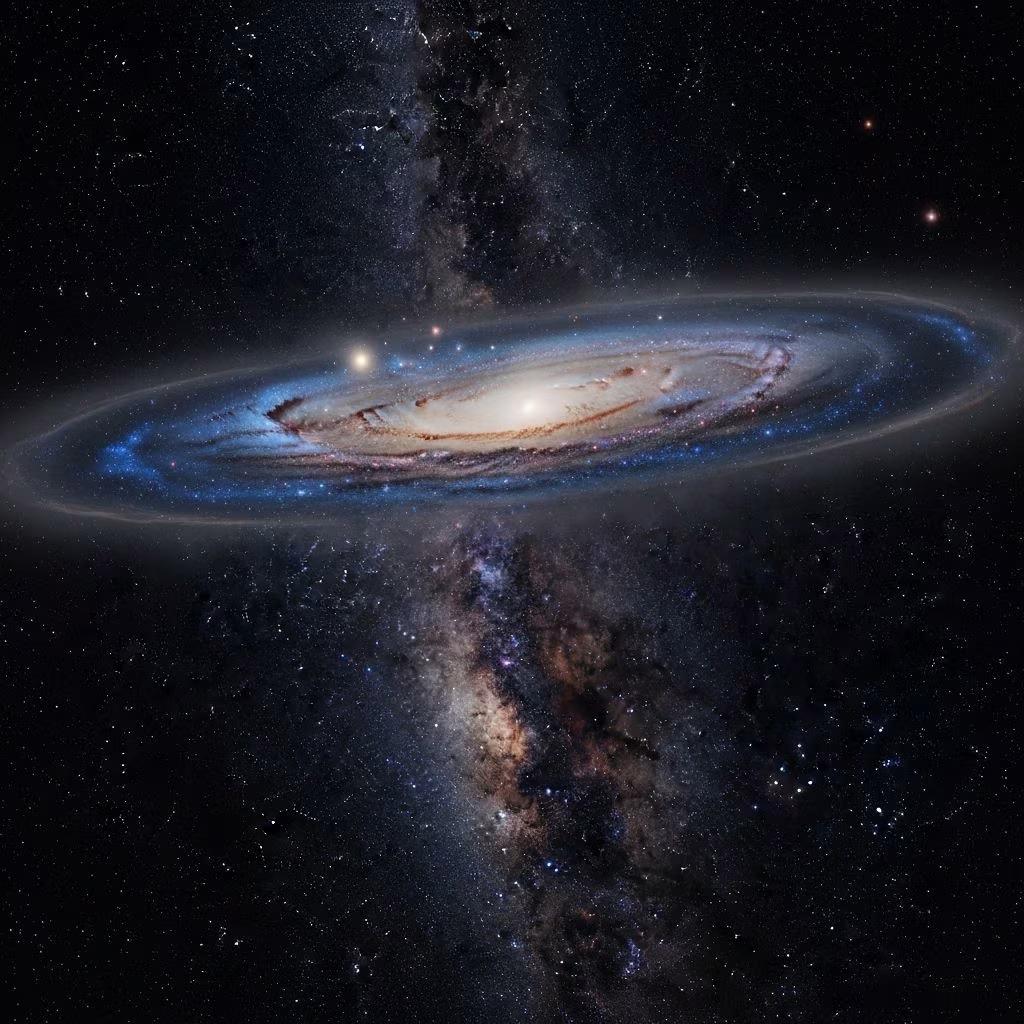
The Milky Way’s True Shape: A Galactic Rethink
For generations, the Milky Way has been illustrated as a grand spiral, its four bright arms unfurling gracefully from a dense central bulge. Now, a new wave of astrophysical research is challenging that iconic image, suggesting our galactic home may, in fact, possess only two major spiral arms—placing it more squarely among its cosmic peers and transforming our view of the galaxy we call home.
Why the Milky Way’s Shape Matters
Understanding the structure of the Milky Way isn’t just a matter of galactic cartography. The arrangement of our galaxy’s spiral arms has profound implications for how we interpret star formation, the distribution of matter, and the unique history of the Milky Way amid billions of other galaxies. For decades, the four-arm model set our galaxy apart as a rare outlier—so confirmation of a two-arm spiral would reshape everything from textbooks to theories about galactic evolution.
Galactic Geometry: The Classic Model
The traditional image of the Milky Way depicts it as a barred spiral galaxy with four broad, well-defined spiral arms: Perseus, Sagittarius, Scutum-Centaurus, and Norma. Each arm extends outward from a bright, bar-shaped swarm of stars and dust at the center. This portrayal rendered our galaxy exceptional—most spiral galaxies observed elsewhere feature only two main arms, typically splitting into several minor branches.
- Spiral arms: Pathways of star formation rich in gas, dust, and young, hot stars.
- Central bar: A pronounced bar-shaped structure of stars at the very center.
- Galactic bulge: A rounded, dense region surrounding the bar and central black hole.
But if our galaxy really has four arms, it’s an oddity—one that would demand an explanation for its uniqueness amid the cosmos.
Astronomy’s Newest Puzzle: Are There Only Two Arms?
Recent work by a team from the Chinese Academy of Sciences, led by scientists at the Purple Mountain and National Astronomical Observatories, has cast doubt on the four-arm model. Leveraging the precision data of today’s top-tier space telescopes, especially the European Space Agency’s Gaia observatory, the team assembled one of the most comprehensive, accurate maps of the Milky Way ever created.
How Did They Investigate?
- Mapping Stars: Used sophisticated instruments to measure distances to over 200 individual stars, refining models of their location within the galaxy.
- Gaia Telescope Data: Incorporated Gaia’s precise tracking of the movement and position of stars, adding depth and clarity.
- Focus on OB Stars: Analyzed tens of thousands of hot, massive OB stars—short-lived, luminous beacons ideal for mapping spiral arms due to their minimal drift during their lifespans.
- Star Clusters: Included data for over 1,000 open galactic clusters, reinforcing the accuracy of arm placement.
This detailed approach led the researchers to make a bold conclusion: The Milky Way features primarily two main spiral arms, not four.
Decoding the New Two-Arm Model
The new observations reveal a barred spiral structure dominated by two symmetric arms—the Norma and Perseus arms—which originate near the central bar’s ends. As these arms spiral outward, they branch and bifurcate, forming offshoots that connect to other features traditionally labeled as major arms, like Centaurus and Sagittarius.
| Traditional Model | New Model |
|---|---|
| Four major spiral arms (Perseus, Sagittarius, Scutum-Centaurus, Norma) | Two main symmetric arms (Norma and Perseus) with branching sub-arms |
| Unique, rare among spiral galaxies | Consistent with most other spiral galaxies |
| Central bar and bulge | Central bar and bulge retained in both models |
This shift not only aligns the Milky Way with the most common galactic forms seen in the universe but may also eliminate the need for exotic explanations for our galaxy’s supposed rarity.
What’s Special About OB Stars?
Mapping the galaxy’s spiral arms requires tracers: stellar objects young enough to have formed recently, and short-lived enough not to have wandered far from their birthplaces. OB stars are perfect for this purpose—these luminous blue-white stars burn fast and hot, often living for just millions of years, compared to the billions of years typical of cooler, less massive stars. Their locations thus pinpoint where spiral arms are most active in star production, providing a detailed sketch of the Milky Way’s modern structure.
- OB stars help map spiral arms with minimal bias from stellar drift.
- Combining OB star data with star clusters improves precision and fills gaps.
Implications of a Two-Arm Milky Way
The reinterpretation of the Milky Way’s structure reverberates through many fields of astronomy. If our home galaxy is not a four-arm outlier but rather a classic two-arm barred spiral, theories on its history, composition, and future dynamics must be updated. Other consequences include:
- Star Formation Models: May need revision to reflect a more ordinary spiral environment.
- Evolutionary History: Suggests a standard evolutionary track rather than one requiring special events or conditions.
- Comparative Cosmology: Aligns the Milky Way more closely with the majority of observed spiral galaxies.
Why Did It Take So Long?
Unlike nearby galaxies, we are embedded within the Milky Way, viewing it from the inside out. Star dust and interstellar clouds obscure our vision, especially toward the center. Prior models relied on indirect measurements and assumptions about symmetry, but modern instruments can peer through these obstructions with improved precision.
Beyond Shape: The Core Structure of Our Galaxy
Regardless of the exact number of arms, the Milky Way retains its barred spiral identity, featuring several key components:
- Galactic Nucleus: At its heart lies Sagittarius A*, a supermassive black hole weighing approximately four million solar masses.
- Central Bar and Bulge: A dense labor of stars, gas, and dust forming a bar-like feature through the center.
- Thin and Thick Disks: Lanes of stars, gas, and dust where most spiral arm activity occurs.
- Spherical Halo: An extended cloud of stars, globular clusters, and dark matter encompassing the disk.
The two main arms wind out from the central bar, each arm bifurcating into subsidiary arms as they sweep toward the galaxy’s outskirts. The seemingly straightforward spiral structure is anything but simple upon closer examination.
Why Do Spiral Arms Form and Persist?
Spiral arms are not fixed structures, but rather density waves—regions where stars and gas cluster as they orbit the galaxy’s center. Star formation is more active in these areas, keeping the arms bright and prominent in certain wavelengths. The barred spiral formation may further organize these arms and influence star formation rates across the galaxy.
The Bigger Picture: Evolution of Galactic Images
Our understanding of the Milky Way’s shape has evolved as technology improved. In the early 20th century, astronmers could only infer our galaxy’s form using telescopic surveys of star counts and nebulae patches. With the launch of all-sky space observatories like Gaia and Spitzer, 21st-century astronomers began to peer through dusty veils and map the precise locations and distances of stars with unparalleled accuracy.
- Historic models overemphasized symmetry and used limited data.
- Modern models combine myriad sources: stellar parallax, spectral measurement, infrared imaging, and space-based telescopes.
Frequently Asked Questions (FAQs)
Q: What is a barred spiral galaxy?
A: A barred spiral galaxy is a spiral-shaped galaxy featuring a central bar-shaped structure composed of stars. The bar’s ends typically connect to the galaxy’s main spiral arms, a structure observed in about two-thirds of all spiral galaxies—including the Milky Way.
Q: Why did scientists think the Milky Way had four arms?
A: Early observations and models, limited by data on star distribution and obscuring cosmic dust, depicted four bright arms based on indirect evidence such as the locations of star-forming regions and radio emissions. Improved mapping techniques now challenge that view.
Q: What evidence supports the two-arm model?
A: The latest studies combine accurate distance measurements for vast numbers of stars and star clusters, especially using Gaia’s precise tracking of positions and motions. Mapping luminous, short-lived OB stars and clusters reveals two symmetric arms branching outward from the Milky Way’s bar.
Q: Has our knowledge of the Milky Way’s shape changed before?
A: Yes. Models shifted repeatedly as new instruments—radio telescopes, infrared surveys, and now space telescopes—provided more precise measurements, revealing that previous assumptions about symmetry and arm count often reflected the limits of older technology.
Q: How big is the Milky Way and where do we live within it?
A: The Milky Way spans about 100,000 light-years in diameter. Our solar system resides in a minor spur called the Orion Arm, situated roughly halfway between the central bulge and the galaxy’s disk edge.
The Future of Galactic Cartography
The new findings ignite a vibrant discussion throughout the astronomical community. As instruments continue to improve and vast international surveys like Gaia gather even more detailed data, our picture of the Milky Way will grow ever more accurate and detailed. Explaining the Milky Way’s shape isn’t just academic—it’s vital to understanding how our galaxy, our solar system, and perhaps even life itself, came to be.
Key Takeaways
- New evidence points to only two major spiral arms in the Milky Way, challenging the four-arm model long depicted in scientific literature.
- Advanced data from instruments like the Gaia telescope made this reassessment possible by providing precision measurements of stellar locations and movements.
- Our solar system remains in the Orion Arm—sometimes considered a minor branch or spur—regardless of which model best describes the broader galactic pattern.
- The Milky Way’s revised shape aligns it more closely with other observed spiral galaxies and has far-reaching implications for our understanding of galactic structure and evolution.
References
- https://en.wikipedia.org/wiki/Milky_Way
- https://www.britannica.com/place/Milky-Way-Galaxy/The-structure-and-dynamics-of-the-Milky-Way-Galaxy
- https://lco.global/spacebook/galaxies/the-milky-way-galaxy/
- https://science.nasa.gov/resource/the-milky-way-galaxy/
- https://www.space.com/milky-way-galaxy-different-shape
- https://www.amnh.org/explore/ology/astronomy/the-milky-way-galaxy2
- https://imagine.gsfc.nasa.gov/science/objects/milkyway1.html
- https://sci.esa.int/web/gaia/-/58206-anatomy-of-the-milky-way
- https://cosmosatyourdoorstep.com/2023/01/11/structure-of-the-milky-way/
- https://www.britannica.com/summary/Milky-Way-Galaxy
- https://www.astronomy.com/science/how-we-learned-the-shape-of-the-milky-way/
- https://www.cfa.harvard.edu/news/skeleton-milky-way
- https://www.skyatnightmagazine.com/space-science/how-know-what-milky-way-looks-like
- https://phys.org/news/2023-05-rethinking-milky-galaxy.html
- https://en.wikipedia.org/wiki/Galaxy
- https://supernova.eso.org/exhibition/1004/
- https://www.space.com/14724-milkyway-galaxy-shape.html
- https://chandra.si.edu/build/our_galaxy.html


